

What to bring to know about smart glasses for content creation: instruments, not accessories
Most evaluations of a first-person camera product are done with what arrived in the box: the device, a cable, and optimism. That produces a result which is true and useless — the product works on the sample, on the desk, in a quiet room, for four minutes. The buyer who brings a different kit gets a different answer, because the questions that decide a content-creation purchase only surface under load: does the frame rate hold while the creator walks, does the stored file survive a session, does the device still record at the ninety-minute mark. Those are the questions worth an evaluation, and each of them needs something brought to the test.
What to bring to know about smart glasses for content creation is therefore an instrumentation problem, not a shopping problem. The published specification for the camera tier is a resolution class, a cell capacity, a charge time, a colour count, a rated runtime, a charging interface, and a case capacity on some models. Not published for any model: the sensor, the field of view, the video resolution and frame rate, the stabilisation, the low-light behaviour, the storage capacity and overwrite behaviour, the capture latency, the thermal behaviour, the frame weight, or a runtime test condition. Every one of those is a question the bench has to answer, and the more of them the bench answers, the less of the specification the buyer takes on trust.
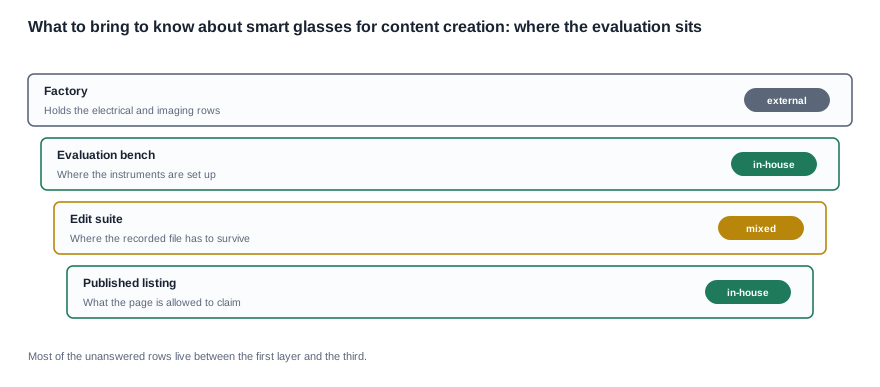
Who is running the evaluation, and what it has to produce
The reader is someone buying for a brand, a channel buyer or a product manager who is going to sit down with a supplier's sample and decide whether a first-person camera line is worth opening. The decision is not whether the camera works — that is visible in thirty seconds. The decision is whether the camera works for this creator, on this content, in this environment, and whether the result can be written down in a form that survives a second shipment.
The fear behind that decision is specific: an evaluation that produces an impression rather than a measurement. An impressive demo is easy to report upwards and impossible to defend downwards, because when the second shipment arrives and the picture is softer than the sample, nobody can say what was measured or under what conditions. The output of a good evaluation is a document. The output of a bad one is a memory.
That reframing is what turns the kit from a list of accessories into a list of instruments. Every item on it exists because there is a question that nothing else in the room can answer.
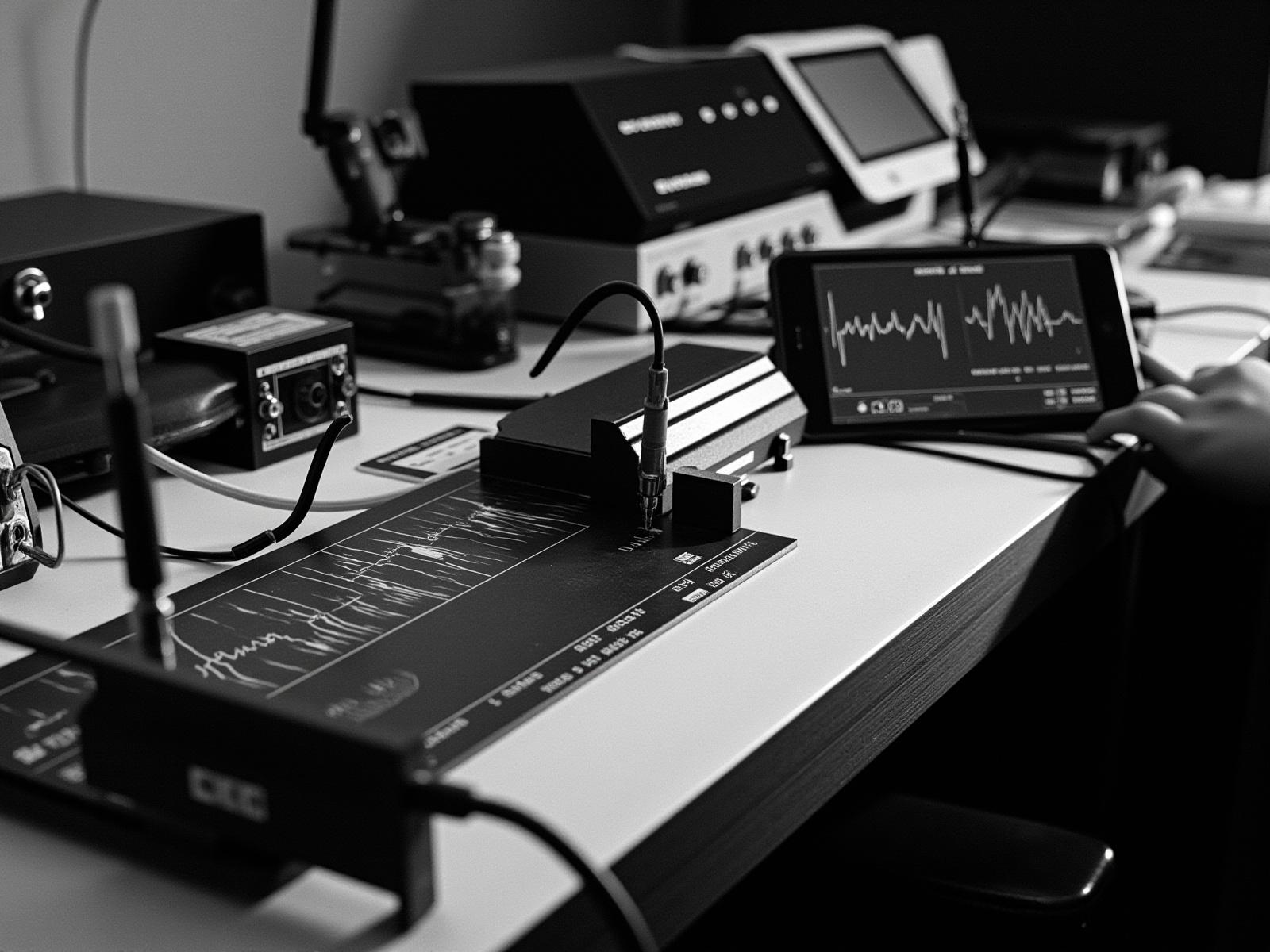
The eight instruments, and the single question each one can answer
| What to bring | What it is for | The question it answers |
|---|---|---|
| A second unit from the same batch | Separating design from manufacture | Is the result a property of the product or of this unit |
| A second phone, of a different make | Holding the far end constant | Is the call quality the device's or the network's |
| A known grid, printed on paper | Measuring the field of view | How much the listing photographs can claim |
| A stopwatch and a written protocol | Making the runtime comparable | What the endurance figure actually means |
| A hard surface, a bench, a clamp | Reproducing the movement | Does the device stay where it was put |
| A pack of tissues and a cloth | Reproducing the improvised wipe | What the coating has to survive in practice |
| A low-light source, and a way to measure it | Reproducing the dark scene | Whether the product works where the content happens |
| A card reader or a laptop with the files | Checking format and overwrite | Whether the output is usable in an edit |
The two units are the most important item on the list. One unit cannot separate a design characteristic from a manufacturing inconsistency, and the two need completely different remedies — a product change and a supplier conversation. A buyer who finds a problem on one unit and cannot tell which kind it is has to resolve that before they can act on it at all, and the cost of the second unit is trivial next to the cost of an order placed on the wrong diagnosis.
The written protocol is what makes anything comparable. Fix the volume, the phone state, the light level, the distance, the movement, the storage state and the ambient temperature before the first run, not after the third. A runtime measured at a fixed volume with the device paired and a runtime measured across a three-hour shoot with the camera running are different numbers, and the published runtimes carry no condition at all. The published rows and what they omit are at battery life, and the open-ear audio background is at open-ear audio.
The tissues and the cloth are not a joke. A creator wipes a lens with whatever is to hand, and the lens material and the coating are not published for any model, so there is no coating that can be called safe against abrasion. A week of representative handling predicts the scratch claim better than a pristine sample ever does, and the cost of the kit is a few cents.
The hard surface and the clamp are for the retention question. A device that moves produces soft, framed-away footage, and no firmware change repairs it. The unit weight is published for one model in the entire catalogue, the MT6 at 158 g — the weight of the glasses body including its cell and camera, excluding the foldable charging case — and the hinge specification is not published for any model, so retention is a physical observation that has to be made under movement rather than at a desk. The camera background is at camera imaging, the product range is at AI camera glasses, and the scenario entry point is smart glasses for content creation.
What not to bring is part of the kit. A laptop with unlicensed editing software produces an evaluation that ends in an argument about the licence. A phone on the same mobile account as the test phone turns a network question into an apparent product result. A creator who has been told the device is good produces a biased first run, and the bias is very hard to remove later because nobody records that it was there. The cleanest bench is a boring one: the same scene, the same light, the same phone, the same person behind the camera, and a written protocol that says so before anybody switches anything on.
How many units the evaluation needs, and how long the bench takes
Three units is the minimum that produces a usable answer, and the reasoning is short. One unit cannot separate a design characteristic from a manufacturing inconsistency. Two units can, but only for a single question, and a content evaluation asks at least eight. Three units from the same batch let the buyer describe the result as a batch characteristic rather than as a sample, which is the form in which the incoming inspection criteria can actually be written.
The time cost follows from the fifth run, not from the first four. The baseline, the field of view, the moving video and the low-light repeat together take under an hour. The full session takes as long as the device takes to reach its limit, which on the camera tier means somewhere between five and eight hours of continuous recording, and the buyer should plan for a second session because the first one is usually the one with the setup problems. Budget a full day for the bench, not an hour, and book the supplier's engineer for the first two hours rather than the last: an engineer who arrives at the end can answer a question about a result but cannot change a condition that produced it.
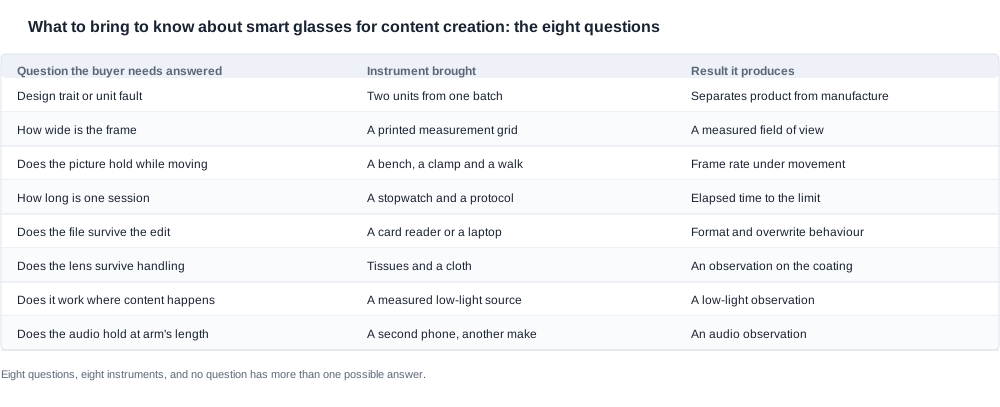
The five runs, in the order that produces comparable numbers
The order is not arbitrary. Each run depends on the one before it, and the last one is the most expensive in time and the least useful without the first four.
- The baseline set, with the grid and the fixed scene, both units side by side, so that every later run has something to be compared against. If this is skipped, the later results are observations rather than measurements.
- The measured field of view, with the grid photographed and the angle read off it. This is the only way a listing can say anything about how much the camera takes in, because the field of view is not published for any model.
- The moving video, with the creator walking and the frame rate watched on a monitor rather than judged by eye. The frame rate is not published either, and movement is where a fixed-camera impression breaks down.
- The low-light repeat, on the same scene with the light level stated and measured. Low-light behaviour is not published for any model, so this is the run that decides whether the product works where the content actually happens.
- The full session, continuous, until the device reaches its limit — noting the elapsed time, what degrades first, and what happens to the stored file when the session runs long.
Doing the full session last is deliberate: putting the device into the dust and the heat first produces a result with no comparison behind it, and the bench numbers never get produced at all.
Recording the run, so that the run can be re-judged
Every run needs four things written down before it starts and one thing recorded while it happens. Before: the unit identifier, the light level, the distance, and the storage state at the beginning. During: the elapsed time at which the first visible change occurs. That single number — the moment the picture softens, the recording stops, or the unit becomes too warm to hold — is worth more than a final verdict, because it is comparable between units and between shipments, whereas "it got worse" is not.
The recording itself matters more than most buyers expect. A session video, saved and named against the protocol, is the artefact that settles a disagreement with the supplier about what happened at the ninety-minute mark, and it is the artefact that becomes the reference in the incoming inspection criteria. The alternative is a set of notes describing a session nobody can watch again, and a description cannot be turned into an acceptance threshold.

The rows the bench has to fill in
It is worth being explicit about the gap between the published specification and the specification a content buyer needs, because the second list is longer than the first. The camera tier publishes a resolution class of 8 MP on eight models — the CY03 and the V06, the MT5 and the CY05, and the V03 and the V03 Pro, and the KY06 and the MT6 — and 13 MP on three, the L2 Utral and the S7, and the L1 Pro. It publishes cell capacities from 220 mAh to 290 mAh, a charge time on every model, rated use that sits between five and eight hours depending on the model, a charging interface on seven of the eleven camera models, and a case capacity on five of them.
What it does not publish is the list that decides a content purchase: the sensor, the field of view, the video resolution and frame rate, the stabilisation, the low-light behaviour, the storage capacity and the overwrite behaviour, the capture latency, the thermal behaviour over a long session, the frame weight for any model except the MT6, and the condition behind every runtime figure. A buyer who can fill eleven of those from a bench measurement has converted a large part of the specification from trust into evidence, and that is the entire purpose of the kit.

What the evaluation has to end with: a signed sheet, not an impression
The output is a signed sheet: the protocol, the conditions, the results, the unit identifiers, the dates and the number of units tested. That sheet is what the incoming inspection criteria are written from, what a dispute with the supplier is settled with, and what the listing copy is allowed to say.
A sheet without conditions is not a sheet. A sheet without a unit count is a sample rather than a measurement. A sheet without the unit identifiers is a sheet that cannot be matched to a later shipment, which is the same as no sheet at all, because the incoming inspection criteria will refer to units by identifier and the identifiers will not exist.
The consequence runs in both directions and this is the part that gets missed. The sheet is what tells the buyer what to accept in production, and it is what tells the supplier what the buyer measured. A supplier who has seen the protocol and the results can build a first-article check against it, and a first-article check on the production batch is the document that answers every complaint in year two. A supplier who has never seen the protocol will ship to the incoming inspection criteria and let the buyer find the difference.
Documents to request before a deposit. The signed evaluation sheet with its conditions, the output parameter sheet with methods, the two runtimes per model with their conditions, the storage and overwrite behaviour, the thermal behaviour, the model designation table, the certificate register, and the agreed incoming inspection criteria. Two pages close the commercial side: the clause wording as published is at contract terms; the commercial shape of an opening order at pricing.
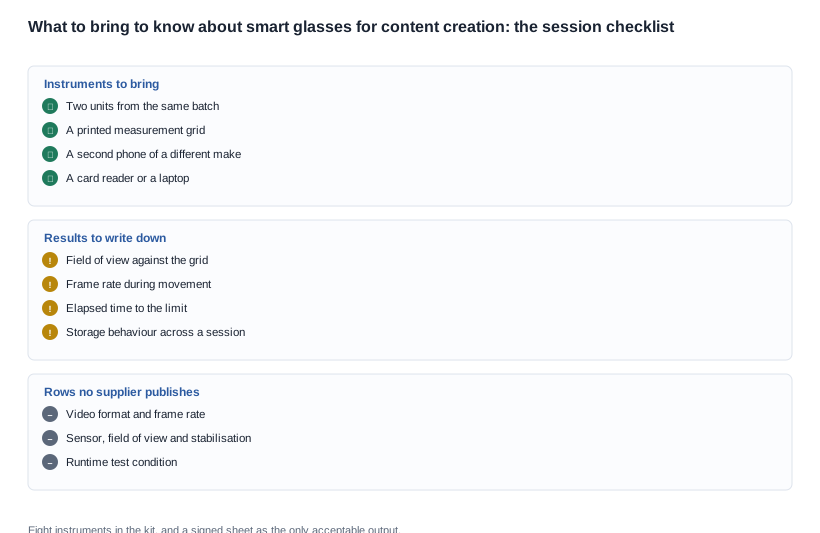
Where evaluation kits go wrong
Arriving with what is in the box. That kit answers whether the product works, not whether it works for this creator, on this content, in this environment. The symptom is a positive evaluation followed by an order that produces the same complaints the sample did not have.
One unit. The most expensive mistake in the list, because it turns a solvable question into an argument. The symptom is a defect report that the supplier rejects and the buyer cannot substantiate. The prevention is the second unit from the same batch, which costs one unit of stock and settles the argument in an afternoon.
A protocol that changes between candidates. If the light or the distance moves between runs, the comparison measures the setup rather than the products. The prevention is a written protocol, signed before the first run, with the light level and the distance on it.
Testing the picture and stopping. A still is the easiest thing to shoot and the least predictive thing to sell. The prevention is the moving run, which is where the frame rate question lives, and the frame rate is not published.
A result that never becomes a criterion. A measurement nobody writes into the incoming inspection is a demonstration, and a demonstration is the supplier's document rather than the buyer's. The prevention is to write the criterion into the inspection sheet on the same day the measurement is taken.
No written conditions. The single most expensive sentence in a procurement file is a runtime with no workload behind it. The prevention is the protocol, and the rule that a number without a condition does not go into the sheet.
What the evaluation can still move, and what it cannot
Some of the commercial outcome is settled before the bench is set up, because it is a property of the product rather than of the relationship. The resolution class and therefore the ceiling on image quality is fixed. The cell configuration and therefore the runtime ceiling is fixed. The charging interface is fixed: the catalogue publishes magnetic charging on the V06 and the V03, and the KY06 and the S7, and the MT5, Type-C on the V03 Pro and the L2 Utral, and no charging interface row at all on the MT6 and the CY03, and the CY05 and the L1 Pro, which publish a charging case capacity instead — 1400 mAh on the L1 Pro and the CY05, and the CY03, 900 or 1400 mAh as a configuration choice on the L2 Utral, and 1200 mAh on the foldable case of the MT6. The cost and the lead time of conformity testing cannot be compressed by a better negotiation, and a mould charge is a one-time cost that belongs in a separate quoted line rather than folded into the unit price.
Everything else is open, and the evaluation is where the leverage is.
- Whether the supplier will run the protocol against production units and supply the recordings, so the result can be re-judged. This is the single most valuable item on the list, and it is often refused because it exposes a number the supplier would rather not publish.
- Whether the case is included and at which capacity, which decides the session length a creator can plan around. The camera models sit in three case states — published capacity on five, a case without a published capacity on the KY06 and the MT5, and no case row at all on the V06 and the V03 Pro, and the V03 and the S7 — so "a case is included" is not a fact that can be assumed for any model, and the four with no row are the ones a supplier has to answer for in writing.
- The incoming inspection criteria, which are a negotiation between two parties rather than a form one of them issues.
- Whether the supplier funds a baseline measurement on the production batch, which is the document that answers every complaint in year two.
- Minimum order quantity tiers, and whether two configurations can share a purchase order.
- Logo, lens tint and packaging, which are cheap to change between runs and expensive to change after the artwork is printed.
- Splitting a first run into two deliveries against a staged payment, which suits a creator line that starts with one channel.
The two levers worth holding hardest are the first and the fourth. Everything else in the commercial conversation is a price conversation, and a price conversation is settled in the room. The protocol and the production baseline are settled in the supplier's engineering department, and they are the two things that make the second shipment predictable.
What to send us next. Tell us the content types, the session lengths, the channel, the price band and the markets, and we will say which of the questions above the kit is built around, which published rows apply to the models in question, and which results have to be in hand before a purchase order goes out.
Related reading
- The scenario's starting point — smart glasses for content creation
- The catalogue rows — battery life
- The imaging background — camera imaging
- The catalogue range — AI camera glasses
Tell us the content types and the session lengths, and we will say which questions the evaluation kit is built around.


