Cycling is the scenario where a category's unstated assumptions meet reality at speed. Helmet geometry, wind, vibration and weather are not edge cases for a rider — they are the normal operating condition, and in this category most of them have no published specification to plan against. What smart glasses for cycling procurement actually comes down to is a configuration decision made against four conditions the catalogue does not describe: a helmet, moving air, a rough surface and a bag on the handlebars. Expect the electrical rows to be published and to settle the hardware, and expect the ride itself to be settled on a sample.
Smart glasses for cycling: the ride profile, not the spec sheet, sets the configuration
Why two quotations for the same riding configuration differ so widely. The published rows sit close together across the range, so the rows cannot explain the gap between two offers for what appears to be the same product. The gap comes from four configuration choices a buyer makes without noticing: whether a charging case is in the box, which case capacity is ordered, whether the interface is a magnetic contact or a Type-C socket, and whether the artwork is a standard cavity or a custom one. Each of the four moves the bill of materials, the declared shipping weight, the transit documentation and the artwork cost at the same time, so a quotation with no configuration attached is a placeholder rather than an offer. A buyer who arrives with the interface and the case decided receives a quotation that can be put next to another supplier's; a buyer who does not receives two numbers that cannot be compared at all. The ride profile decides the rest: a route of two hours needs a different power plan from a half-day loop, and a route over rough tarmac needs a different video expectation from a smooth commute.
Who this is for. The reader is a brand owner, a channel buyer or a product manager who is putting a smart-glasses line into a cycling range, or into a broader sports range where cycling is one of the use cases. The task in front of them is not a product evaluation in the abstract; it is a shortlist decision with a physical constraint attached. The fear behind it is the specific one that a data sheet cannot cover: a unit that works on a desk, passes the sample review, and comes off on the first ride because the temple geometry and the helmet disagree, or because the audio is unusable above a certain speed.
The shape of the published position. The range divides into three groups. Eight models are published as Bluetooth audio glasses, three as sport glasses, and eleven as camera models. The sport camera models carry the two entries with an ingress marking and the structural features that matter for a moving body: the V06 and the S7 both publish a detachable inner frame, the D17 and the ZH12 publish a remote capture control, and the V06 and the S7 carry the IP54 marking. Between them, the published rows are close: cell capacities from 100 mAh to 290 mAh, rated runtimes between about five and about eight hours, and a charge time that is two hours or less on every model except the D17 and the ZH12, which publish about one hour.
The published rows a cycling shortlist can be built on
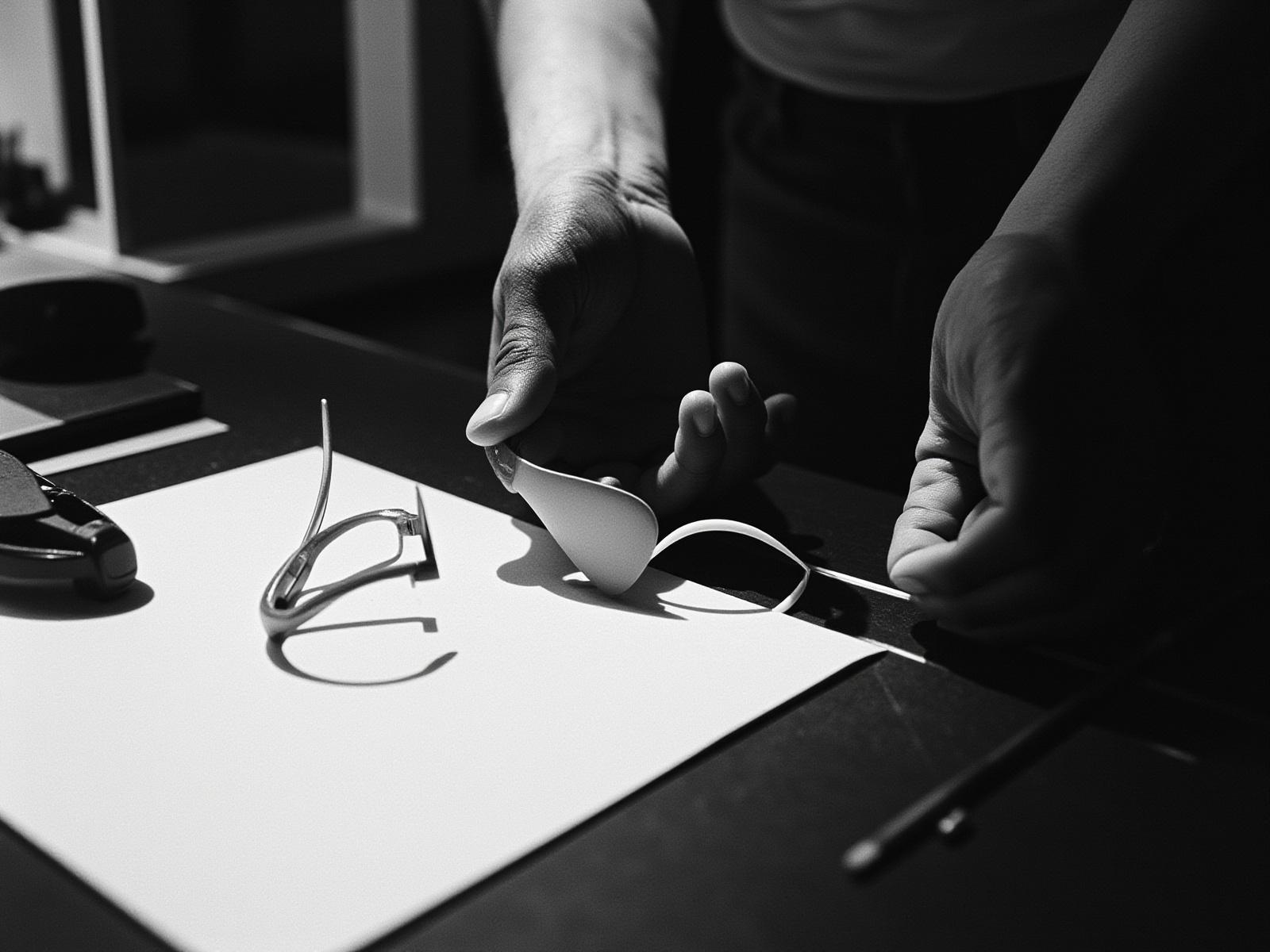
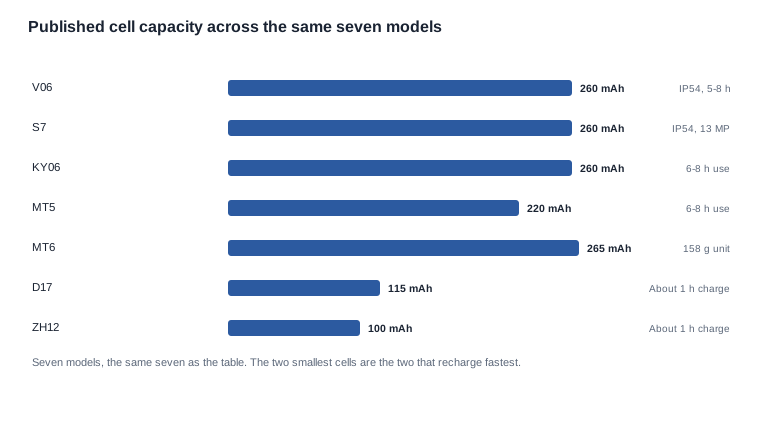
The table below is the honest base for a cycling shortlist: seven models, each with the cell capacity, the rated runtime band, the charge ceiling and the interface as published. The chart beside it plots the same seven cell capacities, because the size of the cell is what decides whether the ride ends with a battery or with a case.
| Model | Cell | Rated use | Charge | Interface |
|---|---|---|---|---|
| V06 | 260 mAh | 5-8 h | 2 h or less | Magnetic |
| S7 | 260 mAh | 5-8 h | 2 h or less | Magnetic |
| KY06 | 260 mAh | 6-8 h | 2 h or less | Magnetic |
| MT5 | 220 mAh | 6-8 h | 2 h or less | Magnetic |
| MT6 | 265 mAh | About 7 h | 2 h or less | Not published |
| D17 | 115 mAh | About 7 h | About 1 h | Type C |
| ZH12 | 100 mAh | About 8 h | About 1 h | Type C |
Read the charge column as a ceiling, not as a typical value. Every model in the range publishes a charge time, and on twenty-six of them the published figure is two hours or less — that is the upper bound the catalogue commits to, not the figure a rider should schedule around. The D17 and the ZH12 publish about one hour, which is the genuinely different number in the range, and it is the reason a between-rides recharge fits into a change-of-clothes window on those two models and does not suit on the others.
Read the runtime column as a band, not as a working day. The camera models publish three different kinds of figure: five to eight hours on the V06 and the V03, and the V03 Pro and the S7; six to eight hours on the KY06 and the MT5; and about seven hours on the CY05 and the L1 Pro, and the MT6 and the CY03, and the L2 Utral. None of them carries a published test condition, and none of them tells you whether the figure was reached with the camera idle or recording. Continuous capture is a heavier load than the rating usually describes, so the lower end of the band is the number to plan a ride around.
The interface column is the one that changes the bag. A Type-C model recharges from a cable the rider already owns; the range publishes Type-C on the V03 Pro and the D11, the ZH12 and the D17, and the D12 and the L2 Utral. A magnetic model needs either a dock or the case carried, which converts the case from a protection accessory into part of the charging architecture. That single choice changes the bill of materials, the declared shipping weight, the transit file and the price ladder together, and it is the reason the case decision belongs before the packaging decision.
The charging-case answer has three versions, not two. Among the eleven camera models the catalogue publishes a 1400 mAh case on the CY05 and the L1 Pro, and the CY03, a choice of 900 or 1400 mAh on the L2 Utral, and a 1200 mAh foldable case on the MT6. The KY06 and the MT5 ship as a case whose capacity is not published. The V06 and the V03 Pro, and the S7 and the V03 have no charging-case row in the catalogue at all, which is an unpublished item rather than an absent one. Those are three different answers, and the difference between "the catalogue publishes no case row for this model" and "the catalogue publishes this model with a case" is a question a buyer has to ask, because neither of them settles the configuration on its own. The supplier answer is what closes it, and it belongs in the request for quotation rather than in an assumption on the order.
What is not published, and therefore cannot be used to select anything. Temple length, for any model. The unit weight, for every model except the MT6, and the figure published for the MT6 is 158 g for the glasses body including its 265 mAh cell and camera and excluding the foldable case. No bare frame weight is published for any model. The field of view, the video format, the frame rate, the stabilisation behaviour, the storage capacity and the clip limit, the operating temperature range, the runtime test condition, and the lens material and coating. The IP54 marking appears on two models in the whole catalogue and is a catalogue attribute with no third-party test report published behind it; the digit reading is at IP ratings.

The four questions the catalogue cannot answer for a rider
Each of the four below has a published row somewhere in the specification and no published answer to the question that actually matters. That is the pattern worth recognising: this is not a category with thin documentation, it is a category whose documentation is strong on the electrical side and silent on the physical side.
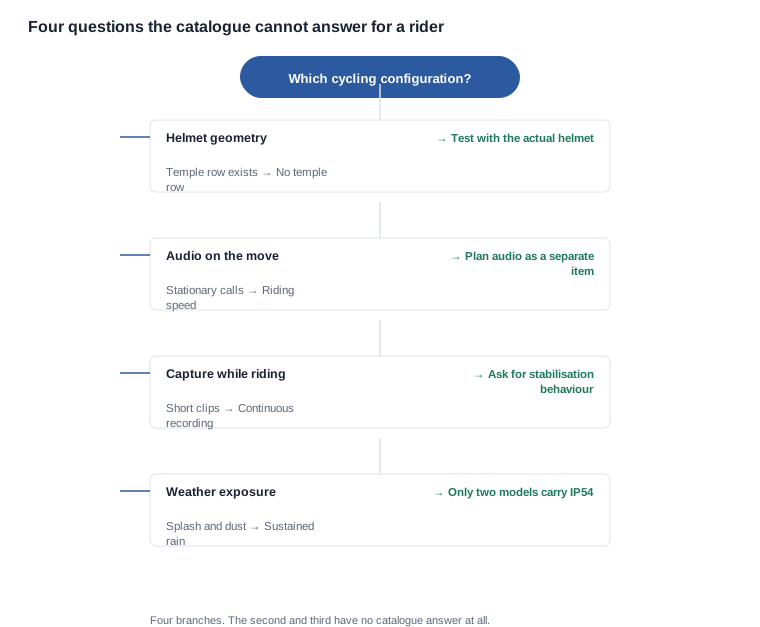
Helmet geometry. The first question, and the one our documentation cannot answer. Temple length is not published across the camera range, and a helmet changes temple geometry in ways a specification sheet does not capture. If your riders use a helmet, this has to be tested with the actual helmet rather than a similar one. It is the most common reason a cycling unit comes off on the first ride, and it is a return-rate cause rather than a defect.
Wind on an open-ear architecture. The audio models radiate from the temple. That works in still air and degrades in movement, and at riding speeds the effect is continuous rather than occasional. Nothing in the catalogue describes the behaviour in wind, so if audio matters to your riders, treat it as a separate kit decision rather than a product one, and put a number on it during the sample test rather than an opinion.
Vibration and stabilisation. Continuous capture on a bicycle produces footage that is either stabilised by some mechanism or not, and our documentation does not say. A stabilisation claim is not published for any of our models, and we will not infer one from the existence of a camera. Ask specifically what the footage is like at riding speed, and ask for a sample clip rather than a description.
Weather. No ingress rating is published for the camera range except the IP54 marking on the V06 and the S7, which covers splashing water and a dust protection level and does not cover immersion or a sustained downpour. Rain tolerance is therefore a behavioural decision — whether the unit goes in a pocket during a downpour is the rider's call, and one that no marking can make for them.

The documents to request alongside the sample. The paper answers are separate from the ride answers, and they arrive at different times. Ask for the bill of materials per configuration with the case row attached, because "the case" is four different catalogue answers rather than one. Ask for the battery transport documentation for the exact configuration, since a case in the box is a second lithium cell that has to be declared. Ask for the ingress position in writing for the model you intend to list, so that a marking and a report are not confused with each other in the listing copy. Ask for the model designation table and check every certificate number in the issuing body's public register; the procedure is at certification checklist. And ask for the runtime figures with their test conditions, per model, because a configuration sold on an endurance claim has to be defensible against the buyer's own measurement rather than against the published band.
The sample test that closes all four. The four questions are answerable on one ride with one sample, and the test is worth writing down because it is the difference between a sample review and a sample session:
- Ride the route with the sample and record on the roughest section. Not a smooth test track. The footage from the section that shakes most is the footage that decides whether the camera row survives.
- Check the temple geometry against the helmet actually used. Adjust once at the start, ride for the full duration, and record whether anyone touches the temples mid-ride. A touch is the signal.
- Time a full ride on a full charge, with the case in the bag. The ride, not the rated band, and with the bag packed the way it will be packed in practice, because the bag is what decides whether the case is reachable.
- Measure the audio at riding speed against a stationary baseline. Record both on the same device at the same volume. The ratio between them is the number that decides whether the audio row is viable.
- Log the storage consumed per hour of riding. The storage capacity and the clip limit are not published for any model, and a device that stops recording without warning produces a broken clip, which is a support incident rather than a missing file.

What the case does to a ride that outlasts the battery
Once the interface is decided, the case becomes the power plan, and for a cycling configuration it is worth more attention than it gets in most buying conversations.
The arithmetic of a long ride. A ride that outlasts the lower end of the published band needs a second source of energy, and the case is the only published one. For a camera model that means choosing between a 1400 mAh case, a 900 mAh case as a lower configuration on the L2 Utral, and a 1200 mAh foldable case on the MT6 — and for the KY06 and the MT5 it means choosing a case whose capacity the catalogue does not publish, which means asking for the figure in writing rather than assuming. For the V06 and the S7 it means deciding, deliberately, what happens after the cell runs down on a model with no published case row.
The case is a second lithium cell. That is a transit obligation, not a packaging preference. The requirement is set out at battery transport, and the narrow question for the supplier is whether the file covers the configuration you are ordering, with the case in it. A case shipped in the box and a case sold separately produce two different files and two different freight weights.
What is fixed and what is open in the cycling configuration. Fixed before the negotiation: the cell capacity, the charge time ceiling, the rated runtime band, the charging interface where it is published, the IP54 marking and the models that carry it, the certification cost and lead time, the tooling cost amortised across the first order, and the battery transport documentation. Open, and worth the negotiation time: whether the case is in the box or sold as an accessory, the case capacity configuration, the colour and logo treatment, the packaging and the insert contents, the payment structure, the shipment split, the warranty length, the sample cost against the first order, and the minimum order quantity tier. A pilot tier and a run tier are usually priced separately, and that is where most of the room sits, because it is the factory's own exposure.
The returns profile is part of the cycling configuration, not an afterthought. A cycling channel sees returns for reasons that a desk channel never does: a scratched lens from a jersey pocket, a case that was left in a wet bag, a temple adjusted too hard in a shed. The cheapest reduction in that number is a lens cloth and a contact-cleaning item in the insert, which costs a few cents per unit and changes nothing about the freight weight, and the second cheapest is a factory-applied protective film. Neither of them is visible in the specification, and both of them are ordinary lines on a bill of materials — which is the point. A buyer who negotiates the case configuration and ignores the insert contents is leaving the cheapest available return reduction on the table, and the returns desk will find it within two months of the first shipment.
A worked example, written as a scenario. Take a European cycling retailer that has decided to list two models under one brand — one audio model and one camera model — for a channel that sells through its own store. The first decision is the interface, because it settles the kit: taking the Type-C route, the case becomes optional rather than mandatory, so the camera model is configured with a 1400 mAh case sold as a separate accessory and the audio model ships without one. The second decision is the claim set: the listing says the IP54 marking covers splashing water and a dust protection level, it does not say waterproof, and the ingress position is stated as a catalogue attribute with no third-party report published behind it — and it is stated only for the two models that carry it. The third decision is the documentation, and the transit file is the item that has to be settled before the order rather than after it, because it covers the case configuration. The outcome is two price points from one platform, a kit whose per-unit cost is visible and small, and a return rate the first shipment can measure.
What we publish for a cycling buyer, and what we hold back
We publish the rows a buyer can order from, and we will not fill the gaps with industry averages. For a cycling shortlist that means the sensor class, the cell capacities from 100 mAh to 290 mAh, the charge times of two hours or less with about one hour on the D17 and the ZH12, the rated runtimes between about five and about eight hours, the charging interface per model, the published structural features — the removable inner frames on the V06 and the S7, the ultra-slim detachable temples on the G07, the slim detachable temples on the YK12, the remote capture control on the D17 and the ZH12 — the colour counts, and the case capacities where they are published.
What we do not publish, and will not estimate: the temple length, the frame material, the lens material, the coating, the hinge specification, the per-model unit weight beyond the single published 158 g whole-unit figure for the MT6, the field of view, the video specification, the stabilisation behaviour, the storage capacity, the runtime test condition, the standby draw, the cycle life rating and the operating temperature range. We will also not state that any product in our range is tested to IP54, because no test report is published behind that marking, and we will not extend the marking to any model beyond the two that carry it.
What to send us next. Send the ride profile you are designing for, the models you are comparing, the interface you have decided on, the volume and the markets, and we will return the published rows that cover each configuration, the case options that exist, the documentation that has to be settled before the order, and the claims the listing can carry without overreaching. The product families are at sport smart glasses and AI camera glasses, the published runtime figures are at battery life, the charging decisions are at charging solutions, the clause language is at contract terms, and the scenario entry point is smart glasses for cycling.
Related reading
- The entry point for this scenario — smart glasses for cycling
- Which product families exist — sport smart glasses and AI camera glasses
- The published figures — battery life
- The charge schedule — charging solutions
Tell us the interface, the models and the price band, and we will return the configuration each one should carry.