
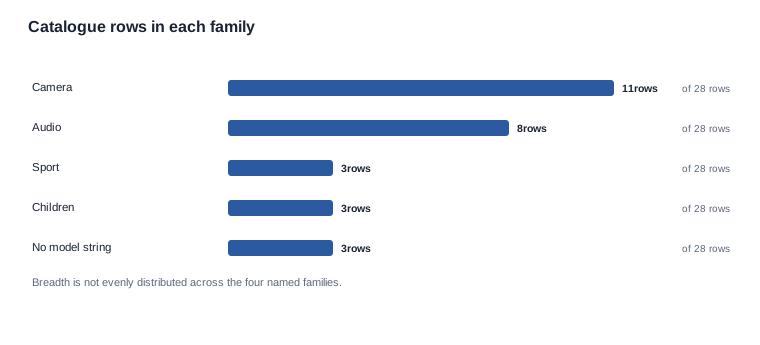
Category breadth is a decision with a cost attached, and distributors usually discover the cost after the catalogue has been assembled rather than before it. Our own catalogue holds twenty-eight rows, and every one of them is legitimate. Eleven camera models, eight audio models, three sport models, three children's models and three entries that carry no model string at all. The mistake is not carrying breadth. The mistake is treating all twenty-eight rows as interchangeable stock, because they are not: they differ in which specifications they publish, in which families they can be grouped with, and in how much of each one a distributor can actually describe to a customer without asking us a question first.
This article is about how to convert that breadth into a range you can carry, defend and reorder. It is a method article rather than a recommendation list. Nothing here says which models to stock, because that depends on your market, your customer and the claims you intend to make — three things only you know.
Smart glasses category breadth: what the catalogue actually offers
Twenty-eight rows across seven headings
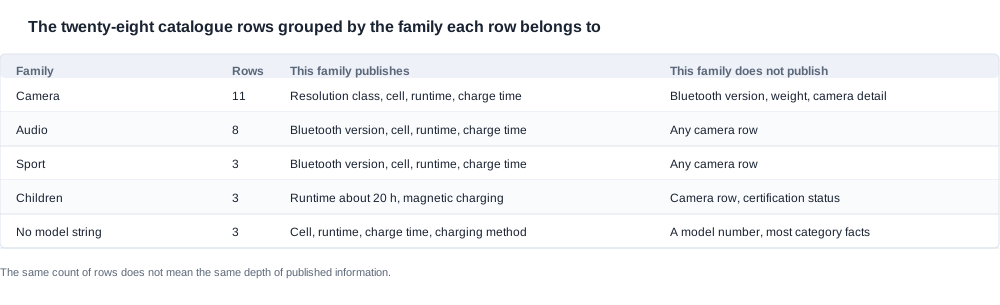
The catalogue's twenty-eight rows divide into a set of families that behave differently, and the behaviour matters more than the count. The camera family is the largest at eleven: the KY06 and the MT5, the S7 and the L1 Pro, the CY03 and the V03 Pro, the V03 and the MT6, the L2 Utral and the V06, and the CY05. The audio family holds eight: the G07, the LC-105-1 and the YK12, the K01, the D12 and the K02, the D11 and the LC-105-2. The sport family holds three: the YKC02, the D17 and the ZH12. The children's family holds three: the A05, the A06 and the A07. Three further entries — the AR, electrochromic and bone conduction rows — carry specifications but no model number.
That last group is the one a distributor should treat most carefully, because a row without a model string cannot be ordered against a SKU. Our own product record notes that all three need a formal model number to be added before they can be quoted as individual products, and that the AR entry's published figures are identical to a standard Bluetooth audio pair — a 100 mAh cell, a charge time of two hours or less, about eight hours of runtime, magnetic charging and Bluetooth V5.4 — with no AR capability disclosed anywhere on the page. The record marks its target customer, target industry and differentiator as unknown, and notes that the page may simply be an unfilled template or a product that is not in production.
A distributor building a category page today has three rows available for information and zero rows available for order. That is a different thing from a product that can be ordered, and conflating the two is how a range plan acquires a dead entry.
The asymmetry that decides a carried range
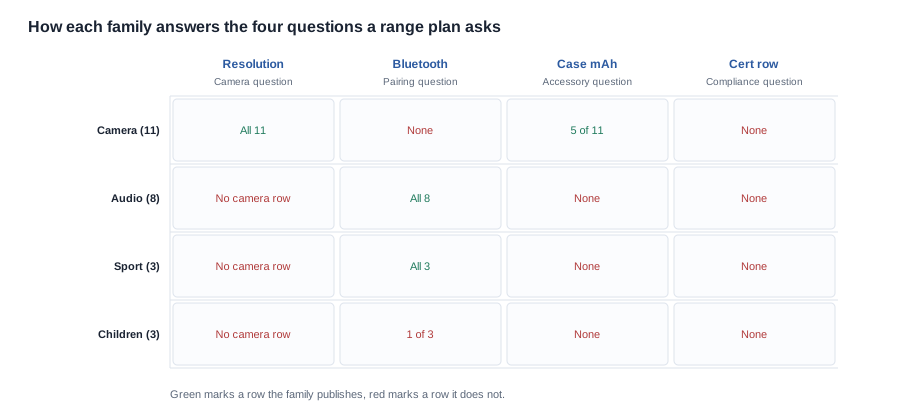
Each family publishes a different subset of the specification grid, and the gaps are not evenly distributed. The camera family publishes a resolution class for every one of its eleven models — 8 MP on eight, and 13 MP on the L1 Pro and the S7, and the L2 Utral — plus cells from 220 mAh to 290 mAh, runtimes of roughly five to eight hours, and a charge time of two hours or less on every model, and a charging method on seven of the eleven. It publishes no Bluetooth version on any of them, no weight on ten of the eleven, and no camera detail beyond the resolution class.
The audio family inverts that. All eight publish a Bluetooth version — V5.3 on the K01 and the K02, V5.4 on the other six — and all eight publish a cell configuration and a runtime. None of them publishes a camera row, so none of them can be described as an imaging product.
The sport family publishes Bluetooth versions on all three and a camera row on none. The children's family publishes a runtime of about twenty hours on all three, a magnetic charging method, and — on the A05 and the A06 — a set of feature lines covering a lens-side electronic fogging unit and correct and incorrect posture-and-distance prompts. It publishes a Bluetooth version on the A07 alone.
For a distributor, this means the range cannot be planned as a single grid with one level of detail across it. A camera family listing can be built from published rows and will still need Bluetooth version, weight and camera detail filled in. An audio family listing can be built from published rows more completely than any other, and needs no camera information at all. A sport family listing can answer a durability question — the V06 and the S7 publish an IP54 marking, the only two models in the whole catalogue that do — but those two sit in the camera family, which is worth knowing before a buyer asks for "the sport models" and receives an audio answer.
Three entries that are not products yet
The unnamed entries should be handled as information rows rather than as stock. The electrochromic entry publishes a 100 mAh cell, a charge time of two hours or less, about seven hours of runtime, magnetic charging and Bluetooth V5.4, with an electrochromic lens — and the catalogue publishes no performance figure for the lens at all. No switching range, no switching speed, no transmittance, no uniformity. Our own product record makes the same point: for this category, switching speed, switching uniformity and lens transmittance are the parameters that decide the product, and the catalogue provides none of them, which leaves no defensible basis for a differentiator claim.
The bone conduction entry publishes an amplification gain of 35 dB, a 200 mAh cell, a charge time of two hours or less, about seven hours of runtime and Type-C charging. The record flags this as the most aggressive figure in the catalogue and simultaneously the highest compliance risk in it: selling it with a hearing-assistance claim may bring it within medical device regulation, and that is a question for a company's legal function rather than for a distributor's marketing team. We do not make that claim, and a channel partner should not make it either.
Smart glasses range selection: the criteria that remove a model
A range decision is easier to make as a series of eliminations than as a ranking. A ranking requires you to weigh the models against each other, which is a comparison you cannot make from catalogue rows alone. An elimination requires you to check each model against a criterion, which you can.
Six disqualifying tests
Applied to this catalogue, six tests remove rows quickly and leave a defensible residue.
Test one: does the product page need a camera? Any model with no camera row cannot be positioned as an imaging product. That removes the entire audio family, the entire sport family and the entire children's family from a camera programme — and removes the camera family from a pure call-and-audio programme.
Test two: does the product page need a Bluetooth version? Only the audio family, the sport family, the A07 and the AR and electrochromic entries publish one. Eleven camera models, the A05 and the A06 and the bone conduction entry publish none. If the listing copy names a pairing standard or a generation of hardware, the model has to be one that publishes the row, or the value has to be requested.
Test three: does the range need a weight? One model in the entire catalogue publishes a weight: 158 g for the MT6 glasses, excluding its foldable case. A shipping-weight figure on a product page comes from a packing list, not from the catalogue.
Test four: does the range need a charging case as a described accessory? Five camera models publish a case capacity — 1400 mAh on the L1 Pro and the CY03, and the CY05, a row reading 900/1400 mAh on the L2 Utral, and 1200 mAh in a foldable case on the MT6. Two more, the KY06 and the MT5, list a case without publishing a capacity. The V03 and the V06, and the S7 publish no case row, and the V03 Pro is published as having no case at all.
Test five: does the customer need colour options? Only the V03 Pro and the V06 publish colours — three and four respectively. A range that is sold on colour has two published candidates out of twenty-eight.
Test six: does the programme need an ingress rating? Two models publish IP54. The product record adds the constraint that should travel with any mention of it: the marking is a catalogue annotation, no third-party test report number is attached to it, and an ingress claim needs a report behind it before it goes on a page in any market.
Turning tests into a shortlist
Applying the tests in order produces a shortlist that a buyer can defend line by line, because each removal has a recorded reason tied to a published row. This is the difference between a range plan and an opinion. A range plan can be handed to a supplier and to a compliance reviewer, and both can check it.
Two things make the shortlist work in practice. First, write down the reason for each removal at the time of removal; a reason reconstructed later becomes an argument. Second, keep the removed models on a list rather than deleting them, because most of them fail a test that is specific to the programme rather than to the product — a range that adds a camera line next year does not have to re-open the whole selection.
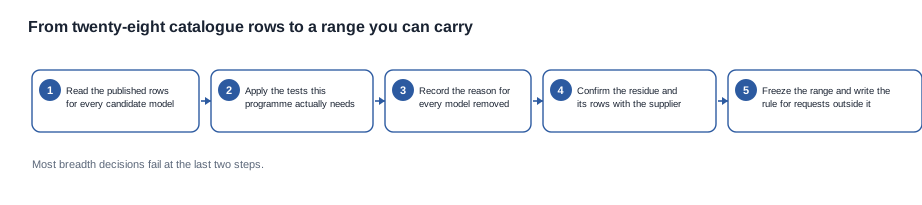
The flow above is the whole method in five steps: read the rows that exist, apply the tests the programme needs, record the reasons, confirm the residue with a supplier, and freeze the range. The last step is where most breadth decisions fail — a range that is not confirmed against a specific configuration is a plan for a conversation, and the conversation will be about availability rather than about fitness.
Why a shortlist is a negotiating position
A range assembled from published rows gives a supplier something to work with, and a range assembled from guesses gives them nothing. When you can state that a programme needs eight camera models with published resolution classes, a case row on five of them and a Bluetooth version on none of them, the supplier can answer with what they can actually do, and you can compare that answer against another supplier on the same terms.
This is also the practical way to read the range category comparison and the OEM-ready option set: both are useful as orientation, and neither substitutes for a shortlist built against your own criteria.
Smart glasses customisation breadth: what each family records
Distributors do not only carry products; they carry them with a brand on them, in packaging they can sell. That is where the second kind of breadth question appears, and it has to be handled with care, because our own records are specific about what they say and what they do not.
Recorded axes by category, without reading them as a capability list
Our internal product record carries customisation axes per category, and the counts differ sharply: seven axes for the camera records, five for the audio records, five for the sport records, two for the children's records plus one entry marked as awaiting verification, three for the electrochromic entry, nothing disclosed for the bone conduction entry and an unknown value for the AR entry. The axis names differ between the three named families and none of the three is a subset of another, which tells you something important: the customisation conversation for an audio model is not the audio version of the camera conversation.
We do not reproduce those axis lists as a capability statement, and a buyer should not treat them as one. A recorded axis is a line in an internal record; whether it can be executed for a particular model, at what depth, at what cost and on what schedule are questions that belong in the quotation. The record's own note is the right instruction to follow: any requirement that is new to us is treated as a development item with a cost and a schedule, rather than as a configuration switch.
Certification in three states
Our record states the certification position in three different ways across the categories, and collapsing them into a single "certified" would be inaccurate in both directions. For the camera, audio and sport records, no CE, FCC or RoHS text and no per-model certification row is published, and no certificate number exists for us to quote; the sport record adds that the IP54 marking is a catalogue annotation with no third-party report number attached. For the children's records, no certification information is published at all, and the record notes that children's products usually carry additional requirements in Europe and the United States that would need to be established. For the three entries without a model string, nothing is published for the electrochromic entry, nothing for the bone conduction entry and nothing for the AR entry either.
The catalogue text itself contains no reference to CE, FCC or RoHS at all, and no per-model certification row appears anywhere in it. The catalogue does carry a company-level export certification page, and its content is images rather than text: ten patent certificates — eight appearance-design patents and two utility-model patents.
For a distributor, the practical conclusion is that certification status is a document request with a model list attached, not a catalogue row to be copied. Which documents arrive, for which models, under whose name and covering which destination markets is the question that has to be asked in writing before a listing goes live.
The customisation questions a breadth decision raises
The breadth decision and the customisation decision are made at different times, and they interact. Carrying a wide range multiplies the number of configurations that need artwork, packaging and documentation; carrying a narrow range concentrates them and makes them cheaper per unit. Three questions belong to the range conversation rather than to the artwork conversation:
- How many distinct configurations will carry your brand, and does each one need its own artwork and its own packaging specification?
- Which parts of the packaging and documentation are yours to produce, and which are you asking the supplier to produce against a specification you supply?
- When a model leaves the range, what happens to the artwork, the packaging print and the label content that were specific to it?
The channel marketing support discussion sets out the other side of this in more detail, and the wholesale case approach covers how a case proposition changes what a distributor needs to be given.

Smart glasses channel economics: what breadth costs and what it returns
Breadth has a cost side and a return side, and both belong in the same conversation with a supplier.
The cost side
Every additional model in a range carries fixed work that does not scale with volume: a listing, a set of photographs or an honest statement that none exist, a product page, a set of support material, an entry in the ordering system, a place in the warehouse, and a line in the after-sales procedure. Our own record states that none of the twenty-eight entries carries real photography, video material or test reports, so for at least one part of that work the cost sits with the distributor rather than with the supplier.
The cost also has a variable side, and it is the one that is hardest to see from a catalogue. A range carrying eleven camera models has eleven different combinations of cell, case and charging method in play, and each combination is a separate configuration to receive, inspect and describe. The five camera models that publish a case capacity, the two that list a case without a capacity, and the four whose charging method is not published are all different stock-keeping and inspection problems.
The return side
The return side of breadth is coverage, and it is real. A distributor who carries only the audio family cannot answer a customer who wants to record; one who carries only the camera family cannot answer a customer who wants calls. Twenty-eight rows is a range that covers most questions a category buyer asks, and a four-model range is a range that covers a decision.
The trade-off is usually stated as breadth against margin, but that framing is wrong for this category because we publish no unit price, no minimum order quantity and no lead time — nothing about our pricing structure is available to compare against. The honest framing is breadth against operational complexity: how many configurations your team can receive, inspect, describe and reorder without errors. A buyer who cannot answer that question from their own operational data will overstate their capacity and will discover the gap during the first mixed order.
The mixed-range question
A carried range with a single model per family is not a range, and a carried range with every catalogue row is not a range either. The useful middle is a defined set with one or two entries in each family that the programme actually serves, and a written rule for what happens when a customer asks for something outside it.
That rule is worth writing down because it determines the behaviour of the ordering system. A rule that expands the range on demand creates the setup costs you were trying to avoid. A rule that holds the range and refers the customer elsewhere protects the operational position but costs you the sale. Whichever one a distributor chooses, the decision belongs in writing, and it should be the decision most likely to be tested — because it will be tested by the customer who wants the model you decided not to carry.
Smart glasses category breadth: the position and the next step
What a distributor gets in writing, and which models stay unpublished
We will publish the rows we have, mark the rest as not published, and tell a channel partner which published rows apply to the models they intend to carry. We will supply the specification sheets and the conformity documents a distributor needs, with the model list on them, and we will say which models they cover. We will not publish synthetic product photography for a product we cannot photograph, we will not write a certification claim that has no document behind it, and we will not let a price, a minimum order quantity or a lead time be inferred from a catalogue page — each is confirmed per enquiry, because each is set by configuration, quantity, mix and the schedule then in force.
The distributor and retailer programme in the solutions section sets out how that enquiry is normally handled.
How to size the range before asking for prices
If you are deciding how broad to go, the most useful first move is not a request for a price list. It is a request for the specification sheets and conformity documents against a candidate range of five or six models, plus the published rows for those models in one file. Send us the market, the customer and the families you intend to serve, and we will tell you which rows exist for those models, which do not, and which questions the quotation has to settle before the first order.


