

A wholesale case is not a large order. It is a business built out of many small ones, and the difference shows up in every part of the operation: the pricing, the packaging, the documentation, the returns and the support.
The mistake most first-time wholesale entrants make is treating the wholesale programme as a scaled version of a direct-to-consumer one, and then discovering that the fixed costs per order do not scale at all. A direct business amortises its setup across thousands of units that arrive at once. A wholesale business amortises it across dozens of shipments that each need their own paperwork, their own labelling and their own documentation check.
So the right way to think about a smart glasses wholesale case is as an operating design rather than a product decision. The product is usually the easy part. Our published range already gives a buyer more than enough to choose from: charging case capacities published at 900, 1200 and 1400 mAh, six families, twenty-eight entries, camera entries at 8 MP and 13 MP, magnetic charging on seventeen entries and Type-C on seven, and colour options published for only two entries. The difficult part is what happens to an order once it is forty units rather than four thousand.
Unit prices, production lead times and minimum order quantities are confirmed per enquiry rather than published on this site. Each one depends on configuration, mix, quantity, packaging, documentation scope and destination. What follows is about the structure of the operation, which is the part a supplier can actually help with.
Smart glasses wholesale case approach: designing the operation, not the product
The first decision is not which model to carry. It is which of two businesses you are building, and they look similar on paper and behave nothing alike.
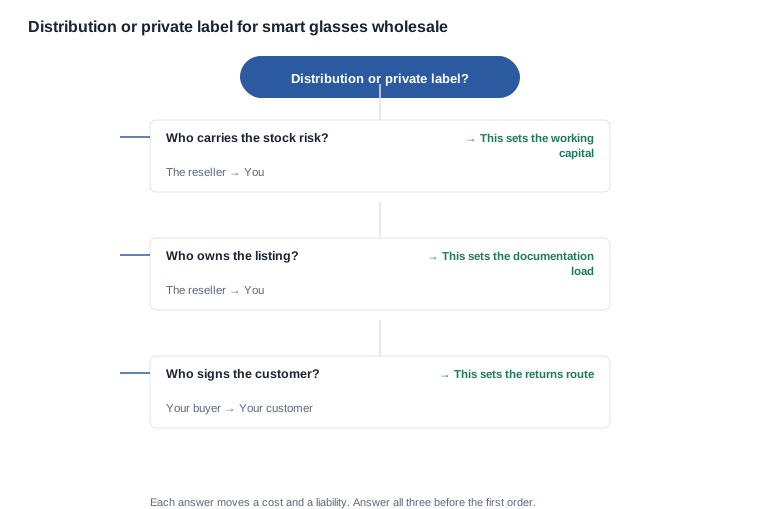
A distribution business resells what already exists. You buy at a wholesale price, you sell to resellers or retailers, and you carry the stock risk on your balance sheet. The unit margin is thinner and the working capital heavier. The documentation burden sits largely with you, because the documents travel with the product and you are the party presenting them in each market. What you need to be good at is range management, forecasting and logistics.
A private-label business adds your own brand, your own packaging and your own artwork. The margin is better and the working capital is heavier in a different way, because artwork, print minimums and translation decisions land on you and do not scale down when an order gets smaller. What you need to be good at is specification, artwork management and per-market compliance.
The four questions that decide which one you are building are simple, and they are worth answering before anything else. Who carries the stock risk? Who owns the customer-facing listing? Who signs the end customer, and therefore carries the returns obligation? And who is responsible for the documentation in each destination?
There is a third model that sits between them and that experienced wholesalers often arrive at by accident: a mixed model where you carry a small exclusive range under your own brand and distribute the rest. It works when the exclusive range is genuinely exclusive, and it fails when the "exclusive" range is simply the range your supplier happens to sell to everyone else, because then you have paid for artwork and packaging setup on a product you do not have exclusivity in.
The design principle underneath all three is the same. In wholesale, the margin is made at the level of the order, not the level of the unit. A buyer who has calculated their margin per unit and has not calculated what an order costs to serve will discover the second number somewhere between the first quotation and the second shipment.

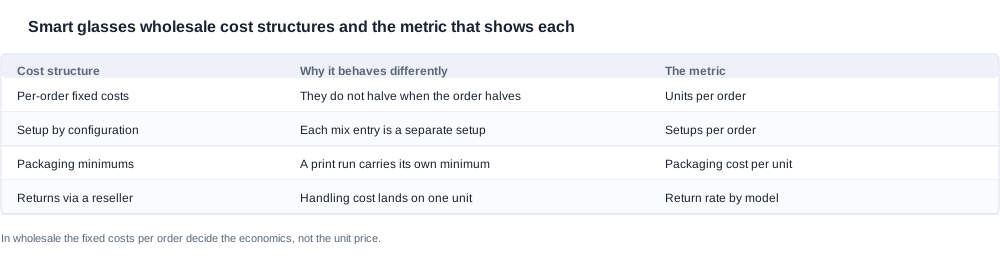
Four cost structures that behave differently in smart glasses wholesale
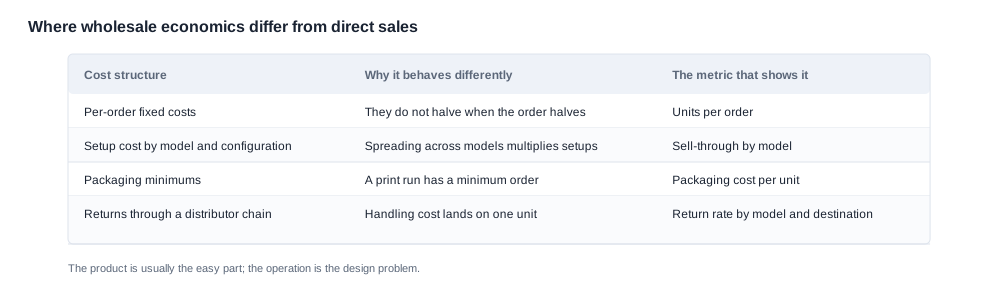
1. The per-order fixed costs do not halve when the order halves. A wholesale order arrives with its own documentation, its own labelling for a destination, its own packing list, its own compliance check and its own shipment. A smaller order carries almost all of that overhead and a fraction of the units. This is the arithmetic behind why a wholesale price is higher than a direct price on the same product, and it is the reason volume thresholds exist at all. In this category the documentation component is unusually heavy, because there is no per-model certification row for any entry, and the export certification page lists ten patent certificate images with no model list on any of them. A document set has to be established per destination, per model, before anything ships.
2. The mix dominates the unit economics. Setup cost is incurred per model and per configuration rather than per unit, so an order spread across six models at fifty units each costs far more in setup than one model at three hundred units. Our published range shows how wide the configuration space is: cell capacities in the camera tier from 220 mAh to 290 mAh, single and dual cell arrangements elsewhere, magnetic and Type-C charging, case capacities published at 900, 1200 and 1400 mAh, camera resolution at 8 MP and 13 MP, and colour options on two entries only. Each combination in that space is a separate setup on the line and a separate line in the packing list.
3. Packaging becomes a per-order cost in a way it is not direct. Retail-ready packaging with printed inserts is a production run with a minimum order, so the wholesale operator either commits volume across many buyers or accepts a simpler box that changes the retail proposition. Two details make it sharper here. There is no translation row anywhere in our catalogue, so each further language for the manual means fresh artwork and a fresh print run instead of a reprinted insert. And the published colour options are narrow, so a wholesale range that intends to offer several colours may be buying setups rather than offering choices.
4. Returns are a per-order event, not a per-unit one. A distributor's customer returns a unit, and the unit comes back through the distributor, and the handling cost is spread over a single unit. The warranty and returns structure has to be planned for this, because the cost lands on the party least able to bear it: usually the wholesaler, who has neither the warranty relationship nor the visibility.
There is a fifth structure that does not appear in the price at all and is the one that most often decides whether a wholesale business is viable: the documentation rework per order. If a sixth of the orders require a label change, a document re-read or a manual correction, the business is paying the fixed costs of an operation twice and the margin that looked adequate on paper is not.
The way to build a wholesale price model is to work from the order rather than from the unit. Take a realistic order size, list everything that happens to it, and price each item: the goods, the documentation work, the labelling and packing, the shipment, the payment terms and the expected handling of the returns that come back with it. The result is a cost per order, and dividing it by the units in the order gives you the cost per unit that the quoted wholesale price has to beat.
Most first wholesale models get this wrong in one of two directions. They add the per-order costs to the unit price, which produces a wholesale price that is too high and quietly kills orders. Or they ignore the per-order costs entirely, which produces a business that loses money on every shipment and discovers it when the bank balance runs out. A third common error is to model returns as a percentage of the unit price rather than as a handling cost per returned unit, which understates them badly in a channel where the unit comes back through a distributor rather than straight to the factory.
There is a practical test for the finished model: run it at half your expected order size and see whether it still works. A wholesale operation that only works at full order size is not a wholesale operation. It is a direct business with a wholesale label, and the first slow month will show it. Run it a second time with a narrower mix, because a model that only works with six models is a model that has quietly assumed it will be carrying the whole range.

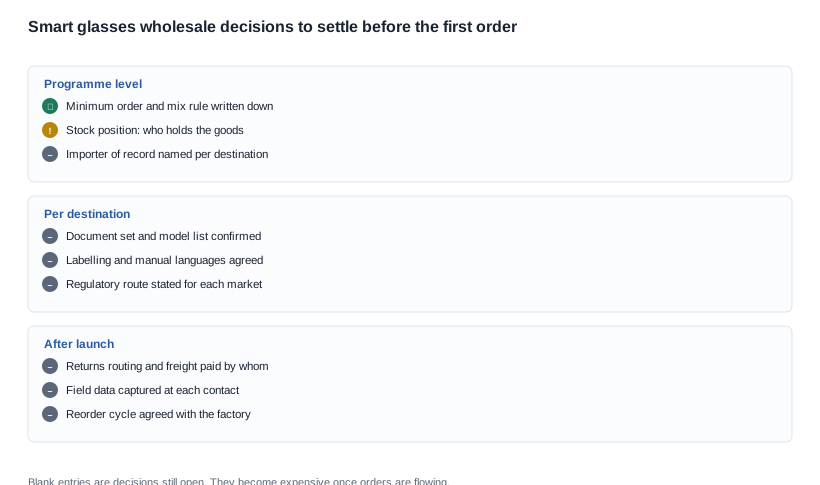
The five decisions that shape a smart glasses wholesale business
1. What is the minimum order and what is the mix rule? A wholesaler who will take a single model in a single configuration can run a simpler operation than one who will take anything. The answer determines the whole downstream structure: the setup cost, the stock position, the documentation set and the way you forecast. The published minimum order quantity for any configuration is not on this site and is confirmed per enquiry, and the reason is that it is a function of the setup burden of that specific configuration rather than a single company-wide number.
2. Who holds the stock? Whether the manufacturer holds finished goods against your forecast, or you hold them, or the units are built to order, determines the working capital, the shelf-life risk and the reliability of the availability answer. For a battery-powered product with published charge times of two hours or less for most entries, storage and rotation are a real operational topic rather than a formality. The stock availability discussion separates the availability question into three distinct layers when you ask how quickly something can be supplied: the base model, the specific configuration, and the shipping state.
3. Who is the importer of record in each destination? This is frequently overlooked and it has real consequences. The importer carries the customs obligations, the product registration where it applies, and the recall liability. It also determines whose name is on the paperwork when something goes wrong, and whose regulator comes to the door. For a business that expects to sell into several markets, this is not a per-order question, it is a per-market decision that should be made once and written down.
4. How is the documentation handled per destination? The certificates, the declaration of conformity, the labelling, the packaging requirements and the language of the manual all vary by market, and in a wholesale operation this becomes a per-destination workstream rather than a per-order task. The specific thing to settle is the model list. A document that exists but does not name your model is not coverage, and because our published position contains no per-model certification row, the only way to establish coverage for a given model and market is to ask for the document and read the model list on it.
5. How do returns and warranty work across the distributor chain? A customer of your customer returns a unit. Does it come to you, to the distributor, or to the manufacturer? Who inspects it, and with what? Who pays the freight in each direction? What evidence is required, and what happens to a unit that comes back with no documentation? The answer has to be agreed before the first order, because retrofitting it is painful and the cost lands on the party least able to bear it.

The metrics that tell you whether the smart glasses wholesale operation is working
Four metrics are worth tracking from the first order, and they matter more than the gross margin because they are leading indicators rather than lagging ones. The due diligence question about a supplier is which one of these four they can report without being asked twice, and the answer tells you more about the operation than the price does. A shortlist built on the wrong criteria is a shortlist that gets rebuilt after the first shipment, and the trade-off of carrying a wide range is paid for on every order rather than once.
Units per order, and selling cost per unit. The first tells you whether the fixed costs are actually amortising. The second tells you how much selling cost the model of business carries per unit, which is the number that decides whether a thin margin is viable or merely present. If units per order is drifting downward, the margin is drifting downward with it, and it will do so quietly.
Sell-through by model, not by order. A wholesale programme is where the market tells you which configurations are real. Our published range runs to camera, audio, sport and children's entries, and to an AR platform, a bone conduction platform and an electrochromic platform, and the mix that actually moves tells you which direction to go next. Order data tells you what you sold. Sell-through data tells you what worked, and the two diverge quickly once a distributor's own demand shaping gets involved.
Return rate by model and by destination. Return rates are a leading indicator of a documentation or a fit problem rather than a quality problem, and they are only visible at scale. Splitting them by destination is what tells you whether the cause is the product or the paperwork, because a fit problem appears everywhere and a documentation problem appears in one market.
Documentation rework per order. If this is not close to zero, the per-order overhead is not under control and the unit economics will not work, however good the gross margin looks. This is the metric that explains the other three, because every unit of rework is a unit of fixed cost being paid twice.
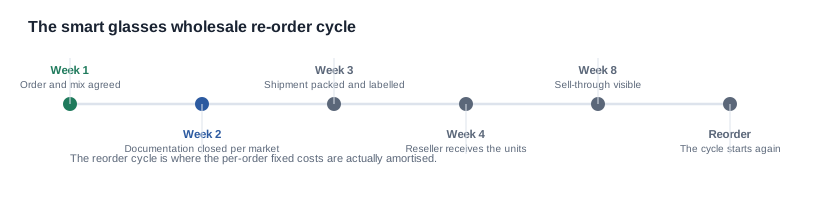
Two more are worth adding once the operation has some history. The reorder cycle time, measured from the moment the reseller decides to reorder to the moment the goods are received, because a wholesale business with an unpredictable cycle cannot forecast and a business that cannot forecast cannot commit to a price. And the on-time rate against the confirmed date, because a wholesaler who is reliably late loses the reseller relationship faster than one who is reliably expensive.
The instrumentation behind those metrics is simpler than it sounds, and it is the difference between a wholesale business and a wholesale hobby. Three records are enough for the first year: a copy of every order with the mix in it, a note of every return with the model, the batch if there is one, and what the customer actually said; and a count of every piece of documentation work that had to be redone. All three can live in one spreadsheet, and the discipline is to fill them in at the moment rather than at the end of the quarter, because a record reconstructed from memory in month nine is a record of what you believe rather than of what happened.
Once those three records exist, four of the metrics become computable without any new systems, and the fifth, documentation rework, becomes visible as a count rather than as a feeling. That is usually the point at which a wholesale business finds out that its real problem is not its margin or its price but its paperwork, which is a much better problem to have and a much cheaper one to fix.

Which model to lead a smart glasses wholesale range with
If a range has to be narrow, the model it leads with should be chosen on four criteria, and all four are knowable before the first order.
The published rows have to be complete enough to brief a factory. Where the case position, the capacity, the Bluetooth version, the charge time and the charging method are all published, the configuration can be quoted and reordered without a clarification round trip. In our range, four camera entries publish no charging method at all, three entries have no charging case row while one explicitly has no case, and eleven camera entries publish no Bluetooth version. Those entries are perfectly good products. They are simply the ones where a wholesale reorder carries more open questions than a wholesale reorder should.
The claims the channel wants to make have to be supportable. A channel selling on the basis of being rugged needs an ingress rating, and exactly two entries in our range publish one, both of them IP54. A channel selling on lightness needs a weight, and one entry publishes it, for the glasses alone. A channel selling on audio character needs a measurement, and none is published anywhere in the range, though three entries carry a surround-audio description on the listing. Where a claim cannot be supported, then either the claim has to change or the model has to.
The documentation has to be closeable for the markets you intend to reach. Since no per-model certification row is published, the practical test is to ask for the document set for the candidate model in your first destination and then check the model list against it. A model that closes cleanly in one market is usually a model that closes cleanly in others, and one that does not is a model that will cost you rework on every order.
The reorder has to be possible without a new setup. This is the criterion that separates a wholesale range from a showroom. Where a model can be reordered on the existing setup, its reorder cycle is governed by component availability. A model that needs a fresh setup, which in practice means a colour that does not exist as a published option or a configuration outside the current range, has a reorder cycle governed by a setup that has to be scheduled. For a business whose customers expect availability, the second kind is a liability.
Which one you lead with matters less than that the criteria are written down before the range is chosen, because the range will feel obvious afterwards. The narrow-range discipline is real: a range of six models carried properly beats a range of twenty carried thinly, because each model in the mix carries its own setup, its own document set, its own packaging variant and its own stock. In a wholesale operation, breadth is paid for on every single order rather than once, because the per-order fixed costs are the part that does not scale.
Two things decide whether a wholesale programme works: control of the fixed costs that every order carries, and a mix that is understood rather than guessed at. Both sit inside the operation rather than the product, which is why both are questions a supplier can answer. Where the work sits is the part that has to be drawn clearly, so we will draw the line between the parts of the operation that sit with us and the parts that sit with you, because in wholesale that boundary matters more than the product does.
We will also be direct about the structure of the answer. If you send us the models, the expected mix, the order sizes, the destinations and the stock position, we will come back with an itemised figure for a specific configuration and quantity, so you can see which line is open to negotiation and which is fixed by the setup you have chosen. We will not publish a wholesale price list, because a price list across a configuration space this wide is a list of numbers that cannot be used.
If you tell us the models, the expected mix, the order sizes and the destinations, we will come back with an itemised figure and an honest view of where the operational risk sits.
Related reading
Send the models, the expected mix, the order sizes and the destinations and we will come back with an itemised figure.


