
A channel marketing programme has three raw materials, and most of the friction in a launch comes from mixing them. The first is what the catalogue publishes: resolution classes, cell configurations, runtimes, charge times, charging methods, case capacities, Bluetooth versions, colour options and the two ingress markings. The second is what the supplier has to send in writing: specification sheets, conformity documents with a model list on them, artwork tolerances, warranty terms. The third is what the partner has to produce and defend itself: the listing, the claim about what the product does for the customer, the market-specific wording, the after-sales promise.
On channel marketing support, our position is narrow and deliberate. We publish the first set, we produce the second set on request, and we help with the third by supplying the structure the claims have to fit into. What we do not do is supply material we cannot substantiate: no product imagery generated for a product we cannot photograph, no performance claims that have no document behind them, no warranty text, and no translated marketing copy that turns an unpublished feature into a published promise.
This article is written for the person who has to launch the category in a market: the channel marketing manager or the e-commerce operator who needs a defensible set of pages and needs to know which lines are safe to write today.
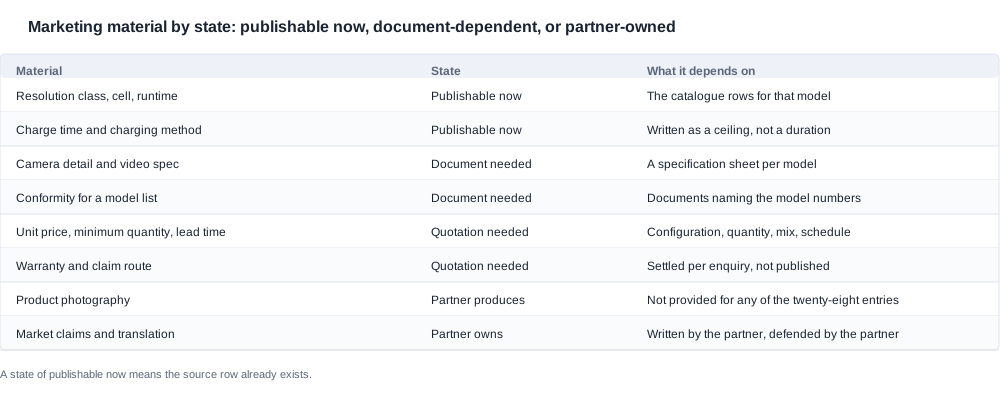
Smart glasses channel marketing support: the three raw materials
What the catalogue publishes and can be reproduced verbatim
Every row in the catalogue can be reproduced on a partner's page without further conditions, because each row is already a statement about the product rather than about the programme. The practical list is shorter than it looks once you separate rows from impressions.
Published and safe to use: the resolution class on each camera model — 8 MP on eight of the eleven camera models, 13 MP on the S7 and the L2 Utral, and the L1 Pro; the cell configuration on each model, from the 40 mAh single cell on the A05 and the A06 through to the 290 mAh cells on the CY05 and the CY03, and the L2 Utral and the L1 Pro; the rated runtime in each published band; the charge time; the charging method where it is published; the charging case capacity where it is published; the Bluetooth version on the fourteen entries that carry one; the colour options on the two models that publish them; the IP54 marking on the V06 and the S7; and the 158 g weight on the MT6 glasses, which excludes its foldable case.
Three rules apply to all of them. Write the charge time as a ceiling, not a duration — the catalogue publishes two hours or less on twenty-six of the twenty-eight entries, and only the D17 and the ZH12 publish approximately one hour. Write the runtime as the published band rather than as a promise. And when a row exists for one model but not its sibling, do not carry it across: the D11 publishes a surround sound line and the D12 does not, and that is the only difference between those two models in the catalogue.
What has to arrive as a document
Several claims a marketing programme wants are not rows, and they have to arrive as documents before they can be written. Camera specifications are the largest group: no camera model publishes a sensor model, a field of view, a frame rate, a video format, a stabilisation figure, a storage capacity or a file format, so a page that describes recording quality needs a specification sheet against the exact model.
Conformity is the second group, and it is the one where a distributor most often has to be careful. No standard is named anywhere in the body text of the catalogue, and no per-model certification row appears in it; a company-level export certification page does exist, but its content is a set of images rather than text: ten patent certificates, of which eight are appearance-design patents and two are utility models. Our own product record notes that CE, FCC and RoHS are recorded as claimed for the camera, audio and sport categories, leaving the individual models and certificate numbers awaiting confirmation, that the IP54 marking is a catalogue annotation without a third-party report number attached, and that the certification position for the children's models is not provided at all. The bone conduction entry's position is not provided either, and the AR entry's is unknown.
The third group is commercial: unit price, minimum order quantity, lead time, warranty terms, tooling or development items, and the artwork and packaging charges that a branded programme incurs. None of these appears in print; each is confirmed per enquiry, because each is a function of configuration, quantity, mix and the schedule running at that point. A marketing programme that publishes a price it has not been quoted is describing a competitor's business model.
What the partner has to produce and defend
Everything that describes what the product does for the customer rather than what the product is. The marketing manager owns the claim that a first-person camera makes a creator's life easier; the claim that a bone conduction entry is suited to hearing assistance belongs to nobody and should be avoided, because our own record identifies it as the highest compliance risk in the catalogue and flags that a hearing-assistance claim could pull the product inside medical device regulation. The claim that a given model carries an ingress rating requires a report behind it before it appears on a page in any market, and our record says exactly that.
This split is what makes a launch defensible. A page whose every sentence maps to a published row or a supplier document is a page that survives a competitor challenge and a marketplace review. A page whose sentences map to enthusiasm is a page that needs rewriting, and it will usually be rewritten after the launch rather than before it.
What a market entry has to settle before the copy exists
Three questions decide the material a launch needs, and they are worth answering before any page is drafted rather than after. The first is which market the page will run in, because it determines the conformity documents that have to exist, the labelling language, and the wording rules the copy has to follow. The second is what the customer is buying, because a page aimed at someone who wants first-person capture and a page aimed at someone who wants hands-free calls draw on different published rows and cannot share a specification block. The third is which claims the range is being sold on, because a claim-driven page and a specification-driven page need different evidence, and a page that mixes the two without a source for each sentence is the version that fails review.
Once those three are answered, the material list follows mechanically. A market-driven launch needs the conformity set with a model list, the labelling and packaging specification, and the claims the page makes about what the product does. A specification-driven launch needs the configuration sheets and the data graphics, and its risk is thin copy rather than unsupported copy. A claim-driven launch needs both of those plus the documentary evidence behind each claim, and that is where most of the time goes.
What this prevents is the common failure of drafting a page in one market and adapting it to another. Adaptation preserves the claims and drops the context, which is exactly backwards: the claims are the part that needs checking again.

Smart glasses channel marketing support: who owns each layer
Ownership is easier to manage as a stack than as a list, because the layers have different failure modes and different review cycles.
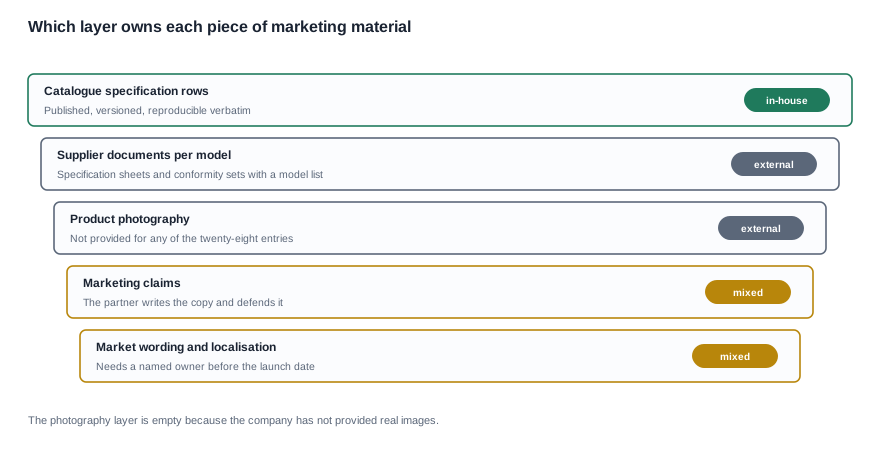
The ownership ladder
The catalogue layer is ours. It is published, versioned and consistent across every channel that uses it, and it can be reproduced without attribution work. It is also the layer with the most gaps, because it carries specification rather than interpretation.
The document layer is the supplier's, on request. Specification sheets, conformity documents with a model list, sample documentation, artwork tolerances and the warranty position come from us once a configuration is defined. They arrive per model, because a document covering a family name is not a document a distributor can put in a compliance file.
The photography layer is empty, and that is a fact rather than an omission. Our product record states that no real photography, no video material and no test reports exist for any of the twenty-eight entries; the catalogue's per-model pages carry a single product image each. We do not generate substitute imagery, because a generated product picture describes a product that does not exist and creates a discrepancy with the unit a customer receives. This layer has to be produced by the partner, by a photographer, or by an agreed studio arrangement — and it is the layer that most often decides whether a launch happens.
The claims layer is the partner's. Once the specification and document layers are in hand, the marketing manager writes the copy, and the copy is theirs to defend. Our role here is a review of the factual basis, not an approval of the copy.
The market layer is mixed. Wording that describes a feature in the customer's language, translation of that wording, and the regulatory language for the destination market all sit between the partner and the supplier, and all three need a named owner before the launch date is set.

Smart glasses channel marketing support: clearing a claim before publication
The claim clearance process is short, and it is the same for every partner. It has five steps and one rule.
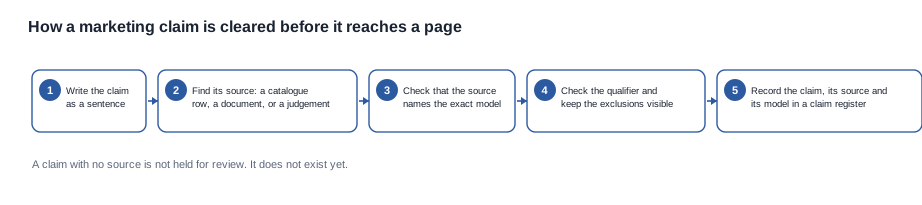
The clearance ladder
- Write the claim as a sentence. "The camera records in 4K" is a claim. "8 MP resolution" is a specification. Only the second is publishable today.
- Find its source. A published row, a supplier document, or the partner's own judgement. If no source exists, the claim is not cleared — it is not held back pending review, it does not exist.
- Check the scope. The source must name the exact model. A document covering the family does not clear a claim on one member of it.
- Check the qualifier. Ceilings stay ceilings, exclusions stay visible, and a catalogue annotation is not converted into a tested figure.
- Record it. The cleared claim, its source and the model it applies to go into a claim register, so that the next revision of the page is a diff rather than an argument.
The four claims that fail most often
The first is the duration claim. "Charges in two hours" says something the catalogue does not support; the catalogue says two hours or less, which permits a unit that takes exactly two hours. The second is the runtime claim written as a guarantee rather than as a published band, when the underlying figure carries no published test condition. The third is the ingress claim, where the marking exists on two models and no third-party report number is attached to either of them. The fourth is the feature claim that arrives from a demonstration unit: a function observed on a sample is not a catalogue row, and putting it on a page moves the liability from the supplier to the partner.
The lifecycle support article covers what happens downstream when a page has promised something the documentation does not cover, and it is worth reading before the copy is written rather than after the first claim arrives.
The review cycle, and what changes when the range changes
A claim register only pays for itself if something re-triggers it. Three events do. A model entering the range means new claims, a new configuration sheet and a new set of documents, and the register is re-based on the new model's published rows rather than on the old model's. A model leaving the range means the pages that referenced it are corrected, and any artwork or packaging print specific to it is retired rather than reused, because a print that carries a model no longer carried is a stock liability. A specification changing upstream means a diff against the previous version, which is a far cheaper operation than the review that preceded the first version.
The cycle should be owned by a named person on the partner's side, with a written trigger list, and the review should be scheduled rather than reactive. The cost of a scheduled review is small; the cost of an unscheduled one is a page that has been live for a week carrying a figure that changed upstream. This is ordinary change control, and it is the part of channel marketing support most often left until a claim arrives.

Smart glasses channel marketing support: the material a partner actually needs
The launch material checklist
A first launch in a new market needs a bounded set of material, and the bounded set is what makes a launch date achievable.
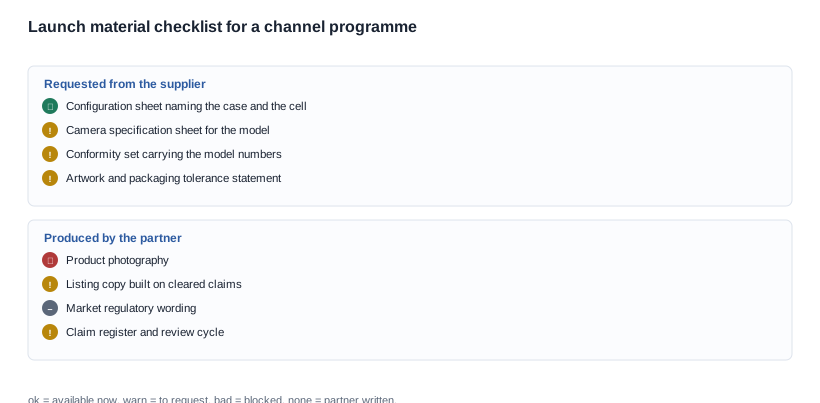
The checklist separates what arrives from the supplier from what the partner produces. On the supplier side: the configuration sheet per model, the camera specification sheet per camera model, the conformity document set with the model list, the artwork and packaging tolerance statement, the warranty and claim route, and the sample documentation including the golden sample. On the partner side: the photography, the listing copy built on cleared claims, the market-specific regulatory wording, the localised packaging and inserts, and the after-sales procedure that the customer's first contact will follow.
Two items deserve emphasis because they are the ones most often deferred. The claim register, because without it the second revision of the range becomes a re-litigation of the first. And the localisation plan, because a translated marketing sentence becomes the partner's own claim in that language, while a translated specification row remains a specification row.
Data graphics as a supply item
There is one category of material we can supply in quantity and at quality, because it is built entirely from data we hold: specification comparison graphics, decision paths, protocol sequences and specification tables, with the source rows named underneath. These are useful to a channel that wants to explain a range rather than push a single SKU, and they are honest in a way that a photograph is not — they can be audited against the catalogue.
What we do not supply is product imagery. The distinction is worth stating plainly because it is a limitation, not a policy preference: the company has provided no real photography, no video material and no test reports for any of the twenty-eight entries, and a picture generated from a description would show a product that does not exist. The wholesale case strategy sets out how a case proposition changes the material a channel needs, and the stock availability discussion covers the point at which an availability claim needs to be confirmed rather than assumed.
For a channel partner, the practical instruction is to design the launch around the material that exists. Build the range page from the published rows. Use the graphics. Ask for the documents early. And treat photography as a production task with a budget and a schedule, not as a line in a supplier request.
Localisation: what survives translation and what does not
A translated page has two kinds of content in it, and they behave differently under translation. Specification content does not change: a published row translated accurately is still the same row, and a charge time described as a ceiling stays a ceiling in any language. Marketing content does change: a sentence written to persuade becomes the partner's own claim in the target market, and it acquires that market's regulatory context whether or not the translation carries it.
The practical rule is to translate specifications and rewrite marketing. A translation that renders "two hours or less" in a language where the idiom implies a shorter figure has created a claim nobody cleared. This is why a translation scope note matters even where no model publishes a translation row: the note is not about a device translating speech, it is about the page being read correctly by the people the page is for.
Two further items belong in a localisation plan rather than in a translation brief. The insert and manual text, which are often left in their original language because they sit physically inside the box and nobody checks them, and the label content, which is where market-specific regulatory wording usually lives. Both are decided at artwork freeze, and both are expensive to change afterwards.
The marketing review criteria, and the red flags a first reply shows
A marketing programme is judged by what it can evidence, so the useful conversation with a supplier is a list of questions rather than a request for a catalogue. Before you order, ask these:
- Which published rows apply to the exact models on the order? A row published for a family does not cover a model inside it, and the applicable rows have to be named in the quotation.
- What do you need from me to clear each claim I intend to publish? This is the criteria for a marketing review, and it is cheaper to establish before the copy than after it.
- Which claims can you not support, and why? The list of what a supplier will not state is more informative than the list of what it will, because it is specific.
- What documents will accompany the shipment, for which models, under whose name? The answer tells you what your compliance file will contain three months from now.
- What is the review cycle for a specification change? How to evaluate an upstream change is a process question, and the process is far cheaper to ask about than the change.
- What red flags have you seen in channel claims on this category before? A supplier that has watched the category fail will name the failures, and naming them is how to avoid repeating them.
- What is the total cost of the programme, including artwork, packaging and documentation? Unit price is one line; the total cost of ownership is the number that decides whether a launch works.
- What should a shortlist look like for my market? A supplier who has supplied several markets can say which criteria actually decide a purchase and which are decoration.
These are the questions that let you compare two suppliers on the same terms, which is the only comparison worth making.
Smart glasses channel marketing support: our position and the next step
Our side of the commitment
We will supply the published rows, the specification sheets for the models you are selling, the conformity documents with the model list, the data graphics, and the artwork tolerance statement for a branded programme. We will tell you in writing which models each document covers, so that your compliance file and your product page describe the same set of products.
We will not supply claims. We will not supply a warranty statement as a marketing asset, because the terms are settled per enquiry. We will not publish availability that has not been confirmed against a production plan. And we will not generate product photography.
The wholesale programme and the distributor and retailer solution pages set out the commercial framework that sits behind this material.
The three things we need to check your listing claims
The fastest way to start is to send three things: the markets you intend to sell into, the models you intend to carry, and the claims your current draft listing makes. In return you get the published rows that apply to those models, the list of claims that are supported and the list that are not, and the documents we can release against them. That exchange usually takes one round, and it replaces most of the review cycles that a launch would otherwise absorb.


