

A mixed order policy is the rule set that decides what a distributor may put in one shipment, what the supplier will accept as a single order, and what each line of that order commits both sides to. It is written before the first order and it is the document that prevents the eleventh order from being negotiated from scratch. In this category it matters more than in most, because the published configuration space is wide: twenty-eight catalogue rows, with charging methods published on twenty-four of them, case states that split four ways across the camera models, and colour options on two models only.
The policy is not a discount document and it is not an inventory document. It is a set of answers to six questions, and the value of writing them down before the first order is that both parties stop paying for ambiguity. What follows sets out what a mixed order actually contains in this category, the six rules a workable policy needs, the costs the catalogue makes real, and the flow an order follows once the policy exists.
Smart glasses mixed order policy: what the term means in practice
What the published configuration space looks like to a buyer
Before any policy is written, the buyer needs a picture of the space the policy has to cover. Ours is wide, and the reason is that the catalogue publishes specification rows rather than configuration rows — so the configuration space is the product of several published dimensions, not a list anyone can read off a page.
Take one camera model. The V03 publishes a resolution class, a 220 mAh cell, a rated runtime of five to eight hours, a charge time of two hours or less and magnetic charging, with no case row at all. That model is a single published specification surrounded by an unspecified number of commercial configurations, because colour, packaging, artwork and destination labelling all sit outside the catalogue. A model like the V06 adds four published colours and an IP54 marking. The V03 Pro adds three published colours, photochromic lenses and a Type-C charging port, and it is the one camera model published as having no case.
A policy written against the model list alone is therefore written against the wrong object. The policy has to be written against configurations, and the configurations have to be enumerated before the minimum, the artwork and the documentation scope can be settled. That enumeration is the first task in the sequence, and it is the one most often skipped because it looks like an administrative exercise rather than a design step.
Three kinds of mixture
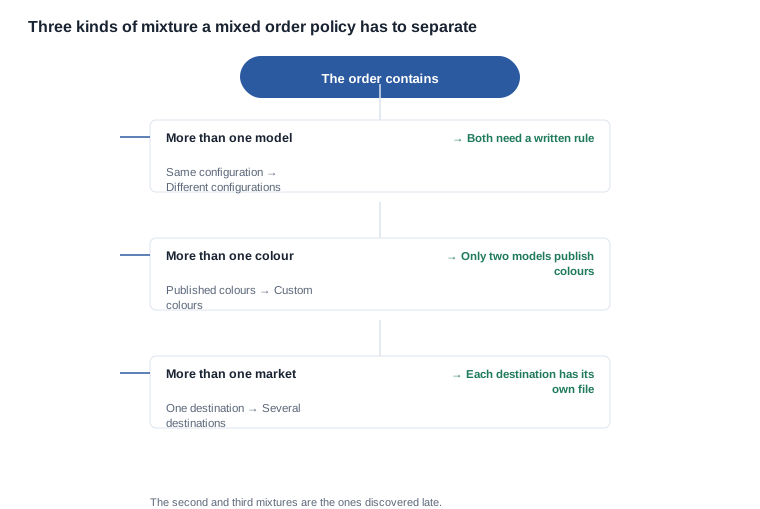
Order mixtures are usually described with one word, which is why policies written from that description fail. In practice three different mixtures travel together, and each of them has its own cost and its own rule.
The model mixture is several models in one order. It is the most ordinary version and the least expensive, provided the configurations share artwork, packaging and documentation. The configuration mixture is one model in several configurations — different colours, different packaging, different artwork, different destination labelling. It is the expensive one, because each configuration is a separate set-up in the supplier's operation and in yours. The market mixture is one order destined for more than one country, which adds a conformity and labelling layer to every line that is not already split by configuration.
The second and third mixtures are the ones that get discovered late. A distributor who wrote the policy around the first mixture will find the second one on the first promotional reorder, and the third one at the first customs query.
Why a policy written in advance beats one negotiated per order
A policy is a set of pre-agreed answers, and its value shows up in three places. The first is speed: an order that arrives inside an agreed rule can be processed without a negotiation cycle, and the commercial conversation moves on to the part that actually needs it. The second is consistency: a written rule applies to the fifteenth order as it did to the first, which is what makes a distributor's own pricing and forecasting possible. The third is the one nobody plans for — disputes. A mixed order that was settled by an exchange of emails has no baseline when the sixth line of it goes wrong, and the baseline is precisely what a policy provides.
The cost of writing one is a day of a buyer's time and one exchange with a supplier. The cost of not writing one is paid on every order, in the form of set-up charges that were never agreed, configurations that shipped against the wrong artwork, and a re-order that cannot be placed because nobody can say what the original order was.

Smart glasses mixed orders: the six rules a policy needs
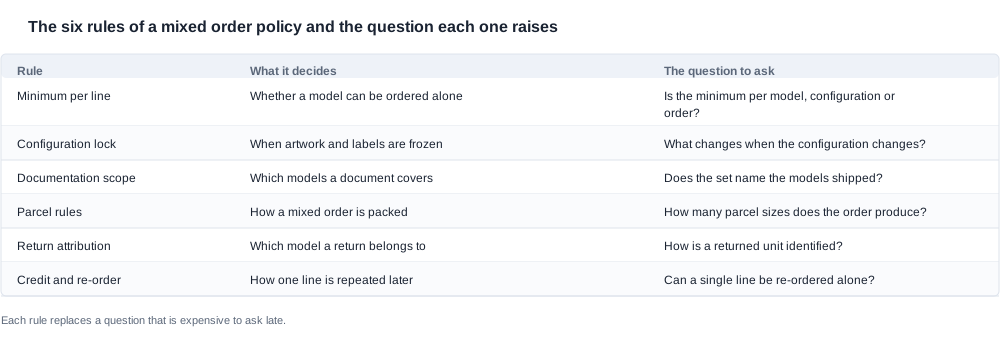
Six rules cover the practical decisions. Each one exists because the alternative is a question asked late, when the answer is expensive.
The rules in order
Rule one — the minimum, and what it is measured against. This is the rule most often left implicit, and the most expensive one to leave implicit. Is the minimum counted per model, per configuration, per colour, per packaging, or per order? A minimum measured per configuration means a programme with a wide configuration space needs a larger commitment to get through it. We do not publish a minimum order quantity, and the minimum order quantity questions are the ones to put to a supplier before the range is fixed rather than after the first order is refused.
Rule two — the configuration lock. Once artwork, label content and packaging print are approved for a configuration, what changes when the configuration changes? The useful part of this rule is the list of what does not require a new approval. A colour that the catalogue publishes for the V03 Pro or the V06 is within the published set; a colour outside it is a new configuration, and a new configuration is a new artwork file and a new label.
Rule three — the documentation scope. For each model on the order, which documents travel with it, and does each document name the models it covers? Our catalogue carries a company export certification page built from images rather than text, the body text names no standard, and no per-model certification row appears anywhere, so the document set has to name the models explicitly to be usable in a file. A document that names a family is not a document that can be filed.
Rule four — the parcel rules. How is a mixed order packed, and how many parcel sizes does it produce? The case states in this category make this a real decision rather than a formality, and the OEM-ready platforms and packaging discussion covers the artwork and packaging side of it.
Rule five — return attribution. When a unit comes back, how is it identified as a model and a configuration? A mixed order without a configuration record produces unidentified returns, and an unidentified return cannot be inspected, credited or resold. This is the rule with the longest tail, because it is used for years after the order was placed.
Rule six — the re-order path. Can one line of a mixed order be re-ordered on its own, and if so, does it carry the same minimum as the original order? A policy that forces every re-order to repeat the whole mix is a policy that forces stock to be held against the range rather than against demand.

Smart glasses mixed orders: what the catalogue makes expensive
The questions to ask a supplier before the policy is written
A mixed order policy is a set of supplier answers before it is a set of rules, and the order of the questions matters more than their number. Six of them, asked in this sequence, determine whether the policy can be written at all.
- Is the minimum order quantity measured per model, per configuration, or per order? The answer determines the smallest order the programme can run.
- Does a configuration outside the published set carry a development item, and what does that include? The published options are a small set, and anything beyond them has to be priced as work rather than as stock.
- Which documents travel with which models, and can the document set be issued per model list? The model list on the document is the whole point of it.
- Can a single line be re-ordered later without repeating the rest of the mix, and on what minimum? This rule determines how the range has to be stocked.
- What happens to the schedule and the balance when a configuration changes after the artwork freeze? A change-control question, and the answer is worth more than a discount.
- Which terms of the quotation vary by configuration and which are common to the order? A quotation that mixes the two without separating them cannot be compared against another supplier's.
The criteria behind this sequence are simple: ask the questions whose answers change the design of the programme before the ones whose answers only change its price. Minimum, configuration status and re-order path determine how the range has to be built. The rest is negotiation.
Configuration count and its cost
The cost of a mixed order is proportional to the number of configurations, and in this category the configuration space is wider than the model count suggests. Three sport models, three children's models, eight audio models and eleven camera models account for the twenty-five named rows, and three further entries carry no model string at all. Within that, charging methods split three ways — magnetic on seventeen rows, Type-C on seven, and not published on the CY03 and the CY05, and the L1 Pro and the MT6 — and charging method is a configuration input, because a bundled accessory or a printed instruction has to match it.
Colour is the sharper constraint. Only two models in the whole catalogue publish colour options: the V03 Pro with three, and the V06 with four. Every other model, and every colour outside those sets, is a configuration that has to be created, which means artwork, a label and a packing specification of its own. A mixed order that carries both published colours and a custom colour has two different classes of line inside it, and the policy has to treat them differently.
The case states and the parcel
Three case states exist across the eleven camera models, and each one produces a different parcel. Capacity is published on five — Capacity appears on the CY03, the L1 Pro and the CY05 — each at 1400 mAh, the L2 Utral publishes two figures in one row — 900 and 1400 mAh — and the MT6 states 1200 mAh in a foldable case. The KY06 and the MT5 list a case with no published capacity. The V03 and the V06, and the S7 and the V03 Pro have no case row at all, so the carton contents for those four have to be confirmed per model.
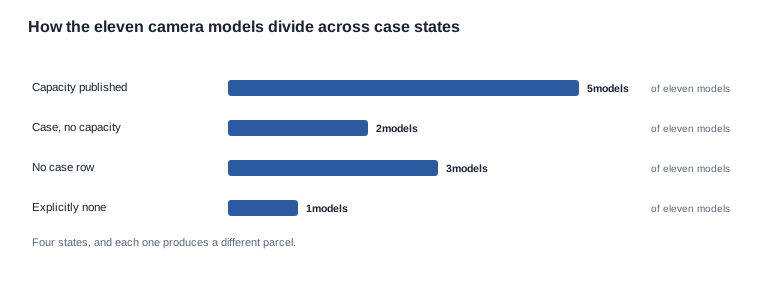
A mixed order that spans these states produces more than one parcel size, which is a picking decision, a carton decision and a carrier decision rather than a manufacturing one — but it is a cost, and it lands on the party that has to handle it. The policy question is therefore not whether to mix, but how many parcel sizes the programme will accept, and the answer should be a number rather than a preference.
Documentation and artwork per configuration
Each configuration that changes the packaging changes the documents that describe the packaging, and each model on the order changes the model list on the conformity documents. The combination rule — the model list plus the packaging specification plus the artwork version — is what a policy has to freeze, because it is what a receiving inspection and a returns disposition are both checked against.
The rule is simple to state and easy to get wrong in practice: a configuration is identified by the model, the colour or option set, the packaging version and the destination labelling. Two lines of the same model that differ in any of those are two configurations, not one line in two places. The model selection guidance is worth reading before the range is fixed, and the MT6 against the V03 Pro comparison is a useful illustration of how two models in the same family differ on published rows.

Smart glasses mixed order policy: the flow from enquiry to dispatch
The seven steps

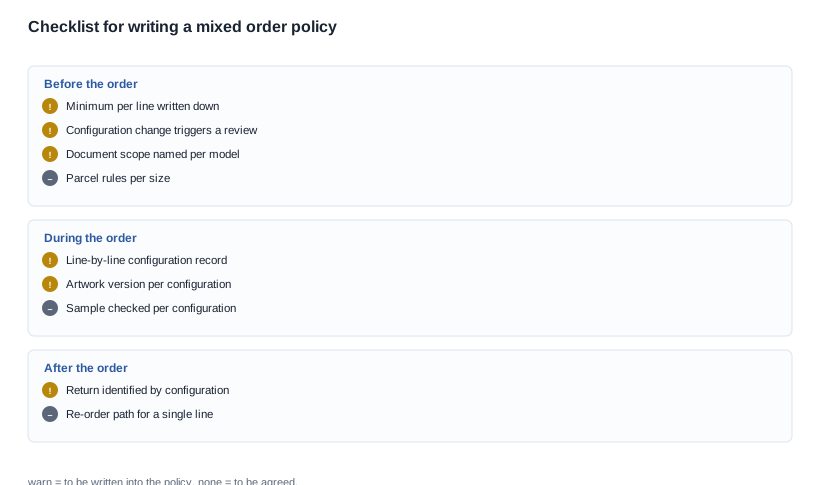
- The enquiry names the models, the configurations and the destinations. Not "the range" — the specific lines.
- The supplier checks the minimum and the configuration status. What is within the published configuration space, and what has to be created.
- Artwork, label and packaging versions are confirmed or frozen. This is the freeze point for the whole order.
- The document set is confirmed against every model on the order. Each document named against the models it covers.
- The shipment is built as one consignment or several, following the parcel rules in the policy.
- The order is released with a line-by-line configuration record that travels with the shipment.
- The re-order path is defined, so a single line can be repeated without repeating the mix.
The failure points
The first failure point is step one, where an enquiry arrives as a wish list rather than a line list, and the supplier quotes against a range rather than against an order. The second is step three, where artwork is approved before the configuration is settled, so the approval is against something that then changes. The third is step six, where the configuration record is not made and the returns and the re-orders have nothing to reference.
There is a fourth, and it is the one that generates the most arguments: a policy that does not say what happens when a model on the order is unavailable. The rule should be explicit — the line is substituted by an agreed equivalent configuration, the line is deferred, or the order proceeds short — because "it depends" is what turns a policy into a negotiation.
The regulatory questions that attach to a mixed order belong to the distributor's legal function rather than to a supplier, and the general product safety requirements for the European market are the reference point for those questions. The mixed-order structure makes one of them sharper: when several models and several destinations travel under one order, the traceability of each unit becomes harder, which is a reason to keep the configuration record rather than to leave it to the packing list.
The questions to ask your own operation
The other half of a mixed order policy is internal, and it is the half that is usually skipped. Before the policy is agreed with a supplier, three internal questions should be answered by the people who will operate it.
First, how many distinct configurations will the warehouse receive, and who identifies each one on arrival? The identification step is the one that fails quietly: a unit that arrives without a matching configuration record is checked against a packing list rather than against a specification, and the difference between the two shows up later as a stock discrepancy nobody can explain.
Second, what happens to a line that is unavailable? A policy that requires the order to ship complete and a policy that allows a short line are both workable, and they have opposite consequences for the customer's launch date. Choose one, write it down, and tell the supplier which it is.
Third, how will a returned unit be attributed to a configuration, and who authorises a credit? A mixed order with a returns process that assumes one configuration produces unidentified returns, and unidentified returns produce manual work at the worst possible moment.
The internal answers are cheap to produce, and they are what makes the supplier's answers usable. A policy that only the buyer knows is a negotiation position; a policy both operations know is a process.
Smart glasses mixed order policy: our position and the next step
What a mixed order policy commits
We will work to a policy, and we will put the policy's commercial consequences in the quotation rather than leaving them to be discovered later: unit price per configuration, minimum order quantity per configuration, lead time for the configurations on the order, the development items for any configuration outside the published set, the delivery terms, and the packaging minimum where packaging carries its own. None of those is published, and each is confirmed per enquiry, because each turns on configuration, quantity, mix and the schedule at that point.
We will not accept an order that mixes configurations without a configuration record, because the document set, the packing specification and the returns handling all depend on it. We will not quote a mixed order as if every line carried the same terms. And we will not create configurations outside the published set without pricing them as development items, which means they carry a schedule as well as a cost.
Building a mixed order policy from one live configuration
The fastest way to write a workable policy is to start from one real configuration rather than from the whole range: take two models, one published colour option, one destination, and ask for the minimum, the lead time, the documentation scope and the re-order terms for exactly that. The answers form the template, and the remaining lines are variations on it. A policy reviewed once a year, against the models actually reordered, is worth more than a policy written once and never revisited, because the range that a distributor reorders is rarely the range they launched with. The distributor and retailer programme describes the commercial framework around the policy.


