

MT6 smart glasses vs V03 Pro is a harder comparison than the specification counts suggest, because the two models agree on the row most buyers would rank them by. Both publish an eight megapixel camera, both publish a charge time of two hours or less, and both sit in the same camera family. The differences that remain are structural rather than cosmetic: one model is published with a foldable charging case and a weight figure, the other publishes no charging-case row at all and carries a photochromic lens, a flexible temple and three colour options that the case-led comparison cannot replicate. This piece does not name a winner, because the published rows cannot support one — what it does instead is lay out the decision branches, name the input each branch needs, and list what to ask before you order either model.
MT6 smart glasses vs V03 Pro: start from the rows they share
Two published rows are identical, and both of them are the rows a hurried buyer would use.
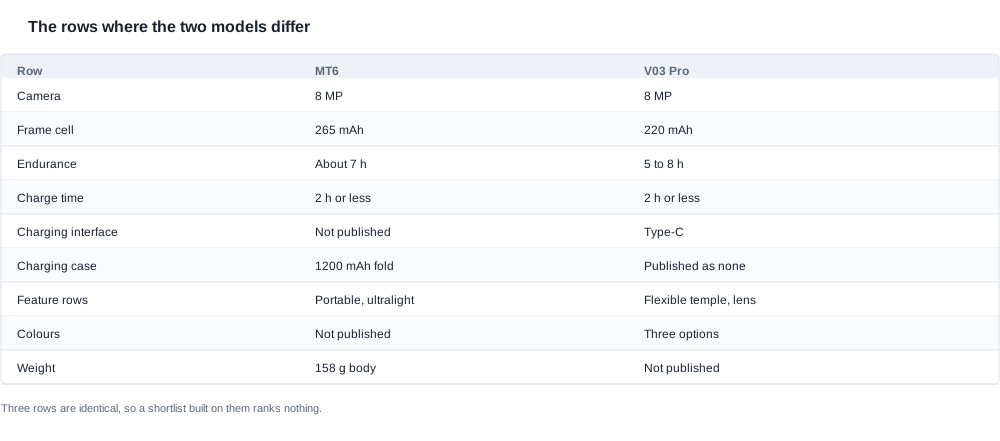
The first is camera resolution. The MT6 publishes an eight megapixel camera. The V03 Pro publishes eight megapixel as well. Across the eleven camera models in this range, eight sit in the eight megapixel class and three sit in thirteen megapixel, so neither of these two models occupies a different tier from the other. Any shortlist rationale written as "one has a better camera than the other" is unsupported by the catalogue, and this piece will not repeat it.
The second is charge time. Both models publish a charge time of two hours or less. That figure is an upper bound rather than a measured value — it permits exactly two hours, and it does not state the starting state of charge or the criterion that declares the charge complete. Neither page states how a case refills, for the simple reason that only one of these two models has a case.
So the resolution row and the charge-time row both come out level. That leaves three areas where the pages genuinely differ: the case, the lens and temple construction, and what is published about weight.
A point estimate and a range are not the same claim
The endurance row is where this comparison usually gets misread, and it is worth separating carefully.
The MT6 publishes about seven hours. The V03 Pro publishes five to eight hours. At a glance these look comparable, and in a loose sense they are: both models describe a working day of camera use. But they are not the same kind of claim. One is a point estimate. The other is a range with a lower bound and an upper bound. A range is a weaker claim than a point estimate, because it can accommodate two very different devices, while a point estimate commits to one figure.
There is a second complication that belongs in any comparison a procurement team will defend later. The two models label that row differently. Across the camera pages, three different labels carry an endurance figure, and the same word is used for a different quantity on three pages — the MT5 and the KY06, and the V03 use the word that elsewhere denotes charge time, and carry a separate charge-time row alongside it. If your extraction process reads rows by label, this pair will not land in the same bucket unless someone checks manually.
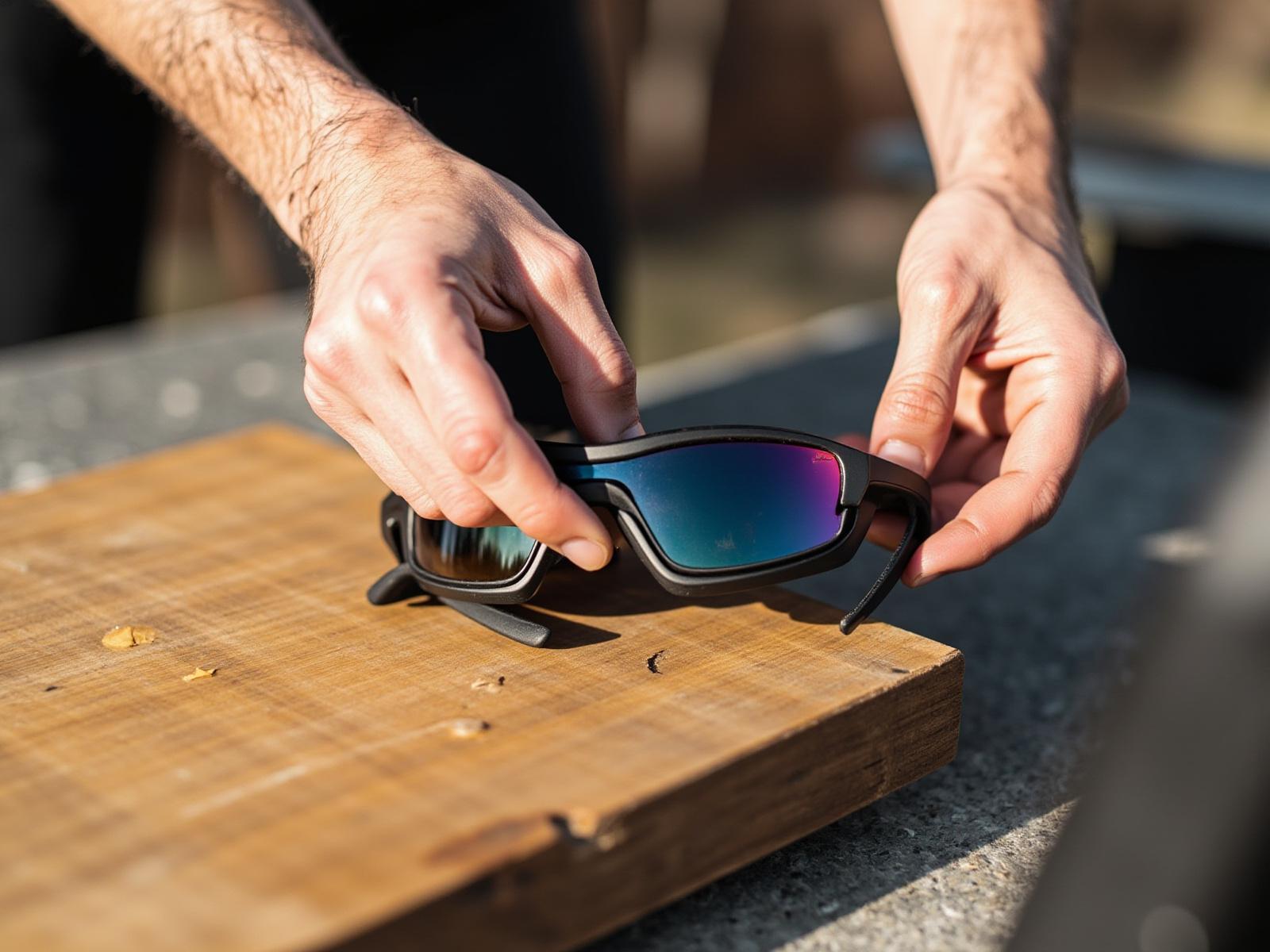
Neither model publishes the test condition behind its endurance figure. No profile is stated — camera recording, camera idle, audio playback or a mixed duty cycle — and no ambient temperature or unit count is given. That matters more for the V03 Pro than for the MT6, because a range with no stated test basis can absorb a wide spread of real outcomes, while a point estimate reads as though it came from a defined condition.
The practical handling is to ask both suppliers the same four questions in the same words: what was the device doing, from what starting state, at what temperature, and over how many units. If the two answers differ, the published figures are not comparable and the endurance row should be dropped from your evaluation entirely. If the answers match, you can use the figures — but you should still record them as test figures, not as shift-length figures.
The endurance question in more depth is treated in the V03 Pro battery life note, and the wider consistency question across the camera range is covered in the AI camera glasses battery comparison.
The case, the interface and what each one costs downstream
This is where the two models separate most clearly, and the separation is one-sided in a way that changes what you have to arrange.
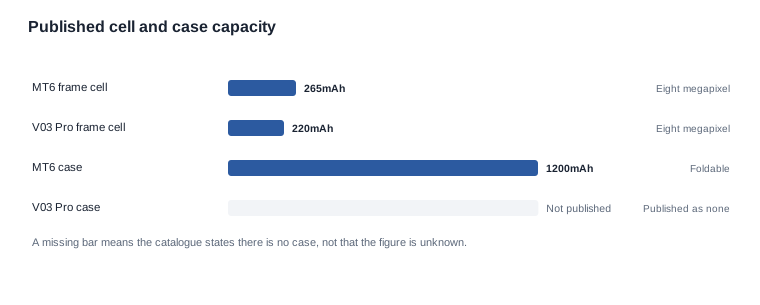
The MT6 publishes a foldable charging case at 1200 mAh. No other camera model page in the range describes its case as foldable. The fold reduces parcel volume, which matters on any channel charged on volumetric weight, and it introduces a hinge, which is a wear path and a transit failure mode. Neither benefit should be taken without the corresponding cost: ask for a hinge cycle figure rather than accepting a durability adjective.
The V03 Pro publishes no charging-case row at all. This is worth stating precisely, because no model in the range is published with a case row that says otherwise. Across the eleven camera models there are three distinct case states — capacity published, case present with capacity unpublished, and no case row at all — and the V03 Pro sits in the third group, with the V06 and the S7, and the V03. That means the box contents are undocumented in the catalogue rather than decided by it.
The commercial consequences follow from that. A configuration that carries no charging case in its carton is a simpler parcel: less volumetric weight, no second lithium cell in the unit, and no case to become a returns failure mode. It is also a weaker retail proposition if your channel expects an all-day reserve story, and it is a product that has to be positioned around the device rather than around the package. A model that ships with a foldable case is a stronger parcel story and a heavier one.
On the charging interface, the asymmetry runs the other way from the case. The V03 Pro publishes a Type-C charging port among its feature rows. The MT6 page publishes no charging method or interface row at all — across the camera range, four models sit in that unpublished state, and the MT6 is one of them. So one model gives you a documented, standard interface for service planning, and the other leaves that question open. Ask for the MT6's interface in writing before you design a repair bench or order charging docks.
There is one trap worth naming because it recurs across this range. A catalogue page that publishes a Type-C row for one model does not imply anything about the other model's interface, and a buyer who reads a shared product family as a shared accessory set will assume the charging dock for one fits the other. Nothing in the published rows supports that assumption, and it is the kind of assumption that survives all the way to a warehouse.
Why a shared accessory assumption is the expensive kind of mistake
That last trap deserves a section of its own, because the failure it produces is quiet. It does not show up as a technical fault; it shows up as a return event three months into a channel's life, by which point the supporting decision has been forgotten.
The assumption takes a specific form. A buyer reads that one model publishes a Type-C charging port, sees that both models share a camera class and a charge-time figure, and concludes that the accessory ecosystem is shared — one dock, one spare-part pool, one service procedure. Every element of that conclusion is a reasonable inference, and none of them is supported. The catalogue publishes rows per model, and a row that appears on one page has not been stated for another page. Shared specification lines are not a shared platform, and the difference is invisible precisely because the two models look so similar on the other rows.
Three practical consequences follow, and each one is cheap to avoid at the specification stage and expensive to discover later.
The first is the spare-parts pool. If a single dock or cable line is planned for both models and one interface turns out to be different, the entire spare inventory becomes wrong for half the range. The mitigation is not expensive: require a per-model interface statement in the technical file before any spare-part purchase order is raised, even when the cost of the answer is one email.
The second is the service procedure. A repair bench configured around the documented interface will work on one model and improvise on the other, and improvisation in a service workflow is where warranty disputes are born. The mitigation is to write the interface into the procedure as a model-specific step, which is a documentation change rather than a hardware change.
The third is the after-sales promise. Warranty terms written generically across a range will be read by a customer as covering whatever accessory came in the box. When the case position differs between the two configurations, a generic sentence is ambiguous exactly where the ambiguity is expensive.
None of this requires new information about either model beyond the one interface answer. It requires treating that answer as model-specific rather than family-wide, which is the discipline this comparison is really testing.

Colour, photochromic lens and the capture question
The V03 Pro's remaining differentiators are published on its own page, and they are unusually specific for this catalogue.
It lists a flexible temple, a photochromic lens, and a Type-C charging port, and it is one of only two camera models in the range that publish colour options — three for this model: orange, cream white and black. The MT6's page carries a different kind of descriptor set: portability, ultralight construction and the foldable case, with no colour row at all.
A note on the lens. The photochromic lens appears in this model's feature row; it does not appear in the model name, where the designation carries the eight megapixel class instead. If your product data feed derives marketing copy from the model name, this attribute will be lost, and if your channel listing relies on the name to distinguish variants, the distinction will not survive. Treat the feature row as the source of truth and keep the attribute as a structured field rather than as descriptive text.
The colour row has a different commercial significance. For a channel that merchandises on finish, a model with three published colours supports a colour-led range plan and a photography plan. For a channel that sells one configuration, the colour row is unused information. Neither model publishes lens tint depth, activation time, or the temperature range over which the lens changes, so a channel that wants to build a product story around photochromic behaviour has to source those figures separately — ask for the activation range and the time to change, in writing, along with any stated limits on the mechanism.
The flexible temple is the one descriptor on that page whose practical effect is hard to judge without a sample. A flexible temple is generally associated with fit and durability, but no dimension, material or adjustment figure is published for it on either model, and no bare frame weight appears anywhere in this catalogue. If fit is a genuine concern in your channel, a sample unit is worth more than a further specification round.
The published rows for this model are collected in the V03 Pro specification list, and the photochromic behaviour is covered in the photochromic smart glasses buying guide.

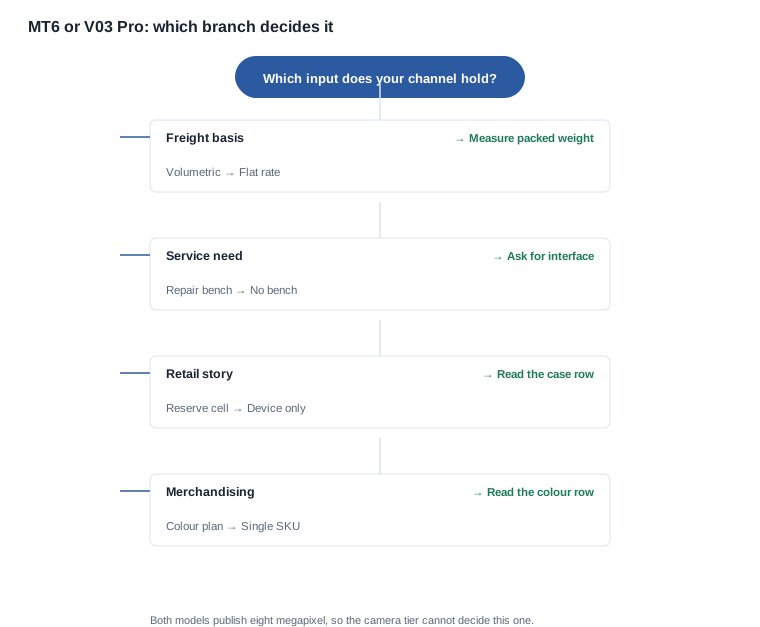
Four decision branches and the input each one needs
Because both models agree on the camera tier, the choice cannot be made on specifications alone — it has to be made on which of four commercial inputs your channel actually controls.
Branch one: does your parcel sell on volume or on weight? A foldable case reduces volumetric weight and adds a hinge. A model without a case reduces both. If your freight is charged volumetrically and your units travel, the case question dominates; if your channel is domestic and freight is a minor line, it may not. The input you need is a measured packed unit weight and packed volume for each configuration.
Branch two: does your channel need a documented charging interface? A repair bench, a spare-unit pool or a retail demo loop all need one. One model publishes Type-C; the other publishes nothing. The input you need is a written interface statement, plus confirmation of what dock or cable a technician requires.
Branch three: is a reserve battery part of the product story? A case at 1200 mAh supports an all-day claim that a no-case model cannot make from published figures. If your retail listing, your channel training or your after-sales promise depends on that story, the case is doing structural work in your sales process. If the listing makes no such claim, the simpler parcel is worth more.
Branch four: does your range plan need colour variants or a photochromic angle? Only this model publishes colours or the lens attribute. That is an asymmetry that supports a colour-led merchandising plan and does not support a claim that the alternative is inferior — only that this attribute is documented here.
Each branch needs one input, and each input has a named source: a measured sample for weight and volume, a written statement for the interface, your own merchandising plan for the reserve story, and a written technical file for the lens behaviour. Where you cannot obtain the input, record it as an open item rather than resolving it by assumption, because the assumption will reappear at the point where it is most expensive.
How this model sits against the wider range is treated in the V03 Pro how it compares note, and the range-level selection method — which works from published rows rather than from a ranked recommendation — is in the AI camera glasses which model to pick piece.
What to ask before you order either model
The following items are the ones that this comparison cannot answer from published data. They are ordered so that the answers most likely to change the decision come first.
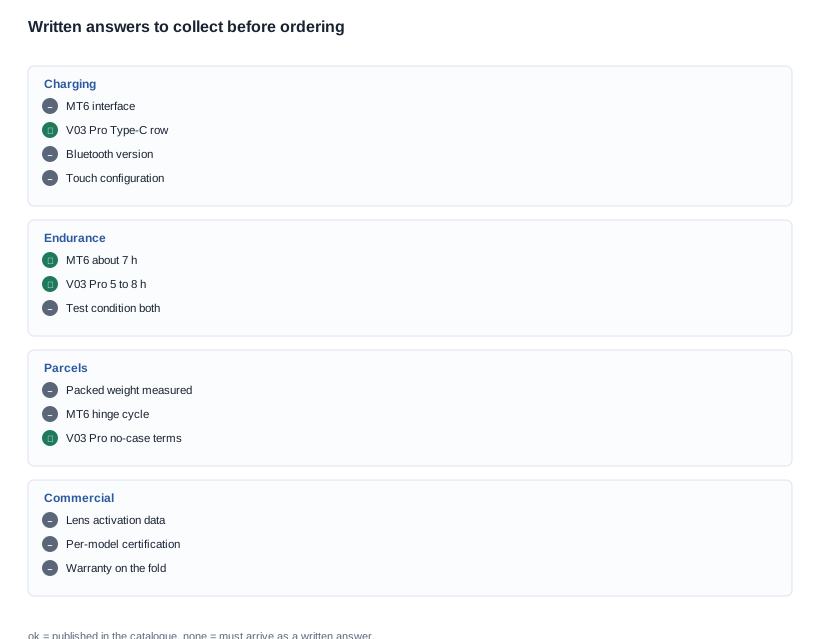
- Charging interface for the MT6. No interface row is published. Ask which interface is fitted, whether it is a proprietary contact, and what cable or dock a technician needs.
- Endurance test condition for both, asked in identical words: duty profile, starting state of charge, ambient temperature, number of units.
- Measured packed unit weight and volume for each configuration, in the packaging you would actually ship.
- Case details for the MT6 — external dimensions, case weight, refill interface, case charge time, and a hinge cycle figure for the fold.
- Lens data for the V03 Pro — activation time, temperature range, and any stated limits on the photochromic mechanism.
- Bluetooth version for both. None of the eleven camera models publishes one, so the row is genuinely open for every model in this family.
- Touch configuration for both. No model in the catalogue publishes a touch row at all, so whether the temple carries a touch surface, and how it is configured, has to come from the supplier.
- Per-model certification documentation for each destination market. One export certification page sits at company level in our catalogue, and everything on it is imagery rather than words; its text names no CE, FCC or RoHS, and no per-model certification row appears anywhere. Treat a per-model conformity claim for a destination market as written material you must obtain before you rely on it.
- Warranty and defect terms for the fold on the MT6, if you order it — a folding mechanism has a different failure profile from a rigid one, and a generic warranty sentence will not cover the distinction.
Parcel planning for either model runs on measured figures rather than catalogue ones, which is the subject of the AI camera glasses shipping weight note. The published rows for the MT6 are in the MT6 specification list.
Turning the answers into a purchase order and a technical file
Collecting answers is only half of the work. The other half is getting each answer into a document that binds the order, because an answer that exists only in an email thread protects nobody once the relationship changes.
Into the purchase order go the items that define what is being bought as a distinct configuration: the exact model designation, the colour where the model publishes colours, whether a case is included or explicitly excluded, and the packaging configuration. Every one of those is a place where two plausible readings exist. A purchase order that says "AI camera glasses" without a case statement will eventually be filled with a case; an order that names the eight megapixel class without naming the model will eventually be filled with the wrong member of that class. Precision here costs nothing and prevents the most common fulfilment dispute.
Into the technical file go the answers that describe behaviour rather than configuration: the endurance test condition, the interface statement, the Bluetooth position, the touch configuration, and the lens data where the photochromic model is ordered. These are the items that support your own product claims and your own after-sales responses later. If a retailer asks a customer question six months after launch, the only defensible answer is one that traces to a document, and a catalogue page that does not contain the figure is not that document.
Into the contract or the purchase terms go the items that allocate risk: warranty scope, whether the fold mechanism is covered on the same terms as the rest of the device, what happens if the endurance figure is not met under a stated test condition, and the remedy if a per-model certification file cannot be produced for a destination market. The last of these is worth particular attention. This catalogue publishes no per-model certification row and names no conformity framework anywhere in its text; a single export certification page sits at company level, and what appears on it are ten patent certificates — eight of them for appearance designs, two for utility models. If a market requires a per-model conformity file and one cannot be produced, the allocation of that risk needs to have been agreed before the bulk order, not discovered at the first customs inspection.
The sequencing follows from this. Ask before you order, write before you ship, and allocate before you scale. A comparison that produces nine written answers but no document trail has changed nothing about the risk profile of the business.
Related reading
- Published rows for both models — MT6 specifications and features and V03 Pro specifications and features
- Endurance in depth — V03 Pro smart glasses battery life
- Range-level selection method — AI camera glasses which model to pick
Send us the freight profile, the channel format and the destination markets, and we will tell you which of these four branches your business actually has to answer — and which of the questions above are the ones worth putting in writing before you order.


