

Smart glasses for ecommerce: a nine-line checklist settled before the purchase order
The short answer is this: in e-commerce, the unit price is almost never the number that decides whether a smart glasses product works as a channel. The configuration decides it, and the configuration is fixed in the purchase order and negotiated nowhere else. A listing that overstates a specification by one notch generates returns that cost far more than the margin on the unit that survived, and the overstatements are predictable enough to design around — but only if the configuration, the published rows and the inspection criteria were settled before the order went out, rather than discovered when the first parcel opened.
The nine lines. This checklist is ordered the way the losses occur, and it is deliberately a purchase-order checklist rather than a shopping checklist. First, the model string and the configuration, so the supplier and the buyer are building the same product. Second, the case configuration, because it is a second lithium cell and a different parcel. Third, the charging interface, because it decides the cable, the freight and the first-session experience. Fourth, the published rows that the listing is allowed to quote, so that the copy is written from the specification rather than from the brochure. Fifth, the document set for the destination market, so that the artwork is not released before the compliance route is known. Sixth, the bill of materials per configuration, so the customer is not promised a case that is not in the box. Seventh, the incoming inspection criteria, so both sides agree what a good unit is. Eighth, the return reasons you will accept and the ones you will dispute. Ninth, the replacement process and who carries the two-way freight.
Who is doing this checklist and what it is for. The reader is a brand-side buyer, a channel buyer or an e-commerce seller placing a first order. The checklist is a working document that goes into the purchase order and the inspection file, not a reading exercise. The purpose of a checklist in this category is not rigour for its own sake: it is that each line, once settled, removes a specific class of return. A configuration line removes a mismatch return. A case line removes a parcel and a declaration problem. An inspection line removes an argument about a defect that nobody defined. A freight line removes a margin leak that is invisible until the quarter closes.
The five steps, in order. Fix the model and the configuration before anything is written. Write the listing from published data only. Test the unboxing and the first session in the destination region. Decide in advance which return reasons you will absorb. And agree the replacement process before you need it. Each step is cheap in isolation and expensive to do out of order, because every one of them assumes the previous one has been settled.

The configuration attributes to fix in writing
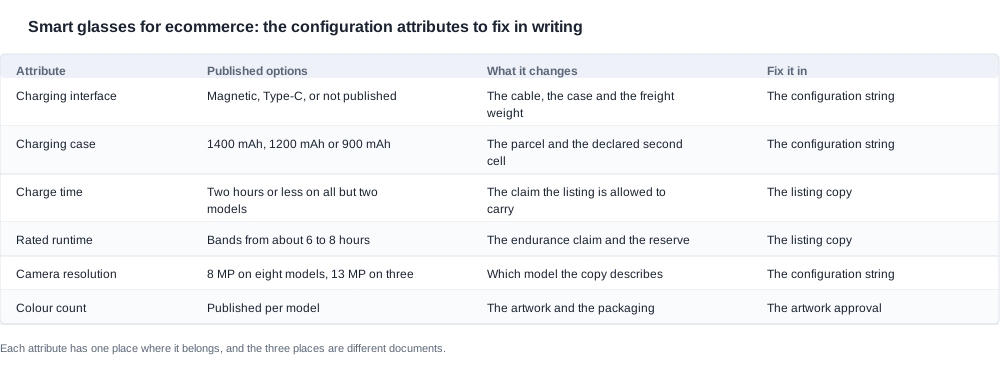
Each attribute in the table above has one place where it belongs, and the three places are three different documents. That is the part a first order usually gets wrong: a configuration attribute written into the listing copy instead of into the configuration string, or a commercial term assumed because it appeared somewhere in the quotation.
The charging interface. Published for twenty-four models — magnetic on seventeen and Type-C on seven — and not published for four camera models, the CY05 and the L1 Pro, and the CY03 and the MT6, which publish a case capacity but no interface row. This single attribute decides three things at once: whether the customer needs a cable in the box, whether the case is structural or optional, and how the parcel is built. It has to go into the configuration string, not into the copy.
The charging case. Published in four forms, and the buyer has to name the right one per model: 1400 mAh on the CY05 and the L1 Pro, and the CY03; a choice of 900 mAh or 1400 mAh on the L2 Utral, which means it is a configuration variable rather than a fixed feature; a 1200 mAh foldable case on the MT6; a case whose capacity is not published on the KY06 and the MT5; no charging-case row at all for the V03 and the S7, and the V06; and an explicit absence of a case for the V03 Pro. A listing that says "with charging case" against a device that ships without one is the fastest route to a one-star review in this category, and the fix is to write the case option into the configuration string and let the copy follow it.
The charge time. Every entry in the catalogue publishes one, as a ceiling of two hours or less for all but the D17 and the ZH12, which publish about one hour. Two things have to be settled here. The first is the wording: a ceiling of two hours or less permits exactly two hours, so "under two hours" is a claim the catalogue does not make. The second is what the figure may be used for — the catalogue publishes no starting state and no end criterion, so it cannot be converted into a claim about charging during a working day.
The rated runtime. Published as a band, and the bands differ by family: about six to eight hours across the eight audio models, five to eight hours on the V06 and the V03, and the S7 and the V03 Pro, six to eight on the KY06 and the MT5, and about seven on the L2 Utral and the MT6, and the CY03 and the CY05, and the L1 Pro. No runtime carries a test condition. The line to settle in the purchase order is therefore the band and its model, so that the copy and the reserve are both built from the same figure.
The camera resolution class. 8 MP on eight camera models — the V03 Pro and the CY05, the V06 and the MT6, and the MT5 and the V03, and the KY06 and the CY03 — and 13 MP on three, the S7 and the L1 Pro, and the L2 Utral. The class is published; the sensor, the field of view, the video specification and the frame rate are not. Settling the class in the configuration string prevents the most common copy error in the category, which is a stills figure being read as a video capability.
The colour count. Published per model and easy to overlook, because it decides the artwork and the packaging rather than the product. Colour is cheap to change between runs and expensive to change after the artwork is printed, so it belongs in the artwork approval, not in a later instruction to the packing line.

What has to be true at each order stage
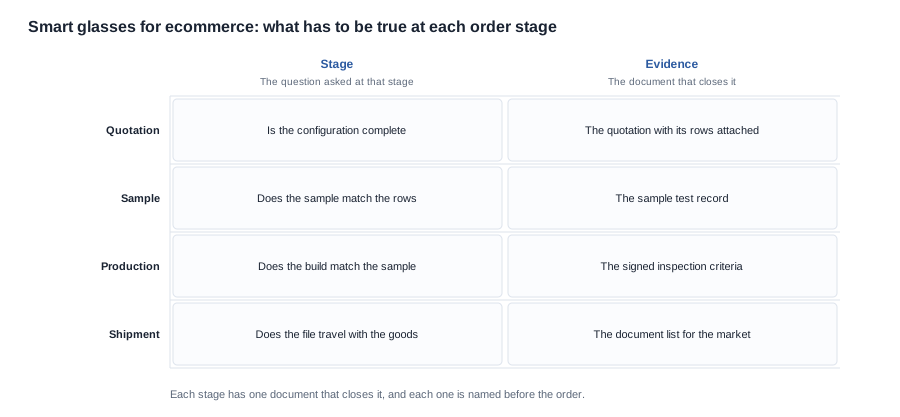
The matrix above names, for each stage of the order, the question that has to be answered and the document that closes it. Each stage has exactly one closing document, and each one is named before the order rather than after it. That is the whole discipline: a stage with no named document is a stage where the buyer will be asked to agree something after the money has moved.
The quotation stage. The question is whether the configuration is complete enough to price, and the closing document is the quotation with the published rows attached to each line. A quotation for a product family is not comparable to a quotation for a configuration, and the difference shows up later as a purchase order that does not match the sample.
The sample stage. The question is whether the sample matches the rows it was quoted against, and the closing document is the sample test record. The rows that can actually be checked on a sample are the ones that are published: the charge time against the ceiling, the runtime against the band, the interface, the case capacity, the resolution class, the ingress marking where the model carries one. The rows that cannot be checked are the ones that are not published, which is exactly why the sample is worth ordering.
The production stage. The question is whether the build will match the sample, and the closing document is the signed inspection criteria. This is where most of the return rate is actually controlled. The criteria have to name what is inspected, how many units are inspected, what the acceptance threshold is, and what happens to a lot that fails — and they have to be written before production, because an inspection standard agreed after the goods arrive is an argument rather than a standard.
The shipment stage. The question is whether the file travels with the goods, and the closing document is the document list for the destination market. A per-model certification position is a document to request in writing, because the catalogue text contains no reference to CE, FCC or RoHS and carries no per-model certification row, and the radio equipment obligations for a Bluetooth product sit in the Radio Equipment Directive (EU) 2014/53/EU.
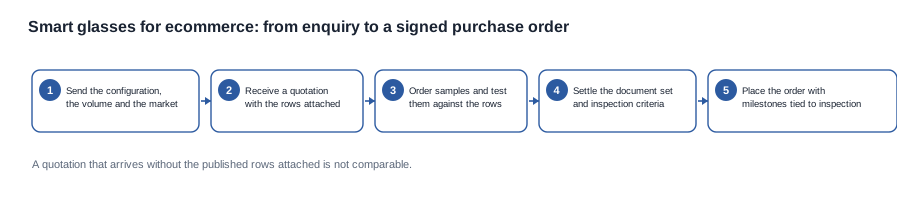
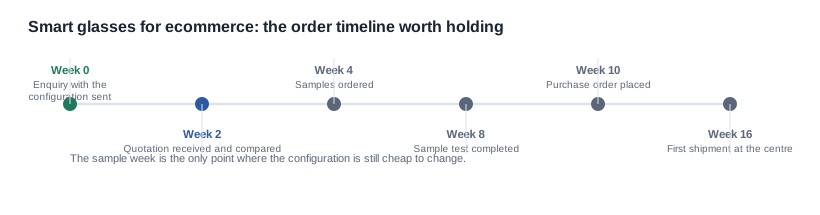
The sequence that carries the five steps. The flow above is the operational version of the checklist, and it is worth noticing that the sample is placed before the document set and before the order, not after. That ordering is what keeps the purchase order from becoming the place where everything is negotiated at once.
Two checks that only a sample can run
A sample earns its cost in two places, and both of them are places where the catalogue is deliberately silent. The first is the first session: unbox the unit, do exactly what a customer will do, and write down every point where the process stops. Nothing about that sequence is published — no pairing procedure, no account or update requirement, no regional behaviour of the companion software, no verified device list — which means the sample is the only instrument that can tell you whether the listing has to carry a setup instruction and what it has to say. The second is the charging case in the delivered configuration, because the case is a separate object with its own charge time and its own interface, and because on four camera models the catalogue publishes a case capacity without publishing the charging method at all. A sample with the case in the configuration answers the question that the specification leaves open.
There is a third check that is cheap and often skipped: the bill of materials, counted against the artwork. Open the box, list what is in it, and compare the list with the packaging artwork and with the product page. Three documents have to agree, and in a first order the artwork is usually written before the bill of materials is fixed, so the count is what catches the drift. It takes twenty minutes and it removes the fastest source of a one-star review in this category.
The checklist that runs at the purchase order, not before it
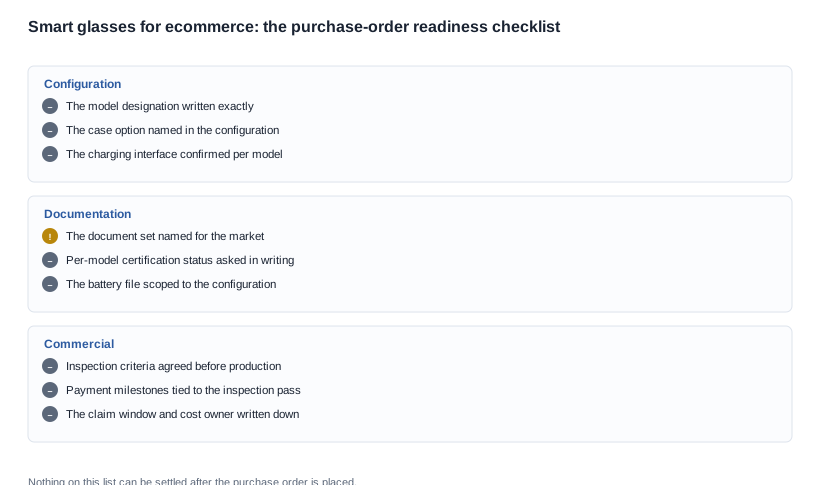
The readiness checklist has three groups and nine lines, and the last group is the one most often left out. A buyer can fix the configuration and still be exposed on the claim window, the replacement ratio and the freight allocation, because those three decide whether a returned unit is a cost or a claim. They belong in the agreement at the same moment as the unit price, because a clause added after the first dispute is a clause negotiated under pressure.
Two lines deserve a second reading. The battery transport file scoped to the configuration is the one that catches a second lithium cell before it catches a shipment, and the scope matters: a file that covers the device without the case does not cover the configuration with the case. The requirements are at battery transport. The payment milestones tied to the inspection pass is the one that protects the buyer from the scenario every importer recognises — the goods arrive, the inspection fails, and the deposit has already gone.

The commercial lines worth negotiating
Most of a first order is settled by the buyer without noticing which lines were worth the time. These are the ones that move money, and they are worth more than a unit-price argument of a few per cent.
Minimum order quantity tiers. Not the headline minimum but the tiers, because the tier structure is where a buyer's real volume lands. A supplier's tier structure tells you where it wants the business, and a buyer who takes the share at the pilot tier rather than at the run tier is taking the supplier's risk exposure as well as its price.
Whether two models can share one purchase order. Two models means two minimums, two artwork states and possibly two transit files. If they can share a purchase order, the working capital gap is paid once, and the packaging and freight can be planned as one programme rather than two.
Splitting a first run across two deliveries. This is a working-capital decision disguised as a delivery decision. A first order split across two shipments against payment held until inspection suits a channel being built in stages, and it cuts the stock at risk before any returns data exists. The cost is two shipments of freight instead of one, and the trade-off is worth checking against the freight rate rather than against instinct.
The share of units taken at the pilot tier. Already mentioned, and it belongs on the same list because it is the single largest source of room in a first order.
Payment milestones tied to inspection. The structure is standard — a deposit, a balance against inspection, a retention or a release against the shipping documents — and the detail that matters is that the inspection milestone has a defined threshold and a defined deadline rather than a vague reference to "acceptance".
The replacement and freight position. How many units can be replaced without a factory return, who carries the two-way freight on a unit that arrives faulty, and whether the replacement is shipped before the faulty unit is received. A replacement that ships after the faulty unit is received has a lead time that is the sum of two freight journeys, and for an e-commerce channel that is often longer than the customer will wait.
What we will confirm and what the agreement has to carry
The boundary we hold: we will give you everything in the published column so that the purchase order and the listing can be complete, and we will not give you anything from the unpublished column, even though a specification sheet with fewer rows converts less well. Here is exactly where the line falls.
What we will confirm in writing, for a named model and configuration. The cell capacity in catalogue form, including the doubled cells where a model publishes them; the charge time as published; the runtime band; the charging interface where it is published, and its absence for the four camera models that publish no interface row; the Bluetooth version where it is published, which is V5.3 on the K01 and the K02 and V5.4 across the audio and sport models; the camera resolution class; the ingress marking and the two models that carry it, which are the V06 and the S7; the charging case position in all four of its published forms; the structural features the catalogue records, including the removable inner frame on the V06 and the S7, the detachable temples on the G07 and the YK12, and the remote shutter control on the D17 and the ZH12; the colour counts the catalogue lists; and the single published weight, 158 grams for the MT6 glasses body, with the foldable case excluded. The catalogue publishes no touch row for any model, so a temple control surface has to come to us as a written confirmation rather than being quoted from the range sheet.
What we will not supply, and what the agreement has to carry instead. We do not publish unit prices, minimum order quantities or lead times on this site, and those are confirmed per enquiry, along with tooling, mould costs and any non-recurring engineering charge. We do not publish a warranty duration, a defect definition, a response time, a spare-parts position, a replacement ratio or a return-freight allocation, and we will not quote a typical value for any of them — those belong in the agreement, and the agreement is where they belong because they depend on your channel's fault mix rather than on our factory. We do not publish a per-model certification position, because the catalogue text contains no reference to CE, FCC or RoHS and carries no per-model certification row, so that position is a document to request against a named model.
The open rows, which are a document request rather than a refusal. The sensor model, the field of view, the video specification, the frame rate, the storage capacity and the overwrite behaviour; the lens material and the coating; the microphone pickup distance, the noise-reduction implementation and the wind performance; the runtime test condition, the standby draw, the cycle-life rating and the operating temperature range; the per-model unit weight for every model other than the MT6; and the in-box bill of materials, including whether a charger is included. Each of these can be obtained as written material for a named configuration, and each of them is worth obtaining before you order rather than after you have committed to a listing.
What we will do with the checklist. Take the models, the configurations, the volume, the destination market and the channels, and return the published rows for each configuration, the bill of materials position, the document list for the market, the inspection criteria we would propose against each published row, and the commercial lines worth negotiating first. The product families are at AI camera glasses, Bluetooth audio glasses and sport smart glasses. The commercial blocks are at pricing, MOQ, payment terms and contract terms; the inspection side is at quality consistency and quality control; the sample terms are at samples. The scenario entry point is smart glasses for ecommerce, and the listing-side discipline that sits on top of this checklist is at ecommerce beginner mistakes.
What to send us. Send the models, the configurations, the volume, the destination market, and the channels. We will return the nine lines above, answered, with the open rows marked as open.
Related reading
- The entry point for this scenario — smart glasses for ecommerce
- The commercial blocks — pricing, MOQ, contract terms
- The listing side — ecommerce beginner mistakes
Send the models, the configurations, the volume and the market, and we will return the nine lines answered and the open rows marked as open.


