
Most returns blamed on product quality in this category were caused by a product page. A runtime figure copied from a supplier's marketing deck, an ingress adjective written where a designation belongs, a weight carried over from a comparable model — each of those is cheap to publish and expensive to defend. What stops them is not more copy. It is an evidence pack, built before the page is written, in which every figure on the page traces to a named source and every claim that cannot be traced is marked rather than filled.
Smart glasses for ecommerce: a completion test for a pack before publication
Who is buying, and what an evidence pack is for
The reader is a brand product manager, a channel buyer or an ecommerce operator who is about to publish a page and has been handed a specification sheet that does not obviously correspond to the product. The situation is one of three: a first listing that has to survive a platform review; a second listing that has to be consistent with the first; or a relisting after a claim that turned out to be a description problem rather than a fault.
The fear is specific and it is not a compliance failure. It is a customer who reads a figure on the page, tests it, finds it does not hold, and reports it as a misdescription — which is a category of problem that a returns desk answers with a refund and a marketplace operator answers with a warning on the listing. By the time that happens, the evidence that the figure was never traceable has been destroyed by the act of publishing it.
An evidence pack is the set of records that makes a page defensible, and it is not the same thing as a document file. A document file answers "what do we have"; an evidence pack answers "what does the page say, where did each element come from, and what is on the page that we cannot support yet". The second question is the one that decides whether a listing is launched, corrected or withdrawn, and it is the one that a supplier is best placed to answer, because the supplier is the party that holds the configuration and the documentation.
The pack is also the thing that makes a second listing cheap. A channel that has already traced its camera configuration to its published rows and its case position to its model row can build the second listing from the same pack in a fraction of the time, and will not repeat the first listing's errors.
What the pack has to contain
Five groups, and each group has a completion test rather than a checklist item.
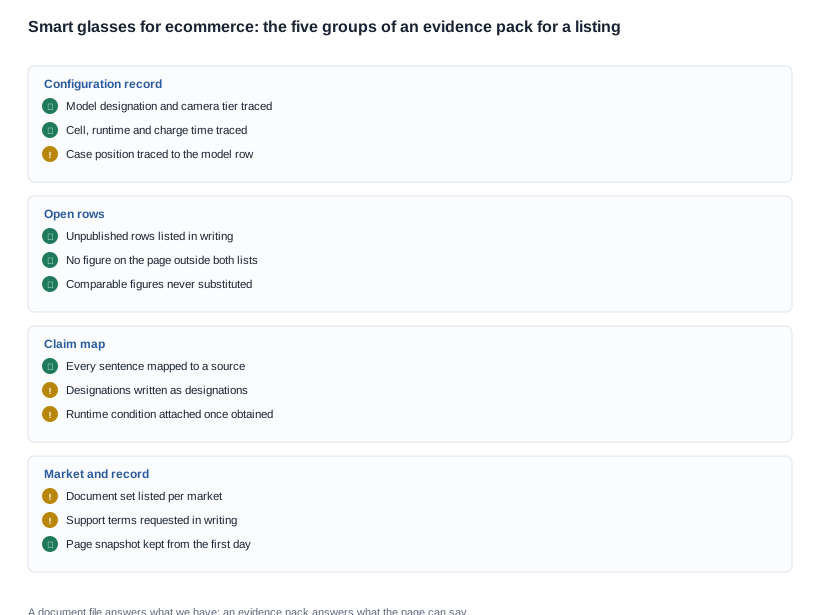
- The configuration record. The model designation, the camera tier, the cell capacity, the rated use, the charge time, the charging method and the case position, each with the source it came from. The completion test is that the record matches the artwork and the purchase order.
- The open-rows list. The rows the catalogue does not publish for that configuration, written as a list. The completion test is that no figure appears anywhere on the page or the artwork that is not on either list.
- The claim map. Every sentence on the page mapped to a published row or to a document. The completion test is that every sentence on the page has an entry.
- The document set for the market. Which documents exist for that configuration and that market, and which do not. The completion test is a list per market rather than one global list.
- The page record. A copy of the page as published, with the date, in each language version. The completion test is that the record exists before the first claim arrives rather than after.
Every number on the page needs a document behind it
The traceability rule is one sentence and it is worth writing on the wall: for every figure on the page, name the document it came from. If the answer is a supplier's website, a marketing deck, a competitor's page or a previous listing, the figure is a marketing claim rather than a specification, and it is the one that generates the return.

The rule is stricter than it sounds, because in this category the temptation is to assemble a page from the parts that look most complete. The temptation produces the specific failure where a seller takes a cell capacity from one model, a runtime from another, a case capacity from a third and an ingress marking from a fourth, and produces a product that has never existed.
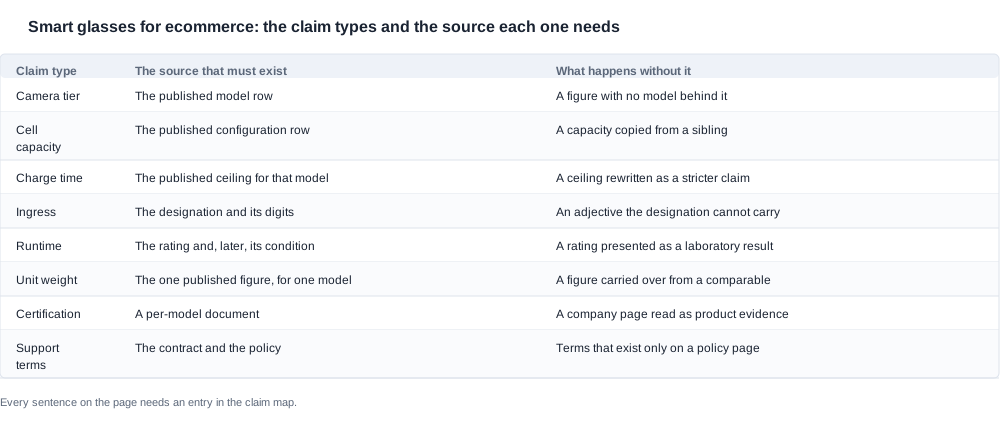
The rows that can be traced for this range are these. The camera tiers are 8 MP and 13 MP, published across eleven camera models. The cell capacities run from 40 mAh on the A05 and the A06 children's models, through 70 mAh on the A07, to 290 mAh on the camera range. The charge time is published for every model, as a ceiling of two hours or less, with approximately one hour on the D17 and the ZH12. The rated use is published per model. The charging method is published per model on twenty-four of the twenty-eight entries, and the CY05 and the L1 Pro, and the MT6 and the CY03 publish no charging-method row. The Bluetooth version is published on the audio range, the AR model, the A07, the sport models and the electrochromic model, and it is not published for the camera range. The case capacities are published for five camera models — the L1 Pro and the CY03, and the CY05 — each at 1400 mAh, the L2 Utral at 900 mAh or 1400 mAh by configuration, and the MT6 at 1200 mAh in a foldable form. The ingress marking appears on the V06 and the S7. The colour counts, the structural features and the single published unit weight — 158 g for the MT6 glasses body, including its cell and camera and excluding its foldable case — are all traceable.
The rows that are not traceable for any model are these: the camera sensor, the field of view, the video specification and frame rate, the storage behaviour, the runtime test condition, the cycle life rating, the standby draw, the operating temperature range, the firmware version and support window, the lens material and coating, the frame material, the hinge specification, the Bluetooth version for the camera range, the charging method for the four camera models named above, the case capacity for the KY06 and the MT5, the charging-case row for the V06 and the V03, and the S7, and any per-model unit weight beyond the MT6.
The three sources that are not documents
Most unsupported figures do not arrive from a careless supplier. They arrive from a source that looks like a document and is not. There are three of them, and each has a different treatment.
The marketing deck. A supplier's own presentation is the most common source, and it is the hardest to reject because it comes from the supplier. It is still not a document: a deck is a summary prepared for persuasion, and a figure lifted from one has lost whatever condition it was measured under. The treatment is to ask for the row itself rather than the slide, and to accept the answer that the condition is not published — which is a legitimate answer that a deck would never have offered.
Another seller's page. A page written by a competitor is the second source, and it is the one most likely to be untraceable even in principle, because the underlying documentation may never have existed. The treatment is strict: a figure from another seller's page is not admissible at all, even when it matches the model. The correct move is to ask us for our own row and use it if the two differ.
A previous listing. A seller's own earlier page is the third source, and it is the most seductive because it is internally consistent and already approved. It is also where a single unverified figure tends to survive for years, because every later page inherits it. The treatment is to re-open it: a figure that cannot be traced to a row is removed from the new page even though it has been there for three years, and the removal is cheap now and expensive later.
A useful discipline for all three is to write the source column in the claim map with enough precision to be checkable. "Supplier" is not a source; "the model row for the CY03" is. When the source column cannot be written that precisely, the figure is not yet a specification, and the criteria for whether to publish it are the criteria of the next section rather than this one.
Adjectives, designations and the words that quietly create claims
A number is the easy case. An adjective is the difficult one, because the sentence looks like description and functions as a claim.
The rule is that a designation is written as a designation and nothing more. The catalogue marks IP54 on the V06 and the S7, which means the first digit covers a dust protection level and the second covers splashing water; it does not cover immersion, it does not cover a sustained downpour, and it does not carry a third-party test report number behind it. A page that says waterproof has turned a designation into a performance promise, and the customer in a downpour is the customer who tests it. The digit reading is at IP ratings.
The same discipline applies to the rated figures. A rated use published without a test condition is a rating, and a page that quotes it as a laboratory result has upgraded it. The correct form on a page is the figure labelled as a rating, and — better — the condition attached to it once the condition has been obtained in writing. The published measurement approach is at battery life.
The third category is the claim that comes from describing the design. An open-ear design described as an open-ear design is fine. An open-ear design described by a performance adjective is a claim about leakage, and the catalogue publishes no leakage figure for any model in the range, so the adjective is unsupported. The same applies to a camera tier: 8 MP and 13 MP are published, and a sentence about how good the picture is is not.
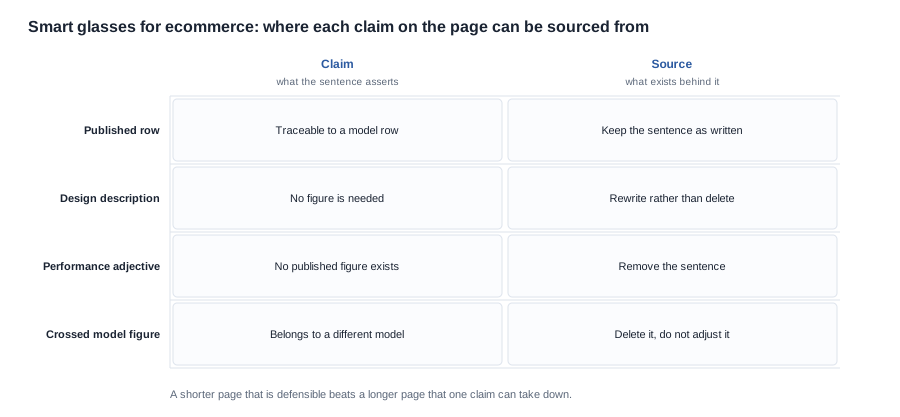
The practical workflow is to run the draft page against the open-rows list, sentence by sentence, and to classify every sentence into one of three buckets. Sentences that map to a published row stay. Sentences that describe behaviour rather than capability can often stay in a rewritten form. Sentences that assert a capability with no published row behind them come out. Removing them makes the page shorter, and a shorter page that is entirely defensible is a better commercial outcome than a longer page that a single claim can take down.

Support, warranty and the terms the page has to carry
The support terms are the part of the evidence pack that is most often assumed and least often sourced, and they are on the page whether or not the seller put them there. Warranty duration, the returns window, the freight responsibility for a unit that arrives faulty and the support route are all things a customer reads, and all of them are terms rather than specifications — which means they belong to the contract and the policy, not to the catalogue.
Our documentation publishes none of them, so each is an item to request in writing. The four that matter commercially are the replacement turnaround, whether a replacement ships separately from the return, who carries the two-way freight, and whether a spare part can be bought separately. On the last point the catalogue gives a buyer something to work with: the G07 publishes ultra-slim detachable temples, the YK12 publishes slim detachable temples, and the V06 and the S7 publish detachable inner frames, which makes a part-level replacement route possible on those four models and turns a device write-off into a part order.
The second thing the page has to carry is the intended market. A category that ships into jurisdictions with different regulatory expectations cannot carry one ambiguous listing into all of them, and the ambiguity is settled by the seller if the seller does not settle it. The per-market document position is at select by market, and the document list itself is at certification checklist.
The third is the evidence status of the claims themselves. The catalogue carries a company-level export certification page whose content is images rather than text, and the catalogue text contains no reference to CE, FCC or RoHS, with no per-model certification row anywhere. A page that says "fully certified" is making a statement our documentation does not support, and the evidence pack is where that should have been caught.
The support resources a channel should be able to point at
The term support resources usually means the pages a customer can reach. In a pre-launch pack it means something narrower and more useful: the set of internal documents that let the channel answer a question without guessing, and hand the question on to the supplier without inventing an interim answer.
Five groups cover it, and a channel that holds them can answer most of the questions it will be asked in its first month.
- The configuration record per listed model, with the source for each row, so the desk can answer a specification question from the file rather than from a screenshot.
- The open-rows list per model, so the desk can say plainly that a row is not published instead of estimating it. An answer of "that is not specified for this model" is a good answer and it is only available if the list exists.
- The claim map for the live page, which is what makes the page snapshot meaningful rather than decorative.
- The per-market document position, so the desk knows which market a unit is cleared for and which it is not.
- The escalation route with the supplier, named, with a stated response expectation. A desk that has to invent the escalation route answers the customer first and the supplier second, which is backwards.
The last point is the one worth negotiating. The support terms a seller publishes — the warranty duration, the returns window, the replacement turnaround, the freight responsibility — are not published in our documentation, and they are not published by any supplier's catalogue. They are terms that a supplier can price, and a supplier who prices them is showing the real cost of the product. A buyer who treats the support terms as an afterthought discovers the cost in the first quarter rather than in the quotation, and the total cost of the programme is then materially different from the one that was planned.

Keeping the published page as a record
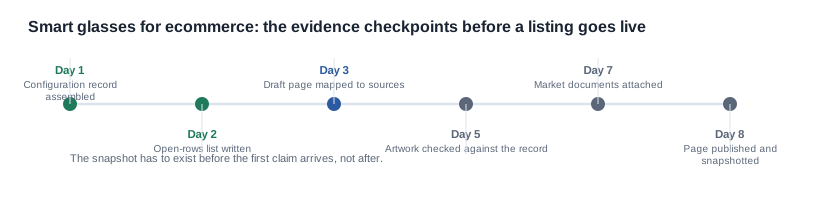
The record-keeping rule is short and it is the one most often skipped: keep a copy of the page as published, in the language it was published, on the date it was published.
The reason is that the difference between a claim about a misstated specification and a claim about a fault is decided by what the page actually said on the day, and that record is gone the moment the page is edited. A seller who holds the snapshot answers a complaint in one message with the sentence that was on the page. A seller who does not reopens the entire file, treats the claim as a question about the product, and often concedes it because the answer is cheaper than the argument.
The record is also what makes the second listing cheap. The pack, the claim map and the snapshot together are the reusable assets of a channel: the first listing is expensive because they have to be built, and the second listing is cheap because they already exist.
The evidence we will hand over
The boundary we hold: the evidence for a configuration belongs with the supplier, and supplying it means handing over the rows the page can be built from and naming the rows it cannot be built from. For this range that means we will give you, per model, the configuration record — the camera tier, the cell capacity, the rated use, the charge time, the charging method and the case position where each is published — together with the open-rows list for that model.
We will also flag the wording that exceeds the evidence before the page is published rather than after it, which is a favour to a channel partner because a returned unit on a misstated claim is charged to them. And where we do not hold a figure we will say so plainly, with the correct response on a page being to omit the row rather than to substitute a comparable one.
What we will not do is provide a comparable figure for a field we do not hold, and we will not write a per-model certification statement, because the catalogue contains no per-model certification row. We will not present the ten certificates on our company-level export certification page as conformity evidence for a product; they are ten patent certificates, eight appearance-design patents and two utility-model patents. And we will not quote a support window, a warranty period or a firmware version, because none of them is published.
What we will do is take the models you are listing, the markets and the languages, and return the configuration records, the open-rows lists, the claim map for the draft page, and the per-market document position. The scenario entry point is smart glasses for ecommerce, the product families are at AI camera glasses and Bluetooth audio glasses, and the listing structure that consumes this pack is at the listing template.
Related reading
- The listing structure this evidence pack feeds — the listing template
- The documents behind a market access claim — certification checklist
- The claim boundary in practice — medical claims boundary
Send the models and the markets you are listing, and we will return the configuration records, the open-rows lists and the per-market document position.


