

Smart glasses for ecommerce pages fail in the same places every time, which is the strongest argument for a template: the specification block drifts from the configuration, the gap sentence gets dropped in the second listing, the in-box line and the photograph disagree. A template does not make the page better. It makes the page the same on every variant and every language, and that consistency is what turns a one-off listing into an asset a channel can add to.
Smart glasses for ecommerce: the test that every field names a source
Who this is for, and why a template beats a fresh page each time
The reader is a brand product manager, a channel buyer or an ecommerce operator who is about to publish, or has already published, more than one listing in this category. The situation is usually one of three: the first listing is live and the second is due; the first listing is live and has to be rebuilt because the configuration behind it changed; or a set of listings has grown across several markets and nobody can say which of them says what.
The fear underneath that enquiry is drift. A page written from scratch each time will be internally consistent and mutually inconsistent, and the inconsistency shows up in the returns rather than in a review of the content. A customer on the second listing complains that the specification differs from the first page they read; a marketplace operator compares two pages from the same brand and queries the discrepancy; the support desk gives two different answers to the same question about the same model.
A template fixes that by making the fields explicit and the sources attached to them. The nine fields below are the ones a listing in this category needs, and each one has a source. Where a field's source is a published row, the field is written from the row. Where a field's source is a document, the field is written from the document. Where a field has no source, the field says so — and that is a field with content rather than an empty box.
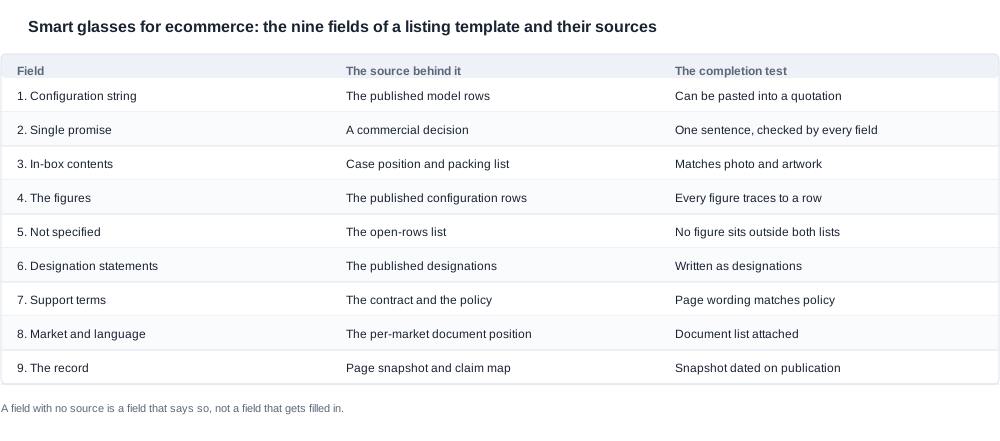
The template also settles a question that is otherwise answered by whoever is writing the page on the day: what happens when the configuration changes. Because each field carries its source, a configuration change produces a list of fields that need re-derivation rather than a vague instruction to update the page. That list is the reason a template is worth building.

Fields one to three: identity, configuration and the promise
Field one — the configuration string. The model designation, the camera tier where one applies, the cell capacity, the charging method and the case position, in a single line that can be pasted into a quotation and checked against a unit. It is the spine of the other eight fields, because every one of them describes that configuration and nothing else. If the configuration string names a product family rather than a buildable configuration, the template has already failed.
Field two — the single promise. One sentence naming what the page leads with. In this category that sentence is the commercial decision, because it determines which claims the rest of the page has to support and which published rows are relevant. A page that leads with capture is governed by the storage behaviour and the camera tier; a page that leads with audio is governed by the Bluetooth version, the cell form and the temple system. The template carries one promise per listing, and it is the first thing a reviewer checks.
Field three — the in-box contents. What is physically in the carton, with the case position stated explicitly rather than implied by a photograph. This is the field that carries the most commercial weight relative to its length, because the case position is per model and the seven camera models that ship with a case publish their capacity unevenly: the CY05 and the L1 Pro, and the CY03 — each at 1400 mAh, the L2 Utral at 900 mAh or 1400 mAh by configuration, and the MT6 at 1200 mAh in a foldable form, with the KY06 and the MT5 shipping with a case whose capacity is not published, and the catalogue publishing no charging-case row at all for the V03 and the V03 Pro, and the V06 and the S7.
Two rules attach to field three. The in-box list and the photograph have to agree, or a "not as described" claim follows; and the list has to match the packaging artwork, because the artwork is what the packing station works from.

Fields four to six: the figures and what they may be called
Field four — the figures. The published rows for that configuration, written in the catalogue's own terms: the cell capacity, the rated use, the charge time, the charging method, the Bluetooth version where it is published, the camera tier where one applies, and the case capacity where it is published. The field carries a note that the rated use is published without a test condition, because the note is part of the claim.
Field five — what is not specified. The open rows for that configuration, listed rather than omitted. For the camera range this is a long and specific list: the camera sensor, the field of view, the video specification and frame rate, the storage behaviour, the runtime test condition, the cycle life rating, the standby draw, the operating temperature range, the firmware version and support window, the lens material and coating, the frame material, the hinge specification, the Bluetooth version, and the per-model unit weight beyond the single published figure for the MT6. A listing that omits these rows is fine; a listing that fills them is not. Writing them as a single "not specified" line is the difference between a thin page and a page with a false claim in it.
Field six — the designation statements. The places where a designation has to be written as a designation. The IP54 marking on the V06 and the S7, with what its two digits cover and nothing beyond, since the catalogue publishes no third-party test report behind the marking and no ingress rating for the rest of the range. The charging method, as magnetic or Type-C, or as an open question for the four camera models whose row is silent — the MT6 and the CY05, and the L1 Pro and the CY03. The charge time, as a ceiling of two hours or less, with approximately one hour on the D17 and the ZH12. And the single unit weight, 158 g for the MT6 glasses body including its cell and camera and excluding its foldable case, applied to that model only and never to another.
Field six is the field most often lost in translation, and it is the one where a translated sentence drifts from a designation into an adjective. The digital signage counterpart shows the same mechanics, and it is worth checking every designation by hand rather than by dictionary.

Fields seven to nine: the box, the support and the market
Field seven — the support terms. The warranty duration, the returns window, the replacement turnaround, the freight responsibility for a unit that arrives faulty and the support route. None of these is published in our documentation, which means they are contract and policy terms rather than catalogue rows, and the template treats them as a field with a source: the contract, the policy, or a written answer from the supplier. A template that leaves field seven blank produces a page whose support terms exist only on a policy page, which is where customers discover them.
Field eight — the market and the language. The intended market for the listing, the language version, the safety and warning text for that market, and the per-market document position. This is a field rather than a paragraph because it changes per listing even when nothing else does, and a template that carries it explicitly is what stops a market-specific requirement being quietly omitted. The per-market route is at select by market, and the document position is at certification checklist.
Field nine — the record. The snapshot of the page as published, with its date and language version, plus a reference to the configuration record and the claim map that produced it. This is the field that makes the other eight auditable, and it is the one that is always omitted first because it produces nothing visible on the page.
The nine fields and their completion tests
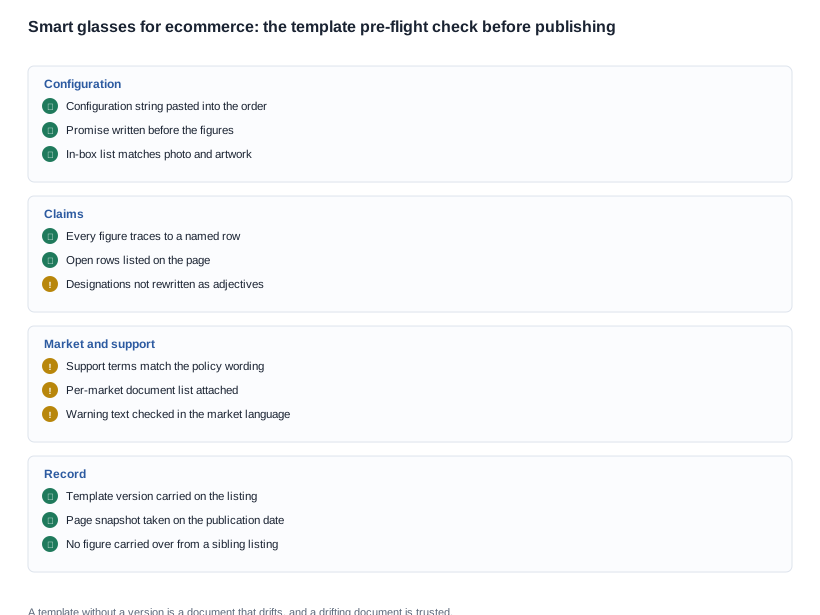
Each field has a completion test, and a template without completion tests is a set of headings.
| Field | The source | The completion test |
|---|---|---|
| Configuration string | The published model rows | It can be pasted into a quotation and checked against a unit |
| Single promise | A commercial decision | One sentence, and every other field is checked against it |
| In-box contents | The case position and the packing list | It matches the photograph and the packaging artwork |
| The figures | The published configuration rows | Every figure traces to a named row |
| Not specified | The open-rows list | No figure on the page sits outside both lists |
| Designation statements | The published designations | Each one is written as a designation, not an adjective |
| Support terms | The contract and the policy | The page wording matches the policy wording |
| Market and language | The per-market document position | The document list for that market is attached |
| The record | The page snapshot and the claim map | The snapshot exists on the publication date |
The three templates a channel actually needs
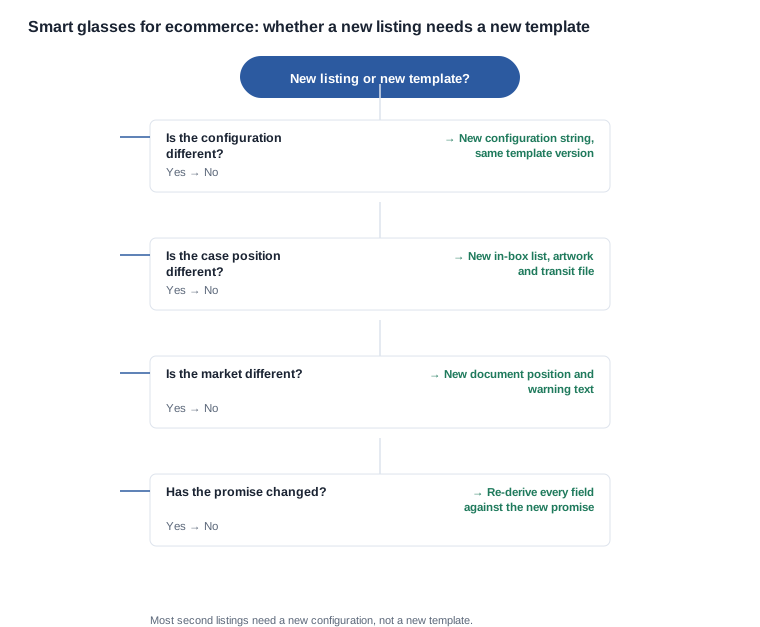
A channel that starts from one template and adds fields as listings accumulate ends up with a template per listing, which is the same as having no template. The alternative is to build a small number of templates, each covering a genuinely different kind of configuration, and to accept that a configuration which does not fit one of them is a question rather than an exception.
Three cover almost every programme in this category.
The bare-device camera template. A camera configuration with no case in the carton: the V06 and the S7, and the V03 Pro and the V03 publish no charging-case row, so the supplier has to confirm the box contents in writing for each of them. Fields three and six are simpler here, the freight weight is lower, and the transit file covers one cell rather than two. The page still carries the full gap list, because the camera gaps are the same regardless of the case.
The camera-with-case template. A camera configuration with a published case capacity, which is where the price ladder and the unboxing structure live. The five configurations in this group publish 1400 mAh on the L1 Pro and the CY05, and the CY03, 900 mAh or 1400 mAh by configuration on the L2 Utral, and 1200 mAh on the foldable case of the MT6. The case capacity becomes a field with two values on the L2 Utral, and the artwork, the freight weight and the transit file all follow the choice.
The audio template. The eight audio models, where the published rows are Bluetooth V5.3 on the K01 and the K02 and V5.4 on the D11, the D12, the LC-105 pair, the G07 and the YK12, with cell configurations published as 55 mAh × 2, 90 mAh × 2 and 100 mAh, and a rated use between six and eight hours. Structural features differ across the eight — the detachable temples on the G07 and the YK12, the surround sound on the D11 — while no touch row is published for any of them, so the template carries a feature block rather than a fixed set of feature sentences.
A fourth template is worth having only if the channel lists the sport models or the children's models, and in both cases the template inherits more from the market than from the product. The three sport models are the YKC02, the D17 and the ZH12, and the three children's models are the A05, the A06 and the A07, whose market regime sits outside our documentation entirely and whose listing cannot be written from our file.
What to ask the supplier when the template is being built
The template is only as good as its fill rules, and the fill rules come from the supplier. The questions to ask are therefore about the source of each field rather than about the template's appearance.
- Which fields can you populate from the catalogue, and which do you populate from the model record? The completion test is a list of nine fields with a source named for each.
- What is the process for a field with no source — who decides it, and what is the turnaround? A supplier who will name the owner and the turnaround can be held to it; a supplier who says the case will be confirmed later has described a delay without naming it.
- Which fields are configuration-specific and which are model-specific? A field that changes per configuration has to be re-derived per configuration, and a field that changes per model does not. Getting this wrong produces a template that is either rebuilt too often or not often enough.
- Who signs the template against the purchase order, and against the artwork? The completion test is a named role rather than a department.
- What is the process when a published row changes between two production runs? A catalogue row that moves is a template event, and a buyer who has not asked will find the mismatch on a review page rather than on an artwork proof.
The commercial side of the same conversation is where the template earns its keep as well. A template removes the copy work from each listing, so a buyer should ask how the supplier prices that work — whether it is absorbed into the per-unit cost, quoted as a one-off, or quoted per listing. A channel with five listings should know which of those it is paying for, and a buyer who is negotiating the sample order, the tooling and the minimum order quantity at the same time is establishing which quotations are comparable. The procedure for the sample route is at samples, the contract language at contract terms, and the price structure at pricing.

Maintaining the template across variants and languages
The template earns its cost in the second listing, and the second listing is where the maintenance rules start to matter. There are three kinds of change, and they are not equivalent.
A variant that changes the box. A change of case configuration changes field three, the freight weight, the transit file and the artwork, and it may change field one if the configuration string carries the case. This is the expensive kind of change and it has to be made before the artwork is released.
A variant that changes the appearance. A colour or logo change does not change fields one, three, four, five or six, which means the specification content is reusable and only the imagery is re-shot. This is the cheap kind of change and it is the one most often botched by rebuilding the page rather than the image.
A language version. A translation is a translation of a fixed source, not a rewrite. The source is the English page, the specification fields are fixed, and the wording that carries a designation has to be checked by a person because a designation becomes an adjective very easily in translation. The warning text and the support terms are part of the translation, and both are legally sensitive in a way that a feature description is not.
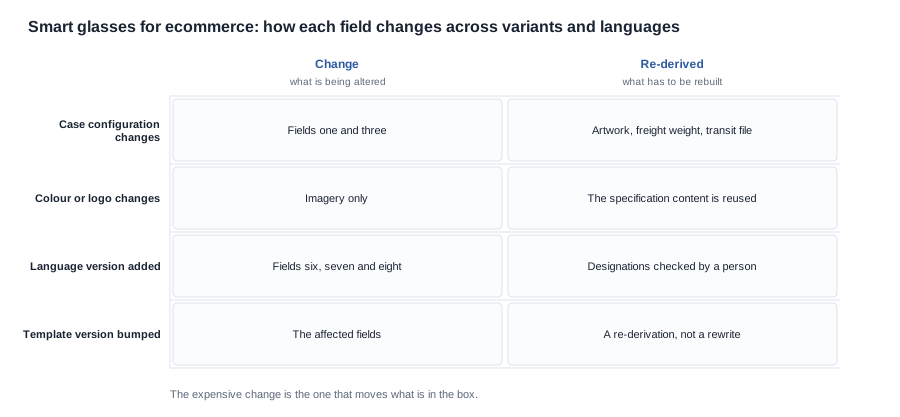
The practical rule that falls out is a versioning rule: the template has a version, every listing carries the template version it was built from, and a change to the template triggers a re-derivation of the affected fields rather than a wholesale rewrite. A template without a version is a document that drifts, and a document that drifts is worse than no template, because it is trusted.
What a template from us can and cannot do
The template is a deliverable, and delivering it means handing over the fill rules and the sources rather than a blank form. For this range that means the configuration records per model, the open-rows lists, the designation wording for the models that publish one, and the market positions we can evidence.
What the template cannot do is fill the fields we do not hold. It cannot fill field five with a sensor model, a field of view, a video specification, a storage behaviour, a runtime test condition, a cycle life rating, a standby draw, an operating temperature range, a firmware version, a lens material, a frame material or a hinge specification. It cannot fill a per-model weight beyond the 158 g figure published for the MT6 glasses body, which excludes its foldable case. It cannot fill a Bluetooth version for the camera range, a charging method for the four camera models whose row is silent, a case capacity for the KY06 and the MT5, or a charging-case row for the S7 and the V03, and the V06. And it cannot fill field seven, because we publish no warranty duration, no returns window, no replacement turnaround and no support window.
What the template will not do is let a figure be carried from one model to another. This is the rule that matters most in a template, because a template is exactly the mechanism by which a figure migrates: one listing is written carefully, the next is written from the first as a starting point, and a number that was never traced becomes a line that has apparently always been there.
What we will do is take the models and the markets you are listing, and return the configuration records, the open-rows lists, the designation wording, the claim map for a draft page and the template version the listings should carry. The scenario entry point is smart glasses for ecommerce, the product families are at AI camera glasses and Bluetooth audio glasses, and the evidence that feeds the template is at support resources.
Related reading
- The evidence that fills the template — support resources
- The box the template describes — gear checklist
- The claims the template has to hold — ecommerce pre-launch checklist
Send the models, the variants and the markets, and we will return the configuration records, the open-rows lists and the template version each listing should carry.


