

Smart glasses for e-commerce is a returns-desk problem before it is a product problem. A frame carrying a camera, a cell, a radio and firmware has more ways to disappoint a buyer than a plain pair of glasses, and every one of those ways lands on your fulfilment centre rather than on your supplier. The useful part of this article is what a channel can do inside that gap before the first pallet reaches a shelf.
Smart glasses for ecommerce: a written agreement test for warranty terms
The conclusion first. In this category the warranty is not a document you publish; it is a set of terms you negotiate with the supplier and then mirror in your own returns policy, and the two have to agree in writing before the order. Three facts make that necessary rather than merely tidy. The catalogue publishes no warranty duration, no return window, no RMA process and no advance replacement terms, so none of them can be inherited from published material. The catalogue also publishes no field of view, no video format, no frame rate, no storage path, no transfer method and no per-model conformity row, which means a large share of returns in this category are created by the description rather than by the device. And the packaging is heavier than buyers of eyewear expect, because a camera model usually ships with a second lithium cell in the box. A channel that treats the warranty as marketing copy discovers all three at once, usually in the same week.
Who this is written for. The reader is a channel buyer or an e-commerce operations lead who has already chosen the models and now has to price the risk of getting them wrong. The task in front of them is to build a returns reserve, write a policy that survives a dispute, and negotiate the terms that will decide whether a fault costs a credit note or a refund. The fear underneath it is not a defective batch; it is a batch of returns that arrives in a month the cash flow cannot carry, at a rate nobody budgeted, with a supplier contract that does not say who pays for the freight.
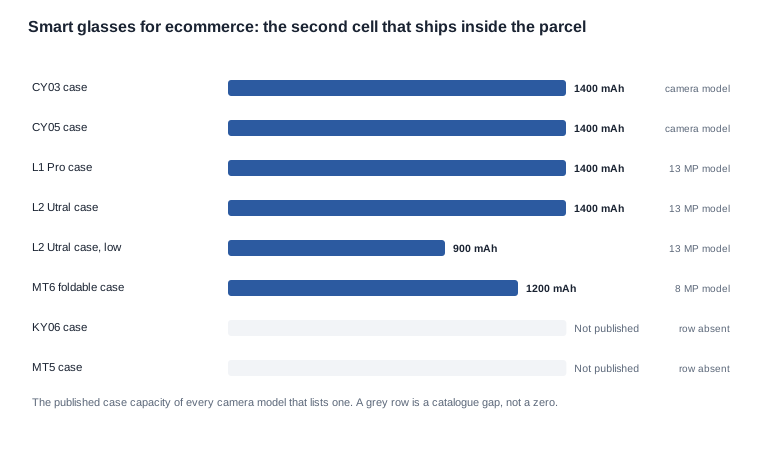
Why two channels with the same hardware get different return rates. The published configuration rows are close together, and the differences that decide a return are mostly in the packaging and the wording rather than in the device. The CY03 and the CY05 carry a 290 mAh cell and a 1400 mAh charging case. The L1 Pro pairs a 13 megapixel camera with that same 290 mAh cell and a 1400 mAh case. The L2 Utral carries a 290 mAh cell with the case published at 900 or 1400 mAh as a configuration choice. The MT6 ships with a 1200 mAh foldable case and is the only model in our range with a published whole-unit weight, at 158 grams for the glasses themselves, including the cell and the camera and excluding the foldable case. The KY06 and the MT5 ship with a case whose capacity is not published, and the catalogue lists no charging-case row at all for the V03, the V06 or the S7 — which is a gap in the documentation rather than a statement that no case exists.
Against that, a return is a commercial event with a cost attached: reverse freight, inspection time, refurbishment or scrapping, the loss of the retail margin, and a negative review that lowers conversion on every future listing. The reserve is the number that covers those, and it can only be built from the return reasons you can name in advance.
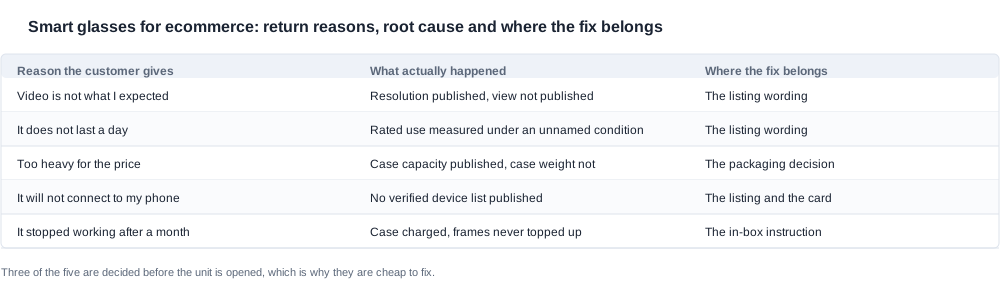
Five return reasons and the root cause behind each one
A buyer who returns a camera-glasses unit is usually not reporting a defect. They are reporting that the product did not do the thing the listing implied, and the listing is where that decision was made. The five reasons below account for the bulk of returns in this category, and each one is written as a root cause rather than a symptom, because the root cause decides where the fix goes and what it costs.
The camera promise. "13 megapixels" is a headline that buyers read as "13 megapixels of video", and for the L1 Pro and the L2 Utral the catalogue publishes a resolution without publishing the field of view, the video output format, the frame rate, the storage path or the sensor model. A buyer who assumes a phone-grade video camera and receives a stills-first device with a narrower view will return it, and they will describe it as a defective camera. Root cause: a published resolution was converted into an unpublished capability. Fix location: the listing wording, and a sample clip recorded on the unit that actually ships. The catalogue has one product image per model and no video, so any motion footage in a listing has to be produced by the merchant.
The endurance promise. The catalogue gives roughly seven hours of rated use for the 290 mAh camera models and a five to eight hour band for the 220 mAh V03 and the V03 Pro, with no test condition attached to any of them. A buyer who streams for four hours and then films a two-hour walk experiences the gap as a battery fault. Root cause: a rated figure with an unnamed condition was printed as a day-length promise. Fix location: the listing wording, and the choice of whether a case is included. The charge time of two hours or less is a ceiling rather than a fixed duration, so it cannot be turned into "fully charged by lunchtime" either.
The physical one. Only the MT6 has a published weight, and even that figure excludes the case. The charging case on the L1 Pro and the CY05, and the L2 Utral and the KY06, and the CY03 is a substantial object in the parcel. A buyer who expected a light pair of glasses and unpacked a case holding a 1400 mAh cell will describe that as poor value rather than as a defect, and it will still come back. Root cause: an expectation set by the category, not by the listing. Fix location: the packaging decision and the product imagery, and the freight budget that has to carry the parcel.
The connection one. The catalogue publishes the charging interface per model and publishes no verified device list for any model in the camera range. A buyer whose phone does not appear in a support article has no way to know whether the fault is theirs or the product's. Root cause: compatibility was implied rather than stated. Fix location: a published support range, plus an in-box card that says what to do before a ticket is raised.
The case one. A magnetic charging case and a case-charged product are not the same arrangement, and a buyer who charges the case and assumes the frames are full will find them flat. The MT6 case is foldable, the CY03 and CY05 cases are 1400 mAh, and the L2 Utral is offered at 900 or 1400 mAh. Root cause: the relationship between case charge and frame charge was left to be inferred. Fix location: the in-box instruction, and the choice of which case configuration actually ships. Which one arrives in the customer's parcel is a packaging decision made before production, not after.
Pricing the returns reserve before the first pallet is booked
The returns reserve is usually the line a channel forgets, because it is not quoted by a supplier and it is not visible on a purchase order. It has to be built by the buyer, and the building blocks are the five return reasons above, each with its own cost profile.
The method. Take the unit cost, multiply it by the proportion of units you expect to come back, and add the per-unit cost of handling each return: reverse freight, inspection time, refurbishment or scrap, and the refund itself. Then run the calculation per return reason rather than as a single blended rate, because the reasons have different costs and different cures. A description mismatch is cured by editing a page and costs almost nothing beyond the refund. A physical marking on the lens costs a refurbishment cycle or a write-off. A fault inside the warranty period costs whatever the supplier charges for the replacement route, which is exactly why that route has to be negotiated before the order rather than discovered during one.
The variables you can actually pin down today. The published case capacities tell you the parcel. A 1400 mAh case on the L1 Pro and the CY05, and the CY03, a 1400 or 900 mAh case on the L2 Utral and a 1200 mAh foldable case on the MT6 mean a unit that ships with a second cell, which affects the packed dimensions, the gross weight, the freight rate and the transport documentation. A configuration without a case is a lighter parcel and a different reserve. The published cell capacity and the charge time of two hours or less tell you the service interval, which tells you how often a customer has to do something, which is where the connection and case returns come from. What you cannot pin down is the return rate itself: no benchmark is published for this category, and anyone offering you one is either quoting from a different category or selling a service on top of a guess.
The two lines that are usually missing. The first is the refurbishment and scrap loss on units that come back because of a physical fault. It is not a refund — the customer is often made whole — but the unit is out of the stock pool, and for a channel that bought a fixed quantity it is a lost unit that has to be re-ordered at the next lead time. The second is the negative-review cost, which is real, recurring and impossible to price in advance, which is why the cheapest mitigation is the dispatch check and the corrected listing rather than a goodwill gesture.
What makes the reserve shrink. The returns that are caused by the description do not disappear; they convert into a page edit and a card revision. The returns that are caused by the packaging do not disappear either; they convert into a different case configuration. The returns caused by a missing in-box instruction convert into a printed insert. Each of those is a one-off cost with a permanent benefit, and each of them is cheaper than the reserve line it replaces.
The first batch is the calibration event, not the answer. No published figure gives a channel a return rate for this category, so the reserve you sign off before the first order is a provisional number and should be labelled as one. What the first shipment produces is a list of return reasons with counts attached, which is a far better input than any estimate made before the order. The method is straightforward: every return is logged against one of the five reasons above rather than against a free-text note, and the log is read at thirty days against the listing wording. A reason that clusters in one listing is a wording problem, and it is fixed with an edit. A reason that clusters in one model or one case configuration is a configuration problem, and it is fixed by changing what ships in the box. A reason that spreads evenly across models and configurations is the one worth escalating to the supplier, because it is the only one that a supplier can act on. That three-way split is the whole of the calibration, and it costs nothing but the discipline of making the returns desk log a reason instead of writing a sentence.
The decision a channel has to make on the returned unit itself. Each unit that comes back is either inspected and put back into the stock pool, inspected and downgraded into a second price point, or written off. That decision is not a quality question, it is a margin question, and the inputs are the refurbishment cost, the discount a refurbished unit needs to move, and the lead time for replacing it. Channels that have never written that policy end up refurbishing everything, which quietly turns a returns problem into a working capital problem. Channels that write it before the first order end up with a reserve that reflects the real cost of each reason.

The three clauses that decide whether a return is cheap
A warranty clause in this category is worth reading as four decisions rather than as a paragraph of goodwill. The supplier has already made three of them by what it publishes and has not published; the fourth is the one you negotiate.
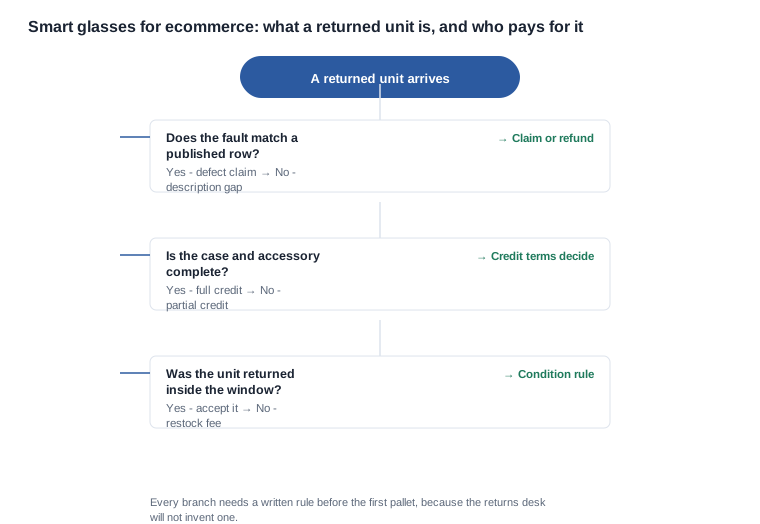
The condition rule. This is the clause that causes the most trouble, because a returned device that has been used, marked or returned without its case is a unit that has to be inspected, refurbished or scrapped, and that cost belongs in the margin rather than in a surprise. The rule has to state what condition a unit must be in for a full credit, what condition earns a partial credit, and what condition is refused outright. It also has to say who bears the freight in each case, because "the customer pays the return shipping" and "the supplier pays the return shipping" are the same clause with completely different effects on the refund a customer actually receives and on the volume of returns you will see.
The replacement route. A unit that fails inside the warranty period is worth very different amounts to a channel depending on whether there is an advance replacement, and how quickly it arrives. A channel that cannot hold stock treats the warranty as a credit against the next order and prices the delay into its cash plan. A channel that can hold a small buffer of spare units treats the warranty as a service promise and prices the buffer instead. Neither is wrong, but a clause that does not specify which one applies leaves the supplier to decide at the moment of the claim, which is the worst possible time.
**The conformity question.Our catalogue holds a company-level export certification page whose content is imagery rather than wording, and no reference to CE, FCC or RoHS is written into the catalogue text. There is no per-model certification row anywhere in the catalogue, and there is no record of a certification number pending confirmation for any model either. A buyer who needs a model-level conformity file for a destination market therefore has to obtain it as a written document from the company that holds it, and a warranty clause should say whether that file, once it exists, is passed to the buyer in the form the buyer needs it for the market in question. That is a question about documents, and it is answerable.
What the catalogue publishes and what it deliberately leaves open
The published position, for the camera models, is this: the charge time, the resolution class, the cell capacity, the rated use, the charging interface, and the case capacity where the catalogue lists a case row. The MT6 carries the single published whole-unit weight at 158 grams, and the catalogue is explicit that this is the weight of the glasses themselves — including the 265 mAh cell and the camera, excluding the 1200 mAh foldable case. The case weight is not published for any model.
The open positions are these: the field of view, the video output format, the frame rate, the storage path, the transfer method, the sensor model, a bare frame weight for any model, the operating temperature range, the cycle life rating, the runtime test condition, the lens material and the coating. For four models — the CY03 and the L1 Pro, and the CY05 and the MT6 — the charging method itself is not published, although all four do publish a case capacity. The camera models do not publish a Bluetooth version. The AI assistant is listed across the camera range, but the model behind it, whether it works offline, whether it carries a subscription and where the data is processed are not published either.
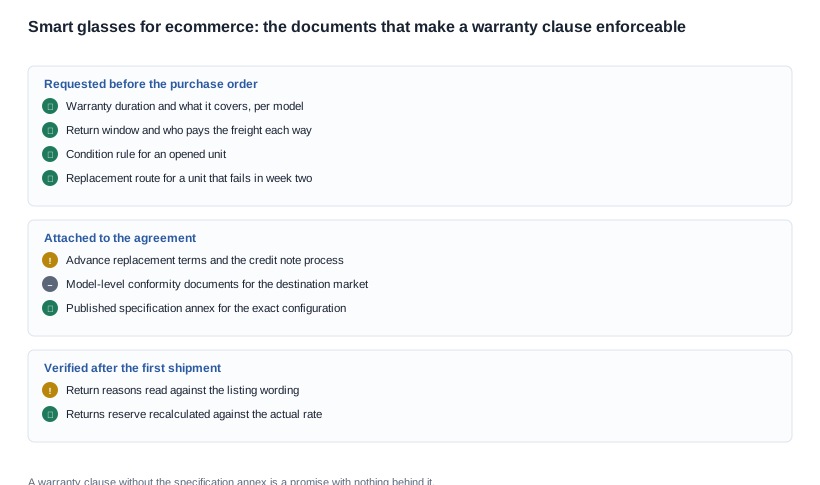
Why the open positions are the ones that matter commercially. Every open row above is a row that a customer can notice. Nobody compares a lens coating; everybody notices that the recording is not where the listing said it would be. That is why a warranty in this category is mostly a description of how the supplier handles the faults nobody wrote down, and why the honest version starts with telling a buyer which of those faults exist. The documentation to request before the purchase order is short: the warranty duration and its coverage per model, the return window, the condition rule, the freight allocation, the replacement route, the credit note process, and the model-level conformity documents for the destination market. The clause language sits at contract terms, and the selection decisions that come before this one are in the e-commerce buying checklist.
How to put the warranty question into a purchase order
A warranty is negotiated, and the negotiation has one trick that works better than any other: attach the specification annex. The annex is the published rows for the exact configuration being ordered — model, cell capacity, charge time, rated use, charging interface and case capacity — with the open rows written as open. When that annex is part of the agreement, the claim conversation changes shape. "The unit does not do what the annex says" becomes a defect claim with a document behind it, and "the unit does not do what the listing said" becomes a description gap that the listing has to fix. Those two conversations have completely different costs, and only one of them is a supplier problem.
Send us the models, the case configuration for each, the destination market, and the returns policy you intend to publish. We will tell you which claims in that policy can be evidenced from the published rows, which ones we would talk you out of, and which of the open positions the company can actually close for the configuration you are ordering. The physical and packaging side of the same question is in the smart glasses for e-commerce range, and the model-by-model published figures sit alongside it.
The last thing to settle. A category with an unpublished field of view, an unpublished storage path and an unpublished per-model conformity position will generate returns regardless of how good the hardware is. The fix is in the listing and in the clause, not in the factory, and it is cheaper than every alternative. We will not publish a warranty duration we have not agreed with a buyer, and we will not quote a unit weight for any model except the MT6 — and for that one, only the whole-unit weight of the glasses themselves, including the cell and the camera and excluding the foldable case.
Related reading
- The camera and audio range
- A buying checklist for ecommerce sellers
- Troubleshooting the five recurring faults
Send the models, the case configuration and the destination market, and we will tell you which warranty terms the published rows can carry.


