

Smart glasses for ecommerce: six items that change the session before it starts
Evaluating smart glasses for ecommerce goes wrong when the buyer arrives with a product page in mind instead of a decision in mind. The page is the last artefact, not the first: the camera model that will be listed depends on what the footage looks like, the endurance figure depends on what a customer will actually do with it, and the packaging depends on where the parcel is going. This article is a preparation list — what to bring to the evaluation so the session produces a listing rather than an impression.
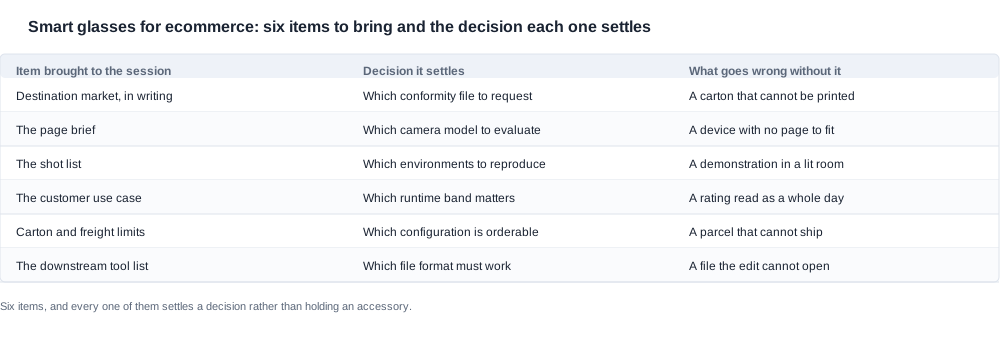
Six items do the work, and none of them is a device. The destination market, written on one page. The page brief. The shot list. The customer's use case, told as a story rather than as a number. The carton and freight limits. And the downstream tool list, meaning the software that has to be able to open the file. Each of them settles a decision, and each of them is cheap to bring and expensive to guess.
Who the buyer is, and what the session has to produce
The reader is a brand buyer, a channel buyer or an e-commerce selector who is deciding whether a first-person camera SKU can be opened on a channel at all. The decision in front of them is not whether the camera records — a demo settles that in a minute. The decision is whether the channel can carry this product: whether the page can be written truthfully, whether the parcel can be shipped to the customer at an acceptable cost, and whether the conformity position exists for the markets the channel serves.
The fear behind that decision is rarely a defect rate. It is a launch that has to be pulled back after the packaging is printed, or a listing that has to be rewritten after a customer complaint, or a page whose claims cannot be supported by anything the supplier holds. All three are expensive in a way that is invisible at the start of the evaluation and very visible a month later.
That is why the output of this evaluation is a set of written decisions rather than a set of impressions. A buyer who arrives with the six items leaves with answers to six questions; a buyer who arrives with a product page in mind leaves with a favourite.

The destination market, written down on one page
This is the item people leave behind and it changes more downstream decisions than any other. The European Union and the United Kingdom are separate regimes, not one regime with two stickers. The General Product Safety Regulation has applied since 13 December 2024 and requires the manufacturer and, where applicable, the importer to be identifiable on the product or its packaging. The requirements are collected at GPSR.
If you arrive without this, the evaluation will produce a device you like and a carton you cannot print. The failure arrives late and lands on the packaging supplier, because the artwork is the last thing in the chain to change and the first thing to be paid for.
What to write on the page is narrow. The market or markets. The role of the company placing the order — manufacturer, importer, or distributor — because that determines who the identifiable party has to be. Whether the product is consumer-facing, which is what brings the general product safety regime into scope rather than the equipment regime. And the date the listing will go live, because it sets the deadline for the conformity file rather than the date for the meeting.

What the catalogue does not settle about conformity
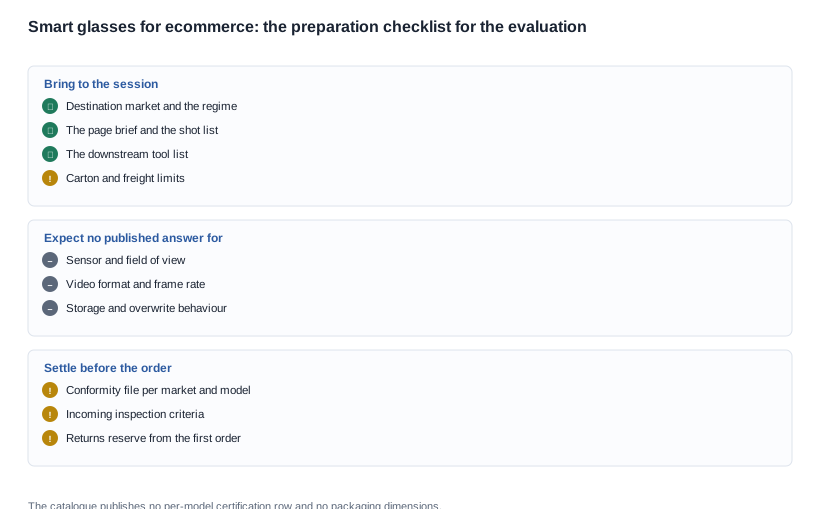
It is worth being precise here, because a lot of buying time gets wasted assuming otherwise. The catalogue carries a company-level export certification page whose content is images rather than text, and the catalogue text contains no reference to CE, FCC or RoHS anywhere. There is no per-model certification row on any model, and no record of a pending per-model confirmation. That means a buyer cannot assemble a conformity position for a channel from the catalogue. A buyer can only request it — per model, per configuration, per market — and build the launch date around the answer.
The requirement set for a consumer-facing electronic product sold into the European Union is standard and worth naming once: radio equipment under the Radio Equipment Directive (EU) 2014/53/EU, electromagnetic compatibility under the EMC Directive (EU) 2014/32/EU, lithium cell transport under the UN 38.3 test summary, general product safety under the General Product Safety Regulation (EU) 2023/988, and the radio and conformity documentation practice at certification checklist. None of those is answered by a company-level page, and each of them is answered by a document that names a model.
The page brief, the shot list and the downstream tools
The camera models in this range are published at 8 MP and 13 MP resolution classes, and nothing else about their imaging. There is no published sensor model, no published field of view, no published video resolution or frame rate, no published low-light figure and no published stabilisation data. The published resolution classes are 8 MP on eight camera models — the V03 Pro and the CY05, the MT5 and the V03, and the CY03 and the KY06, and the MT6 and the V06 — and 13 MP on three, the L1 Pro and the S7, and the L2 Utral.
So bring a real brief: what will be filmed, where, for how long, and what happens to the file afterwards. A brief of "short videos for the shop" produces a completely different requirement from "long talking-head videos shot in a dim room", and the published resolution class answers neither. The evaluation is where the device's actual behaviour gets discovered.
The shot list, including the boring shots. Three shot types decide whether a camera model is right for an ecommerce listing. A static talking head at close range. A walking shot in daylight, which is where the field of view shows up. A low-light shot, which is where the absence of published low-light data becomes an actual problem rather than an abstract one. Add a shot with the device at arm's length and a shot in a windy outdoor space, because that is where audio quality decides whether the model is audio-led or camera-led.
The downstream tools. A device that records to a format the editing tool cannot read is a returns problem, not a preference problem. The catalogue does not publish the file format, the storage capacity or the overwrite behaviour for any camera model, so bring the actual software and check the file during the evaluation rather than after the first upload failure. This is the single most common failure in the ecommerce category: everything about the purchase looked right, and the file was the problem.

The endurance story, the customer use case and the packaging envelope
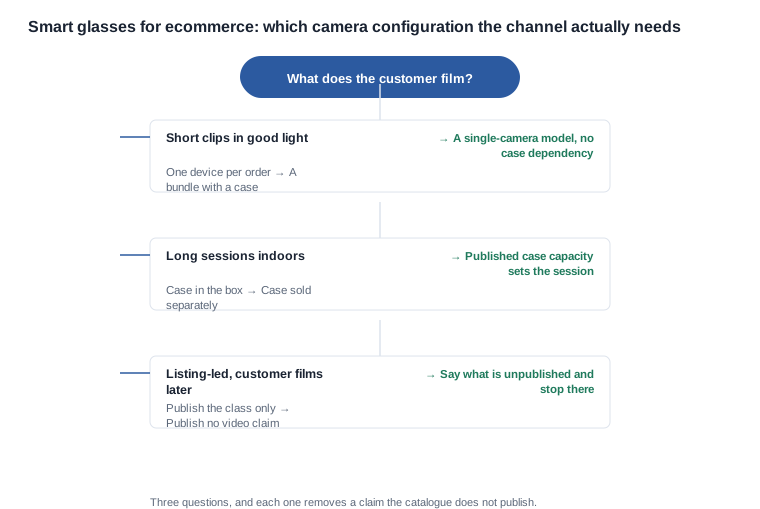
Ask for the rated endurance and then ask what it was measured under. The camera models publish ranges — five to eight hours on the V06 and the S7, and the V03 and the V03 Pro, six to eight on the KY06 and the MT5, and roughly seven on the L2 Utral and the MT6, and the CY05 and the CY03, and the L1 Pro — and no runtime figure in the range carries a published test condition. The charge time is published for every model, as a ceiling of two hours or less, with roughly one hour on the D17 and the ZH12. The camera is the dominant power draw in this use case, which is why the camera figures are the ones that matter here.
The number that matters for ecommerce is a customer recording two hours of walking footage, checking the listing from a phone, and being on a call. That is a mixed workload, and it is not what any published figure describes. Bring the customer question rather than the feature list: what does the customer do with the recording, and what happens when the battery runs out in the middle of a take, given that storage capacity and overwrite behaviour are not published for any camera model.
A model that records a strong still and then stops mid-video is still a good product. It is a bad ecommerce listing for anyone who assumed otherwise, and the fix is in the copy rather than in the hardware — which is the cheaper of the two options.
Building the landed-cost model from what is actually published. An ecommerce channel is judged on landed cost per unit, and the cost model is where unpublished rows become expensive. Four components can be built from the catalogue. The unit cost is the quotation. The freight weight can be measured on a sample and then multiplied, which is the only route available because no shipped weight is published for any model — the single 158 g figure belongs to the MT6 glasses body and excludes its foldable case. The case changes the parcel: the camera models with a published 1400 mAh case are a materially different object from a single-cell Type-C model, so the case configuration has to be fixed before the carton is measured, not after. And the battery transport file has to be requested for the configuration including the case, because the case is a second lithium cell that has to be declared; that requirement sits at battery transport.
The component that cannot be built from the catalogue is the return provision, and it is the one that moves most. A listing that overclaims on runtime or on water resistance does not produce a defect rate; it produces a return rate, and the two are indistinguishable at the level of a monthly report. The provision therefore has to be set from the first shipment's actual ratio, and the first shipment should be small enough that a bad ratio is survivable. That is the trade-off worth naming: a larger first shipment buys a better unit price and a worse first correction.
How to shortlist the models for a channel
Three criteria decide it, and the order matters. The first is the customer's session, because it sets the case requirement and the runtime band together, and the case states are published per model rather than per range. The second is the environment, because only the V06 and the S7 carry an ingress marking at all, and a channel selling into a wet climate either names those two models or names no water claim. The third is the page, because the resolution class is what can actually be written down — 8 MP on eight camera models, 13 MP on three — and everything else about imaging stays unpublished.
A buyer who applies those three criteria arrives at a shortlist of one or two models and a page that can be defended. A buyer who starts from the supplier's feature sheet arrives at eleven models and a page that cannot.
The packaging envelope. Carton size affects freight cost and shelf presentation, and the range spans a wide physical spread: a model with a 1400 mAh charging case is a materially different parcel from a single-cell Type-C model. If landed cost per unit is being compared, bring the carton dimensions and the fulfilment assumptions. One caution on weight: the catalogue publishes a unit weight for exactly one model, the MT6, at 158 g, and that figure is the weight of the glasses body including its cell and camera, excluding the foldable charging case. No shipped weight, with or without a case, is published for any model, so the freight model has to be built from measured samples rather than from the catalogue.

The questions you expect not to be answered
Write down the four questions you suspect will get an unhelpful answer, so that the unhelpful answer does not derail the session. In this category those are typically the camera sensor detail, the field of view, the ingress test results and the certificate numbers. Knowing which answers will be missing is what lets the sample testing be planned to fill them instead of leaving them open.
Two more belong on the list for a channel. The charging case position, because the camera models sit in four different states — five publish a case capacity, two ship with a case whose capacity is not published, three have no case row at all, and one has no charging-case row. And the model designation for the exact configuration, because a truncated designation is worth more than a tidy one: it is the string that makes a lost unit traceable and a second shipment comparable to the first.
What to do with the answers that arrive. A published row can go on the page. A row the supplier confirms in writing can go on the page with the supplier's name behind it. A row nobody can answer either comes off the page or is written onto it as unpublished. The third option is the one most channels avoid and it is the one that costs least: a listing that says which rows are not published reads as more careful than one that quietly omits them.
Where an ecommerce evaluation goes wrong
Arriving with the page already written. The symptom is a session that confirms decisions rather than making them, and a launch date that was set before the answers existed. The prevention is to write the page last, from the signed record.
Measuring the battery by standing still. A runtime measured on a desk with the device idle is the easiest number to produce and the least relevant one, because the camera is the dominant draw in this use case and a customer filming while walking is not an idle device. The prevention is to fix the workload in the protocol before the first run.
Checking the file on the phone it came from. If the recording transfers to the same phone that made it, the transfer path is never tested, and the transfer path is where the customer's first failure happens. The prevention is to bring the second phone, of a different make, and to check the file on the device the customer will actually use.
Sizing the parcel before fixing the case. A carton measured against a configuration that later changes is a carton that has to be reprinted, and printed packaging is the most expensive avoidable cost in this category. The prevention is to fix the case configuration before the carton.
Treating the return rate as a hardware signal. The symptom is a supplier conversation about defects that turns out to be a listing conversation about claims. The prevention is to keep the return reasons separated from the first shipment onward, because they need different corrections and the same supplier will defend whichever one is written down.
Where the session should end, and what it can still move
The session should end with a written record: the brief, the shot list, the conditions, the results, the unit identifiers and the list of rows that are still open. That record is what the incoming inspection criteria are written from, what a complaint in month three is answered with, and what the page is allowed to say.
The commercial terms that can still move at this point are the ones that depend on how the session went. Minimum order quantity tiers, and whether two configurations can share a purchase order. The pilot quantity against the run quantity, which is where most of the room sits on a channel launch because it is the supplier's risk rather than the buyer's. Whether a protective film ships and whether it is factory-applied, which on a first-person camera product is one of the cheapest reductions in the return rate available in the bill of materials. Logo, lens tint and packaging, which are cheap to change before the artwork is printed and expensive afterwards. And a split first run into two deliveries against a staged payment, which suits a channel that wants to test the listing before committing to the volume.
Settled by the product rather than by the relationship: the resolution class and therefore the ceiling on image quality, the cell configuration and therefore the runtime ceiling, the charging interface, and the cost and lead time of conformity testing. A mould charge is a one-time cost and belongs in a separate quoted line rather than folded into the unit price. The commercial structure of a first order is at pricing, and the sample procedure is at sample evaluation.
The go or no-go decision at the end of the session. Three outcomes are legitimate, and confusing them is what turns an evaluation into an argument. A yes, on the shortlist model, with the open rows written down and attached to the order. A no, on this configuration for this channel, with the reason recorded — which is a useful document, because it stops the same configuration being proposed again in the next quarter. Or a yes on a smaller question, where the evaluation settles the packaging and the conformity path but leaves the imaging to a second bench. The third is the most common and the least used, and it is usually the right answer when the catalogue leaves a row unpublished and the sample cannot settle it either.
What we will do with your brief. We will give you the published figures for the models you evaluate, we will be direct about which of your questions our documentation does not answer, and we will not fill those rows with values from another product. Where the evaluation has to decide something the documentation cannot, the sample on the table is the right instrument. If you send us the destination market, the content brief and the downstream tooling list, we will tell you which models are worth evaluating first and which questions will need testing rather than reading. The listing errors these evaluations prevent are collected at ecommerce beginner mistakes, and the scenario entry point is smart glasses for ecommerce.
Related reading
- The listing errors these evaluations prevent — ecommerce beginner mistakes
- Market documentation requirements — GPSR
- Running an evaluation properly — sample evaluation
Send the destination market and content brief and we will tell you which models to evaluate first.


