

The common problems in smart glasses for education are not primarily technical, and buyers who expect them to be usually spend their time in the wrong place.
The technical questions — endurance, fit, charging — are real but tractable, and the published model data gives a starting point. The children models in our range are the A05, the A06 and the A07. The A05 and the A06 publish a 40 mAh cell, a charge time of two hours or less, roughly twenty hours of rated use, a magnetic charging interface, a lens-type electronic atomiser module and posture and distance detection. The A07 publishes Bluetooth 5.4, a 70 mAh cell, the same two-hour charge and the same twenty-hour rated use. The A05 and the A06 are published with identical parameters, and the difference between them is not confirmed.
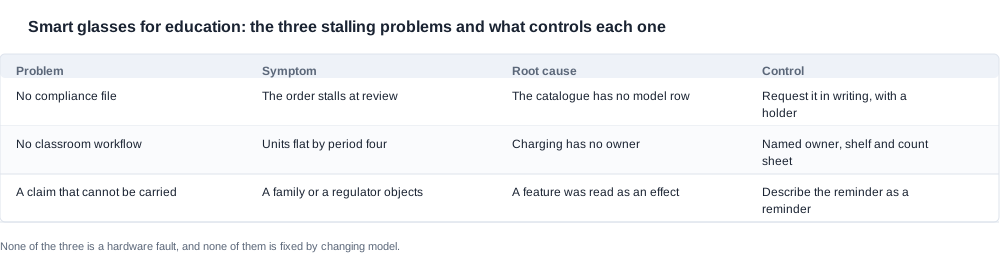
The problems that actually stall an education project sit in three other places: the compliance file, the classroom workflow, and the claim that the product can be made.
Smart glasses for education: the three problems that stall a programme
The conclusion first. Three problems account for most of the education projects that stall, and none of them is a hardware fault. The first is that the compliance file does not exist yet — for the A05, the A06 and the A07 the certification position is not provided to us, which is a different situation from a supplier holding documents and not sending them. The second is that the classroom workflow was never designed, so nobody owns the charging and the units go flat by the middle of the morning. The third is that the claim the product is being sold on is one the product cannot carry, which turns into a governance problem for the school rather than a hardware problem for you.
Who this is written for. The reader is a brand-side buyer, a channel buyer or an e-commerce operator with an education programme that has stopped moving. The situation is usually that something has stalled and nobody can say what, and the instinct is to investigate the hardware. That instinct is expensive, because the hardware is the best-documented part of this category and the least likely to be the cause. The fear underneath the enquiry is not a defective batch; it is a school that has quietly decided the product does not work, a renewal decision that goes the wrong way, and a stock position built around a programme that no longer exists.
Why the hardware is usually not the cause. The published configuration for the children's range is narrow and specific: a 40 mAh cell on the A05 and the A06, 70 mAh on the A07, a charge time of two hours or less across the range, roughly twenty hours of rated use, magnetic charging, and the reminder and atomiser features on two of the three models. Those figures are enough to build a charging plan, and they are enough to rule a battery hypothesis in or out in a conversation with an institution. What they cannot do is settle whether the programme may lawfully proceed in the destination market, whether the classroom can administer twenty shared devices, or whether the proposal may say what it says. Those three questions are where a project actually stalls.
Problem one: the compliance file is not there yet
For the A05, the A06 and the A07, the certification position is not provided to us. That is a different situation from a supplier who has documents and has not sent them, and it is the first thing an education buyer has to resolve. Children's products carry requirements on top of the radio and chemistry ones, and the applicable set in Europe and in the United States includes requirements for mechanical and small-part properties that a product aimed at adults does not have to meet.
Ask two questions in writing. Which requirements apply to this product in the market you are shipping into, and who holds the evidence. If the answer is that the evidence sits with a sub-supplier, you need to know how it is transferred to you and in what form, because a school or a district tender will ask for it as a document with a holder named on it.
The detail that causes the delay. The catalogue carries a company-level export certification page whose content is images rather than text, and the catalogue text contains no reference to CE, FCC or RoHS, and there is no per-model certification row anywhere in the catalogue. So the file a buyer needs does not exist as a published row that can simply be quoted, and it cannot be produced by paraphrasing a company-level page. The radio side of the requirement set is set by the Radio Equipment Directive (EU) 2014/53/EU in the European Union, the electromagnetic compatibility side is a separate instrument and should not be confused with it, and the chemistry and substance side is separate again. Where the product is presented for children, the additional requirements have to be confirmed as applicable to the specific model. That determination belongs to the destination market and to a qualified adviser, and the buyer's job is to hold a written answer with a name on it before the order rather than to form a view.
What the delay costs. A file that arrives after the teaching term has started is worth very little, because the programme cannot be launched retrospectively and the institution's own governance process has to be re-entered. This is the problem that makes a procurement timetable unpredictable, and it is the one where the buyer has least control, because the answer comes from outside the supply chain. The only mitigations a buyer has are to ask early, to ask in writing, and to treat the lead time as a programme lead time rather than a paperwork item.
What to do while the answer is outstanding. Three moves, in this order. First, decouple the order from the answer: stage the commercial commitment so that the bulk of it is released against a milestone rather than against a signature, which keeps the exposure proportional while the determination is in progress. Second, keep the programme reversible until the answer arrives, because the alternative is a fleet sitting in a store room with a compliance question still open. Third, and most importantly, do not let the delay quietly become a decision to proceed anyway. A programme that starts before the file exists has made the determination by default, which is the worst version of this problem, because it is invisible and it cannot be undone. Where the determination cannot be obtained in the time the programme requires, the honest answer is that the programme opens in the next cycle, with the hardware ready and the paperwork settled.
Problem two: the classroom workflow was never designed
Twenty hours of rated use sounds like a week of school. It is not, because the published figure comes without a test condition, and a child wearing the device through a full teaching day with the detection features active is running a different load from a passive standby test.
Three practical consequences follow, and they are the ones that turn into complaints.
Charging is a logistics problem. The magnetic interface on the A05, the A06 and the A07 means each device needs its own cable or dock, so a class set needs more chargers than a shop assumes. A room with four sockets cannot charge a class set of twenty. The quantity follows from the device count, the shelf it lives on needs a power plan, and the school is providing infrastructure it may not have budgeted.
Storage is a supervision task. A device that must be collected, charged, wiped and redistributed daily competes for the same adult as the teaching does. Where the devices are shared between students, a unit that is flat at the end of the day is indistinguishable from a unit that was never adopted, and the difference in the record is what a programme review reads.
The parent-facing side carries more weight here than in any other segment. Posture and distance detection produces a notification that has to reach someone, and the question of whether it reaches a parent device, a teacher device or a school system — and what happens when a parent declines — is a design decision that has to be answered in writing. The catalogue lists the AI functions and the account system as key technologies, and the implementation detail for the children's tier is not published, so the notification path is one of the four questions below rather than a line in the specification.
What fixes it. A named owner for charging and a second owner for the count, a place per unit, and a five-minute daily count. That is the whole of the operational fix, and the reason it has to be designed before the devices arrive is that it changes the kit: one charging point per device is an equipment line in the quotation, and a tray with a place per unit is a procurement decision that has its own lead time and its own minimum order quantity.

Problem three: the claim that the product can be made
The single most common failure in education projects is not a hardware failure. It is a marketing claim that the product cannot support. A lens-type electronic atomiser module, a posture reminder and a distance reminder are behaviour and hardware features. They are not a myopia prevention claim, and they are not a vision protection claim, and the publication of the children's product feature set carries an explicit restriction on making efficacy claims.
This matters more in education than in retail, because a school prospectus that contains a health claim creates a compliance problem for the school as well as for you. We will not help build a claim of that kind, and any supplier who volunteers one is telling you something about the rest of their catalogue.
How the claim gets in. It arrives by accretion rather than by decision. A sales deck describes the reminder as "protecting young eyes". A parent letter says the product is "designed to protect eyesight". A listing adapts one of those phrases because it is the phrase that works. None of those documents was written by anyone with the authority to make a clinical claim, and none of them was checked against the catalogue. By the time the phrase is in the listing, it has become the claim the programme is judged on, and it is a claim the published data cannot carry.
What the catalogue does and does not support. It supports the description of the feature: a detection function with a reminder, on the A05 and the A06, with the A07 published without it. It supports the electrical rows behind those models: 40 mAh and 70 mAh cells, a charge time of two hours or less, roughly twenty hours of rated use, magnetic charging, and Bluetooth V5.4 on the A07. It supports none of the following: an effect on eyesight, a reduction in myopia, any clinical outcome, any claim about how the device affects a child's vision over time. We publish no clinical claim for this range and we will not support a listing that says the product prevents or reduces myopia.
The control that actually works. A written claim boundary, agreed before the artwork and before the listing, listing what the product does and what it does not do, and stating the restriction on efficacy claims in the same document. It is a short document, it costs nothing, and it is the only thing that survives a parent question, a prospectus review or a regulator's inquiry. The other half of the control is the escalation path: when a request for a health claim arrives, it goes to a named person who can say no on the record, rather than to whoever drafted the listing that week.

The four questions that close most of these problems
- Which compliance requirements apply, and which document evidences each one? Get the answer in writing with a named holder. The document matters as much as the answer: a school or a district tender asks for a file it can file, and a general assurance cannot be filed.
- What does the notification path look like in practice? Parent device, teacher device or school system, what the message contains, and what happens when a parent declines. This is the question that separates a reminder feature from a feature that can be operated, and it is not answered by the catalogue.
- How is the class set charged and stored, and who owns that task? The answer is operational and it belongs in the pilot plan, not in the product brief. The equipment count follows from the device count and the magnetic interface, and the owner has to be a person rather than a role.
- What is the data position? Where the app and the firmware run, what is stored, and what is published. The AI functions and the account system are listed as key technologies and their implementation is not published, so this has to be answered by the company in writing for the models in scope.
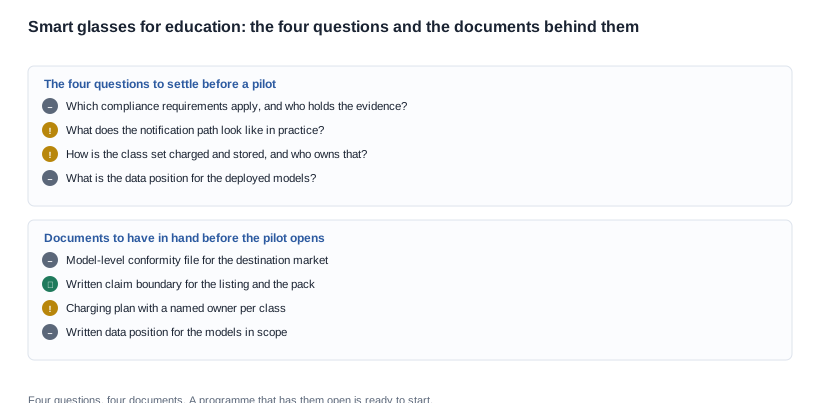
Why these four and not the others. Each of them can be closed with a document or a written answer, which means each of them can be closed before the pilot rather than during it, and each of them is asked of somebody other than the factory. Endurance, charging interface and cell capacity are also worth asking about, and the published rows answer them; the four above are the ones the published rows cannot answer, which is why they are the ones that stall.
Why a pilot is the cheapest instrument for the open items
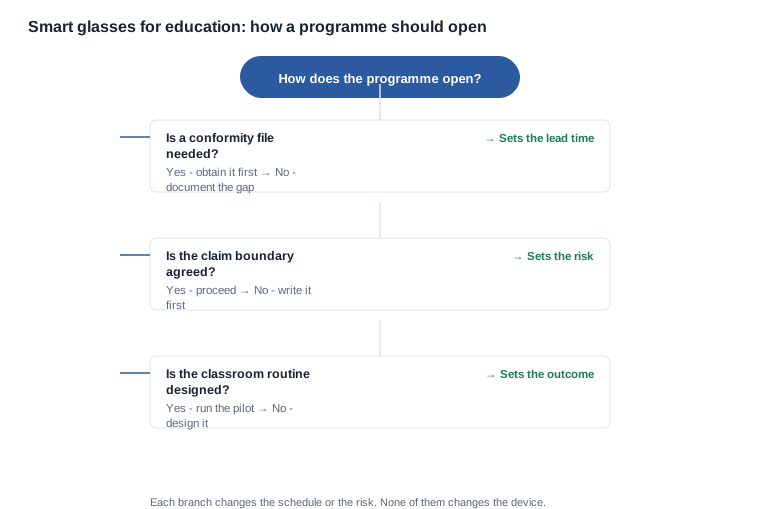
Our position is that the education segment should enter through a pilot with a written claim boundary, and that the boundary is the deliverable. The hardware facts are reasonably clear; the compliance file and the app behaviour are the open items, and a pilot is the cheapest way to close them — provided the pilot is designed to close a named question rather than to demonstrate enthusiasm.
What a pilot closes and what it does not. A pilot closes the questions that need the product in the room: the notification path in practice, the charging regime as an operating routine, the size and shape of the adoption, and the questions families actually ask. It does not close the compliance file, because that is a document question and no amount of running the product will produce one. It does not close the claim boundary either, because that has to be written before the pilot rather than tested by it. Splitting the two is the discipline that keeps a pilot cheap.
Why the pilot has to be small and has to be written down. A pilot that is bought at the rollout minimum order quantity and on the rollout payment terms has given away the only leverage there is. What makes a pilot useful commercially is a quantity that is genuinely smaller, a price tier of its own, and a payment structure that keeps part of the money back until the evaluation point. What makes it useful technically is criteria written before the first session: what counts as adoption, what number of distinct users constitutes a pass, what will be counted as a failure, and who reads the result. A pilot with a written criteria set produces a decision; a pilot without one produces an impression, and the impression is usually flattering in week three.
What we will also say. We would rather a school bought the A05, the A06 or the A07 as a behaviour and hardware product with a twenty-hour rated use and a detection feature, than as a vision product, because the second description creates obligations for both of us that the hardware does not address. We publish the configurations, the rated use figures, the charge times, the charging interfaces and the cell capacities and the reminder and atomiser features as they are listed. We do not publish a conformity position for this range, and we will not fill the data-path or claims gaps. We will not quote an expected classroom usage rate, because we have no basis for one, and a number like that would be borrowed from a setting that is not yours.
The education buying checklist covers the selection side and the ten checks that come before a pilot, and the kids smart glasses range lists the published figures for the three children's models.
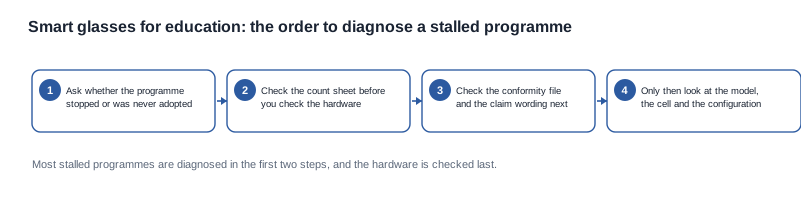
How to use the three-problem frame with a supplier. Send the three questions in the order they appear above — the compliance position, the operating routine, and the claim boundary — and ask for the answer in writing to each one. The first question tests whether the supplier can name a holder for the evidence. The second tests whether they understand that magnetic charging produces a per-device equipment count rather than a shared accessory. The third tests whether they will refuse a claim. A supplier who answers all three precisely is the supplier to run a pilot with, because the three answers are the three things that decide whether the pilot produces evidence. Send us the destination market, the class size, the unit count and the delivery window, and we will tell you which of the three problems your programme is exposed to today, and which of them we can close for you and which of them we cannot.
Related reading
- The education buying checklist — the ten checks before a pilot
- Kids smart glasses range — the published configurations
- Smart glasses for education — the deployment framework
Send the destination market, the class size and the delivery window, and we will tell you which of the three problems your programme is exposed to.


