
Ten checks, in the order they should be done, and the first one is the one most buyers reach last. In the education category the conformity position has to be settled before anything else, because the children's line in our own documentation has no recorded conformity position at all, and the requirements for children's eyewear in Europe and the United States are additional to the standard ones. Every check below follows from that, and none of them is optional.
Smart glasses for education: ten checks and the evidence each one needs
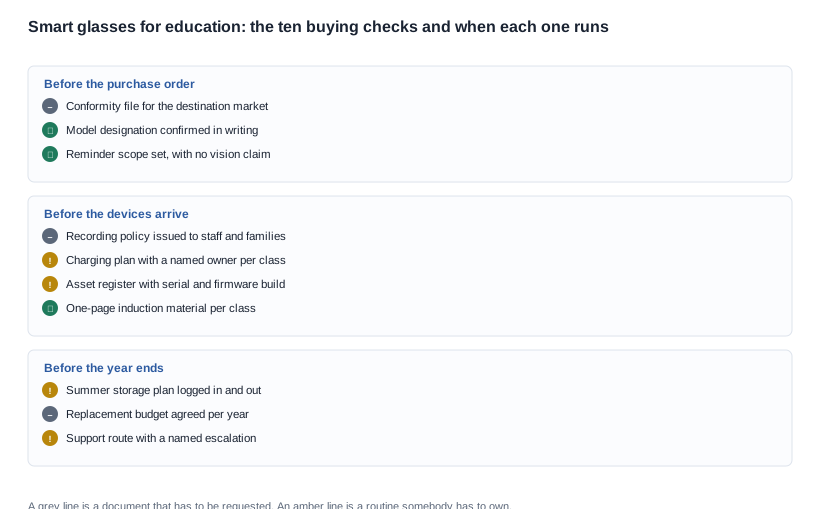
The conclusion first. These ten checks are a procurement instrument, not a list of things to think about. Each one has a pass condition, a piece of evidence, an owner, and a point in the schedule at which it either passes or stops the order. A check without evidence is a wish, and a wish does not protect either side when the institution asks for the file in month three. Three of the ten can stop the order outright, four decide whether the classroom can actually use the devices once they arrive, and three belong to the end of the year, where they are usually forgotten and where the consequences are largest.
Who this is written for. The reader is a procurement officer, a programme manager or a channel buyer assembling an education package, and the person who signs the purchase order. The situation is a quotation to compare, a tender to answer, or a new programme to open, and in every case the comparison only works between quotations that answer the same questions. The fear underneath the enquiry is not a bad price. It is a consignment that is other than the unit that was signed off, a paper file the institution's process demands and cannot produce, or a first term that closes with a fleet nobody can reconcile.
**Why the conformity position comes first.The catalogue carries a single company-level export certification page and it holds images rather than text, and the catalogue text names neither CE nor FCC nor RoHS. There is no per-model certification row anywhere in the catalogue, and no record of a certification number pending confirmation for any model either. For most of the range that is an assembly job for the buyer: identify the requirements that apply to the configuration and the destination, establish whether they are mandatory for this product, and obtain a file that names the model. For the children's line it is heavier than that, because the additional requirements for products intended for children have to be confirmed as applicable to the specific model before anything else is decided. A product designed, tooled, packaged and listed before that file exists is a product that cannot ship.
How to run this as a tender instrument rather than a reading list. The ten checks are worth most when they are turned into a requirement list and sent out once, with a point-by-point answer required against every line. That does three things at the same time. It makes the comparison a comparison, because two suppliers are answering the same ten questions in the same order. It moves the evidence into a file rather than into a conversation, which matters because the person who needs the conformity document in month three is usually not the person who had the call. And it makes the gap visible: a quotation that answers eight lines and is vague on two has told you more than a quotation that answers all ten in adjectives. The file that results — requirement list, responses, evidence, exceptions — is also the evidence archive you will need when the institution asks again, which it will, and which is the point of running the checks at all rather than running them once and losing them.

The three checks that can stop the order
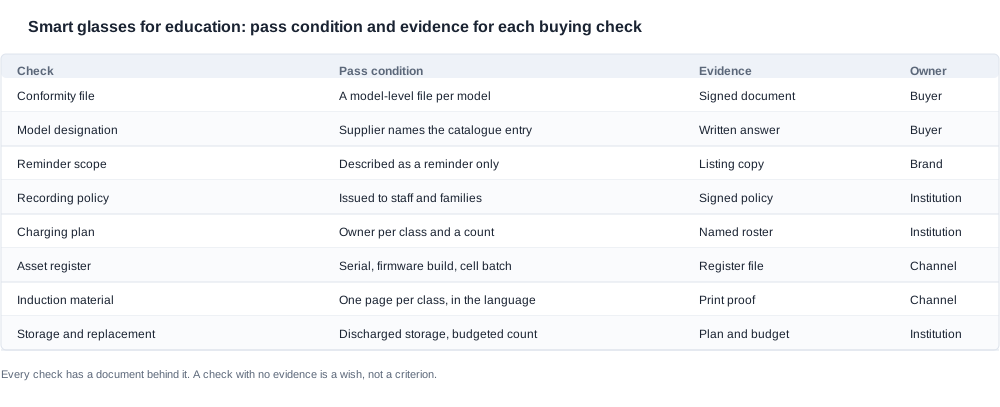
Check one: the conformity file for the destination market. The pass condition is a document that names the model and the market, held by someone identified, transferable in the form the institution needs. The evidence is the document itself. The question to put to the supplier is not "are you certified" but "which requirements apply to this configuration in the market we are shipping into, who holds the evidence, and how does it reach our institution". A company-level statement does not satisfy it, because the institution's own process will name a model.
The requirements themselves fall into layers, and a buyer who asks only for one of them will still be short of evidence at the border. The radio side is set by the Radio Equipment Directive (EU) 2014/53/EU in the European Union, and the electromagnetic compatibility side is a different instrument, so the two should not be confused in a request or in a file name. The chemistry and substance side is a separate set of obligations again, and it does not depend on the radio at all. On top of those, a product presented for children in Europe or the United States carries additional requirements covering mechanical and small-part properties, and the standards that come up in this category include EN 71 in Europe and ASTM F963 in the United States. Whether they apply to a given product is a question for the destination market and a qualified adviser, not for a catalogue, and the buyer needs that determination in writing before the order rather than a general assurance.
Check two: which model, exactly. Two of the three models in the children's line are listed with identical published parameters: 40 mAh, a charging time of two hours or less, a rated run of about twenty hours, magnetic charging, the lens-type electronic atomiser module and the posture and distance reminder. The third is listed with a 70 mAh cell and no reminder function. The difference between the two identical entries is not confirmed, so the pass condition is that the supplier names the catalogue entry in writing before the artwork, the listing and any certificate number are fixed to it. This is a two-minute question that protects three downstream decisions.
Check three: what the reminder is. The catalogue describes a posture and distance detection function with a reminder. That is a reminder — something is detected and the wearer is prompted. The pass condition is that the listing copy and the school-facing documentation describe it in exactly those terms and contain no vision claim. "Protects against myopia" is a clinical statement that neither the factory nor the brand can evidence, and a parent or a regulator will hold the brand to it. The claim boundary is not negotiable and it is not a documentation detail: it is the line on which the whole education proposition stands or falls.
The four checks that decide whether the classroom can use them
Check four: the classroom recording policy. A school is one of the few environments where a wearable camera raises the question before the product does. Some institutions will not permit a camera on campus at all, and some will permit one under a signed policy covering signage, consent, retention and access. The pass condition is that the policy exists and has been issued to staff and parents. It has to exist before the devices arrive, because it is the policy that decides whether the purchase is defensible, and because the catalogue publishes no recording indicator specification for this range, which means a device may record without the wearer or the room showing any visible sign of it.
The model choice changes how heavy that policy has to be, and this is a point worth settling early rather than late. The three children's models in this range are reminder and audio models rather than camera models, so a deployment built on the A05, the A06 and the A07 does not raise the recording question at all — it raises a question about how a reminder notification reaches a parent and who handles it, which is a much smaller governance question. A deployment that introduces camera models for staff raises the full question, with signage, retention and access, and it has to be answered for those models specifically rather than for the range as a whole. A buyer who assumes the camera policy covers the whole programme has written a policy for a class of devices that does not record.
Check five: the charging and rotation plan. The published run times on these models are around twenty hours, so a mid-day top-up is not the constraint; the nightly routine is. The plan names an owner per class, a charging point per device — magnetic charging means one cable or dock per unit — a trolley or shelf count at the end of each day, and a weekly check of the charge times. The charging time published at two hours or less is the number the timetable is built around, and it is a ceiling rather than a guaranteed turnaround.
Check six: the asset register. Serial number, firmware build and cell batch for every unit, in one register, updated as units are added. There are two reasons. A lost unit is unrecoverable without the serial, and the party who absorbs a loss is the teacher who was holding it. And a mixed fleet of firmware builds is a support problem before it is a technical one, because a mixed fleet cannot be diagnosed from a single description.
The register also has to survive the end of the year, and that is where most of them fail. A register that records a serial and nothing else cannot answer the three questions the institution asks at the end of a cycle: how many units are still in service, how many are out of service and why, and how many have moved between classes or cohorts rather than been lost. The three columns that make the difference are the current location, the last recorded state, and the date of the last physical count. The count is what turns the register from a purchase record into an asset record, and it is the same five-minute weekly routine that the charging plan depends on — which is why the two are cheaper together than apart.
Check seven: the induction material. One page per class, in the language the class uses, with the charge routine and the return point on it. This is the highest-leverage item in the whole list, because a class that does not know the routine in week one will not learn it in term two. The page should carry three things: how to charge the unit, how to put it on, and what to do if it will not connect. Nothing else belongs on it.


The three checks that belong to the end of the year
Check eight: the summer storage plan. Store the units discharged, in a cool place, away from sun and heat, and log them out and back in. A lithium cell left charged in a warm cupboard over a long break is the single biggest seasonal risk in this category, and a unit that has been stored badly shows it in the first charge when the term restarts. The pass condition is a plan with a named owner and a log, not a line in a handbook. The seasonal detail is in seasonal considerations for education deployments.
Check nine: the replacement cycle. Cell life over years is not published for this range, so the pass condition is a budgeted number rather than an assumed absence of failures. Write the figure into the proposal as an estimate with an owner and a review date, because a replacement cycle that nobody has costed is a budget line that arrives in the wrong year. The method that works is to start from an agreed rate, review it against the pilot record after the first term, and adjust it. A cycle with a review date is defensible; a cycle with no date is not.
The commercial consequence is worth naming, because it is where a buyer and a supplier disagree most often in this category. A device with no published cell life cannot carry a multi-year guarantee from a supplier, and the supplier who offers one anyway is offering something that cannot be evidenced. What can be evidenced is a replacement commitment: what happens when a unit is returned out of service, who pays the freight, how quickly a replacement reaches the school, and whether the returned unit is quarantined and diagnosed or swapped and returned to service. Those terms are negotiable, they are normal, and they belong in the agreement before the first term rather than in a conversation during it.
Check ten: the support route. Name the person on the site who owns escalation, with a response time. The question that arrives first is usually a parent's, and it arrives at the school rather than at the supplier. The pass condition is a name and a response window, and it has to be reflected in the warranty and replacement terms the supplier has agreed, because a school with a named escalation and no supplier-side replacement route is still holding a broken unit on Monday morning. The questions parents raise most often are covered in parent questions answered.

Running the list in the order a tender actually moves
The order matters more than the list. Three checks can stop the order, and all three are cheapest at the start: the conformity file, the model designation and the claim scope. Four checks decide whether the classroom can use the devices, and those are settled between the purchase order and the delivery date, which is a window that is usually shorter than the buyer assumes. The final three belong to the end of the year, and they are the ones a buyer forgets because nothing prompts them.
The order also determines how a tender comparison works. Two quotations can only be compared when they answer the same questions, and the most efficient way to establish that is to send the requirement list once and require a point-by-point answer. A supplier who answers eight of the ten questions and is vague on the other two has told you something more useful than a supplier who answers all ten with adjectives. The requirement list is what makes the comparison a comparison.
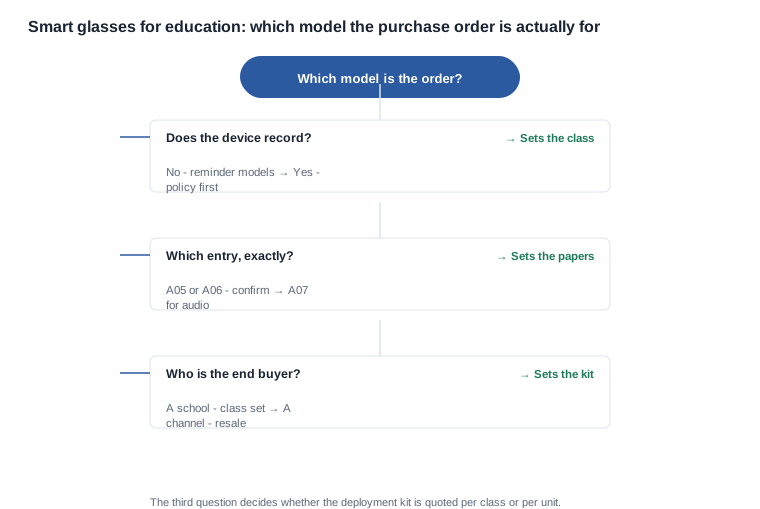
The three questions worth asking in the first round. Which requirements apply to this configuration in the market we are shipping into, and who holds the evidence. Which catalogue entry is being supplied, given that two children's models publish identical parameters. What does the reminder do, in one sentence, without a vision claim. Each one changes the schedule or the price, and each one is cheap to ask, because none of them requires a sample to be built before it can be answered.
One more question that belongs in the first round. Ask what documentation the institution itself needs before it can raise a purchase order — a due diligence questionnaire, a supplier code of conduct, a data processing agreement, a declaration that the devices are not for medical use, a sample of the school-facing documentation. Institutional requirements are known at the start, they are almost never negotiable later, and a programme that discovers them at the delivery stage has missed the cycle rather than saved time. The best way to handle them is to attach them to the quotation as a document set, which also gives the reviewer something to approve. A quotation that answers the institution's own paperwork in the same document as the commercial terms is materially easier to approve than one that answers it in a follow-up email, and it is the same amount of work done earlier.
What we can put behind these ten lines and what we cannot
What we publish for this line: the cell capacities, the charging times, the rated runtime with its stated caveat, the charging interface, the Bluetooth version where it is listed, the presence of the posture and distance reminder on two of the three children's models, and the colour options. We also publish that the A05 and the A06 carry identical parameters and that the difference between them is unconfirmed.
What we mark as not published: the conformity position, the detection method and its accuracy, the frame weight, the cell life, the storage behaviour, the data location, the coating type and any certification numbers. There is no per-model certification row in the catalogue to mark as pending or otherwise, and we will not create one by paraphrasing a company-level page whose content is images.
We will not make a vision or health claim, we will not describe the range as certified, and we will not give a school a green light on a compliance question that belongs to the destination market and to a qualified adviser. What we will do is supply the published figures, mark the gaps precisely, and tell a buyer which of the ten checks above can be closed with a document we can produce, which need to come from the institution, and which need a professional adviser. The published configurations are at kids smart glasses range.
Send us the destination market, the student and staff numbers, the school calendar and the delivery window, and we will tell you which of these ten lines we can support today and which are waiting on a file.
Related reading
- Kids smart glasses range
- Seasonal considerations for education deployments
- Parent questions answered
Send the market, the numbers, the calendar and the delivery window, and we will say which of the ten lines we can close with a document.


