

Smart glasses for field work budget decisions come down to one question: how many hours of a working day is the product actually expected to survive under the load the job applies. This page is written for the buyer building the budget for a field-work deployment, and it sets out how to read the published rows as a budget, what to spend on and in what order, and which line cannot be budgeted at all until someone measures it.
Three conclusions before anything else. First, the device is roughly a third of the cost of a field-work deployment, and the unit price is the smallest of the three products in the budget because the other two scale with the number of people on the crew rather than with the size of the order. Second, the published endurance figures are bands without a test condition, so the planning number is the bottom of the band and the case is the reserve — budgeting on the top of a band is the most common way a field budget breaks. Third, one budget line cannot be costed before a sample arrives, and the honest answer for it is a measured figure rather than an estimate.
Field work is not a livestream and it is not a retail shelf. The device is carried on site, often under a helmet or a hood, often in dust or rain, and often for the full shift rather than for a scheduled session. The published data gives you a starting point for that question, and it also shows you exactly where the published record stops.
Among the sport range, the V06 carries an 8-megapixel camera, a 260 mAh cell, a charge time of two hours or less, a five to eight hour rated use, a magnetic charging interface, a catalogue IP54 marking, an ergonomic frame and a detachable inner frame. The S7 carries a 13-megapixel camera, a 260 mAh cell, a five to eight hour rated use, a magnetic interface, a catalogue IP54, a detachable inner frame and a remote capture control. The YKC02 has no camera, uses Bluetooth V5.4, carries two 70 mAh cells, a charge time of two hours or less, roughly eight hours of rated use and a magnetic interface. The D17 and the ZH12 are the fast-charge models: the D17 has a 115 mAh cell, a Type-C interface and a charge time of about one hour with about seven hours of rated use, and the ZH12 has a 100 mAh cell, Type-C, a charge time of about one hour and about eight hours of rated use.
Smart glasses for field work: the handover that prices the shift, not units
Who is building the budget and what it decides
A brand owner is setting the price of a field-work deployment and needs to know which lines are the product and which are the deployment, because the second group is what a client discovers after the contract is signed.
A procurement manager placing the order needs the accessory chain to be a cost line rather than a surprise, which means it has to appear in the quotation rather than in the second invoice.
A reseller quoting a client needs to know what can be committed to and what has to be qualified, and the distinction is what protects the margin when a client asks for a shift-length promise the published rows cannot carry.
Why the device is the smallest of the three
The arithmetic is worth doing before the negotiation starts. The unit price scales with the order quantity, and the order quantity is chosen once. The spare and consumable chain scales with the headcount, and the headcount grows. The support material and the verification programme scale with the number of models and the number of sites, and they are paid once but they are not free.
A buyer who negotiates only the unit price has negotiated the line that shrinks as the deployment grows, and has left the two lines that grow unnegotiated. That is the structural reason the accessory minimum order quantities and the per-person spare quantities are worth more attention than the unit price discount, even though the discount is the number that appears on the quotation.

Reading the published rows as a planning number
The cell and the case are one number
The field-work mistake is budgeting on the cell alone. A 260 mAh cell with a five to eight hour rated use sounds like a full shift, and the range suggests the number is achievable, but the published figure comes with no test condition attached. The camera is the most expensive thing the cell does, so a shift spent recording will sit at the lower end of a published band, and a shift spent on audio and calls will sit at the upper end.
The way to budget is to work out the shift length, subtract the time the product will spend idle, and ask for the endurance figure under the load that will actually be applied. If the supplier will not state the condition, treat the lower end of the band as the planning number. On the V06 and the S7, that means planning around five hours rather than eight.
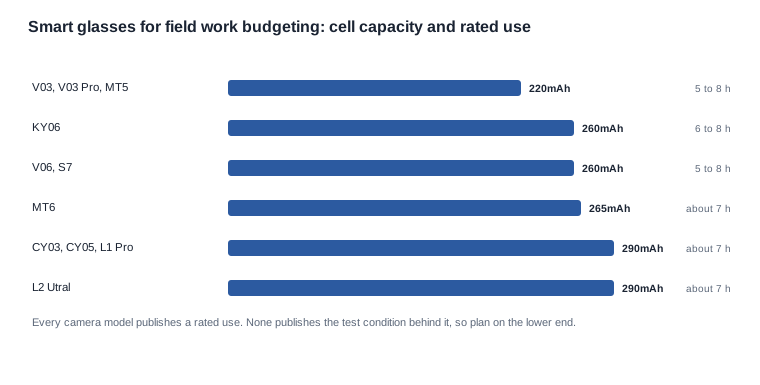
The second half of that number is the charging case, and in the camera tier the case is on the model rather than an option. The CY03, the CY05 and the L1 Pro publish a 1400 mAh case, the L2 Utral publishes 900 mAh and 1400 mAh, and the MT6 publishes a 1200 mAh foldable case. A 1400 mAh case is a genuine reserve of charge for a device whose published cell is 290 mAh, which is the difference between one charger in the case and a kit of spare cells.
The band without a condition is a range, not a promise
The published rated use figures are bands, and the band is the published form of honesty rather than a weakness in the data. A supplier that published a single endurance number without a condition would be making a claim it could not evidence, and a buyer who is handed one should ask what the load was.
The planning consequence is simple and it should be written into the budget as a rule rather than as an intention: plan on the lower end of the band, price the reserve, and revise the number once a pilot has measured it. The measurement is the cheapest correction available in this category, because the sample order has to happen anyway for the frame weight and the operating environment.
What the case position actually is across the camera tier
The case is not one position, it is four, and a budget built on a single assumption about it is wrong for some models. Five camera models publish a case capacity: the CY03, the CY05 and the L1 Pro at 1400 mAh, the L2 Utral at 900 mAh and 1400 mAh, and the MT6 at 1200 mAh in a foldable case. Two publish a case with no capacity stated: the KY06 and the MT5. Three publish no charging-case row at all: the V03, the V06 and the S7. One has no charging-case row: the V03 Pro.
Those four states have different budget consequences. A model with a published capacity can be budgeted as a unit with a reserve. A model with a case of unknown capacity has to be budgeted on the device's rated use alone, because the reserve cannot be quantified, which makes it a model to treat carefully on long shifts. A model with no published case row is a model whose case position has to be established with the supplier, and the V03 Pro is a model where the question is already answered.
When the deployment is audio rather than camera
The camera tier has to be budgeted with a case because a recording shift drains the published band. The sport tier is budgeted differently, because the reserve comes from the charge time rather than from a case. The D17 publishes a 115 mAh cell, about seven hours of rated use and a charge time of about one hour on a Type-C interface; the ZH12 publishes a 100 mAh cell, about eight hours of rated use and the same one-hour charge. Those two models are the only ones in the catalogue that publish a charge time of about an hour rather than a ceiling of two hours or less, and that single difference changes the shape of the budget.
A one-hour charge fits inside a shift break, which means the reserve for those two models is a charging point at the crew's location rather than a second lithium cell carried by the person. That removes a line from the budget and adds an installation to it, which is a different cost treatment and belongs in a different account. It also means the break rota has to be designed around a charge window rather than around a fixed lunch, and a crew that cannot take a break when the unit needs one will discover the limit at the worst time.
The YKC02 sits between the two: two 70 mAh cells, roughly eight hours of rated use, a charge time of two hours or less and a magnetic interface. Two hours or less is a ceiling, so it is not a break-window number, and the reserve question for it is a case question again. A budget that treats the sport tier as one thing is a budget that prices the wrong reserve for at least one model in it.
The five lines, in the order money should be committed
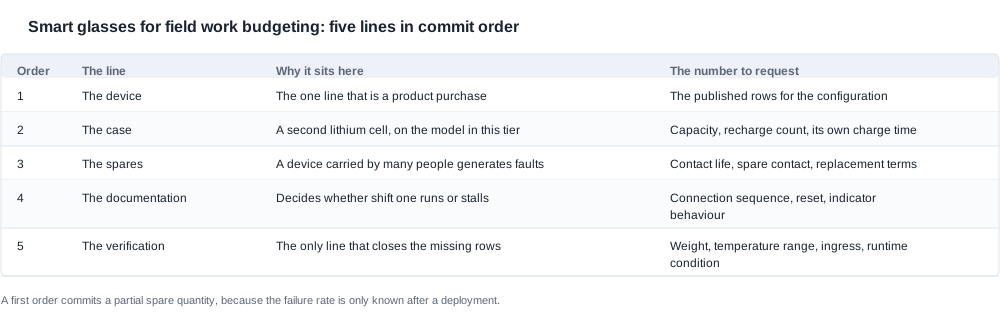
| Order | The line | Why it sits here | The number to request |
|---|---|---|---|
| 1 | The device | The one line that is a product purchase | The published rows for the configuration |
| 2 | The case | It is a second lithium cell in every unit, and on the camera tier it is on the model rather than an option | The case capacity, the measured recharge count and the case's own charge time |
| 3 | The spares | A device carried by twenty people generates failures, and a spare turns a return into a swap | The contact life in insertion cycles, the spare contact and the spare device, and the replacement terms |
| 4 | The documentation | The support material decides whether the deployment runs or stalls on shift one | The connection sequence, the application, the indicator behaviour and the reset procedure |
| 5 | The verification | The sample programme, which is the only thing that closes the rows nobody publishes | The frame weight, the operating temperature range, the ingress report and the runtime condition |
The order is not arbitrary. The device line can be committed once the configuration is chosen. The case line depends on which model was chosen, so it commits second. The spares line depends on the headcount and on the failure rate, and the failure rate is only known after a deployment, so a first order commits a partial quantity. The documentation line costs a day of somebody's time and prevents the escalation that costs a shift. The verification line commits last because it is the only line that produces the numbers the other four are missing.

Turning the estimate into a plan before the order
Model the shift on paper
Shift length, minus idle time, gives the effective working hours, and the published band gives the range. The lower end of the band is the planning number unless the supplier states the condition. This takes half an hour and it is the difference between a deployment that is planned and a deployment that is discovered.

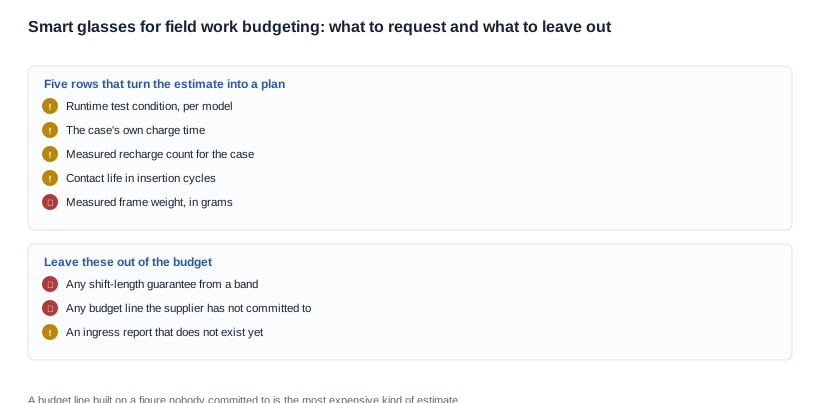
The five rows that turn the estimate into a plan
Request the runtime condition, the case's own charge time, the measured recharge count, the contact life in insertion cycles and the frame weight. Four of the five are absent from the catalogue, and the fifth — the frame weight — is absent for every model except the MT6, which is a camera model whose 158 g covers the whole unit including its battery and camera and excludes its folding charging case.
Price the chain per person, not per shipment
A twenty-person team with a twenty-person spare set is a different line from a twenty-device shipment with one spare, and the first is the realistic one. The per-person spare quantity is what converts a returned device from a defect claim into a swap, and the wear life of the charging contact is the number that tells you how large that set has to be. Neither number is published, and both are obtainable in the same sample conversation.
Six ways a field-work budget goes wrong
The band was budgeted at the top. The symptom is a team flat in the second half of a recording shift. The root cause is a rating with no condition being read as a guarantee. The prevention is the lower end of the band, and the case priced with the device.
The case was treated as an accessory rather than as the power plan. The symptom is a shift plan that assumes reserve power that is not in the box. The root cause is that the case is on the model in this category and the cost line was never drawn. The prevention is to price it with the device, in the same line.
The spares were budgeted per shipment rather than per person. The symptom is a return spike in month two, when the first contacts reach the end of their useful life. The root cause is that the life figure was never established. The prevention is to ask for it and to stock per person.
The documentation was not budgeted at all. The symptom is that every question on shift one escalates. The root cause is that the support material was assumed. The prevention is the documentation line in the budget, and the field-work buying checklist that covers the buying side.
The weight was left out of the budget. The symptom is discomfort complaints on a device carried for a whole shift, and a returns figure nobody can explain from a defect rate. The root cause is that no weight is published for any sport model. The prevention is to weigh the samples and put the number in the file.
The ingress evidence was treated as free. The symptom is a marking that cannot be defended when a client asks for the report. The root cause is that no report is published behind the catalogue IP54 marking on the V06 and the S7. The prevention is to put the report and its lead time in the budget, and to note that the marking belongs to two models only.
What the field-work budget is really made of
The three cost shapes, and why they behave differently
The product is roughly a third of the deployment cost, and the accessory chain and the support material are the rest. That is worth knowing before the unit price is negotiated, because the accessory minimum order quantities and the per-person spare quantities scale with the headcount while the unit price scales with the order. The sport smart glasses range page lists the configurations and their published rows, and the field-work buying checklist covers the buying side.
The three shapes also behave differently under a change of plan. A unit price moves when the order moves. A spare quantity moves when the headcount moves, and it moves in the same direction as the deployment, so it is the line that surprises a buyer at the worst moment. A documentation line does not move at all, which makes it the cheapest protection in the budget.
Negotiating against a fixed budget
Unit price and volume tiers, the case and accessory set with its minimum order quantities, the spare-parts set with its per-person quantities, the support material and the documentation design, packaging specification, delivery splitting, payment nodes against inspection, the warranty period with a stated response, the replacement terms for a deployed device, and the terms of a pilot order. These are the trade-offs worth the negotiation time, and the two that matter most are the per-person spare quantity and the replacement terms, because together they decide whether a failure is a swap or a claim.
The terms the process fixes
What a certification costs and how long the test takes are set by the programme and by whoever certifies it, and for a field-work deployment the certification test cost is usually a one-off per configuration rather than a per-order charge, so it is worth asking which one you are being quoted. Tooling is often amortised across the first order. Ask which one you are being quoted, because the two are frequently bundled into a single line that hides which is which, and on our published position there is no per-model certification row in the catalogue for a buyer to check the answer against.
What belongs in the agreement
The published rows for the configuration ordered; the runtime condition; the case capacity, the measured recharge count and the case's own charge time; the contact life in insertion cycles; the measured weight; the warranty period with a stated response; and the replacement terms. What to leave out: any shift-length guarantee drawn from a band, and any budget line built on a figure the supplier has not committed to.
What we publish, and where the budget stops
The short answer: a field-work budget has three products in it — the device, the case and the spares — and only the first is a product purchase, while the second and third are a deployment cost that scales with the person rather than with the order. We will not publish a runtime condition, a case charge time, a recharge count, a contact life, a frame weight, an operating temperature range or an ingress report for a model where the manufacturer has not provided one, and we will not present the catalogue IP54 marking on the V06 and the S7 as a tested rating.
What we will do is show you how to read the published rows as a budget, what to spend on in order, and which line has to come from a sample. The sport smart glasses range page lists the configurations and their rows.
What to do next
Model the shift on paper and plan on the lower end of the band. Request the five rows that turn the estimate into a plan. Price the case and the per-person spares with the device. Budget the documentation and the sample programme explicitly rather than absorbing them. And put the rows, the replacement terms and the warranty into the agreement rather than leaving them in a supplier's catalogue.
Related reading
- The configurations and their published rows — sport smart glasses range
- The buying side — field-work buying checklist
Tell us the shift length, the headcount and the models you are shortlisting, and we will tell you which budget lines the documentation closes and which have to be measured.


