Field work buying decisions are usually made on the capture specification and then revised twice — once when weight turns out to matter more than resolution, and once when a rain incident exposes a protection claim nobody checked. This checklist is ordered by the sequence those revisions actually occur, so the expensive discoveries happen before the purchase order rather than after it. Each phase below has an entry condition, and the phases are not interchangeable: an item resolved in phase one costs a request, and the same item discovered in phase four costs a return, a replacement and a client conversation.
The premise underneath the list is that a field-work request for quotation is a specification, not a product list. A buyer who sends a list of model names gets a quotation for a list of model names. A buyer who sends a specification gets quotations that can be compared against each other, because every supplier is then answering the same questions. That is the difference between a procurement exercise and a price negotiation, and it is decided before the first enquiry is sent.
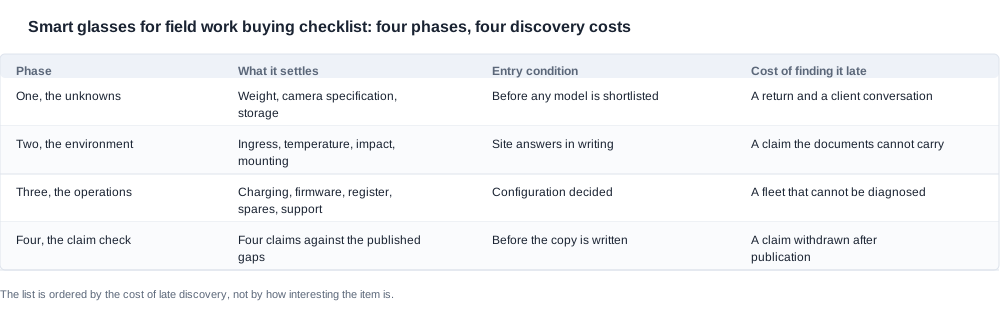
Smart glasses for field work buying decisions fail in a predictable order
Who owns this checklist
Three roles own different parts of it, and the list fails when one of them assumes another has done the work. A brand owner entering the field-work channel owns the shortlist and the claim boundary, and decides what the product listing is permitted to say. A procurement manager owns the phase-three operational plan and the agreement, and decides what happens when a unit fails in month four. A channel buyer or solutions integrator owns phase one and phase two, because those phases are about the customer's environment and the integrator is the party closest to it.
The ownership split matters because phase one and phase two are the phases where a supplier cannot help. Nobody in the supply chain knows the temperature range on the customer's site or whether the crew works in gloves all shift. Those answers come from the site, and a checklist that assigns them to the wrong role is a checklist that stalls.
The questions a good supplier will ask you back
A buyer sending a specification will get questions back, and the questions are a signal worth reading. A supplier who asks where the device is carried, how long the shift is, whether the power is on site, what the recording has to survive, how many people are on the crew and which market the deployment is in, is building a quotation against the deployment rather than against a price list. A supplier who asks only for the model and the quantity is building a catalogue order, and the two produce different quotations.
The answers that change a quotation most are rarely the ones buyers expect to matter. Where the power is decides whether the case is the power plan or an accessory, which changes the bill of materials, the freight weight and the charging infrastructure the buyer has to install. What has to be recorded decides whether a model without a camera is a candidate at all, which is a larger decision than any specification row. The headcount decides the spare quantity, and the spare quantity scales with the deployment rather than with the order.
It is worth answering the questions in writing even when the answers are approximate. A written approximation can be revised; a verbal one becomes a dispute, because neither side remembers what was said and the quotation was built on it.
Why the order of discovery is the order of the list
The list is ordered by what it costs to discover an item late, not by how interesting the item is. Weight, the camera specification and the storage behaviour are the three most expensive to discover after delivery, because each one is invisible in a quotation and each one invalidates a decision already made. The environment items are second, because they are cheap to establish and expensive to argue about later. The operational items are third, because they affect the deployment rather than the product choice. The claim check is last because a claim can be withdrawn before it is printed but not after.
The practical result is that a buyer working the list in order spends most of their effort in the first phase, before any money is committed, and the last phase takes an afternoon of reading.
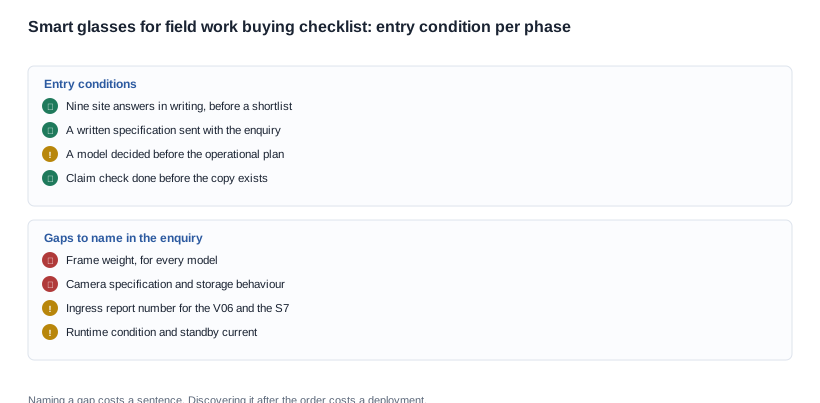

Phase one, the three unknowns that cost the most to discover late
Weight
Unit weight is published for exactly one model in the entire catalogue. The MT6 publishes 158 g for the whole unit, including its battery and camera and excluding its foldable charging case, and no other model in the range publishes a weight at all — not the sport models, not the camera models, not the audio tier. A device carried for a full shift is decided on weight before anything else, and there is no published row to decide it on.
The only route is a measurement. Weigh the sample units on a scale and record the figure per unit, with the configuration stated, and repeat it across the samples rather than on a single piece. A weight measured once and written down is worth more to a procurement file than a figure copied from a competitor's listing, and it is the difference between a product that works for a crew and one that comes back at the end of a shift.
Camera specification
The camera tier publishes its resolution classes, and the split is specific. Eight models publish 8 MP: the V03 and the KY06, the CY05 and the CY03, and the MT5 and the V03 Pro, and the V06 and the MT6. Three publish 13 MP: the S7 and the L1 Pro, and the L2 Utral. That is the full set of eleven camera models, and the class is the only camera figure the catalogue publishes.
Everything else about the camera is not published for any model. The sensor model, the field of view, the video resolution, the frame rate, the stabilisation and the low-light performance are all absent, and each of them is a requirement that a field buyer will have. If the footage is what the deployment is for, request the full specification in writing for the model code, and test it in the worst lighting on the site rather than in the best lighting in a room.
The test itself needs a written completion standard, which for a camera means three things recorded rather than three things judged. Record the resolution class the unit actually produces in the lighting it will be used in, and compare it against the published class for that model. Record whether the unit holds a continuous recording for the length of a real task, because a thermal or a power limit shows up only over time. And record the storage consumption, because the overwrite behaviour question above and the storage consumption question are the same question asked from two directions, and the number that answers both is the one taken on a sample during a real task rather than in a laboratory loop.
Storage and overwrite behaviour
Also not published for any camera model, and this is the one that is hardest to discover because it does not fail on a bench. A device that silently overwrites the oldest material in the middle of a task produces an evidence gap, and in field work that gap is the difference between a usable record and an unusable one. The question to put in writing is what happens when the storage fills: does the device stop, does it overwrite, does it warn, and what is the capacity. Without those four answers, the recording requirement cannot be signed off, and the recording requirement is usually the reason the deployment exists.
These three cost nothing to resolve before an order and a great deal afterwards.
Phase two, matching the environment to what is actually published
Ingress protection
Ingress marking is published for two models only: the V06 and the S7 carry a catalogue IP54 marking, and no other model in the range carries any ingress marking at all. That includes the YKC02, the D17, the ZH12, the audio tier, the children's models, the photochromic model and the bone-conduction model.
The marking itself is a designation rather than a tested result in the public record. The second digit, 4, covers protection against splashing water and a dust ingress limit; it does not cover immersion and it does not cover a sustained downpour. No third-party test report number behind the marking is published. The IP ratings advanced considerations article is the reference for reading the designation, and the claim in any client document has to match what the second digit means.
Temperature and impact
Nothing is published anywhere in this range. There is no low-temperature specification, no high-temperature specification, no drop rating and no impact figure, for any model in the catalogue. Treat them as unspecified rather than adequate, and if they are required, establish them in testing rather than from a datasheet.
This is the item most likely to be quietly assumed. A buyer who does not ask will receive a product that works in a temperate warehouse and a client who works outdoors in winter, and the discovery will happen in the client's season rather than in the buyer's.
Mounting, carry and the remote control
The published sport features that bear on this phase are an ergonomic frame design on the V06 and the S7, a detachable inner frame on those same two models, and a remote capture control on the D17 and the ZH12. The remote control is the feature that matters most where touching the temple in gloves or under a hard hat is not practical, and it is published on exactly two models, so a deployment built around remote capture has two candidate configurations and no third.
Mounting hardware is not published for any model, and the frame geometry is not published either, so a retention accessory or a helmet interface is a trial item rather than a catalogue item.

Phase three, the operational plan behind the purchase order

Charging model and the case position
The published runtime figures are bands without a test condition, so the usable number is the one the buyer's workload produces rather than the one the catalogue prints. Standby current is not published for any model, which means overnight retention cannot be modelled from documentation at all — a unit left on a bench overnight may lose charge at a rate nobody has published.
The case is where the second lithium cell sits, and its position across the camera tier is not uniform. Five models publish a case capacity: the CY05 and the CY03, and the L1 Pro — each at 1400 mAh, the L2 Utral at 900 mAh and 1400 mAh, and the MT6 at 1200 mAh in a foldable case. Two publish a case with no capacity stated: the KY06 and the MT5. Three publish no charging-case row at all: the V03 and the V06, and the S7. And the V03 Pro is published explicitly without one.
A cased configuration such as the CY03, the CY05 or the L1 Pro turns charging into an overnight bench operation rather than a shift-length problem, and that changes the plan rather than just the accessory list. Which model to choose is therefore partly a question about where the power is, not only about what the camera has to do.
When the answers are not available yet
Not every buyer's site data exists on the day the request for quotation has to go out, and pretending otherwise produces a quotation built on assumptions nobody has recorded. The workable approach is to make the assumption explicit and label it, so that it can be corrected later without invalidating the whole comparison.
Three situations are common enough to name. The shift length is often unknown because the rota is not set, in which case the planning number is the longest shift the operation is likely to run and the note says so. The environmental exposure is often unquantified because nobody has measured it, in which case the safe planning choice is the model with the strongest published position rather than the cheapest one. And the recording requirement is often still being negotiated with the client, in which case the camera specification request has to be framed as an open item with a date rather than as a requirement that cannot be met yet.
The rule is that an assumption written in the file is a manageable problem, and an assumption left in an email thread is not. Every supplier can work from a labelled assumption. Very few can work from one they have to guess at, and the ones who do are quoting something else.
Firmware and re-imaging
Record the firmware version per unit at goods-in, in the receiving record rather than in a separate log. A mixed-firmware fleet produces connection and behaviour differences that look like faults, cannot be diagnosed without the version, and generate exactly the kind of intermittent report that damages a supplier relationship. The firmware version is also a re-imaging question, because the ability to re-image a unit at your own site is a different commitment from the ability to ship a new one, and only one of those two affects the spare strategy.
Asset register
Model designation, batch or serial, firmware version and date of receipt, in the register on day one. Without those four fields, a fault report is not diagnosable, and the supplier's first response will be a request for information that the buyer's own records should already hold. The register is also what makes the spare strategy and the warranty claim possible, because both operate on a unit identity.
Spare strategy
The case is the highest-consumption item in this category, and whether a case can be replaced independently of the device is not published for any model. Plan for cases as consumables, and put the per-person quantity in the quotation with a restock interval rather than as a one-off.
Support path
A named contact, a spare-unit procedure and an agreed replacement policy. None of this is published and all of it belongs in the agreement rather than in a good-faith exchange after the first failure. The fault diagnosis sequence itself is at field work troubleshooting, and the material a team needs on shift one is a separate deliverable from the material a buyer needs.
Phase four, the claim check before anything is published or briefed
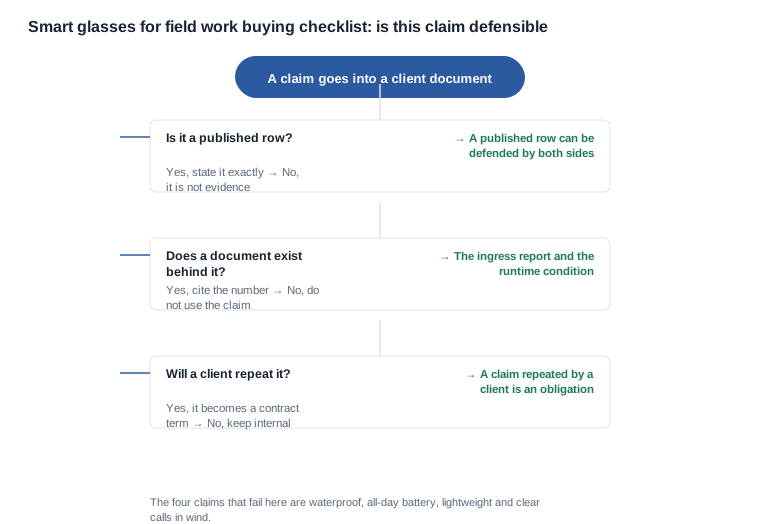
Four claims do not survive field use, and all four trace to a published gap rather than to a difference of opinion.
| The claim | Why it does not hold | What can be said instead | The source of the fix |
|---|---|---|---|
| "Waterproof" | The IP54 marking on the V06 and the S7 is a splash designation, and no report is published behind it | Splash protection and a dust ingress limit, on those two models only | The report number, the tested configuration, the sample batch |
| "All-day battery" | Every rated use figure is a band with no published test condition | A published band, with the lower end used for planning | The runtime condition, measured on a sample |
| "Lightweight" | No weight is published except the MT6's 158 g | The measured weight of the units in the order | The sample weighing, recorded in the file |
| "Clear calls in wind" | Pickup distance, noise reduction method and wind performance are not published across the range | The published Bluetooth version and the remote capture control | The supported device list, established on a trial |
The rule underneath the table is simple: a claim in a client document that the supplier's own documentation does not support is a claim the channel buyer carries, through the contract, for the life of that relationship. That is why the phase-four check belongs before the copy is written rather than after.
What the checklist produces, and what it cannot
What we publish
The short answer: we will give you the published specification set for a configuration and name the gaps that field work exposes — weight, camera specification, storage behaviour, ingress report numbers and standby current — rather than present them as solved. Those are not published for this range, and the four claims above are the ones most often made without support.
We do publish the remote capture features, the resolution classes, the rated use figures, the charge times, the cell capacities and the charging interfaces, the detachable inner frames, the case capacities where they exist, and the catalogue IP54 marking on the V06 and the S7. Unit prices, minimum order quantities and production lead times are confirmed per enquiry rather than published as fixed numbers, and the commercial structure of a first order is set out at pricing and minimum order quantity.
What a quotation has to settle
A field-work quotation has to settle four things or it is not comparable. The configuration, with the published rows and the gaps named. The bill of materials, because a case and a dock change the delivered cost. The acceptance criteria, so that a received unit has something to pass. And the replacement terms, because the difference between a swap and a claim is decided in the agreement rather than during a failure. The clause language is at contract terms, and the incoming inspection side is at quality consistency.
Environment, shifts and recording requirements
Send the environment, the shift pattern, the recording requirement, the headcount and the target market, and we will tell you which published configurations fit, which claims the published rows support, and which rows have to come from a sample. For the sport configurations, the sport smart glasses range lists the published entries, and the site-side survey that feeds phase two is at the site assessment checklist.
Related reading
- Field work troubleshooting — diagnosing faults at the unit
- Sport smart glasses range — the published sport entries
- IP ratings advanced considerations — reading the designation
Tell me the environment, the shift pattern and the recording requirement, and I will tell you which published configurations fit and what we cannot evidence.