Smart glasses for field work fail in a small, repeating set of ways, and almost every one of those failures has two candidate causes: something about the environment the device was in, and something about the unit itself. The job of a troubleshooting procedure is not to repair the device. It is to separate those two causes cheaply, in the hands of the person who found the problem, and to decide with evidence whether the unit goes back to a service bench or onto a warranty claim. That distinction is the whole commercial value of the procedure, because the two routes cost different amounts and the two routes expire on different clocks.
Smart glasses for field work: every fault has two candidate causes
The reason field diagnostics get expensive is not the difficulty of the fault. It is that a symptom arrives without its context, and the context is what selects between the two causes. A device that will not power on in the morning might have a flat cell, a dirty charging contact, a cable that has failed, or a cell that has aged out. None of those can be distinguished from the symptom alone, and a supplier who receives four of these tickets with four identical descriptions has no way to prioritise them.
A useful procedure therefore starts by fixing what has to be captured before the device is touched. Every field fault report should carry at minimum: the model designation, the charge state at the moment of the fault, what was happening on the device at that moment, whether the device had been stored in a vehicle or a locker, and what changed since it last worked. That last item is the one that most often identifies the cause immediately, and it is the one most often left out because it requires the reporter to have been paying attention.
The second half of the procedure is about the interface, because the interface determines how much of the fault is visible to the person holding the device. A magnetic-charging model can fail in a way that a Type-C model cannot: the contact can be fouled, the magnet can hold the device slightly off the dock, and a device that is seated but not charging produces a symptom identical to a dead cell. A Type-C model exposes the state of the cable and the port visually, and a cable or port fault can be ruled out in seconds by trying a second cable. Four models in the range publish no charging method at all, so for those the interface itself is an open question and the first diagnostic step has to be establishing it.
The third half is about what the catalogue can and cannot settle. Published facts about this range include cell capacities by model, rated runtimes, charge times stated as ceilings, charging interfaces where published, Bluetooth versions on the connected models, and resolution classes on the camera models. Not published for any model are the storage and overwrite behaviour, the runtime test condition, the standby draw, the cycle life rating, the operating temperature range, and the field of view. A diagnostic procedure that reaches for those figures to explain a symptom is inventing the explanation, and the resulting warranty claim is the one that gets rejected.

Power faults and the three measurements that separate them
A device that will not power on is the most common field fault and the one with the widest spread of causes. Three measurements, in this order, separate most of them, and each one is something a site supervisor can do without opening anything.
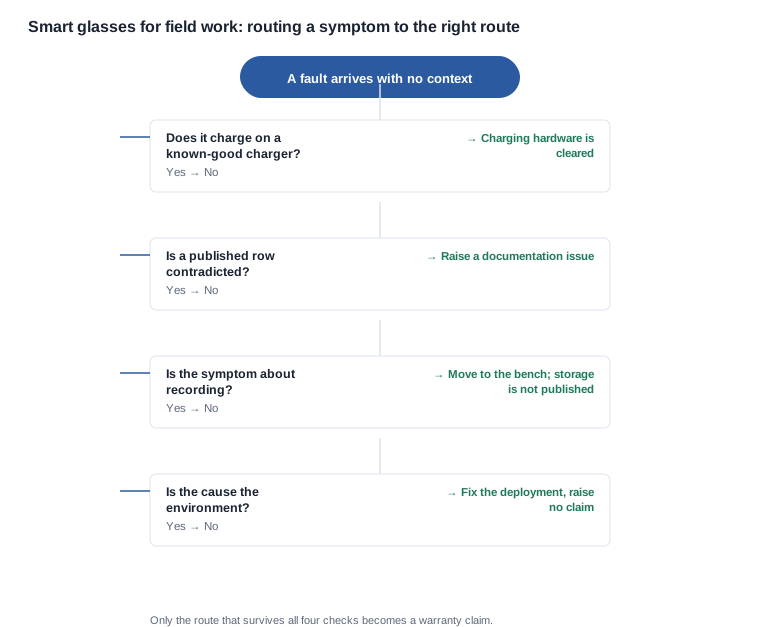
The first measurement is the charge state, taken away from the charging point. If the device does not behave differently when it is on a bench with a known-good charger than it does in the vehicle, the charger is the prime suspect rather than the cell. This measurement is cheap and it eliminates the largest single category of fault, because charging hardware fails more often than cells do — particularly where the same dock is shared across a fleet and the dock is mounted in a position where it collects dust and takes a knock from a wheel chock.
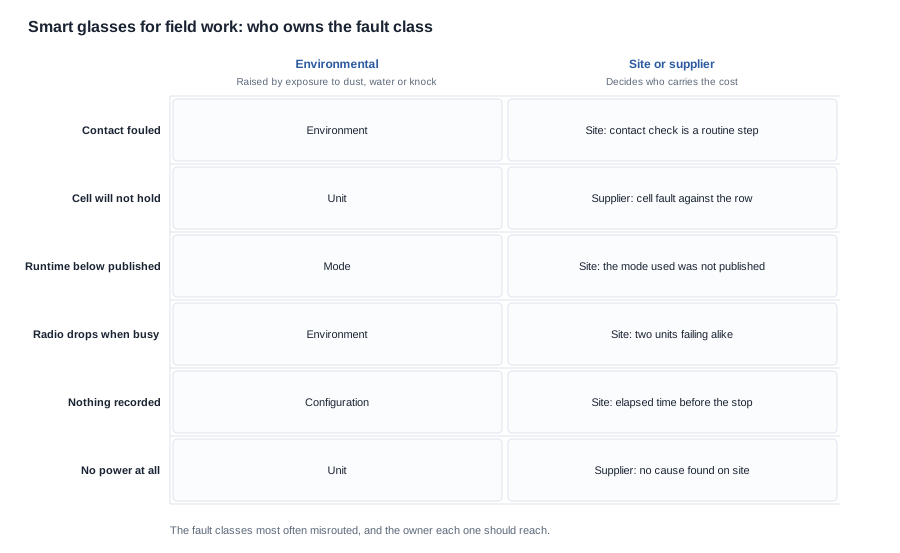
The second measurement is the contact itself. For the models with a magnetic interface, the contacts are the first thing to inspect, and the inspection is a visual and a physical one: whether the contact faces are clean, whether the device seats squarely, and whether the charging indication appears at all. A magnetic contact carrying a film of dust presents exactly like a cell that will not hold charge, and the repair is a service-bench minute rather than a replacement unit. Because the lens material and the coating are not published for any model in the range, the instruction for this inspection has to be conservative and specific rather than a general instruction to clean the device.
The third measurement is the cell behaviour over time. A cell that has been left for weeks in a vehicle in cold conditions, or fully discharged and then stored, will present differently from a cell that has aged. The published capacity figures make this comparison possible in principle: 40 mAh on the A05 and the A06, 70 mAh on the A07, 55 mAh × 2 on several of the audio models, 100 mAh on the D11 and the D12, 115 mAh on the D17, 220 mAh on the MT5 and the V03 Pro, and the V03, and up to 290 mAh on four of the camera models. A device that charges to a visible state and then collapses within minutes, when compared against a published cell size, is a candidate for a cell fault. A device that charges fully and then runs far shorter than the published runtime for that model is a different candidate, and the difference between the two is worth one measurement at the bench.
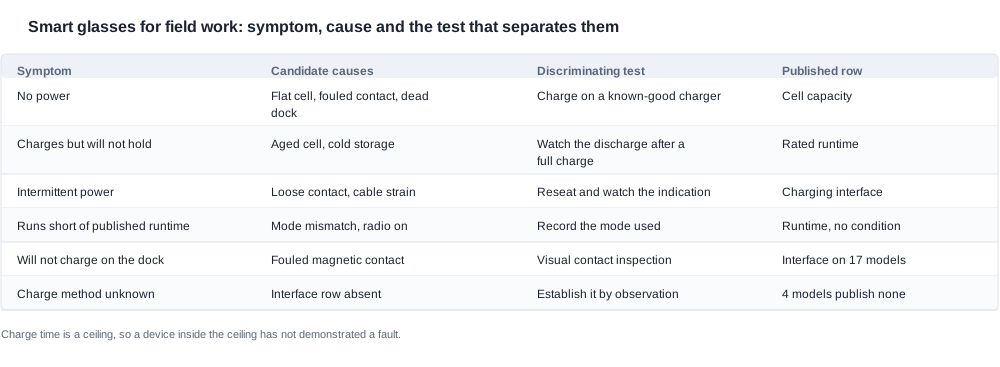
| Symptom | Candidate causes | Discriminating test | Published row that helps |
|---|---|---|---|
| Will not power on | Flat cell, fouled contact, failed dock | Charge on a known-good charger | Cell capacity by model |
| Charges, will not hold | Aged cell, storage in cold | Observe discharge after a full charge | Rated runtime by model |
| Intermittent power | Loose contact, cable strain, knock | Reseat and watch the indication | Charging interface by model |
| Runs short of published runtime | Mode mismatch, radio on, no test condition | Record the mode used | Runtime is published without a condition |
| Will not charge at all on a dock | Fouled magnetic contact | Visual contact inspection | Interface published on 17 models |
| Charge method unknown | Interface row not published | Establish the interface by observation | Four models publish no charging method |
Charge time is the number most often misused in this context. The catalogue publishes a charge time of two hours or less for twenty-six of the twenty-eight models, and roughly one hour for the D17 and the ZH12. Those are ceilings. A device that takes two hours to reach its terminal state has met the published figure, and a fault report that says "it takes longer than the brochure" is not a fault report unless it says longer than the ceiling for that model. A charge time is also not a case turnaround time, and no published figure in this range states the starting state of the charge or the point at which the charge is considered complete — so a shift-length interruption cannot be calculated from it. The underlying figures are collected at battery life and the interface options at charging solutions.
Pairing faults and the models with a published radio row
A device that will not pair, or that pairs and then drops, splits cleanly along the same line. The radio row is published for some models and not for others, and that difference determines what the diagnosis can even ask.
Among the models whose Bluetooth version is published, the range shows two versions: 5.3 on the K01 and the K02, and 5.4 across the D11, the D12, the LC-105 pair, the A07 and the YK12, the G07 and the D17, and the YKC02 and the ZH12, the AR model and the electrochromic model. Against that, none of the eleven camera models publishes a radio version, and neither do the A05 and the A06. For those models the pairing question is answered with a radio row that does not exist, and a supplier asked to confirm the radio behaviour of a camera model has to answer from test data rather than from a catalogue entry.
That distinction matters commercially because the drop-rate question is a paired-model question. A device that pairs and drops is usually a coexistence problem — another radio near the device, a congested 2.4 GHz environment, or a phone running a lot of background connections. The test is a controlled one: the same device, the same firmware, in a known radio environment, compared against a second unit of the same model. Two units failing identically points at the environment and away from the unit, and that is the single most useful piece of information a site can produce before a claim is raised.
The published rows help in a second way. No model publishes a touch row: on the K01 page there is none, and on the K02 page there is none either, so a control-surface question about either model has no published basis and has to go to the supplier. On the G07 and the YK12 the published feature is a slim and detachable temple, and the published endurance for both is roughly six hours, against roughly eight hours for the K01 and the K02 and the LC-105 pair. A support team that treats the audio range as a single endurance class will mispredict the service intervals for the two models whose published figure is lower.
For a camera model, the pairing question usually arrives dressed as a recording question, because recording is what the user was trying to do. The published camera rows do include a resolution class — eight models publish 8 MP and three publish 13 MP — and they include runtimes and cell capacities, but they publish nothing about storage, overwrite behaviour or video specification. A fault report that says "it recorded nothing" cannot be resolved against a published row, and the only defensible next step is the bench.
Recording faults on models with no published storage behaviour
Recording faults are where the gap between the catalogue and the field is widest, and where a supplier's support function is most likely to offer an explanation that the published data cannot support.
The camera models publish a resolution class, a rated runtime, a cell capacity, a charge time, and in five cases a charging case capacity — 1400 mAh on the CY03 and the CY05, and the L1 Pro, 900 mAh or 1400 mAh on the L2 Utral, and a 1200 mAh folding case on the MT6. Two further camera models publish the existence of a case without its capacity, and the catalogue publishes no case row at all for the S7 and the V06, and the V03 Pro and the V03, which is the group where the troubleshooting pack has to assume nothing about the box contents. None of the eleven publishes a storage capacity, a storage type, an overwrite policy, a video specification, a field of view or a frame rate.
That absence has a direct operational consequence. A device that "recorded nothing" can mean the recording was made and then overwritten because the storage filled, or the record failed to start because the control was not triggered, or the file exists and cannot be retrieved. A field report that does not distinguish between these will be sent to a supplier as a hardware fault, and the supplier will ask the one question that decides the case: how much footage is on the device, and what is the storage capacity and overwrite behaviour of this model. There is no published answer to give, which means the case is decided by bench evidence or not at all.
The practical procedure is to move the recovery action forward in the chain rather than further down it. If a device records for a period and then stops, the operator should note the elapsed recording time before the stop. That single datum separates a full-storage event from a thermal or power event, and it is the difference between a configuration instruction, a settings instruction and a claim. For a buyer assembling the evidence file, that datum is worth more than any other single observation on the device.

The file a claim needs before it leaves the site
The cost of a fault in a field deployment is not the device. It is the time to the replacement, the site hours lost while the question is open, and the shipping both ways. What makes a claim move quickly is not the severity of the description but the completeness of the file that arrives with it, and the file has a fixed shape.
- The device identity. The model designation, and the designation on the unit rather than the designation in the order. A kit that contains a device, a case, a cable and consumables has more than one thing to go wrong in transit, and the designation is what makes a loss traceable.
- The symptom in one sentence, with the mode. What the device was doing when it failed, in the terms the configuration uses.
- The two causes, and the measurement that separated them. Which of the environment or the unit was ruled out, and how.
- The state at the moment of the fault. Charge state, storage state, and any indication the device was showing.
- The environment. The exposure conditions, and the ingress marking published for that model if there is one. Only the V06 and the S7 publish an IP54 marking in this range, as a catalogue attribute, with no third-party test report published behind it, so the claim file should reproduce the marking and not extend it.
- The history. What changed since the device last worked, and the elapsed time in the current condition.
- The prior state. Whether this unit is a replacement for an earlier fault and what the earlier fault was, because a repeat fault on the same unit is a different case from a first fault.
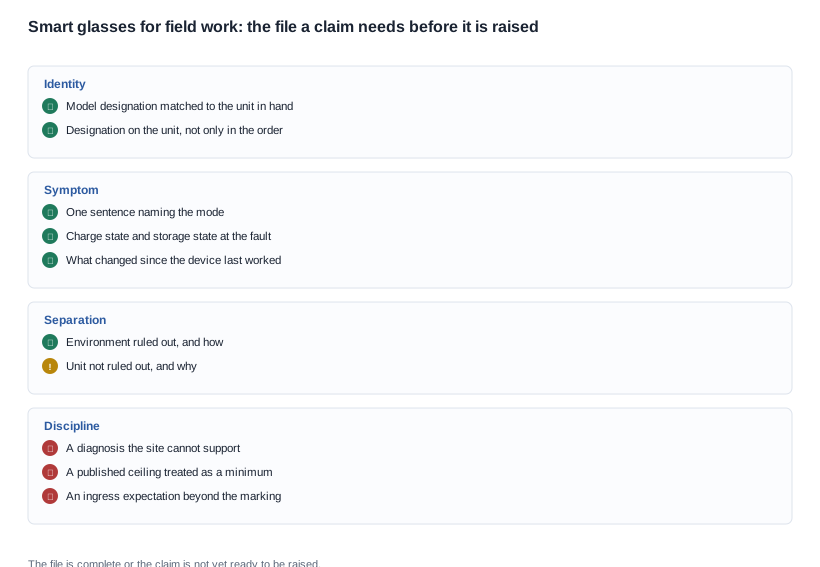
What should not be in the claim file. A diagnosis the site cannot support. A statement that a device "stopped working" without a mode and a state. An expectation expressed as a specification, for example a runtime that the catalogue publishes as a ceiling being treated as a minimum, or an ingress expectation that exceeds the published marking. And a photograph of a scratch presented as a fault, which is a returns question rather than a warranty question and is handled at warranty and returns for field work.
What a supplier should answer without holding the unit
There is a set of questions a good supplier answers from published data, without a sample on the bench and without a week of investigation. A buyer who asks these first gets a faster answer and a clearer picture of which questions are genuinely hard.
Which rows are published for this model, and what is the published value of each. The buyer can hold the catalogue against the answer. If a supplier cannot list the cell capacity, the rated runtime, the charge time as a ceiling, the charging interface and the radio version for a given model, the buyer has a supplier who is not working from the same source, and the discrepancy list starts there.
Which of the six battery facts apply to this model. The catalogue publishes a charging method for twenty-four of the twenty-eight models — magnetic on seventeen, Type C on seven — and publishes no charging method at all for the CY05 and the CY03, and the L1 Pro and the MT6. A supplier that answers "magnetic" for those four models has answered from a template rather than from the data, and the same four are the models where the charging dock decision is most expensive to get wrong.
Which facts about this model are not published. A good answer names the gaps: the storage and overwrite behaviour, the runtime test condition, the standby draw, the cycle life rating, the operating temperature range, the field of view, the video specification, the per-model unit weight except for the single published 158 g figure for the MT6 whole unit, and the frame and lens materials.
What evidence would settle the open questions. A bench protocol, a test report, a sample, or a written statement. A supplier that answers an open question with another open question has at least been honest about it, which is more useful than an answer the buyer will have to retract.
What to ask a supplier before you order a fleet
The questions to ask are worth writing down before the order, because the answers determine how much of the fault load comes back to you rather than to the supplier. Four of them are answerable from published data and should be asked first, precisely because a supplier who answers them from the catalogue is a supplier who will be working from the same source as you.
Ask which rows are published for each model on the shortlist, and in which columns. The catalogue publishes a resolution class on the camera models, a cell capacity on every model, a charge time on every model, a charging interface on twenty-four of the twenty-eight, a radio version on the connected models, and a charging case capacity on five of the camera models. The models where a row is absent are not a smaller product; they are a product with a gap in the published record, and the gaps have to be closed by a question rather than by an assumption.
Ask the supplier to confirm which charging method applies to each model on the shortlist. This is the single question whose wrong answer is most expensive, because four models publish no charging method at all and a wrong answer commits the buyer to a dock or a cable that will not fit. It is also the question where a supplier that answers from a template rather than from the data reveals itself, which makes it a useful test of whether the rest of the answers are worth relying on.
Ask what the supplier's own evidence is for the runtime figure, and whether it was measured in the mode the deployment will use. The catalogue publishes a rated runtime for every model but publishes no test condition for any of them. A supplier that answers with a mode and a condition has done work that the catalogue does not show, and that is worth more than a supplier that quotes a larger number.
Ask what happens to a unit that arrives with a fault, and how long each step takes. The steps in a return path — receipt, inspection, disposition, replacement or credit — are the ones that determine the real total cost of a failure, and they are the ones a buyer cannot derive from a catalogue. A supplier who will put the path in writing has made a commitment about the cost of a failure rather than only about the unit.
The trade-off that sits under all four questions is the usual one: the more of these answers the buyer settles before the order, the fewer levers remain for the commercial negotiation afterwards. The correct order is to settle the configuration and the evidence path first, and to keep the quantity, the payment schedule and the delivery split open until they are settled.
The purchase-order clauses that reduce the fault load
A diagnostic procedure saves time; a purchase order saves money, because it decides which failures the buyer pays for. Four clauses carry most of that value in a field deployment, and all four are written before the first shipment rather than after the first dispute.
A definition of the fault claim. What counts as a fault, what does not, and which symptoms the buyer is expected to diagnose on site before raising a claim. The purpose of the clause is not to narrow the warranty — a narrow warranty that is discovered late costs more trust than a wide one — but to make sure the failure modes the buyer can rule out on site are excluded knowingly rather than by argument later.
A commitment on the return path, with steps and dates. How a unit is received, inspected and dispositioned, and what the buyer receives in exchange for each outcome. The rule that makes this clause work is that the evidence requirements are attached to it, so the claim file is defined once and used for every claim rather than renegotiated for each one.
An agreed statement of the published rows for the ordered configuration. The cell capacity, the rated runtime, the charge time as a ceiling, the charging interface and the radio version, quoted from the catalogue at the date of the order. This clause is worth more than it looks: it settles the expectation that the device will behave as the published rows say, it prevents the runtime ceiling from being read as a minimum, and it gives both sides a single reference when a behaviour needs to be discussed.
A statement about what the supplier cannot warrant. What is not published for the model, and therefore not part of the performance expectation — the storage and overwrite behaviour, the runtime test condition, the standby draw, the cycle life rating, the operating temperature range, the field of view, the video specification, and the per-model unit weight apart from the single published 158 g figure for the MT6 whole unit. Writing down what is excluded is what prevents the buyer from assuming a guarantee that was never given.
These four clauses are the due diligence output in contractual form. The full documentation sequence sits at the certification checklist, the clause language at contract terms, and the inspection side of the same discipline at quality consistency. The upstream selection logic is at choosing smart glasses for field work, the deployment template that should exist before any fault arrives is at the field work deployment template, and the scenario entry point is smart glasses for field work.
Related reading
- How to enter the scenario — smart glasses for field work
- The deployment template — the field work deployment template
- The published figures — battery life and charging solutions
- The claim route — warranty and returns for field work
Send us the model designation and the symptom with the mode, and we will tell you which published rows bear on it and which questions need the bench.