

Smart glasses for field work carry a warranty problem that a consumer electronics warranty does not have: the device is operated by people the buyer never trains, in environments the buyer never sees, and it is usually one of several items in a kit. A warranty for this category therefore does far more than promise a duration. It decides who carries the cost of a dirty charging contact, a device that was left in a vehicle for a week, a case that went missing on a site, and a unit that arrives at the bench with no reproducible fault. The catalogue publishes no warranty period, no return window and no packaging specification for any model, which means every one of those terms is a negotiation rather than a published row.
Smart glasses for field work: what changes at the handover to the bench
The duration is the least interesting number in a field warranty, and the buyer who negotiates it first negotiates the wrong thing. A twelve-month period and a twenty-four-month period differ only if something inside the warranty period is actually returning, and if the claims are being accepted, the period is not the variable that decides the cost. What decides the cost is the set of definitions underneath it — what counts as a fault, who pays to establish it, and what happens when the bench cannot reproduce it.
The category's specific difficulty is that the same physical event can be a defect, a configuration error, or an environmental exposure, and the catalogue makes those three hard to tell apart. A camera model that stops recording might have stopped because the storage filled, and the catalogue publishes nothing about storage capacity or overwrite behaviour for any of the eleven camera models, so the question cannot be settled from the published data. A device that will not charge might have a fouled magnetic contact, and the interface is published on twenty-four of the twenty-eight models, which at least gives the site a procedure. A device that runs short of its published runtime might simply be running in a mode the catalogue never measured, because the catalogue publishes a rated runtime for every model and a test condition for none of them.
So the risk being allocated is not "will the device work" — that is settled by the published rows at the point of purchase — it is "who pays when the behaviour of a device in an environment does not match a row that was never written to describe that environment." That is a question about definitions, and it is settled by the clause text rather than by the duration.
The second structural feature of a field warranty is that the warranty population is larger than the device population. In a deployment where a charging case is issued per device, the case is a second lithium cell that travels separately, gets lost on sites, gets left in vehicles and ends up in a returns bag with a unit in it. The camera models in this range publish case capacities on five — 1400 mAh on the CY05 and the L1 Pro, and the CY03, 900 mAh or 1400 mAh on the L2 Utral, and a 1200 mAh folding case on the MT6. Two further camera models publish the existence of a case without its capacity, and the catalogue publishes no case row at all for the S7 and the V03 Pro, and the V03 and the V06, so the case is a second lithium cell whose warranty status is undefined for four of the eleven camera models. A warranty that covers "the device" and is silent on the case has left the second half of the kit uncovered, and the buyer discovers this on the first claim.
The third feature is that the warranty is written against a product whose documentation is thin, and thin documentation is itself a warranty risk. The catalogue publishes a company-level export certification page whose content is images rather than text, and the catalogue text contains no reference to CE, FCC or RoHS. There is no per-model certification row anywhere. A warranty clause that requires the supplier to maintain conformity documentation is therefore a clause about the future, and the buyer should ask what exists today and what the supplier will commit to producing before the shipment, rather than assume that a page on the catalogue is a set of model-level certificates.

The definitions that decide whether a claim is valid
A claim is not rejected because the device failed. It is rejected because the failure does not match the definition the supplier wrote, and most rejections in this category come from six definitions that were never discussed. Each of them is a sentence, and each of them is worth more than the duration it sits beside.
The definition of the covered fault. The clause has to say what is covered in terms a site can recognise, and it has to say which of those cases the buyer is expected to diagnose on site first. The natural candidates are the ones the site can actually rule out: a fouled charging contact, a device that was not charged, a device that was operated outside the published environment, and a device whose previous fault has not been described. Naming them converts an argument about fault into a procedure, and it also makes the site's own diagnostic work part of the claim record.
The environment the fault occurred in. The clause should refer to the published rows for the ordered configuration, and the buyer should attach the row. The published ingress marking in this range appears on two models only — the V06 and the S7 carry an IP54 marking as a catalogue attribute — and no third-party test report is published behind it. A warranty that covers "water damage" without reference to the marking is a warranty the supplier will interpret narrowly, and a warranty that extends the marking to models that do not carry one is a warranty the supplier cannot honour. The digit reading is at IP ratings.
The runtime expectation. This is the definition most often written wrongly, in both directions. The catalogue publishes charge times as ceilings — two hours or less for twenty-six of the twenty-eight models, roughly one hour for the D17 and the ZH12 — and it publishes rated runtimes without a test condition. A clause saying "the device must achieve the published runtime" turns a rating into a minimum, and a buyer who has written that clause has created a warranty that cannot be honoured without a test protocol that nobody has. The correct formulation runs the other way: the published runtime is a rated figure, the warranty covers a fault in the hardware rather than a shortfall against a rating measured in an undefined mode.
The consumable boundary. Cleaning items, contact items and any case a site treats as a consumable should be named explicitly as consumables rather than left to interpretation. The lens material and the coating are not published for any model in this range, so a scratch claim cannot be adjudicated against a hardness or a coating specification; the only defensible boundary is a defined consumable list plus a defined handling instruction.
The second-cell question. Whether the charging case is inside or outside the warranty population, and if inside, what its own failure modes are. A case that has been left at the base rather than issued per device avoids most of this entirely, which makes it a packaging decision with a warranty consequence.
The no-fault-found outcome. The single most expensive definition to leave out. When a unit arrives at the bench and nothing reproduces, the buyer has paid the freight both ways, the site has lost the device for the duration of the round trip, and the supplier has spent the inspection. If the clause does not say what happens in that case, the default in most contracts is that the unit is returned unrepaired and the buyer is left with a device and a closed claim.
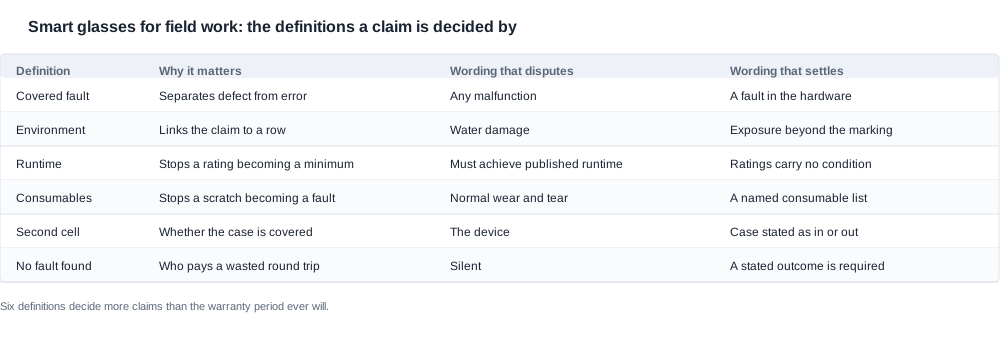
| Definition | Why it decides a claim | Wording that causes disputes | Wording that settles it |
|---|---|---|---|
| Covered fault | Separates a defect from a configuration error | "Any malfunction" | "A fault in the hardware as delivered" |
| Environment | Links the claim to a published row | "Water damage" | "Exposure beyond the published marking" |
| Runtime | Stops a rating becoming a minimum | "Must achieve the published runtime" | "Rated figures carry no test condition" |
| Consumables | Stops a scratch becoming a defect claim | "Normal wear and tear" | "A named consumable list" |
| The second cell | Decides whether the case is covered | "The device" | "The case is stated as in or out" |
| No fault found | Decides who pays a wasted round trip | Silent | "A stated outcome for a non-reproducing unit" |

The cost side of a return, which the warranty rarely reaches
A warranty is usually read as a schedule of what is replaced free. In a field deployment the larger half of the cost sits outside that schedule, and it is worth naming before the negotiation rather than after the first claim.
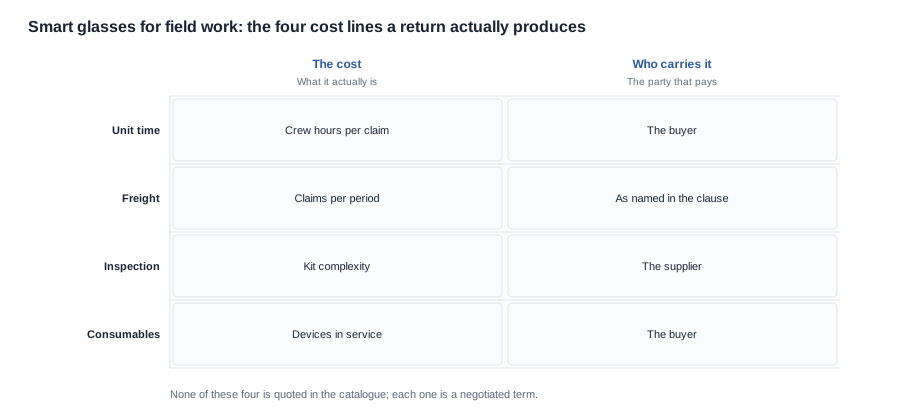
The unit time. A device at the bench is a device not on a site. The cost of that is a crew without the tool it was issued, and it is paid by the buyer whether or not the claim is accepted. In a small deployment the number of affected crew hours is small enough to ignore, and in a multi-site deployment it is the largest single item in the returns budget. A clause that states the replacement or credit timeline in working days is therefore a commercial clause in substance, even though it sits in the warranty.
The freight and the inspection. Both directions, plus the inspection labour, plus the handling of a unit that arrives with a kit attached to it. The inspection cost is the one that grows silently: a returns bag containing a device, a case, a cable and consumables takes longer to inspect than a bare device, and the first inspection in a returns process is usually slower than the last. The clause should state who carries the freight in which direction and for which outcome, including the no-fault-found case, because that is the outcome where the freight is pure cost.
The consumables consumed by the round trip. A returned unit arrives with a used cleaning item and a used contact item, and those are consumed whether or not the device is replaced. For a large fleet the aggregate is a managed supply line rather than an incidental expense, and it is the number to negotiate as a per-device-per-week rate rather than per box.
The evidence cost. Every claim requires a file, and the file is assembled by somebody at the site who is not a technician. The unit time of that person is a real cost and it scales with the number of claims, not with the number of devices. A short, specific evidence list reduces it directly, and the diagnostic procedure that produces the file is at field work troubleshooting.
The number that tells a buyer whether any of this is being managed is the no-fault-found rate. A high rate means the claim route is not matching the fault, which usually means the definition of the covered fault is wrong, or the site is raising claims it should be solving locally, or the diagnostic procedure at the site is not the one that was agreed. It is also the metric that quietly consumes the returns budget, because each no-fault-found round trip consumes the same freight and the same crew time as an accepted claim and produces no replacement.

Building an evidence file that survives a dispute
The difference between a claim that is honoured and one that is disputed usually comes down to whether the file was assembled as evidence or as a complaint. There are six elements, and every one of them is available before the unit leaves the site.
- The identity of the unit, not only the model. The designation on the unit, and the purchase order it came from. A kit of several items has several designations, and a claim that names only the model cannot be traced to a unit.
- The published rows in force on the order date. The catalogue changes. A claim argued against a cell capacity that has since been revised will be resolved against the wrong row, so the buyer should keep a dated snapshot of the catalogue entry for each ordered model, and attach it to the contract rather than to the claim file. The row set is small — the cell capacity, the rated runtime, the charge time as a ceiling, the charging interface, the radio version where published, the resolution class on camera models, the case capacity where published.
- The symptom with the mode. What the device was doing, in the configuration's own terms.
- The environment, with the published marking reproduced rather than paraphrased. Where the marking exists at all, which is on two models in this range.
- The separation of the two candidate causes. Which of environment and unit was ruled out, and by what measurement.
- The history of the unit. Whether it has been through a bench before, and what the previous outcome was. A repeat fault on the same unit is a different case from a first fault, and the second one should not restart at zero.
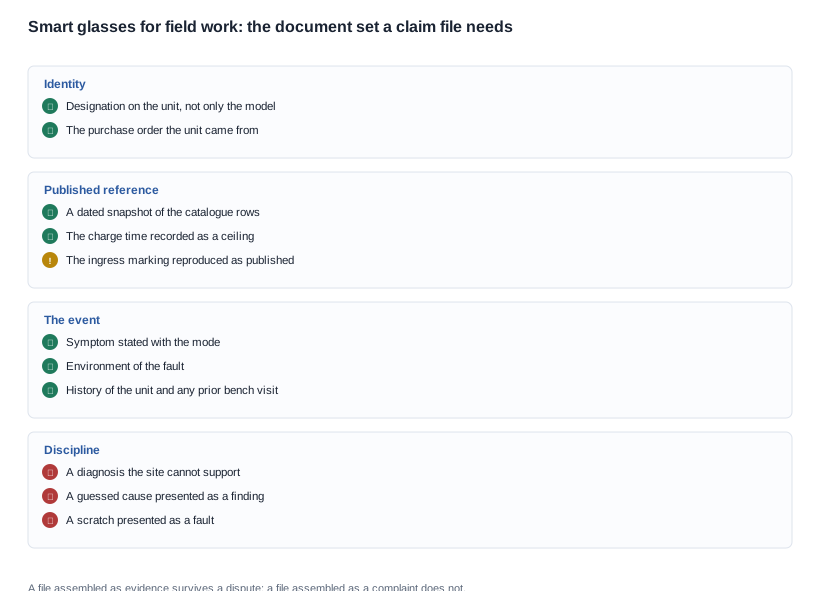
What does not belong. A diagnosis the site cannot support. A photo of a scratch presented as a fault, which is a returns question and not a warranty question. An expectation written as a specification, such as the published charge time being treated as a maximum that the device must beat, or an ingress expectation beyond the published marking. And a guessed cause — "the battery is faulty" — where the file only establishes that the device stopped working.
The clauses worth negotiating on a multi-site deployment
Eight clauses carry the commercial weight in a field warranty, and they are worth negotiating in a specific order because the earlier ones change the cost of the later ones.
- The covered fault definition. Settled first because everything else inherits it. The wording should recognise a hardware fault as the covered event and leave the environmental and configuration cases outside it explicitly.
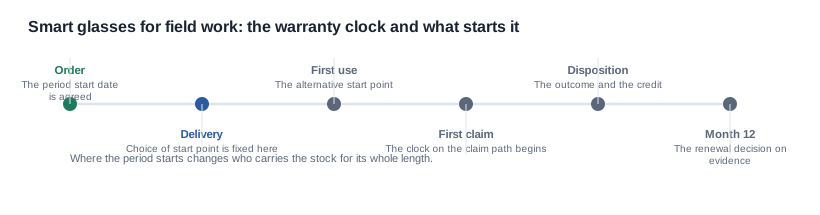
- The start of the period. Delivery, activation, or first use. First use is the hardest for a supplier to administer and the easiest for a buyer to defend, because a device can sit in a warehouse for two months.
- The outcome and the clock for each outcome. Replacement, repair or credit, with a working-day figure for each. A clause that names a replacement timeline effectively prices the crew time the buyer is carrying.
- The non-reproducing unit. What happens when the bench finds nothing. Credit, replacement on request, or a return at the buyer's cost. This is the clause that decides whether the no-fault-found rate is expensive or merely inconvenient.
- Freight allocation by outcome. In both directions, and separately for accepted, rejected and non-reproducing claims.
- The case population. Whether the charging case is in or out, and whether it carries the same period.
- The consumable list. Named items, excluded from the claim population by definition rather than by argument.
- The conformity and documentation obligation. What the supplier maintains, and what is produced before shipment rather than on request afterwards. The requirements are collected at certification checklist, and the documentary chain for a shipped cell is at battery transport.
How the claim path should run. Four steps with a named owner each: receipt and identity check at the returns desk, inspection against the agreed protocol, a stated outcome against the stated clock, and a disposition of the unit that the buyer is told about. A path with three steps and no outcome names is a path where the buyer absorbs the delay.

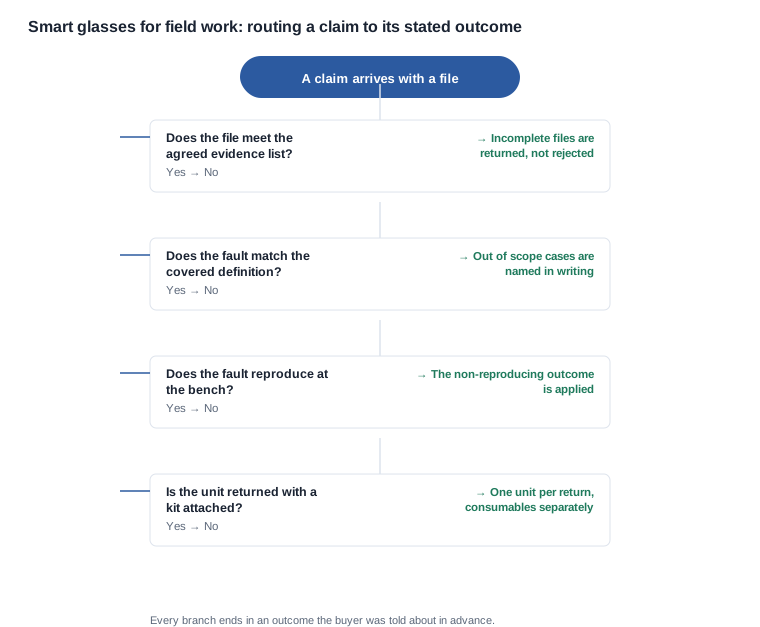
What we will and will not put in writing. Our position is that the catalogue publishes the rows a buyer can order from — the cell capacity, the rated runtime, the charge time as a ceiling, the charging interface, the radio version on the connected models, the resolution class on the camera models, the case capacities where they are published, and the ingress marking on the two models that carry one — and that it publishes no warranty period, no return window and no packaging specification. We will agree a period, a scope, a claim path and a document set in the contract, and we will put the dated catalogue rows into that contract so that both sides argue against the same reference.
We will not write a clause that guarantees a runtime against a rating the catalogue publishes without a test condition, and we will not state that any model carries a certification that the catalogue does not record for it. What we will do is take the deployment, the fleet size, the environment and the market, and tell you which models fit, which published rows apply, which documents have to be settled before the order, and which terms in the warranty are the ones that will decide the cost. The clause language is at contract terms, the commercial structure of a first order is at pricing, and the upstream selection logic is at choosing smart glasses for field work.
Related reading
- Where this scenario begins — smart glasses for field work
- The diagnostic route — field work troubleshooting
- The deployment template — the field work deployment template
- The published data rows — battery life and IP ratings
Send us the fleet size, the environment, the kit contents and the markets, and we will return the warranty definitions that will decide the cost, with the published rows attached to them.


