
The questions parents ask about smart glasses for kids are not technical, and the temptation for a supplier is to answer them technically. That is the wrong register, and in one case it is also a route into a regulated claim. The more useful reframing for a buyer is that every one of these questions is a procurement input: a question the catalogue can answer is a question that costs nothing to publish, and a question the catalogue cannot answer is an open item that has to be closed with a written supplier answer or a legal determination before the product page goes live. The set below is therefore a due diligence list with a human voice, not a set of published answers.
Smart glasses for kids parenting: a parent question is a procurement input
Two of the three models in this catalogue's children's line carry a posture-and-distance indication, and the single most common question is what it does for a child's eyesight. We make no vision claim, no health claim and no safety claim, and the reason is not caution for its own sake. It is that our source material does not support one, and because a claim of that kind is the kind a regulator and a parent will both act on.
The catalogue position behind every answer below. The A05 and the A06 print a 40 mAh cell, a charge time of two hours or less, a rated use of about twenty hours, magnetic charging, a lens-type electronic atomiser module and a posture-and-distance indication. The A07 prints a 70 mAh cell, the same charge time, the same rated use, magnetic charging and a Bluetooth V5.4 radio. The A05 and the A06 print identical rows and the catalogue prints no row that separates them. Nothing is published for frame weight, frame size, lens material, coating, ingress position, storage behaviour, data location, application ownership, detection method or per-model certification.
The three groups a question can fall into, and they have different costs. A question answered by a published row costs one line of copy and can go live today. A question answered by a written supplier answer costs a request, a date and a document, and it has a lead time. A question answered only by a determination costs a legal or compliance function and it blocks the listing until it lands. A buyer's total cost in this category is the sum of the three, and the reason a question set is worth working through before the order rather than after the first ticket is that the third group is the one with no deadline you can set by asking nicely.
What a parent's question tells you that a specification sheet does not. The question set is the shortest available market research. A cluster of questions about the lens state tells you the household expectation is about clarity, and the answer has to be in the listing or the returns will say it. A cluster about data tells you the household expects an answer the documentation does not contain, and that cluster is the one most likely to become a regulatory question in a destination market that has not been determined.
Why the answer set is written in the buyer's terms and not the parent's. A parent asks "does it protect my child's eyes". A buyer has to turn that into a compliance question with a market, a product and a date attached. The transformation is the work, and doing it before the order is the difference between a claim your legal function signed and a claim a support agent said out loud.
Seven questions, and the answer available for each today
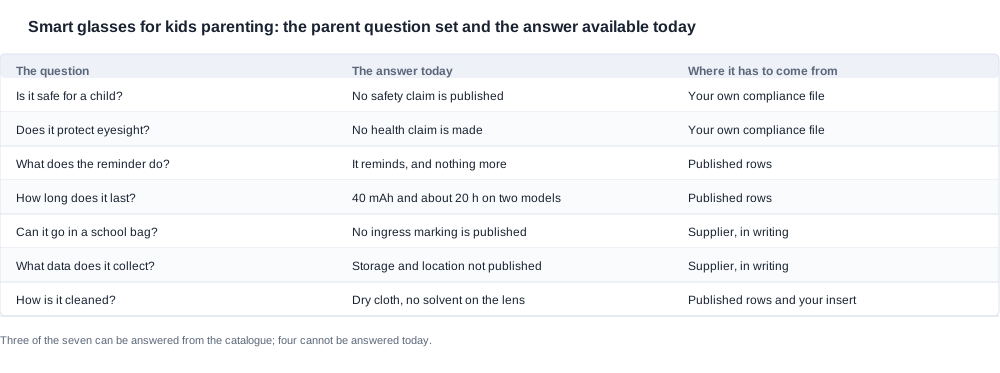
| The question | The answer today | Where it has to come from |
|---|---|---|
| Is it safe for a child? | No safety claim is published | Your own compliance file |
| Does it protect eyesight? | No health claim is made | Your own compliance file |
| What does the reminder do? | It reminds, and nothing more | Published rows |
| How long does it last? | 40 mAh and about 20 h on two models | Published rows |
| Can it go in a school bag? | No ingress marking is published | Supplier, in writing |
| What data does it collect? | Storage and location not published | Supplier, in writing |
| How is it wiped down? | Dry cloth, no solvent on the lens | Published rows and your insert |
"Is it safe for a child?" has two parts, and the second one is not settled. The product itself is a pair of glasses with a small electronics module and a rechargeable cell, and the published figures are 40 mAh with a charge time of two hours or less and a rated use of about twenty hours on two of the three models, and 70 mAh with a comparable rating on the third. The conformity position is the part that is not settled: in our own documentation the children's line has no conformity position recorded, and the requirements for children's eyewear in Europe and the United States are additional to the standard ones, with EN 71 in Europe and ASTM F963 in the United States commonly referenced in this category, though whether either applies depends on the product, the market and the claims made. Until that is confirmed, a brand should not list this product in a children's category in a given market on the strength of a general company declaration.
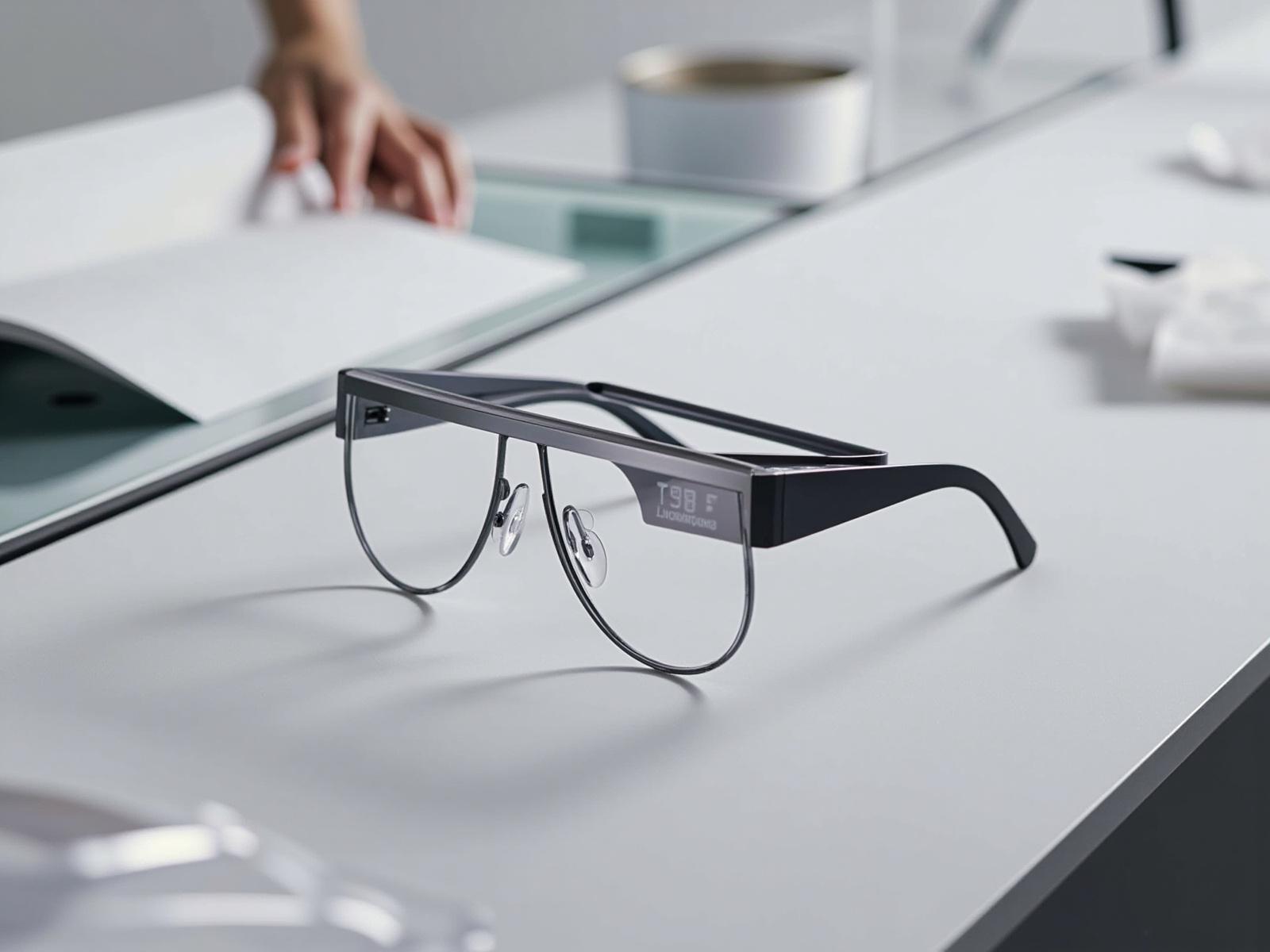
"Does it protect my child's eyesight?" gets a straight answer, and the straight answer is no claim. The catalogue describes the two models concerned as carrying a posture-and-distance indication with a reminder, and the page shows a correct and an incorrect posture-and-distance state. That is a prompt: something is observed and the person is told. Whether that is appropriate for a particular child, at a particular age, with a particular pattern of close work, is a question for a parent and their own professional adviser, and it is emphatically not a question a factory or a retailer should answer. The practical reason is as much commercial as legal: a product page that says "protects against myopia" is a claim that will be challenged, and the party that has to defend it is whoever printed it.
"What does the reminder do?" is the question the listing should answer in full. It is a prompt that can be ignored, it is governed by a setting that is not published, and it does not enforce anything. The A05 and the A06 carry it; the A07 does not, and the A07 is a different product with a different radio rather than a cheaper version of the same one. A listing that describes the indication without saying what it is not will produce a return, because the household expectation is set by the omission.
"How long does it last?" needs the figure and the caveat. Two of the three models are listed at 40 mAh with a rated use of about twenty hours, and the third at 70 mAh with the same rated use. No test condition is published for any rated figure in this catalogue, so the honest reading of "about twenty hours" is a number under conditions we cannot describe. For the A05 and the A06 the charge time is two hours or less, which is a ceiling: it allows exactly two hours, and it is not the same claim as under two hours.
"Can it go in a school bag?" is a question this catalogue cannot answer at all. The IP54 marking in this catalogue sits on two sport camera models, and it is not on the A05, the A06 or the A07, so there is no ingress marking to quote for the children's line. The truthful answer is that no ingress position is published for these models and it has to be obtained in writing from the supplier. It is also the question most likely to be answered casually by someone who has seen IP54 on another page of the same catalogue, which is exactly why it belongs in the due diligence list rather than in a support macro.
"What data does it collect?" is a legitimate question with no published answer. The storage behaviour, whether a companion application uploads to a service, where any data is stored and who owns the application are all not published for most models in this catalogue, and the application and firmware customisation for this tier is recorded as awaiting verification. Our own view is that a product for children should have that answer written down before it is sold rather than after a parent asks, because it is one of the things that separates a product that can go into a school from one that cannot.
"How is it wiped down?" is answerable, and the answer is restrictive on purpose. A dry cloth, one pass, and never a solvent on a coated lens. The A05 and the A06 are built around a lens-type electronic atomiser module, which means the lens is a different construction from a standard one and responds differently to alcohol, ammonia and household glass cleaner. A hazed lens is permanent and reads like a manufacturing defect. The fogging-versus-dirt distinction matters too: if the lens is in its atomised state, wiping it will not help, and that is a different problem with a different answer.
Which question needs a compliance file before the listing
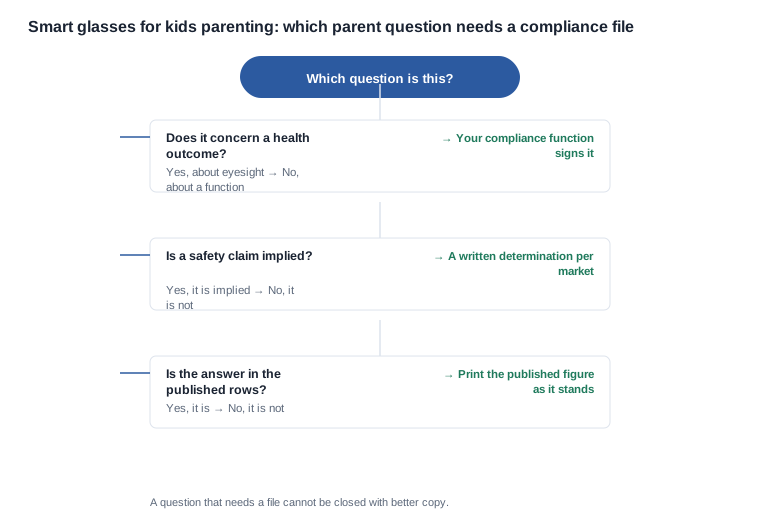
Three questions in the set cannot be answered by a copywriter or a supplier, and they are the ones that decide whether the listing can go live at all.
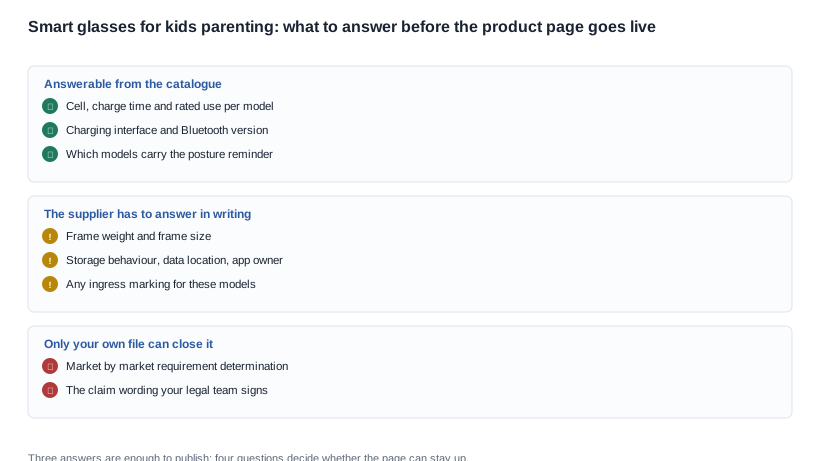
The first branch is the health outcome. Any question that concerns eyesight, protection, or a clinical result is not answered at the desk and not answered by a factory. It is routed to your legal function, and until that function has answered it in writing, the question is not answered at all. This is the branch where a fast and confident answer does the most damage, because it is the answer the household repeats.
The second branch is the implied safety or conformity claim. A question about whether a product is safe for a child, or what a market requires, is answered by a determination, and a determination is a document with a scope: the product, the market, the age range and the claims. The determination has to exist before the listing, because a listing that has already been published cannot be brought into scope retroactively.
The third branch is the published row. If the answer is in the catalogue, it is printed exactly as the row states it, with the caveat attached, and no creativity is applied. "A charge time of two hours or less" is printed as two hours or less. "A rated use of about twenty hours" is printed with the absence of a test condition stated. A buyer's rule here should be simple: if a sentence could be read two ways, the published row is printed and the interpretation is left to the reader.
What to do with a question that is none of the three. It goes on the open list with a date against it and a named owner, and it is answered in writing before it appears anywhere a parent can see it. The most common failure in this category is answering a question on a product page because a support agent needed to say something, and then defending the wording for years.

How a question becomes a published answer
The routing below is what keeps the answer set consistent and what makes it cheap to maintain, because every question is answered once and then answered everywhere.

The question is logged with the model designation attached. The A05 and the A06 print identical rows, so a question logged without the designation cannot be answered from any published row, and a question answered from the wrong designation is worse than a question left open.
The published rows are checked before the unit in front of the desk. The order matters, because a question that has a published answer should never become a diagnostic investigation. A unit-specific diagnosis applied to a published question produces an answer that depends on who was on the desk that day.
A published answer is given the same way every time. Not approximately the same way, the same way. This is a procurement control rather than a service nicety: inconsistent answers are the mechanism by which a brand ends up with two product pages that say different things about the same model, and the second one is the one a regulator reads.
An unpublished question becomes a written request. The request names the model, the row, the market and the date, and it is tracked in the same way as a purchase order. This is the mechanism that turns a support problem into a supplier-management problem, which is the only place it can actually be solved.
An outcome question is escalated and is not answered by the desk at all. It is routed to your legal function, and the listing carries the boundary statement until the answer comes back. Nothing else in the routing is as important, because the cost of a wrong answer here is paid by the brand and not by the supplier.
Every answer is written back to the product page. This is the last step and the one most channels skip, and skipping it is why the same question gets asked by the tenth family. The answer set is a living document, and the trigger for revising it is a recurring question, which is the cheapest market research available.
The due diligence list behind the question set
Read the other way round, the question set is the list of things that have to be closed before the first order, and the matrix below is that list with the owner and the deadline attached.
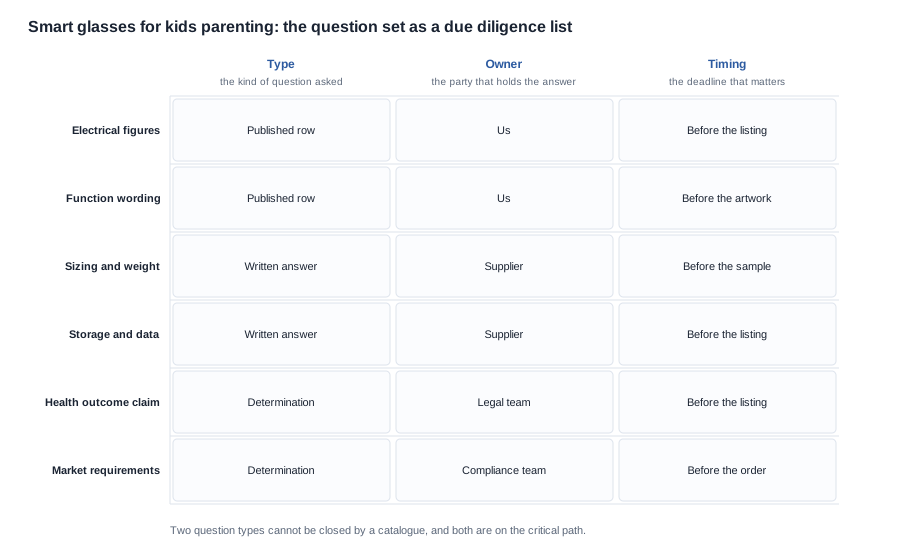
Two of the six question types cannot be closed by a catalogue, and both sit on the critical path. The written supplier answers and the legal and compliance determinations both have lead times, and a buyer who starts them after the artwork is commissioned has already lost the ability to change the artwork. The order of operations is the whole of the advice in this section: rows first, artwork second.
The published-row questions are free, and they should be used as the skeleton of the listing. Cell capacity, charge time, rated use, charging interface, the Bluetooth version where it exists, the presence of the indication on two of the three models, and the deliberate statement that no ingress marking is published for these models. That last one is worth putting on the page, because a question left unanswered on a page is a question a parent asks a support agent, and a stated absence is a shorter answer than an evasion.
The red flags in a draft answer are specific and easy to spot. A safety sentence with no published basis. A performance adjective where a published row should be. A conformity sentence resting on a company-level declaration that the catalogue's own text does not extend to any individual model. A charge time written as under two hours when the row says two hours or less. A weight quoted for a model that does not have one, which in this catalogue means every model except one.
What to negotiate, and what to leave alone. The document set, the reason code, the response commitment and the written-answer service level are all worth negotiating, because they decide what the support function costs. The certification cost and lead time, the conformity determination and the age range on the listing are not negotiable terms at all; they are determinations, and they belong to a different part of the organisation.
How to choose a supplier on the strength of their answers to these questions. A supplier who answers all seven, or who states plainly which ones they cannot answer and when they will, is worth more than one who answers all seven vaguely. The published-row answers should be identical for every supplier, so the difference between them shows up entirely in the two unpublished groups, and that difference is the only thing a buyer is really choosing between.
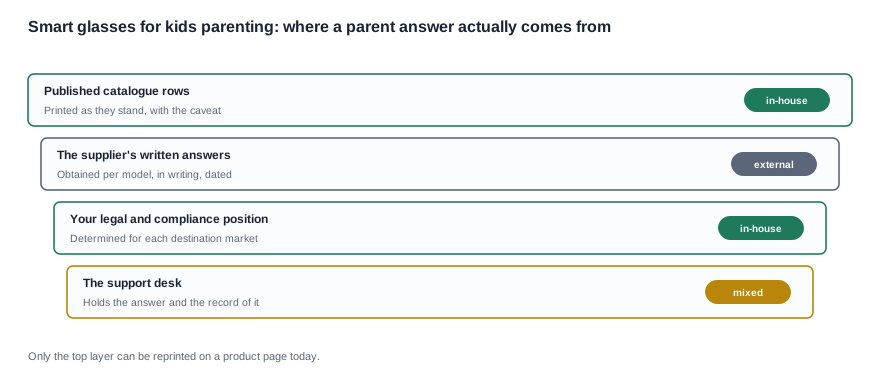
Our position. We publish the per-model figures for the children's line: cell capacity, charge time, the rated runtime with its stated caveat, the charging interface, the Bluetooth version where it is listed, and the presence of the posture-and-distance indication on two of the three models. We mark as not published the conformity position, the detection method and its accuracy, the frame weight, the frame size, the storage behaviour, the data location, the application ownership, the coating type and the certification numbers. We will not describe the indication as a vision or health benefit, we will not describe the children's line as certified, and we will not tell a parent that a device is safe for their child. What we will do is give a brand the published facts, mark the gaps precisely, and tell you which of them need a compliance file rather than a paragraph of copy.
What to send us next. Send the market, the model, the volume and the age range the product is intended for, and we will tell you what can be stated, what has to be confirmed, and what we would not put in a listing.
Related reading
- Kids smart glasses range
- Troubleshooting the children's models
- The support pack a parenting channel needs
- Wiping lenses without damaging them
Send the market, the model and the volume, and we will tell you which of the seven questions you can publish today and which two need a file.


