
Most of what a parent reports about smart glasses for kids parenting problems is not a fault at all. It is a unit that was switched off in a school bag all day and is flat by four in the afternoon, a magnetic dock that has grit on its contacts, a companion application that updated on the phone and no longer matches the device, or a lens that is in its atomised state rather than its clear state. A troubleshooting guide that opens with a defect sends a parent to replace a unit that needed a wipe. That is why the triage order below matters more than the fault list, and why a procurement manager should treat the triage tree as a costed asset rather than as a customer-service courtesy.
Smart glasses for kids parenting: a triage tree is a costed asset
The three children's models in this catalogue are small, simple and identically published, which makes the triage problem unusually tractable and unusually expensive to get wrong. The A05 and the A06 print identical rows — a 40 mAh cell, a charge time of two hours or less, a rated use of about twenty hours, magnetic charging, a lens-type electronic atomiser module and a posture-and-distance indication — and the catalogue prints no row that separates the two designations. The A07 prints a 70 mAh cell, the same charge time, the same rated use, magnetic charging and a Bluetooth V5.4 radio, with no indication function on its page.
Set against that, four of the most common parent reports are states of the device rather than faults inside it. A 40 mAh cell with a rated use of about twenty hours sounds generous until you realise that a rated figure describes a duty cycle nobody publishes, and that a unit powered off in a school bag consumes nothing at all and is therefore at whatever state it was left in. A household that reads a flat battery at four in the afternoon as a defect will return a working unit, and that return will cost the channel a return, a re-stock, a replacement and a review.
The procurement consequence is that the triage tree belongs in the agreement. A supplier who can answer the six triage questions in writing has answered the six questions that decide whether a return is a return. A supplier who cannot has told you that the after-sales cost of this product is unquantified, and the buyer should price that in rather than discover it. The desk hours, the return freight, the credit notes and the replacement units are all costs, and the cheapest reduction available in this category is a triage order that is published, agreed and trained on before the first shipment.
The second consequence is that the return reason has to be coded, from day one. A triage tree nobody measures is an opinion. A triage tree that produces a coded reason for every contact is a defect rate, a return rate and a per-reason cost, and those three numbers are what a buyer uses to decide whether to reorder, to change the configuration, or to change the copy. Without them, the only available response to a rising return count is a discount, which is the most expensive way to solve a problem that a spreadsheet would have solved.
Seven parent reports, and what is actually behind each
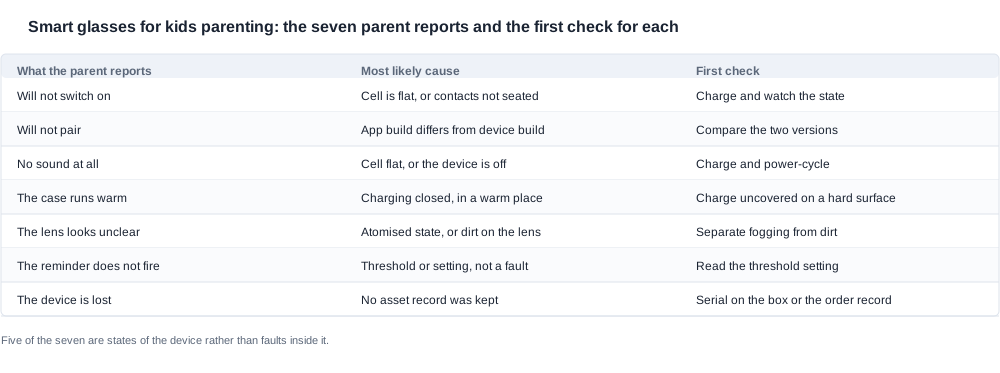
The table below is the working triage reference. It is deliberately short, because a longer reference is a reference nobody follows, and the point of the table is that the first column is a parent's words and the second column is the mechanism behind them.
| What the parent reports | Most likely cause | First check |
|---|---|---|
| Will not switch on | Cell is flat, or contacts not seated | Charge and watch the state |
| Will not pair | App build differs from device build | Compare the two versions |
| No sound at all | Cell flat, or the device is off | Charge and power-cycle |
| The case runs warm | Charging closed, in a warm place | Charge uncovered on a hard surface |
| The lens appears unclear | Atomised state, or dirt on the lens | Separate fogging from dirt |
| The reminder does not fire | Threshold or setting, not a fault | Read the threshold setting |
| The device is lost | No asset record was kept | Serial on the box or the order record |

"Will not switch on" is a charge state until proven otherwise. All three children's models charge magnetically and publish a charge time of two hours or less, which is a ceiling rather than a measurement. A magnetic interface is forgiving in one direction and unforgiving in the other: a unit can be placed in a dock and appear seated while making no contact at all, and a dock that has spent a week in a school bag is the most likely place for that to happen. The first check is therefore a charge, observed rather than assumed, with the unit out of the bag and the dock on a hard surface.
"Will not pair" is almost always a version mismatch. Nothing published for these models states an application build, a firmware build or who owns the companion application, and that silence is exactly what makes this report common: an application that has updated itself on the parent's phone can stop matching a device build that was current when the device was made. The first check is a version comparison on both sides. A reset is the second action, not the first, because a reset destroys the connection record that a support agent needs to read.
"No sound at all" is a state before it is a fault. The A07 is the only model in this children's line that publishes a Bluetooth radio, so an audio question on the A05 or the A06 is a question about a different product and the desk should say so. On the A07, silence with a full charge points to the connection state, the volume state or the unit being off, and the order of checks is the same as for any other device.
"The case runs warm" is a practice problem. A small enclosure charging in a closed case, in a warm place, on fabric, is the most ordinary way to generate heat, and the published charge time gives no guidance about ambient conditions. Charging uncovered on a hard surface resolves it, and the instruction is a one-line addition to the routine card.
"The lens appears unclear" is the distinction most guides skip. The A05 and the A06 are built around a lens-type electronic atomiser module, and their catalogue page shows two lens states — clear and atomised — alongside the correct and incorrect posture-and-distance states. A lens in the atomised state is not a dirty lens, and wiping it will not change it; a lens with dirt on it is not an atomiser fault, and the fix is a dry cloth and one pass. The two are indistinguishable to a parent and completely different to a technician, which is why the check has to name the distinction rather than the symptom.
"The reminder does not fire" is a settings question. The posture-and-distance indication on the A05 and the A06 is a prompt, and prompts are governed by a threshold and a setting that are not published. A prompt that has been muted, or a threshold set so that it never triggers, presents exactly like a sensor fault, and the first check is the setting.
"The device is lost" is an asset-record problem, and it is the only one on the list that the buyer can solve before it happens. The catalogue publishes no serial format, so the number that matters is the one on the box or in the order record. Thirty seconds at the point of delivery turns a lost unit into a found one, and a channel that captures it at delivery has a recovery rate it can quote.
The triage path, and the order the checks happen in
The sequence below is the part of the guide that should be printed, trained on and measured, because the order of the checks is what determines whether a contact costs a minute or a week.
Check one is the identity, and it comes before everything. The A05 and the A06 print identical rows and are not distinguished by any published row, so the desk has to establish which designation arrived before it can apply any published figure at all. A triage that begins with the fault is a triage that has already assumed the answer.
Check two is the charge state. Charge the unit, watch it, and record the result. This single step closes the largest share of the "will not switch on" and "no sound at all" reports, and it produces a recorded value rather than an opinion.
Check three is the pairing path. Compare the application build with the device build. If they differ, the answer is a version, and the version goes into the return record because it is the only way to prove the pairing behaviour later.
Check four is the lens state. Separate the atomised state from dirt, and record which one it was. The catalogue publishes no lens material and no coating, so the desk cannot specify a solvent, and the instruction it can give is a dry cloth and one pass.
Check five is the settings state. Threshold, prompt volume, and whether the indication is enabled at all. The A07 publishes no indication function, so the question itself has a different answer there.
Check six is the second unit. If a second unit in the same household behaves the same way, the cause is systemic and the answer is a configuration or a setting. If only one unit behaves that way, the cause is on the unit and the answer is a return. That one question is the cheapest defect isolation available, and it is the one most desks never ask.

The disposition decision and who signs it
Once the checks are done, the desk is holding one of three situations, and each of them has a different owner and a different cost. Getting this wrong is what turns a cheap triage into an expensive refund.
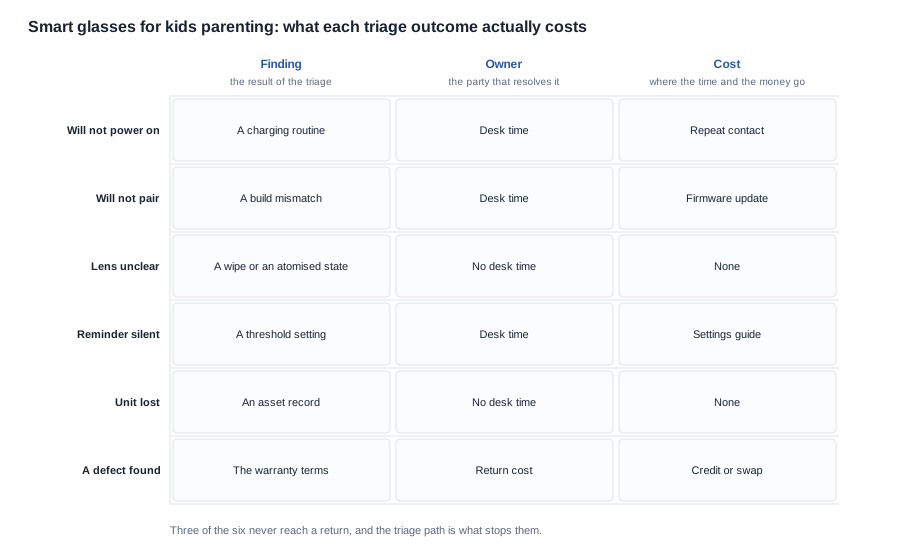
A state, not a fault. The unit works and something about how it is used produced the report. The outcome is a routine and a guide, the cost is desk time, and the return is prevented. These are the cases where the channel saves the most, and they are the cases that a triage tree converts into a guide rather than a replacement.
A fault inside a published row. Something behaves in a way the published specification does not describe. The outcome follows the warranty terms, and the evidence is the captured set. This is the only case that is genuinely a warranty case, and it should be the smallest share of the total.
A fault outside any published row. Something behaves in a way nobody has documented, which for this range is a large category because so much is unpublished. The outcome here is not a return decision at all; it is an escalation to the supplier with the captured evidence attached, and a dated entry on the open list. Treating this case as a defect is how a channel ends up paying for a fault that is really a documentation gap, because the gap keeps producing the same units.
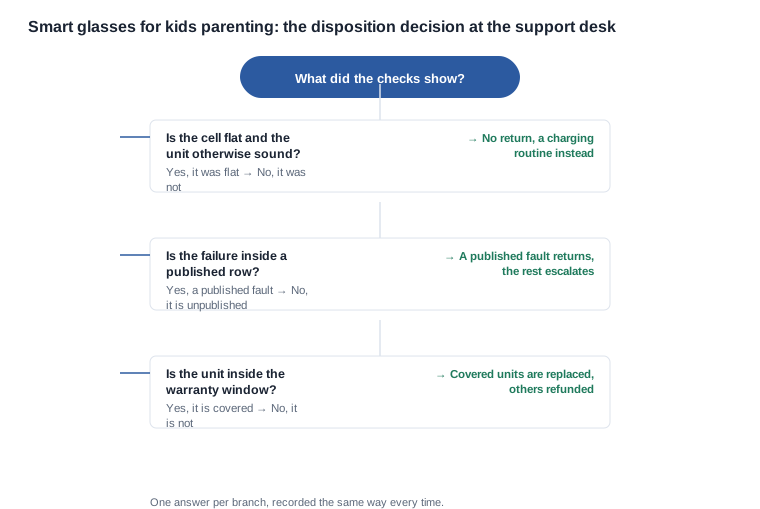
Who signs each outcome is part of the decision and it should not be left to the agent. A state is signed off by the desk. A published fault is signed off by whoever owns the warranty terms, which is a commercial decision rather than a service one. An unpublished behaviour is signed off by the product function, because the answer may change the configuration, the instruction, or the copy. Three signatures, three different departments, and the reason a buyer should know this is that each of them has a different budget attached.

What the desk must capture before a return is authorised
The capture set is what turns returned units into a usable defect statistic, and it is the difference between a support function that measures itself and one that argues with its suppliers. It is short, and it is worth having it written into the agent's script rather than left to habit.
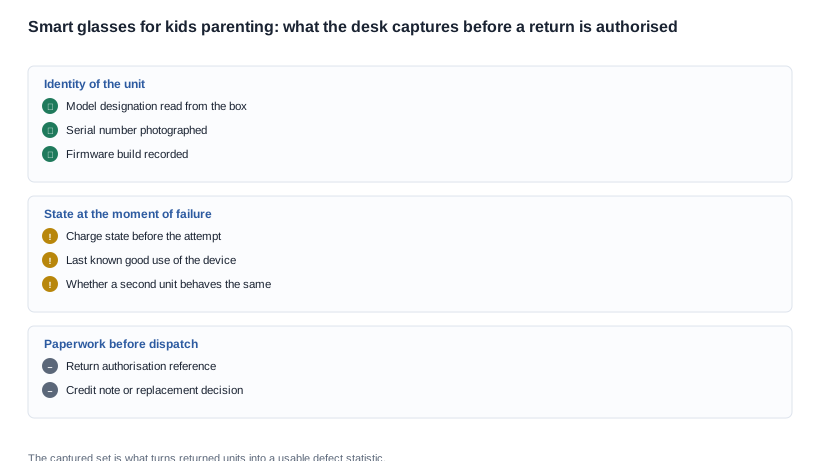
The identity set is three fields and none of them is optional. The model designation read from the box, because the A05 and the A06 cannot be told apart from any published row. The serial number, photographed, because it is the only link to the delivery record. The firmware build, recorded, because the connection behaviour is the most common report and the build is the only evidence that will explain it later.
The state set is three questions asked at the moment of the report. The charge state before the attempt, the last known good use, and whether a second unit in the household behaves the same way. These three are cheap to collect and they are the difference between a defect rate and a pile of returns.
The paperwork set is two fields that are often skipped and should never be. The return authorisation reference, and the credit note or replacement decision, recorded before the unit is dispatched rather than after. A return that arrives without a reference cannot be counted against a reason, and a return that cannot be counted is a return that happens again.
The one field that should be added before launch is the reason code itself. A closed list of six or seven reasons, with the states and the faults separated, applied to every contact whether or not a unit comes back. The reason code is the instrument that turns this whole routine into a measurement, and it costs nothing but a decision taken before the first shipment.
The support clock, and the terms it runs on
The clock and the reason code are the two things a buyer should have agreed in writing before the first order, because neither can be imposed on a supplier after the fact and both determine what the after-sales function costs.
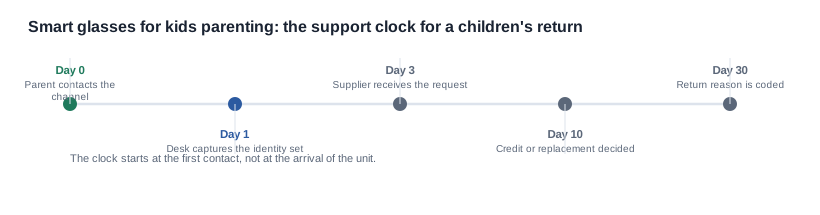
The clock starts at the first contact, not at the arrival of the unit. The interval between the two is the channel's cost and it is invisible unless it is measured, and the measurement is free if the reason code is in place from day one.
The warranty terms for this range are not published, so they are contract terms you write. The catalogue publishes the electrical rows and nothing about the clock, its length, the cost split on a return, whether a restocking fee applies, or which defect codes count as covered. A buyer who expects a standard warranty term here is expecting something the documentation does not contain, and the cost of finding that out is the return freight and the desk hours on the first shipment.
There is one reason in this category that a warranty cannot fix. A household that bought the product expecting a health outcome and received a reminder function will return it, and no warranty term changes the expectation, because the expectation came from the listing. That is a copy problem, and it is solved in the copy, and it is the reason the claim boundary has to be written before the first order rather than after the first review.
Two questions to ask the supplier before you order. Whether a return is accepted for any reason within a stated window, or only for a defect that falls inside the published rows, and whether the reason code on a return is recorded in a form the channel can aggregate. The first determines the shape of the returns desk; the second determines whether the returns desk produces information.
How to choose a supplier on after-sales capability when the figures are unpublished. The criteria that survive contact with a deadline are behavioural rather than numerical: does the supplier answer the six triage questions in writing, will they accept a returned unit against a published fault without arguing the definition, and do they record a reason code on a return in a form you can aggregate. A supplier who answers all three is worth a premium on unit price, because the premium is bounded and the alternative is not.
Our position. We publish the per-model figures for the children's line: the cell capacity of 40 mAh on the A05 and the A06 and 70 mAh on the A07, the charge time of two hours or less, the rated use of about twenty hours, the magnetic charging interface, the Bluetooth V5.4 on the A07, and the presence of the posture-and-distance indication on two of the three models. We mark as not published the conformity position for the children's line, the detection method and its accuracy, the frame weight, the frame size, the storage behaviour, the data location, the application ownership, the coating type and the certification numbers. We will not present a company-level declaration as model-level coverage, and we will not describe the indication as a vision benefit.
What to send us next. Send the destination market, the model, the volume, the age range the product is intended for, and the reason codes you intend to use, and we will tell you which published figures support the triage, which steps have to be closed by a written answer, and which cases will escalate to your product function rather than to your returns desk.
Related reading
- Kids smart glasses range
- Parent questions answered
- Wiping lenses without damaging them
- Returns and warranty handling
Send the market, the model and the reason codes, and we will mark which triage steps the published figures close and which need a written answer first.


