

Smart glasses for livestreaming budget decisions come down to six cost lines, and the unit price is the smallest of them. That is the whole of the framework: a livestreaming channel spends once on the device and then spends repeatedly on the case, the lead, the spare unit and the returns that follow, and the only one of those that appears on a purchase order is the device. A budget built from a quotation alone is a budget that will be wrong by the second season, and the correction is not a better negotiator — it is a larger set of lines.
Smart glasses for livestreaming: the unit price is the smallest line
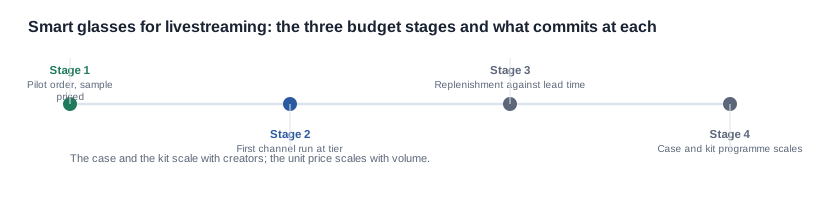
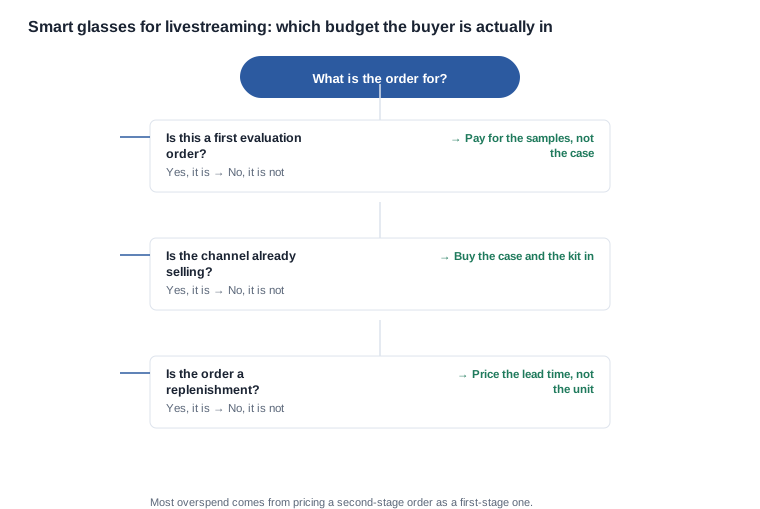
The three budgets a livestreaming buyer actually has. The first is a buyer starting a channel who needs one unit type that survives a four-hour session and has no volume yet. The second is a seller who is already trading and wants a second line with a camera, or a second camera tier. The third is an operator who has run out of units and needs a replenishment channel with a short lead time. Those are three different questions, and most overspend comes from pricing a second-stage order as though it were a first-stage one — buying the case programme and the spare programme for a channel that has not yet proved the format.
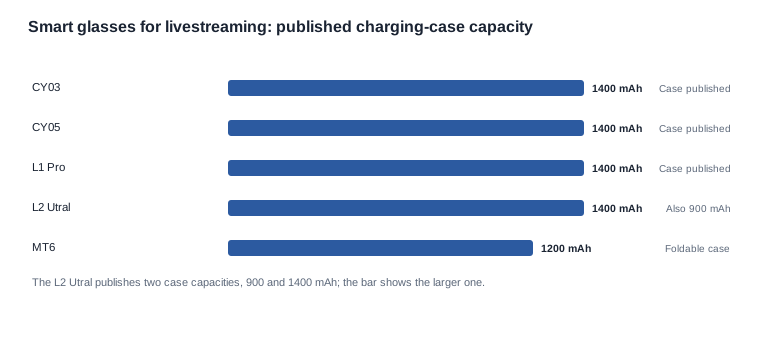
What the published numbers let you do, and what they do not. Among the eleven camera models in this catalogue the cell capacities run 220 mAh on the V03 and the V03 Pro, and the MT5, 260 mAh on the KY06 and the V06, and the S7, 265 mAh on the MT6, and 290 mAh on the L1 Pro and the CY05, and the CY03 and the L2 Utral. The charge time is stated as two hours or less across the whole camera range. The rated use is published as a band of five to eight hours on the S7 and the V03, and the V03 Pro and the V06, a band of six to eight hours on the KY06 and the MT5, and about seven hours on the CY03 and the L1 Pro, and the MT6 and the L2 Utral, and the CY05. The charging cases are published at 900, 1200 and 1400 mAh, and the L2 Utral is offered at both 900 and 1400 mAh.
Those are the numbers you can put in a spreadsheet. What you cannot put in a spreadsheet is a streaming endurance figure, a field of view, a frame rate, a recharge count, a case charge time and a power profile, because none of them is published for any model. A budget that depends on any of those is a budget with a hole in it, and the honest way to write it is with a named assumption and a date attached to it, not with a number borrowed from a neighbouring table.
The correction to the way most of these budgets are drawn. A rated runtime with no test condition is a ceiling reached under favourable conditions with the device otherwise idle, and a live broadcast is a camera workload, which is the least favourable condition the figure could describe. Budgeting a session plan against "about seven hours" is therefore budgeting against the wrong end of a range, and the practical reading is that the case becomes the buffer rather than the frame cell.
The six cost lines a livestreaming order actually has
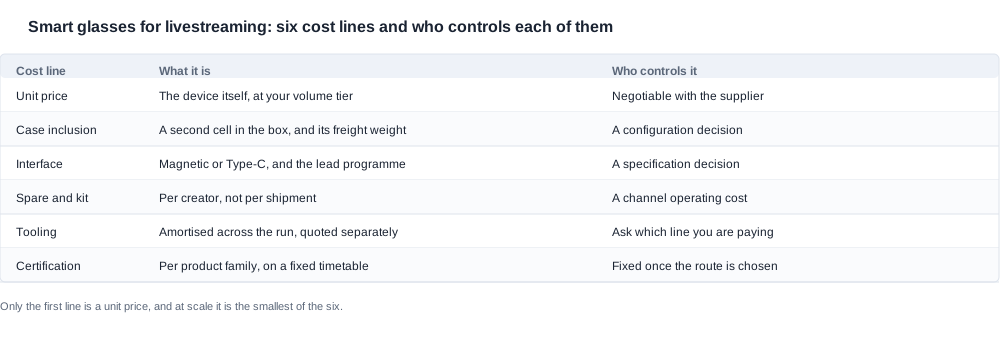
Line one, the unit price, is the one that stops when the order stops. It is a function of the volume tier, the configuration and the terms, and it is the line everybody negotiates first. It is also the line most likely to be squeezed, which is why it is also the line most likely to hide a cost that has been moved somewhere else.
Line two, the case, is a configuration decision with a freight tail. If the channel ships with a case, the case capacity and the case's own dimensions travel with every parcel. The 1400 mAh cases on the CY03, the L1 Pro and the CY05 are the heaviest part of the packaging, and the 1200 mAh folding case on the MT6 is the one that changes how a creator stores the product between sessions. On a channel that ships the device directly to a creator, that parcel is a shipping cost and a transit file, not a freebie.
Line three, the interface, is a recurring programme rather than a one-off. A magnetic interface and a Type-C interface are different unboxing experiences and different accessory programmes, and the lead is a consumable that repeats. The camera range publishes Type-C on the V03 Pro and the L2 Utral, magnetic on the S7 and the V06, the MT5 and the V03, and the KY06, and publishes no interface row at all for the CY05 and the L1 Pro, and the CY03 and the MT6. A team that already carries one cable type has a real saving available, and it is worth writing into the specification rather than discovering at the packing bench.
Line four, the spare and the kit, is the per-creator cost. A creator who needs a spare lead, a spare unit and a case every season is a channel operating cost, and it scales with the number of people streaming rather than with the number of units ordered. A budget that counts these per shipment is a budget that is short every season, and the cheapest fix is a count per creator written into the kitting sheet.
Line five, tooling, is often amortised and often hidden. Tooling is frequently quoted as part of the unit price across the first order, and the consequence is that a buyer cannot tell what the tooling actually cost, cannot amortise it across a larger run, and cannot tell whether the unit price at the next tier is genuinely lower. Ask for tooling as its own line, with the amortisation stated, and the second tier becomes a real price rather than a hope.
Line six, certification, is a per-family cost on a fixed timetable. It follows the process and the testing body, and it does not move because the order got larger. It is the line that is most often bundled with tooling into a single figure, and bundling hides which is which — which means the buyer cannot tell whether a second run in a second market is cheap or expensive.
What the cell and the case decide about the budget
The two numbers that determine whether a budget holds are the cell capacity and the case capacity, and they have to be read together rather than separately.
A scheduled four-hour session is workable on one device with a case. The case exists precisely to cover a long session and to be the thing that is charged overnight between them. On the published rows, a 290 mAh device with a 1400 mAh case is the arrangement with the most headroom in the camera range, and the five models that publish a case capacity are the MT6 and the CY03, the CY05 and the L1 Pro, and the L2 Utral.
A continuous full working day makes the case mandatory rather than optional, and then the case interface matters more than the frame cell. At that point the buyer is buying a power architecture rather than a device, and the questions about the case's own charge time, its pass-through behaviour and its measured recharge count become the questions that decide the budget. None of those three is published for any model.
The case capacity is published for five camera models and it is not published for the rest. The KY06 and the MT5 are quoted with a case whose capacity is not published. The V06 and the S7, and the V03 publish no case row at all, and the V03 Pro has no charging-case row. A budget that assumes a case across the range is a budget with a line in it for four models that do not have one.
The one published weight figure in the catalogue is a shipping number, and it belongs in the budget. The MT6 is published at 158 g, and it is the only model in the range with a published weight at all; it is a foldable-case camera model and the figure covers the device, not the case. A channel that ships directly to creators has a parcel weight and a freight rate, and 158 g is the only number in this catalogue that can be used in that calculation.
How to choose between two case configurations, which is a choice the buyer can make cheaply and later cannot. The criteria are three: which configuration the case row supports for that exact model, which one the transit file will cover without a separate submission, and which one the creator's bag actually has room for. The L2 Utral is the only camera model where the case capacity is a configuration choice rather than a fixed attribute, which means the decision changes the artwork, the parcel dimensions, the freight and the transit file together, and it is a decision worth making before the artwork is commissioned rather than after.
The case decision and the model decision are not the same decision, and a buyer who makes them in the wrong order pays twice. The model determines whether a case row exists at all. The case configuration then determines the capacity. The order that works is model first, then case row, then capacity, then kit, and any ordering that starts with the kit produces a specification that has to be redrawn once the model is fixed.
What is not published and therefore has to be measured, and the three measurements that close the budget. The case's own charge time, the measured recharge count and the endurance figure under a camera-active load. All three are obtainable on a sample in a day, and all three are worth more to a budget than a further round of unit price negotiation, because a wrong unit price is a percentage and a wrong buffer assumption is a whole season.

Three budgets, three different decisions
At the first stage, the sensible allocation is one model, one case configuration, standard packaging and no customisation. A brand logo and a printed box are the two customisation items that cost little in tooling and a great deal in perceived value at the point of sale. The one thing to spend on at this stage is the sample programme, because it is what closes the four unpublished camera rows, and those rows decide whether the model survives the first session at all.
At the second stage, the question is whether the second line should be a different camera tier or a different use. The 13 MP models are the L1 Pro and the S7, and the L2 Utral, and the 8 MP models are the KY06 and the V03 Pro, the CY05 and the V06, and the MT5 and the V03, and the MT6 and the CY03. The published material gives no field of view, no video format and no frame rate for either tier, so a second tier is not a documented imaging upgrade — it is a resolution figure, and whether that is worth a tier is a question to settle on a sample. The V03 Pro carries photochromic lenses and a flexible temple and is published in three colours, which is a different proposition for a channel that sells eyewear rather than electronics, and that route may serve some channels better than a second camera tier does.
At the third stage, the budget question stops being about unit price and becomes about replenishment risk. That is a lead time and a stock question rather than a pricing one, and the published position is that production capacity, slots and lead times are not published in our catalogue. Treat any figure a supplier gives you as an estimate until it is in a contract, and treat the estimate as a decision you have to make against a date rather than a number you can rely on.
What the total cost per session hour is for, and why it is the number a channel should track. The device is the one-off. The case, the lead, the spare and the return provision are the running cost. A channel that has never computed the running cost per creator per season has no way of knowing whether a cheaper device was a saving or whether the accessory programme ate the difference, and the answer changes which model it should reorder.
The due diligence question behind each budget, because a budget and a supplier evaluation are the same exercise. At the first stage the question is which supplier can close the four unpublished camera rows on a sample; at the second stage it is which supplier will price the per-creator kit and the case configuration separately; at the third stage it is which supplier can commit to a replenishment lead time in a contract rather than in an estimate. A supplier evaluation that only asks for the unit price at a volume tier has not started the exercise that matters at the stage the buyer is actually at.
The red flags in a budget quotation, and they are all about what is missing. A quotation with a unit price and no tier named. A tooling figure folded into the unit price. A certification figure that appears only as a rounding, or as a line that says "certification" with no amount and no timetable. A case line that does not name the model it applies to, which in this range is a real possibility because the case position is different for every camera model. A sample programme that is not priced, which is the most expensive omission in the list, because the sample is what closes the rows that decide whether the whole budget holds.

The cost lines to confirm before the purchase order
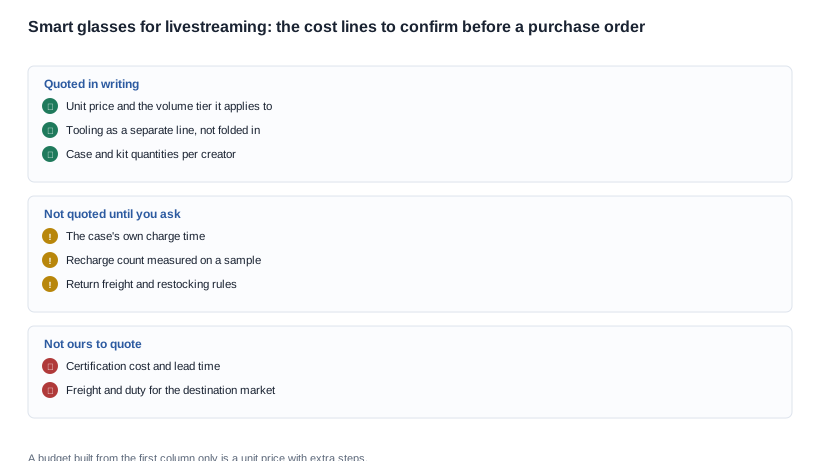
Three lines should be quoted in writing before anything else is discussed. The unit price together with the volume tier it applies to, so that the tier is a fact in the quotation and not an assumption. Tooling as a separate line with its amortisation stated, so the second tier can be calculated rather than hoped for. And the case and kit quantities per creator, because that is the line that scales with the channel and the one a supplier will otherwise price as a rounding.
Three lines are not quoted until they are asked for. The case's own charge time, the measured recharge count and the return freight and restocking rules. None of the three is published, and all three are cost lines rather than specifications, so they belong in the commercial conversation and not in the technical request.
Two lines are not ours to quote. The certification cost and lead time, which follow the process and the testing body, and the freight and duty for the destination market, which depends on the incoterm and the route. A buyer who has not asked for the first as its own line does not know what the compliance route cost, and a buyer who has not asked for the second does not know what landed cost is.
One line is a measurement rather than a quotation, and it belongs in the sample programme. The endurance figure under a camera-active load, the recharge count and the case's own charge time. These are the three numbers that turn a budget from an estimate into a plan, and they are all obtainable on a sample in a day.

The pitfall worth naming. The most common budgeting error in this category is comparing two quotations that do not contain the same lines. One quotation has the case, the lead, the spare, the packaging and the certification in it; the other has a device and a unit price. They are not comparable, and the gap between them is not a discount — it is a list of commitments that will arrive later, usually at a point where the channel has already committed to a season.
The budget rows we hold, and the lines we will not invent
The boundary we hold: the endurance number is the only published figure worth budgeting against, and it should be budgeted as a ceiling rather than as a typical day. We publish cell capacity, charge time and rated use for every model because those are the numbers we hold, and the case capacity for the five models that publish one. We do not publish a streaming endurance figure, a field of view, a frame rate, a case charge time or a recharge count, because a number we cannot show the test behind is a number we will not defend in a refund dispute, and because a derived figure presented as a measurement is a worse outcome than an open row.
What we will do instead is mark the open lines and tell you which of them a sample closes. Send the length of a typical session, whether the frames travel to the venue, the number of creators and the destination markets, and we will tell you which configurations in the AI camera glasses range are realistic for it, which ones need a case in the box to be honest, and which three cost lines have to be measured before the budget can be signed. The selection side of the same question is covered in the livestreaming model comparison, and the accessory programme that carries most of the running cost is in the livestreaming accessory set.
What to send us next. Send the session length, the creator count, the destination market and the target price band, and we will return the six cost lines with the published figure behind each one, the three lines that need a sample, and the two that need a compliance route.
Related reading
- The camera configurations — AI camera glasses
- The accessory programme — livestreaming accessories
- The endurance figures — battery life
- Commercial terms and pricing — pricing
Send the session length, the creator count and the destination market, and we will return the six cost lines with the published figure behind each one.


