

Smart glasses for livestreaming smart glasses accessories is a seven-item list, and one item on it is not an accessory at all. Six of them are ordinary — a charging case, a charging lead, a power bank, a cloth, a capture remote and a spare unit — and the seventh is a mount, which we do not supply and which decides whether the footage is usable. This page is written for the buyer assembling the accessory set that ships with a livestreaming product, and it separates the three items with published rows from the four that depend on a figure nobody publishes.
Smart glasses for livestreaming: the accessory set decides the configuration
We publish the case capacities, the charge times and the charging methods. We publish no compatibility matrix, no power profile and no mount. That sentence is the whole scope of what this article can settle, and everything else in it is either a request to the supplier or a term for the agreement.
The reason the accessory set matters commercially is that in a livestreaming channel the device is the one-off and the accessory set is the recurring cost. A creator who needs a spare lead, a spare unit and a case every season is a per-creator cost, and it scales with the number of people streaming rather than with the number of units ordered. That single structural fact changes what a buyer should negotiate: a per-creator consumable is a different commercial animal from a per-shipment line item, and a buyer who prices the kit per shipment will be short every season.
The case is the reason this is a procurement discussion and not a packing discussion. On the camera range, the case is a charger rather than a pouch on five models — 1400 mAh on the CY05 and the L1 Pro, and the CY03, 900 or 1400 mAh as a configuration choice on the L2 Utral, and 1200 mAh in a folding case on the MT6. The KY06 and the MT5 are supplied with a charging case whose capacity is not published. The V06 and the S7, and the V03 and the V03 Pro publish no case row at all, so what travels in the box for those four is a question to put to the supplier. So "the case" is not one row in this catalogue; it is three different answers, and a buyer who has asked for "the case" has not asked a question that can be answered.
A case is a second lithium cell, and that is a shipping gate rather than a preference. The requirements are set out at battery transport, and the question to the supplier is narrow: does the documentation file cover the configuration I am ordering, with the case in it. A configuration that includes a 1400 mAh cell in the box has a different declared weight, a different transit file and a different freight cost from a bare device, and the difference is not visible in the unit price.
The mount is the item that decides the result and the item nobody in the chain supplies. A mount fixes the device; a badly chosen one puts vibration, a low camera angle or a wind path between the device and the shot. Because the field of view, the video specification and the frame rate are not published for any camera model in this catalogue, the framing and the stability of the shot are the two things the mount actually determines, and both are testable on a sample in a day.
The spare unit is the only real insurance in the list. Every other accessory failure is inconvenient; a dead device on a live session is a cancelled session, and a cancelled session is a commercial event rather than a technical one.

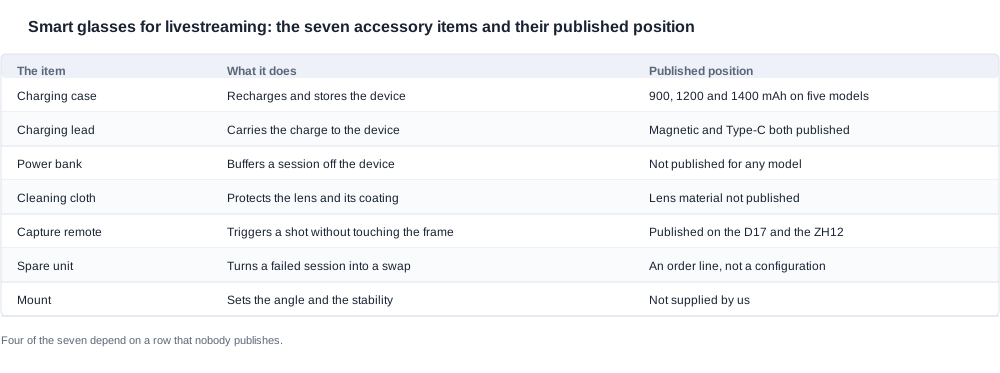
The seven items, and the four nobody publishes
| The item | What it does | Published position |
|---|---|---|
| Charging case | Recharges and stores the device | 900, 1200 and 1400 mAh on five models |
| Charging lead | Carries the charge to the device | Magnetic and Type-C both published |
| Power bank | Buffers a session off the device | Not published for any model |
| Cleaning cloth | Protects the lens and its coating | Lens material not published |
| Capture remote | Triggers a shot without touching the frame | Published on the D17 and the ZH12 |
| Spare unit | Turns a failed session into a swap | An order line, not a configuration |
| Mount | Sets the angle and the stability | Not supplied by us |
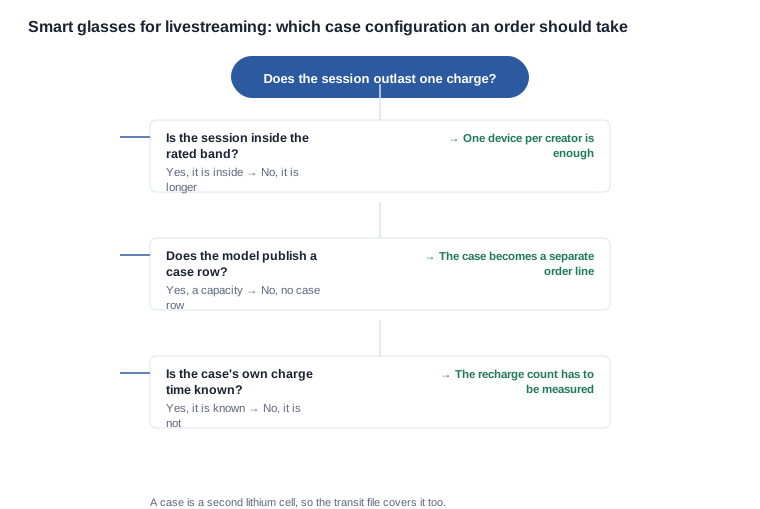
The case, because it is a second battery rather than a pouch. The decision on this row is a published-rows decision. The L2 Utral is the one camera model where the case capacity is a configuration choice rather than a fixed attribute, which means the artwork, the freight weight and the transit file all change with it, and a buyer who has not chosen a capacity has not chosen a configuration.
The lead, because the interface decides what a creator carries. The range uses both magnetic charging and Type-C. Magnetic is published on the V06 and the S7, the MT5 and the V03, and the KY06 among the camera models; Type-C is published on the V03 Pro and the L2 Utral; and for the MT6 and the CY03, and the CY05 and the L1 Pro the catalogue prints no charging interface row at all, which is a different thing from publishing magnetic. A magnetic product needs its own lead, and a lost proprietary lead is a lost session, so the lead belongs in the per-creator count rather than in the box.
The power bank, because nothing about it is published. There is no compatibility matrix and no charge-rate figure for any model, and the question of whether a camera-equipped device accepts power from a bank at all is unanswerable from the documentation. A power bank in the bag is a purchased item with an unspecified relationship to the device, and it should be tested rather than assumed.
The cloth, because the lens material and the coating are not published for any model. The lens is the part most often damaged and the easiest to ruin with an aggressive cleaner, and a solvent on a coating whose specification is unknown can cause a haze that is permanent and reads like a manufacturing defect. The instruction that ships has to be restrictive, and the cloth has to ship with it, because a cloth that is not supplied is a cloth that will not be used.
The capture remote, because only two models publish one. The D17 and the ZH12 publish a remote control and a photo function; neither is one of the eleven camera models that publish a resolution class, and the D17 publishes a 115 mAh cell with a charge time of roughly one hour on a Type-C interface. If the brief calls for a remote, that narrows the shortlist and it should be narrowed before the model is chosen rather than after.
The spare unit, because a livestream has no second take. It is an order line rather than a configuration, and the quantity is a per-creator decision rather than a per-order one. The replacement terms — whether a failed unit is swapped, credited or replaced against a fault reason — are a term in the agreement.
The mount, because the framing and the stability are decided by it and not by the camera tier. It is not in this catalogue, it is not a published row, and it is the item most likely to make a good camera produce unusable footage. It also has to be tested in the position the creator will actually use from, because a mount that works on a desk and a mount that works on a hat are not the same product.
The case is a second lithium cell, and that changes the order
Because the case is a second cell, three things follow that a buyer normally discovers in the wrong order.

The interface comes first, because the interface decides what a case is. A magnetic interface makes the case part of the charging architecture, and a Type-C interface makes it optional. The range publishes Type-C on the V03 Pro and the L2 Utral, magnetic on the V03 and the V06, the S7 and the MT5, and the KY06, and nothing at all for the CY05 and the CY03, and the L1 Pro and the MT6. For those four, the interface is an open question and it has to be asked before the case can be assessed, because a case and an interface are one decision.
The case row is read second, and it is read per model rather than per range. Five models publish a capacity, two publish a case without a capacity, and four publish no case row at all — the V06 and the V03, and the S7 and the V03 Pro. A buyer who writes "with case" on a purchase order has specified a fifth of the camera range and left the rest undefined.
The transit file is settled third, before the order rather than at the border. A configuration that ships with a 1400 mAh cell has to be covered by the documentation for the configuration ordered, with the case in it. Discovering that at the border is the worst possible moment, because the cost falls on the buyer rather than on the factory.
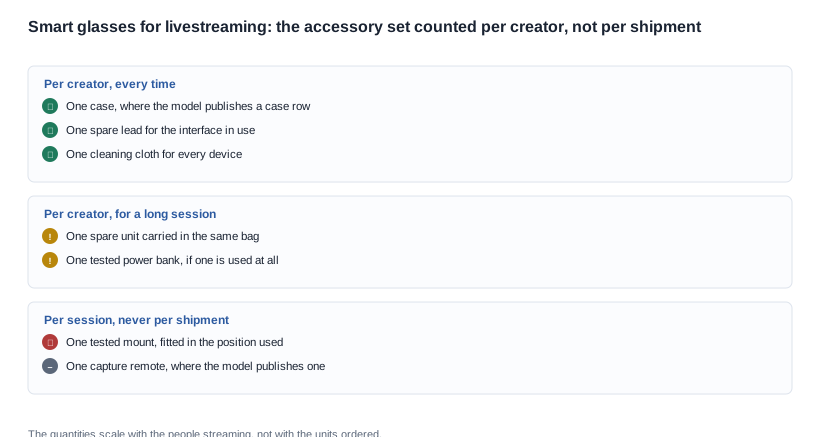
The fourth thing is the count, and it is the one that is usually wrong. The quantities scale with the people streaming, not with the units ordered. A kit counted per shipment is a kit that runs out, and a kit that runs out during a live session is the failure the whole accessory programme exists to prevent.

What to request before the accessory set is agreed
The requests below are deliberately narrow. Each one names a model, a row and a destination, so that it can be answered in writing without a call.
- The case row for the exact model, in the exact configuration. Capacity, and whether it is a choice or a fixed attribute, and whether the model publishes a case at all.
- The case's own charge time and its pass-through behaviour. Whether the case can charge the device while it is plugged in, and how long the case itself takes. Neither is published for any model, and both decide whether the case is a buffer or a storage box.
- The measured recharge count. How many times a fully charged case will top up a device, measured rather than derived. A derived count is our arithmetic on their figures and it is not evidence.
- The charging input and the data-transfer capability. What the device accepts, and whether a Type-C lead carries data as well as charge, because the transfer path is the step after the session and it is the one nobody tests.
- The power bank compatibility and the charge rate. Whether the device accepts being charged from a bank at all, and at what rate.
- The remote, where the model publishes one. What it triggers, whether it is bundled, and what it pairs to.
- The lens material and the cleaning instruction. Neither is published, so the instruction in the box has to be restrictive rather than permissive.
- The mount specification and the connector type. For the accessory that is not in the catalogue, the specification is the buyer's own document, and it is the one that has to be tested.
Why the requests go out before the order rather than after. The requests that cannot be answered quickly are the ones with the longest lead times: the transit file for a configuration with a case, and the certification route for the destination market. Both sit on the critical path, and a buyer who requests them after the artwork is committed has already paid for a configuration they may not be able to ship.
Six items belong in the written terms rather than in a verbal assurance. The published rows for the configuration ordered; the case specification, its charge time, its pass-through behaviour and the measured recharge count; the charging input and the data-transfer capability; the power bank compatibility and rate where one is used; the accessory set with its per-creator quantities; and the warranty period with a stated response time.
Four things must not appear in the written terms at all. Any power bank compatibility claim that was not tested, any recharge count that was derived rather than measured, any mount that has not been tested in the position it will be used from, and any case statement that implies the V03, the V06 or the S7 ship with one. Each of those is a statement the channel would be defending, and each of them is a statement a buyer can obtain the evidence for at a cost of a few days.
Who supplies each layer
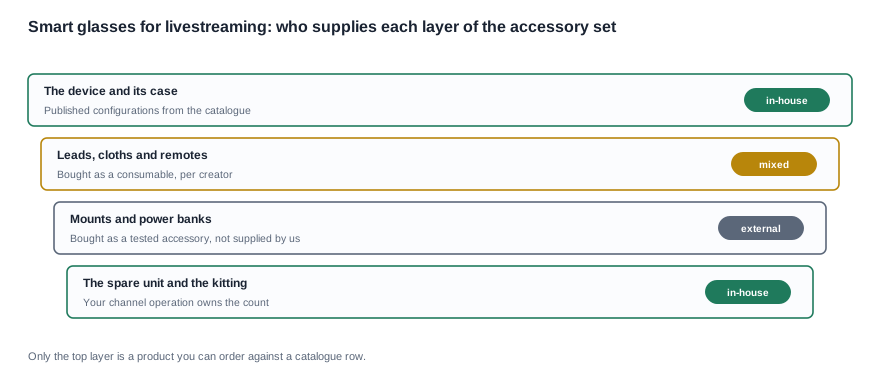
The layer structure is the fastest way to see which part of the accessory programme is a procurement decision and which part is a supply decision.
The device and its case are ours, because they are catalogue rows. That layer is fixed by the configuration and the case choice, and it is the only layer where the published rows settle the question outright.
The leads, cloths and remotes are mixed. They are consumables that a channel buys per creator rather than per shipment, and they are the layer where a small per-unit decision produces the largest reduction in returns. A cloth that is not shipped is a cloth that is not used, and a used cloth is the cheapest insurance against a scratched lens in this category.
The mounts and the power banks are external. They are not ours and they are not in the catalogue, and the correct procurement posture on both is to test rather than to specify. A tested mount and a tested bank are the two line items in this list where a buyer's own test is the only acceptable evidence.
The spare unit and the kitting are the channel's own operation. The count per creator, the swap procedure and the replacement terms are yours, and they are the layer where a livestreaming channel's actual cost sits. A channel that has not costed the spare and the lead per creator has costed only the part of the programme that is visible on a purchase order.
The commercial terms worth spending negotiation time on
The accessory set is where a livestreaming order's commercial structure actually gets decided, and the negotiation time is best spent on the lines that scale with the channel rather than on the lines that scale with the order.
The lines that scale with the channel, and are worth real negotiating effort. The per-creator accessory set and its minimum order quantities, since a per-creator consumable is a volume commitment the supplier will price differently from a per-shipment line. The spare unit quantity and the replacement terms against a fault reason. The mount hardware and its connector types, because a mount is a specification the buyer writes and the supplier sources. The packaging specification, since the case and its packaging change the parcel dimensions and therefore the freight. The delivery split, so that a first run can be taken in two tranches against a staged payment. The warranty period with a stated response time, because a livestreaming channel cannot absorb a unit that is out of action for a month.
The lines that are fixed once the route is chosen, and should be asked for as a separate line rather than bundled. The cost of a certification and the time it takes are decided by the schedule and by whoever certifies it. Tooling is often amortised across the first order and quoted as part of the unit price; ask which line you are paying, because the two are frequently bundled into a single figure that hides which is which. A buyer who has never seen the certification cost as its own line does not know what the compliance route cost.
The lines that are worth a clause rather than a price. The recharge count and the case's own charge time, stated as measured values, because a buyer should not have to derive a buffer from a capacity and a guess at the conversion efficiency. The condition in which a returned unit is accepted, so that a unit returned with a fault that cannot be reproduced is still useful to the channel rather than being written off. The response time on a technical answer, because the accessory programme's biggest single cost is a desk waiting on a supplier for a date it does not have.
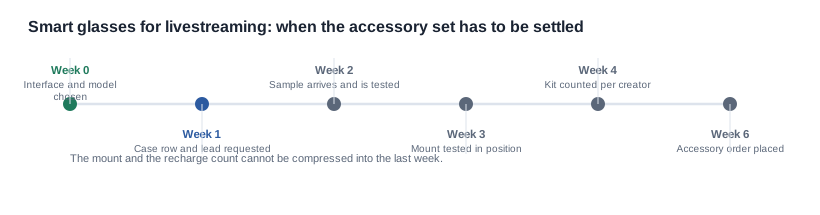
Why the schedule is the part buyers forget. The mount test and the recharge count are the two items on this list that cannot be compressed into the final week, because both need a physical sample in a physical position and both need time on the clock. A channel that has committed to a session date and then discovers that the mount has not been tested, and that the recharge count is unknown, has a configuration risk it cannot close by buying a faster lead time.
Our position. We publish the case capacities, the rated runtimes, the charging interfaces and the charge times, because those are the rows a buyer can order from. We will not publish a compatibility matrix, a power profile, a case charge time, a pass-through behaviour, a measured recharge count, a lens material or a mount for a model where the manufacturer has not provided one, and we will not present a derived recharge count as a measurement. What we will do is give you the seven items, the published position for each, the questions to ask, and the order in which they have to be asked.
What to send us next. Send the number of creators, the typical session length, the models you are deploying and the destination markets, and we will tell you which accessory rows are documented, which have to be requested, and which have to be measured on a sample before the order goes in. The camera configurations are listed on the AI camera glasses range page, the battery figures are under battery life, and the session-side setup is at how to set up for livestreaming.
Related reading
- The channel — smart glasses for livestreaming
- The session setup — how to set up for livestreaming
- The pre-session checks — livestreaming checklist
- The charging architecture — charging solutions
Tell us the number of creators, the session length and the models you are deploying, and we will tell you which accessory rows are documented and which have to be specified.


