
One thing to be clear about before the scenario: this is not a customer case. It is a constructed walk-through, and it is written as a hypothetical case rather than a client project. We do not publish customer names, project details, order quantities or performance results, and this article invents none. What follows is a requirement decomposed against the published catalogue rows, the decisions that requirement forces, and the run sheet those decisions produce. Every figure that comes from us is published; everything else is a stated assumption of the scenario, labelled as such.
The scenario. A brand owner is planning a livestreaming deployment for a channel that demonstrates physical products. The requirement is a three-hour first-person product demonstration, broadcast live, with the audience seeing what the presenter sees. One creator, one device per creator plus a spare, a studio session with a fixed demonstration table, and a channel that has sold twice before and wants a third run.
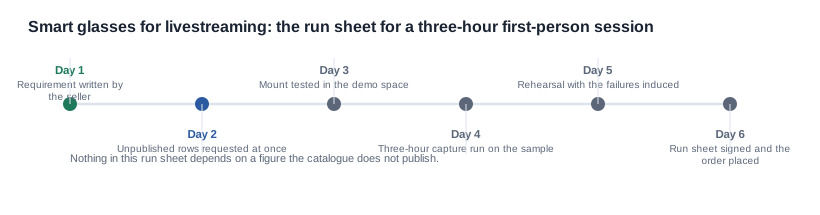
Smart glasses for livestreaming: a constructed three-hour session
Why this scenario and not another. Three hours is longer than the useful half of any published runtime band in this catalogue and short enough to be a real, repeatable session, which makes it the length at which the deciding rows surface. A one-hour session would be decided by the camera rows alone; an eight-hour session would be decided by logistics. Three hours is decided by both, and it is the length at which a buyer can tell whether the published rows actually support the plan.
What the scenario assumes and what it takes from the catalogue. The scenario assumes a three-hour continuous capture with the camera active throughout, a fixed demonstration table, a first-person viewpoint, a live platform, and a single creator with one spare. It takes from the catalogue the eleven camera models and their published cell capacities, charging interfaces, charge times, rated runtimes, case capacities and resolution classes, and it takes the fact that no video resolution, frame rate, field of view, sensor model, stabilisation data, storage behaviour or recording indicator behaviour is published for any of them.
The conclusion the scenario produces. A three-hour continuous capture on a camera model is a worst case rather than a typical one, and the published band does not say which end of it the workload sits at. The camera is the dominant draw, the case is the buffer, and the run sheet is built around that rather than around the resolution tier. Three decisions follow, and they are the three that a buyer has to make before the sample order rather than after it.
The requirement, taken apart row by row
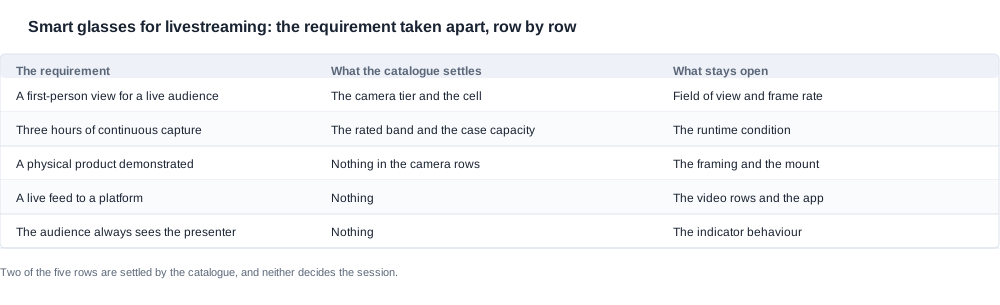
The seller wants first-person footage of a presenter demonstrating a physical product, broadcast live, with the audience seeing what the presenter sees. Broken into rows, that single sentence produces the table above, and the table is more useful than the sentence because each row has a different owner and a different way of being closed.
Row one, the first-person view. The camera tier and the cell are settled by the catalogue. The field of view, the video format, the frame rate and the low-light behaviour are not published for any model. What closes this row is one request per candidate model, and it is the row that decides the shortlist, because a first-person demonstration of a physical object is decided by framing and the framing is decided by the field of view.
Row two, three hours of continuous capture. The published rated use and the case capacities at 900, 1200 and 1400 mAh are what the catalogue settles. The runtime condition and the thermal behaviour over three hours are not published for any model. What closes this row is the endurance test and a start-and-end clip comparison, and it is the row that decides whether the case is optional or mandatory.
Row three, the demonstration is of a physical product. Nothing in the camera rows describes how a handheld object appears in a first-person frame, because nothing in the camera rows describes framing at all. What closes this row is a test mount and a clip from the actual demonstration, and it is the row most often skipped, because a demonstration looks like a demonstration in a catalogue.
Row four, live, to an audience. Nothing published addresses the streaming capability: the video rows, the transfer path, the application, the network behaviour and the start-up latency are all outside what the catalogue holds. What closes this row is a test stream on the actual platform, and it is the row that the sample programme has to be scoped around, because a test stream is a different exercise from a device demonstration.
Row five, the audience can see the presenter at all times. Nothing published addresses the state-confirmation behaviour, or what the audience sees if the device drops. What closes this row is the indicator behaviour and the rehearsal, and it is the row that turns the session from a broadcast into a risk-managed event.
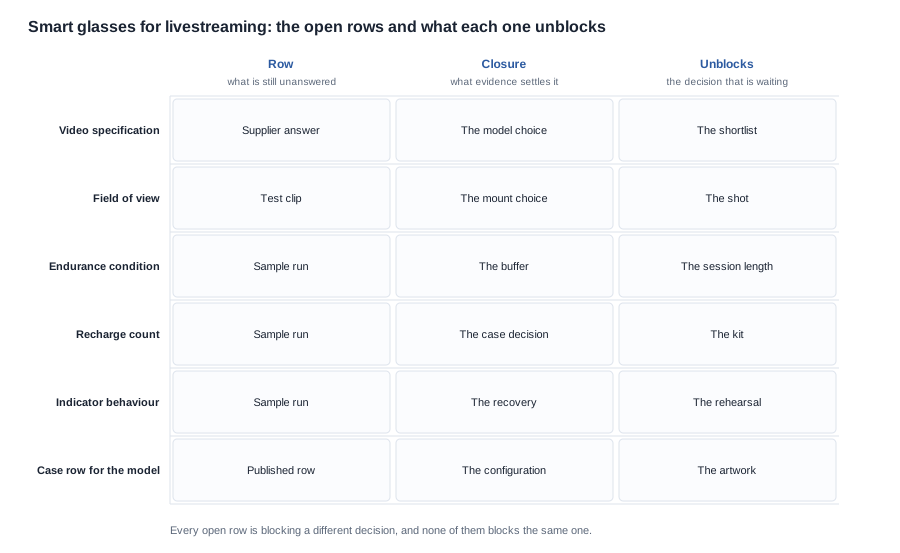
The matrix above is the useful summary of a scenario, because it turns "we need more information" into a schedule. Six open rows, six different closures, and six different decisions waiting behind them. None of them blocks the same decision, which is why a scenario that is worked through in the right order closes faster than one that is worked through in the order the questions arrive.
The three decisions the requirement forces
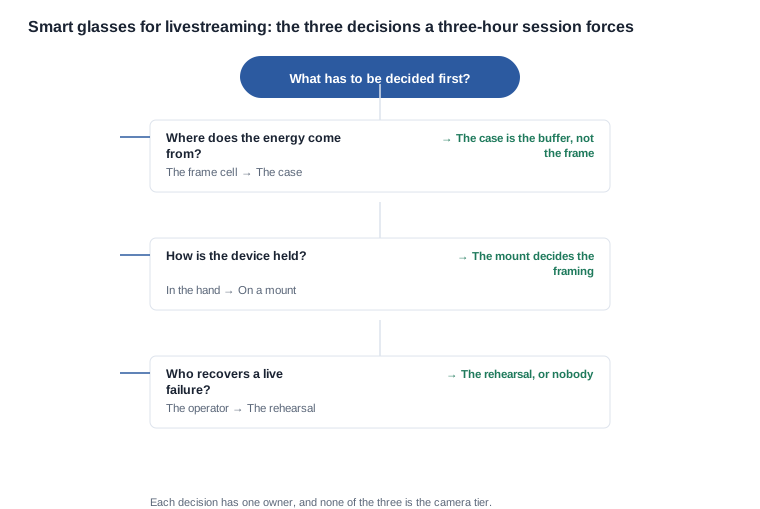
Decision one is the buffer, and it is a published-rows decision. The camera is the dominant draw in every camera-equipped model in this catalogue, and the published rated use carries no test condition, so a three-hour camera-active capture is the least favourable case the figure could describe. The published case positions make the choice concrete: 1400 mAh on the CY03 and the L1 Pro, and the CY05, 900 or 1400 mAh as a configuration choice on the L2 Utral, and 1200 mAh in a folding case on the MT6. The KY06 and the MT5 are published with a case whose capacity is not published; the V06 and the V03 Pro, and the S7 and the V03 publish no case row at all, and none of the four is published as having no case. A buyer who reaches this decision without checking the case row for the exact model has assumed a buffer that may not exist.
Decision two is the mount, and it is not in the catalogue at all. A demonstration of a physical product is the case where the framing and the stability of a mount decide the result. The catalogue publishes no mount, no field of view and no video specification, which means the shot is specified entirely by an accessory the buyer sources. That is why the sample programme has to include one, and why the mount test is a scheduled item rather than an afternoon's errand.
Decision three is the rehearsal, because a live session has no operator. The recovery has to be practised before it is needed, which is a run-sheet item rather than a manual item. The failure modes to induce are known in advance: a link drop, a device swap, a full battery mid-demonstration, and an indicator that says nothing while the audience is watching a presenter who is not visible. Each of them is cheap to rehearse and expensive to discover.
What the three decisions have in common. None of them is the camera tier, even though the tier is what most shortlists are built around. The tier is the cheapest decision in the scenario and the least consequential; the buffer, the mount and the rehearsal are the three that decide whether the session works. A procurement review that has spent its time on the resolution class has spent it on the wrong row.
The commercial consequence of the three decisions. The buffer turns the accessory set into a per-creator recurring cost, because the case is replenished and the spare is carried. The mount turns a device purchase into an accessory programme that the buyer has to specify and test. And the rehearsal turns a one-off session into a repeatable run sheet, which is what makes a third run cheaper than the first. The supplier terms that follow from the three decisions are the case configuration, the accessory set with its per-creator quantities, and a warranty period with a stated response time.
The questions to ask the supplier before the order, as a list rather than a paragraph. Which case capacity is published for the exact model, and whether the case is a fixed attribute or a configuration choice. What the case's own charge time is, and how many times a charged case will top up a device, measured on the sample rather than derived. Whether the unit accepts power while it is recording. What the video specification and the frame rate are for the exact model. What the field of view is. What the recording indicator does when the companion application is closed. And what the response commitment is on a technical answer. Seven questions, and the first two are the ones that decide the buffer.
The criteria for choosing between two surviving candidates, in the order they matter. The camera rows that the supplier will commit to in writing. The published case position for that model, because it decides whether the buffer exists. The published charging interface, because it decides the lead programme and the accessory cost that repeats. Then the published cell capacity, which is the firm per-model number. And only after all of those, the resolution tier, which is a still-image figure and is settled on a sample rather than on a specification sheet. A buyer who applies these criteria in a different order will spend the negotiation on the least consequential row.
The two red flags to watch for in a supplier's response to the first list. A reply that answers in adjectives rather than in values, which is the failure mode this category is built on. And a reply that bundles the camera rows into a single "camera specification" line, which sounds efficient and in fact hides three separate open questions behind one unanswerable answer. A reply that separates them, even when two of them are still open, is a better reply than one that closes all seven at once with a marketing paragraph.
The trade-off worth naming explicitly. The scenario asks for more information than a buyer usually wants, and the cheapest version of it is the one that stops early. Stopping early is fine for a one-hour demo with a single creator and no case, and it is not fine for a three-hour session with a case configuration, a mount and a third run behind it. What to choose between a faster procurement process and a documented one is a decision about risk, and the criteria for making it are the length of the session, the number of creators and whether a third run is planned.
The measurement plan on the sample

The plan has six steps and each one produces a value rather than an impression. Start from a full charge and record the start time, the cell state and the camera state together, so the end state has something to be measured against. Run the full session length with the camera active, because that is the condition nobody publishes and the condition the buyer is actually buying. Record the end time and the remaining state, and repeat the run once, because a single run is an anecdote and two runs are a measurement with an error bar.
Measure the case recharge count on the same sample. The buffer is what the run sheet is built around, so the recharge count is a run-sheet number rather than a product number, and it is not published for any model. Measure it with the same case configuration the order will use, because the L2 Utral publishes two capacities and the count differs between them.
Compare the first and the last clip. A degraded second hour shows up in the file and not in the rating, and a rating is what the published figure is. A clip comparison is the cheapest test of the thermal question, and it produces evidence that can go into the agreement.
Write the measured numbers into the agreement, in place of the published band. The published band is what the catalogue holds; the measured figure is what the buyer is committing to. Putting the measurement in the agreement rather than the band is the difference between a specification and a hope, and it is the clause a buyer should ask for before the order rather than after the first session.
The two measurement steps that are easy to forget and expensive to omit. The transfer path with a large file, because a three-hour session produces a large file and the transfer is the step after the stream. And the indicator behaviour with the application closed, because a live broadcast with no reliable state confirmation is a channel risk rather than a customer one.

The rehearsal, and the run sheet it produces
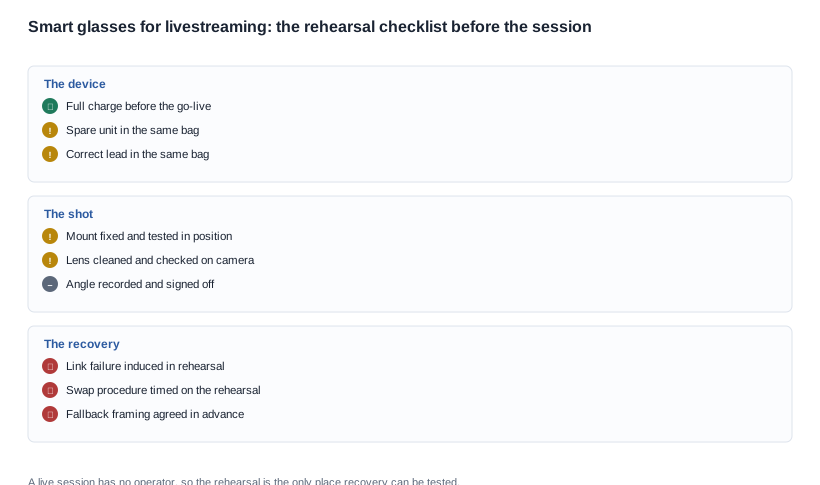
The rehearsal is where the run sheet is actually written, and it should be timed rather than performed. A swap procedure that has never been timed is a procedure with an unknown duration, and an unknown duration inside a live session is a gap in the programme. Timing it once on a sample tells the producer the shape of the recovery, and the producer builds the session around the real number rather than around an assumption.
The device group is the one that protects the session. A full charge before the go-live, a spare unit in the same bag, and the correct lead in the same bag. The spare is the item that most often fails to be packed, because it is packed by a person who assumes the primary unit will work, and it is the item that turns a cancelled session into a thirty-second swap.
The shot group is the one that protects the output. A mount fixed and tested in position, a front element wiped and checked on camera, and the angle recorded and signed off. The front element check is the one that is skipped in a studio, because a studio is clean, and it is the one that is not skipped in a location shoot. The angle being recorded matters for the third run: an angle that was set from memory on the second run is the most common cause of a second session that looks different from the first.
The recovery group is the one that protects the audience. A link failure induced deliberately, a swap procedure timed, and a fallback framing agreed in advance. A live session has no operator, so the rehearsal is the only place the recovery can be tested at all, and a fallback framing agreed in advance is what keeps the audience watching a presenter rather than watching a black frame.
The run sheet the rehearsal produces is short, and that is the point. A run sheet for this scenario is roughly a page: the start condition, the battery and camera state at the start, the point in the run at which the case is swapped, the fallback if the link drops, the fallback if the device stops, the indicator behaviour as observed, and the clip comparison at the end. Every item on it is either a published figure, a measured value or an agreed fallback, and every item on it has a named owner.
What the scenario does and does not prove
What it proves. That a three-hour first-person live session can be planned from published rows plus a measured plan, and that the run sheet which results is short enough to be used. It also shows where the published rows stop, and it shows that the rows that stop are not the ones a buyer would have guessed.
What it does not prove. It is a constructed scenario, so it proves nothing about a real deployment's performance. It does not establish a streaming endurance figure, a video capability, a field of view, a frame rate, a recharge count or a thermal behaviour, because none of those is published for any model and a constructed scenario cannot substitute for a measurement on a sample. It does not describe a customer, a market, a volume or a price, and no such figure appears anywhere in this article.
The rows that stay open after the scenario is walked through. Video resolution and frame rate, the field of view, the sensor model, the low-light behaviour, the storage behaviour, the transfer path, the application behaviour, the network requirement, the start-up latency, the indicator behaviour, the case charge time, the recharge count and the runtime condition. The scenario shows which of those are on the critical path and which are not, and that is the useful output.
What a buyer should take from a scenario like this. Write the requirement in the seller's own words, resolve the buffer, the mount and the rehearsal, request the camera, streaming and application rows in one message, run the full-length capture on a sample in the space on the mount, and put the measured results and the accessory quantities into the agreement. That sequence is the part that transfers, and it transfers because it is built on rows that exist rather than on a result that does not.
Our position. Our position is that a constructed scenario built from published rows and a stated method is more useful to a buyer than a case study with unverifiable numbers in it, and that in this category the rows which decide a three-hour live session are the ones nobody publishes. We will not publish customer names, project details, performance results, video capabilities, application details, network requirements or throttling behaviour for a model where the manufacturer has not provided one, and we will not present a constructed scenario as though it were a customer result.
What we will do is give you the requirement, the three decisions it forces, the rows to request, and the plan that closes them. The configurations are on the AI camera glasses range page, the sample programme is scoped at sample policy, and the accessory set that carries the buffer is at livestreaming accessories.
What to send us next. Send the session length, the platform, the venue, the creator count and the models you are deploying, and we will tell you which rows the documentation closes, which rows the sample has to establish, and which decisions cannot move until those rows come back.
Related reading
- The channel — smart glasses for livestreaming
- The configurations and their rows — AI camera glasses
- How to scope the sample work — sample policy
- The accessory set that carries the buffer — livestreaming accessories
Tell us the session length, the platform and the models you are deploying, and we will tell you which rows the documentation closes and which the sample has to establish.


