
Livestreaming on a pair of smart glasses is a genuine trade, and the useful version of the list names the condition on each advantage. In this category the pattern is consistent: every advantage has a condition attached, and the condition is almost always the session length, the room, or the platform. The ear stays clear so a creator can hear a colleague — unless the room is quiet, in which case that same property is a fault. The case is a second battery — unless the case does not charge, in which case it is a dock. A fast charge is a convenience — unless the streaming point is fixed and the unit spends three hours plugged in, in which case it is irrelevant. This page is written for the buyer putting a livestreaming product in front of creators, and it states six advantages, six costs, and the condition on each without softening either.
Smart glasses for livestreaming: the trade, with the condition attached
Who this is for. The reader is a brand owner, a channel operator or a procurement manager who has to defend a decision that other people will question. Somebody on the team believes the device is convenient; somebody else believes it will embarrass the brand in a quiet room. The task is not to settle that argument emotionally. It is to convert it into a list where each advantage is paired with the condition under which it stops being an advantage, and each cost is paired with the condition under which it disappears. The reason this matters commercially is that an advantage sold without its condition becomes a return, and a cost stated without its condition becomes a reason to buy a competitor's product.
Why the condition is the useful part. A bare advantage is a sales claim; an advantage with a condition is a specification. "The hands stay free" is a claim that every competitor in the category also makes. "The hands stay free, provided the mount holds its angle for the length of the session and the clamp is checked at the break" is a statement a buyer can test, price and write into a sheet. The second version is longer and it is the one that survives a pilot.
What the published rows do and do not settle. The camera models publish 8 MP or 13 MP, cell capacities from 220 mAh to 290 mAh, a charge time of two hours or less, and rated runtimes between five and eight hours. The cases are 1400 mAh on the CY05 and the CY03, and the L1 Pro, 900 or 1400 mAh as a configuration choice on the L2 Utral, and 1200 mAh on the MT6's foldable case, with the KY06 and the MT5 shipping with a case whose capacity is not published. The video format, the frame rate, the field of view, the storage path and the transfer method are not published for any model. So the six rows in the table below are the ones that can be settled from the catalogue, and the six conditions are the ones that have to be tested in a room.
Six advantages and the condition that limits each one
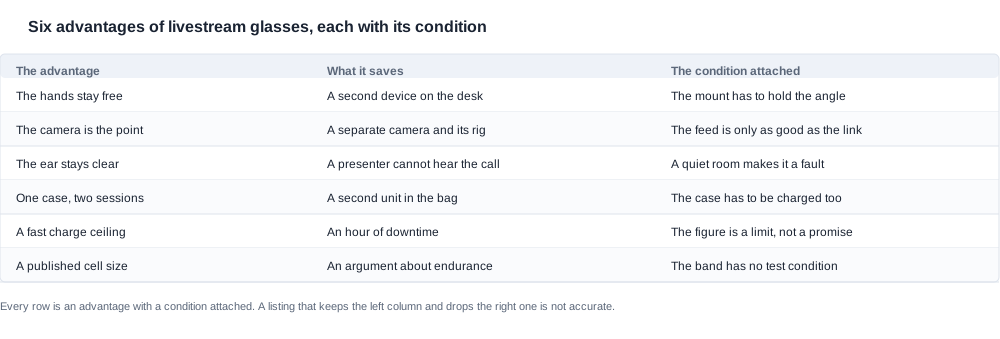
Every row in that table has the same shape: an advantage, what it saves, and the condition. The third column is the whole of the trade. A buyer who reads only the first column is reading a brochure, and a buyer who reads the third column is reading a specification.
The condition that decides most deployments: the room
The room is the variable that flips three of the six advantages into faults. In a quiet room the open ear that lets a creator hear a colleague becomes a leakage problem, because the creator can hear the feed and start reacting to it. In a loud room the same open ear becomes the reason the deployment works, because a creator who cannot hear a colleague cannot follow a conversation without stopping the session. The microphone rows that would settle this — count, pickup distance, processing mode — are not published for any model, which means the room condition has to be established on a sample rather than argued about.
The lighting condition is the same shape. A good picture in a lit room can become a noisy picture in a room lit from behind, and the low-light behaviour is unpublished for every model. The consequence for a listing is that the demonstrative clip and the real session are not comparable, so a marketing claim built on the clip is a claim about the room the clip was made in.
The condition that decides the rest: the session length
A short session makes almost every advantage unconditional, and a long session makes almost every one conditional. Within a session of a few hours, the charge is a non-issue, the case is a convenience, and the mount can be set once. Beyond that, each advantage acquires a condition: the charge becomes a turnround window, the case becomes the difference between one session and two, the mount needs a check at the break, and the storage needs clearing. The published runtimes sit between five and eight hours, and the case capacities decide whether a second session is possible without a wall socket. This is why the session length has to be settled before the model, and the reasoning is at smart glasses for livestreaming long term use.
Which advantage a deployment is actually buying
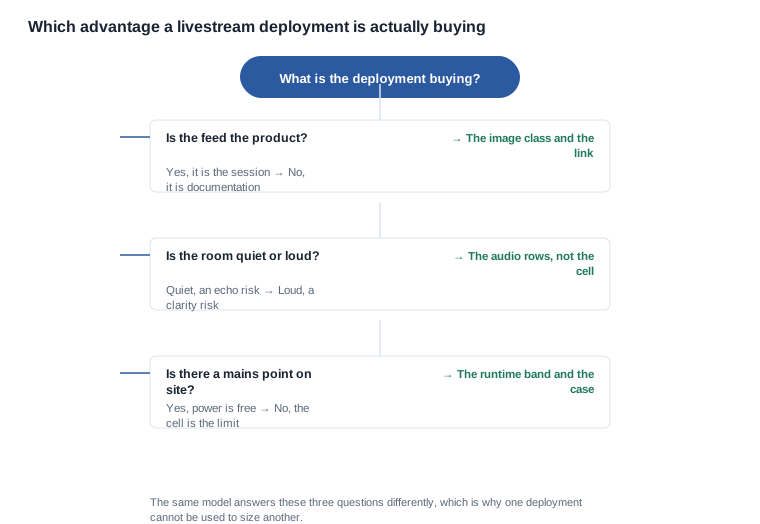
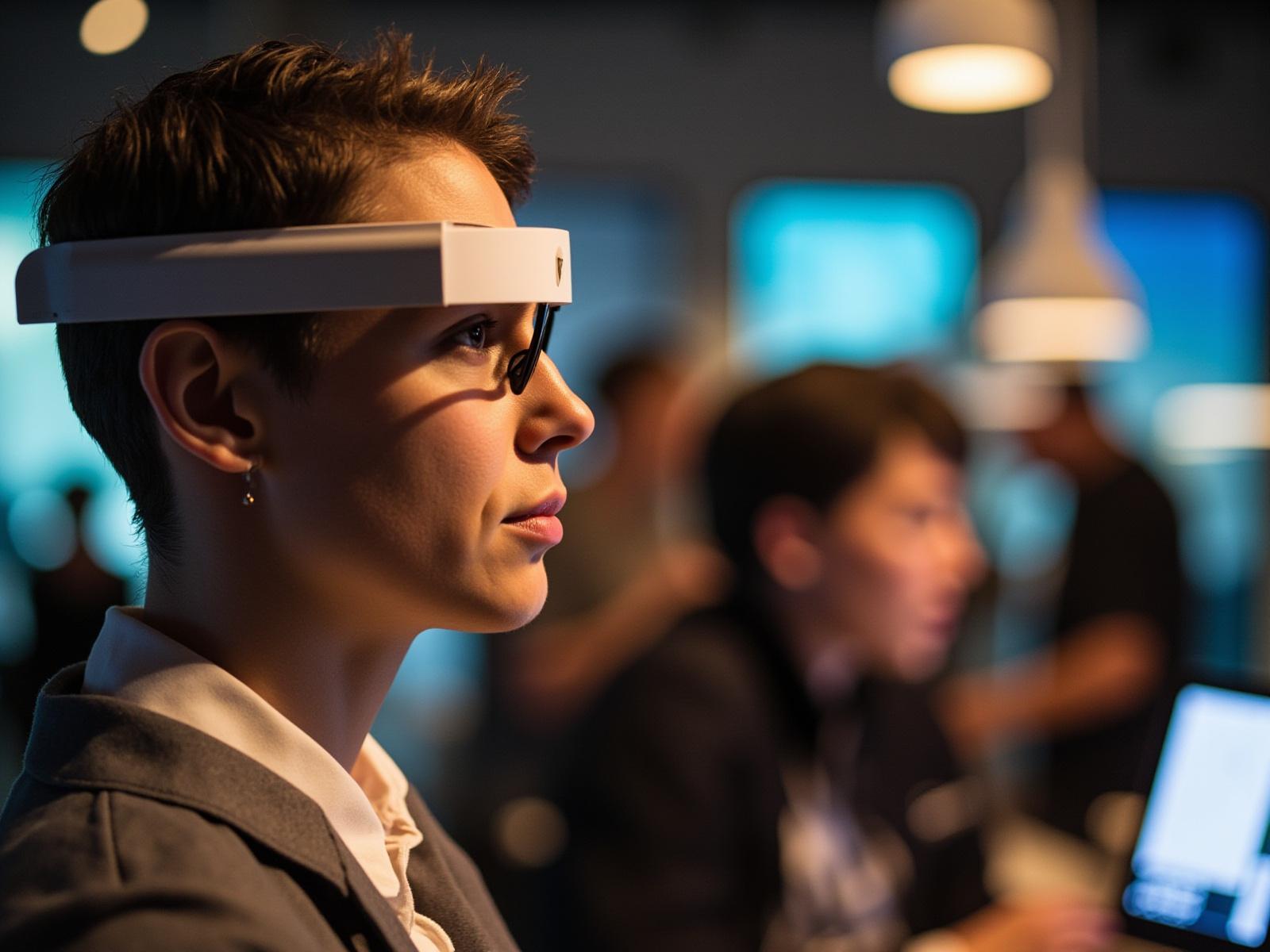
The three branches in that image are the three questions that settle which of the six advantages is doing the work. They are asked in order because each one eliminates a class of deployment, and because the answers are not the same for a desk-based selling session and a field session even when both use the same model.
The three questions that settle it
Is the feed the product, or is it documentation? If the feed is the session, then the image class, the frame rate and the latency are the deciding rows, and the cell is secondary. If the feed is documentation for a session that happens anyway, then the cell, the case and the mount decide the deployment and the image class barely matters. Buyers who have not answered this question often end up optimising the wrong side of the specification, and the symptom is a good image on a unit that cannot finish the session.
Is the room quiet or loud? This decides whether the audio path is a benefit or a liability, and it is the one question a pilot can answer in ten minutes. A quiet room also makes the mount discipline matter, because a unit that shifts is more noticeable when there is nothing else in the frame.
Is there a mains point on site? If there is, the cell stops being the constraint, the case becomes optional, and the deployment is decided by the storage behaviour and the thermal behaviour instead. If there is not, the cell is the constraint, and the published runtime band and the case capacity are the numbers that size the order.

Weighing the deployment against the alternative

The sequence above is the part of the decision that usually gets skipped, and skipping it is how a buyer ends up with a deployment they cannot explain. Step one narrows the advantages to the two or three the deployment genuinely needs, because six advantages weighed together always nets out to a feeling. Step two attaches the condition to each, in the room it applies to. Step three prices the alternative — which is usually a rig, a fixed camera and an operator rather than a competitor's product, and it is usually more expensive than the unit price suggests. Step four costs the case as a second cell. Step five names the condition the buyer is willing to accept failing, and that answer is the actual decision.
What the alternative really costs. A conventional setup for this kind of session is a mounted or tripod camera, a fixed position, and somebody to frame it. Against that, a head-mounted device trades a stable picture for a moving one, and it removes the operator. The trade is worth making when the creator moves and the session cannot be fixed to a position, and it is worth making with a spare unit available, because the failure mode of a head-mounted device is that its position changes during the session. Pricing the alternative with the operator included, rather than with the equipment alone, is what usually makes the decision clear.
The comparison that catches buyers out. The alternative is not usually a cheaper unit of the same category, it is a different way of working, and the two cost structures are not comparable line by line. A fixed setup costs equipment plus an operator for the whole session. A head-mounted device costs equipment plus a spare ratio plus a mount discipline plus a swap routine, and it removes the operator line entirely. Comparing them by unit price compares the wrong lines and produces a decision that has to be reversed later. A buyer who has done the comparison properly writes both cost structures down side by side, and the total cost comparison is the one that goes into the business case.
The four costs, and the condition under which each one disappears
The unit cost disappears as a concern above a volume where the accessories and the spares are negligible, which is usually earlier than buyers expect. The return rate disappears when the consumables are in the box and the mount is right, because most returns in this category trace back to one of those two. The documentation burden disappears when the per-model market documents arrive with the first shipment rather than being chased afterwards. The training burden disappears when the setup sheet is written once for the whole channel rather than for each creator. None of the four disappears on its own; each one disappears with a specific action attached to it, which is the useful part of the list.
The conditions to check before the advantage becomes a claim
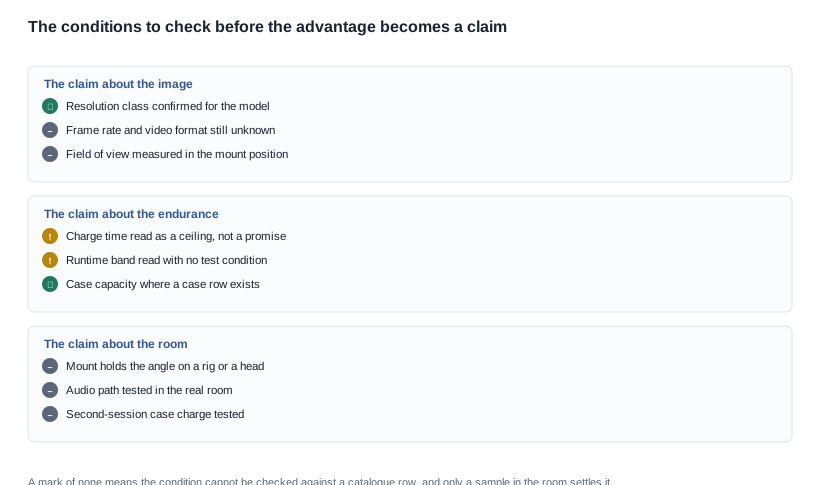
The three groups above are arranged by what settles them, and the arrangement is the point. The first group is closed by a published row or by a published absence. The second group is closed by reading the published figure correctly, which is a discipline rather than a request. The third group is closed only by a sample in the actual room, and it is the group that decides whether the deployment works.
How to choose which conditions to test first. A buyer with a limited pilot has limited hours in the room, and the three conditions that repay the time fastest are the ones that would disqualify a model rather than merely refine it. The field of view disqualifies a model when the mount position cannot frame the shot, and the audio path disqualifies a model when the room is loud and the pickup is short. The runtime condition refines rather than disqualifies, because a band can always be planned around. So the shortlist criteria, in order, are the disqualifying conditions first and the refining ones second, and a buyer who reverses that order spends the pilot refining a model that was never going to work.
The questions to ask, in the order they are worth asking. Before you order, and before a pilot is booked, the questions that change a decision are these — and the criterion for including one is that its answer could remove a model from the shortlist:
- What video format and frame rate does the unit actually produce, and is the format accepted by the target platform?
- What is the field of view, measured, and does the intended mount position use it fully?
- What is the audio path — microphone count, pickup distance, processing mode — and does it hold in a room with the target noise level?
- What is the runtime test condition, and what is the thermal end state after a full-length session in the target room?
- What is the storage capacity and the fill behaviour, and how does a recorded file leave the device?
- Which document, covering which model, with which number, supports the market claim the listing intends to make?
The red flags to watch for in a quotation. A unit price quoted without a volume tier. A certification claim that names a standard without a number and a model. A runtime quoted as a single figure when the catalogue publishes a band. A case capacity quoted as a total when the catalogue publishes cells. A lead time quoted without a starting point. A sample offered without a test script. Each of those is a normal commercial sentence, and each of them is a place where a decision gets made later and more expensively than it would have been made now.
The total cost view, and where the trade actually lands. Adding the accessories, the spare ratio, the freight weight of the kit, the shipping of the case as a second cell and the cost of a cancelled session changes the order of the options in most cases, because the visible unit price is the smallest line and the cancelled session is the largest. Buyers who negotiate the smallest line hardest are the ones who end up with the largest cost. The commercial structure is at pricing and the terms that protect the buyer are at contract terms.
A worked scenario, and what it settles
This is a hypothetical scenario, not a client project. Take a European channel that has decided to run scheduled live selling sessions from a small studio, two presenters, one platform account, and a monthly volume of a few hundred units. The session runs about two hours. The studio is small and treated with a carpet, so the room is quiet. There is a mains point behind the desk, and the two presenters alternate on a single camera position.
The first decision is the model class, and the published rows settle it. The feed is the product, so the image class matters, and the thirteen-megapixel camera models are the ones that qualify. The L1 Pro and the L2 Utral both publish a 290 mAh cell, a runtime of about seven hours and a case, which is more than twice the session length, and the S7 publishes 13 MP on a 260 mAh cell with a runtime band of five to eight hours and no case row in the catalogue. The L2 Utral is the one that fits the studio, because its case row names two configurations and its charging method is published as a Type-C port, which means the studio's existing cable serves the deployment and no second charging accessory has to be carried.
The second decision is the quiet room, and it is where the scenario turns. The open ear that lets a presenter hear the other one is the advantage the deployment is buying, and in a carpeted studio the same property means the presenters can hear the feed in their earphones. The microphone rows are unpublished, so the condition has to be established on a sample, and the practical answer is a closed-back monitoring arrangement and a volume setting that both presenters can hear without strain. This is the part of the scenario that the catalogue cannot answer, and it is the part that a buyer who skipped the room question would have discovered in the first session.
The third decision is the mount and the spare. A fixed mains position means the cell is not the constraint, so the case is a convenience rather than a requirement and the deployment is sized around a two-hour session with a published seven-hour runtime. The mount becomes the condition on the advantage, because a presenter who moves will shift the angle, and the answer is a clamp that is checked at the handover between presenters. One spare unit is held on site, and the swap time is measured during the pilot so that the year-two spare ratio is set from a number rather than a habit. The supplier requests behind those three decisions are the same six that every pilot in this category needs, and the lead time they imply is at lead time.
The published rows close the class in an afternoon, and the room, the mount and the swap procedure take the two weeks of the pilot. The buyer who had negotiated the model first and the room second would have discovered the room condition in the first live session, with the channel's own presenters on air and a brand name behind the feed.
What we publish, and where we stop. Our position is that we publish the rows a buyer can order from, and we will not fill the gaps with typical values. For the camera family that means the resolution class, the cell capacities from 220 mAh to 290 mAh, a charge time of two hours or less on every model, the rated runtimes between five and eight hours, the charging method per model, the case capacities where a case row exists, and the single published weight of 158 g for the MT6 glasses. We will not publish a video format, a frame rate, a field of view, a storage capacity, a transfer path, a linking sequence, a control scheme, a microphone row, a network requirement or a thermal behaviour for any model where the manufacturer has not provided one. The product families are at ai camera glasses and Bluetooth audio glasses, and the charge rows are at battery life.
What to send us next. Send us the session length, the room, the number of presenters, the platform and the price band, and we will return the model class the deployment needs, the published rows that close it, the conditions that have to be tested in a pilot, and the accessory configuration each condition implies. The scenario entry point is smart glasses for livestreaming, and the model selection logic is at smart glasses for livestreaming product recommendations.
Send us the session length, the room and the price band, and we will return the model class, the published rows that close it, and the conditions your pilot will have to test.


