
Smart glasses for livestreaming: seven items, and the failure each one prevents
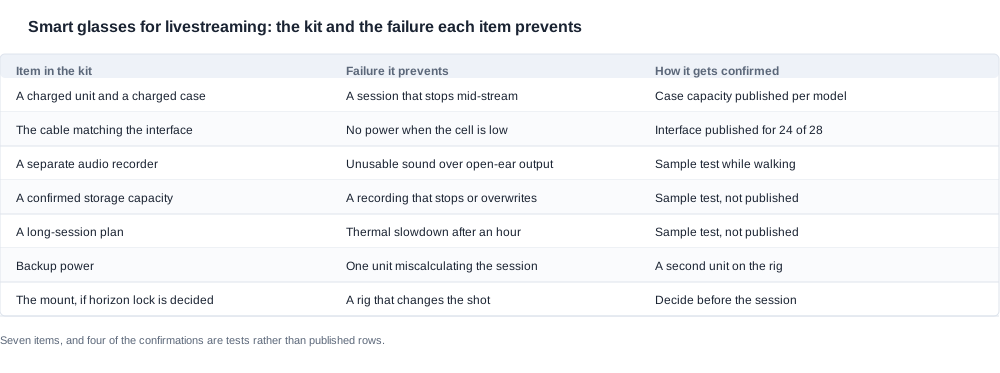
A streaming kit is not a shopping list — it is the set of things whose absence ends a session. Every item below is included because there is a recognisable, specific failure it prevents, not because it is generally useful.
That distinction matters for a buyer, because the two categories behave differently. An accessory that makes a session better is a preference and belongs in a product page. An item that stops a session is a requirement, and a requirement that is missing at nine o'clock on a Tuesday is a stream that does not happen. The seven items here are all in the second category, and each one is paired with the failure it prevents and with the thing that confirms it.
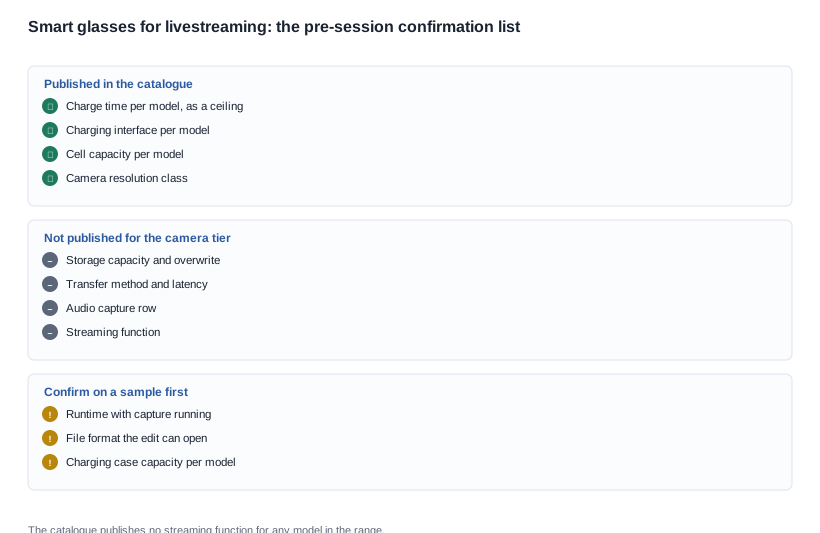
Seven items, and a caution that applies to all of them: in this category the decisive specifications are published on the electrical side and unpublished on everything that happens once the session starts. The catalogue publishes cell capacities, charge times, rated runtimes, charging interfaces and camera resolution classes. It publishes no streaming function, no transfer method, no capture latency, no storage capacity, no overwrite behaviour and no audio capture row for the camera models. So the kit is not a formality around a known specification — it is the instrument that supplies what the specification does not.
Who is buying, and what the session has to survive
The reader is a brand buyer, a channel buyer or an equipment selector putting together a capture rig that will run a long session with someone else operating it. The decision in front of them is which model goes into the kit, and what else has to travel with it, given that the failure mode of this application is a live session that dies on camera rather than a product that fails on a bench.
The fear behind that decision is the one that makes the difference between a supplier and a partner. A unit that stops recording at the wrong moment, a file that cannot be opened, an audio path that degrades as soon as the operator moves — none of these are visible in a demonstration and all of them are visible to an audience. The buyer's job is to convert them from unknowns into kit items before somebody is watching.
The distinctive thing about streaming, compared with the other applications in this category, is that the operator is under load. Nobody running a live session is going to diagnose a storage failure, check a charge state or find a spare cable; the kit has to make those failures impossible rather than recoverable.
How to choose the model, and how to shortlist it
The criteria for this application are narrower than the camera tier suggests, and four of them are published rows. The session length decides the runtime requirement, and because the camera models publish a band of five to eight hours rather than a figure, the honest criterion is the lower end of the band against the longest session. The charging interface decides the cable, and it is published for twenty-four of the twenty-eight models in the range, so it can be fixed before the kit is packed. The case state decides whether a top-up is possible at all, and it is per model rather than per range. And the resolution class decides how the file is handled downstream, at 8 MP on eight camera models and 13 MP on three.
Two criteria are not published and therefore have to be tested. How long the unit actually runs with capture running continuously, and what the file looks like when it comes off the device. Those two tests take half a day on a sample, and they are the reason the shortlist should be one or two models rather than eleven: a shortlist of eleven is a list of models nobody has run through a session.
The comparison to avoid is the one between models on capacity and runtime alone. Those are the two least decisive rows in this application, because the session dies on storage, on the transfer path or on the audio long before it dies on the cell. A buyer who compares two models on cell capacity and rated use has compared the two rows that are least likely to decide the session, and has left the four rows that will decide it untested.
The four items whose absence ends a session
A fully charged unit and a charged case. Both. The camera models publish a charge time of two hours or less, which is what makes a mid-session top-up a planning question rather than a logistics one — provided the case capacity is known. The case states differ across the eleven camera models: a 1400 mAh case is published for the CY03 and the CY05, and the L1 Pro and the L2 Utral offers 900 or 1400 mAh by configuration, the MT6 publishes a foldable 1200 mAh case, the KY06 and the MT5 ship with a case whose capacity is not published, the V03 Pro and the V06, and the V03 and the S7 have no case row at all, so the kit list for one of those four has to be confirmed with the supplier rather than copied from the catalogue. Confirm the capacity for the exact model, or plan as though there is no case.
The right cable. The range uses magnetic charging on some models and Type-C on others, and the catalogue publishes the charging interface for twenty-four of the twenty-eight models. Packing the wrong cable means discovering it at the moment the cell is low, which is the worst possible moment to discover it. This is the cheapest item on the list and the most reliably forgotten.
A related item belongs next to it: the charging dock itself, where the interface is magnetic. A dock is an installed object rather than a consumable, it has to be placed and powered before the session rather than carried to it, and it is the one line in the kit that the operator cannot improvise on the day. The interface row decides which of those two problems the kit has, which is why it is worth fixing before the order rather than on the morning.
A separate audio recorder. The camera models publish no audio specification at all — no open-ear row, no microphone row, no output level. Whatever the sound path turns out to be, it is therefore unknown in advance, and an unknown audio path that degrades with movement is the classic way a session is lost. Test it while walking before deciding a backup is unnecessary.
Storage, confirmed in advance. Storage capacity and the transfer protocol are not published for any model in the range. If the stream length depends on how much can be recorded continuously, that has to be established before the session, not at the point where a recording fails.
The three items that prevent a bad session rather than ending it
A long-session plan. Thermal behaviour over continuous use is not published, and heat-related slowdown tends to appear after the first hour rather than immediately. If the sessions run long, plan a break or a unit swap rather than discovering the behaviour live.
Backup power. A second unit or a power bank. Redundancy beats capacity for a fixed session length, and the failure being protected against is the one where a single unit miscalculates the session.
The mount, if horizon lock is decided. If that decision is still open it belongs on this list, because it changes the rig rather than adding an accessory to it. A rig decision taken on the day is a rig decision taken badly.
What to confirm before the session, and what only a sample can answer
Four questions to the supplier, in writing. What is the runtime with capture continuously active. What is the storage capacity and what happens when it fills. What is the transfer method and how long it takes. And what is the audio capture path on the camera models. All four are currently not published in our documentation, and all four are things a streamer discovers are essential only after the first stream. Asking in advance costs one email.
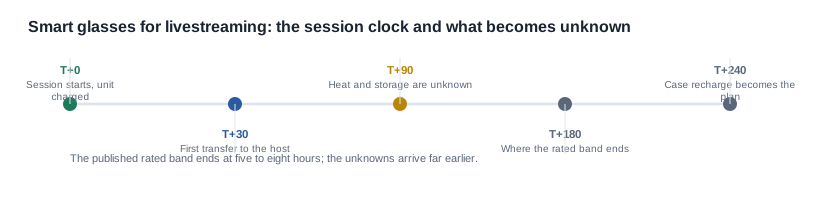
The published rated runtime is also not the same figure as the streaming runtime, and the difference is worth stating precisely. The camera models publish rated use between five and eight hours depending on the model — five to eight hours on the V03 and the S7, and the V06 and the V03 Pro, six to eight on the KY06 and the MT5, and roughly seven on the CY03 and the L1 Pro, the CY05 and the MT6, and the L2 Utral. No runtime figure in the range carries a published test condition, so none of them describes a session with continuous capture running. That is where a two-hour session becomes a five-hour session, or a ninety-minute one, and it is the single most important number in this application and the one with the least published support.
The order of work, and what only a sample produces
- Write the session profile. Length, whether the capture is continuous or triggered, one camera or a rig, whether the operator moves, and what happens to the file afterwards.
- Map the profile onto the published rows and mark the gaps. The electrical rows settle the charging plan and the case. Everything else stays open.
- Take a sample and time one continuous capture session through to its limit. This is the only step that produces a number nobody else can give you.
- Check the recorded file against the editing and streaming tools in use, on a machine other than the one the sample came from.
- Build the kit so that every item answers a named failure, using the table above as the checklist rather than as a shopping list.
- Fix the order terms against the measured session length, not against the published band.

The questions to ask before the order
These are the questions to put in the enquiry, and they are written so that the answer is usable in a kit rather than merely reassuring.
- What is the runtime with capture running continuously, and under what conditions? A published rated figure without a test condition cannot be compared against a session. Ask for the condition and ask for the figure that the supplier will stand behind.
- What is the storage capacity, and what happens when it fills? Overwrite, stop, or drop the oldest file — the three behaviours need three different kit plans, and only one of them is safe for a live session.
- What is the transfer method, and how long does a transfer take? A transfer that takes longer than the interval between segments is a production decision, not a technical detail.
- What is the audio capture path on the camera models? No audio row is published for the camera tier, so the answer decides whether a separate recorder belongs in the kit.
- Which case ships with this exact model, and what is its capacity? Four case states across the camera tier, and the answer decides whether a mid-session top-up is possible.
- What is the charging interface for this model? Published for twenty-four of the twenty-eight models in the range; the four exceptions publish a case capacity instead of an interface row, and those four need the question asked directly.
- What does the unit weigh, and what does the packed unit weigh? Only one model in the whole range publishes a weight, and that figure excludes its foldable charging case, so a rig calculation built on it will be wrong for every model except that one.
- Can you provide the conformity file for this model in our market, in writing? The catalogue carries a company-level export certification page whose content is images rather than text, and the catalogue text contains no reference to CE, FCC or RoHS anywhere, so a per-model position is a document to request.
The answers that arrive in writing are what the kit is built from. The answers that arrive verbally are what the kit is built from when somebody is in a hurry, which is exactly when a session fails in front of an audience.
Where a streaming kit goes wrong, and what the order can still move
A kit assembled from another application's bill of materials. The symptom is a spare cell packed as an accessory, or a screen protector in a bag for a device with no display. The prevention is building the kit from the named failures rather than from a list of things that travel well.
A case assumed because the model is in the camera tier. The camera models sit in four case states, and three of them have no published case row at all. The prevention is the per-model case position in the evidence file.
A rating quoted as a session length. The symptom is a session planned to eight hours. The root cause is a band of five to eight hours, without a test condition, read as a point. The prevention is timing a session on a sample.
The audio path decided in a quiet room. The prevention is a walking test, because open-ear output that is clear at a desk is not clear in movement, and nobody is in a quiet room on a live stream.
Backup decided as capacity rather than redundancy. Two units and a power bank are not the same thing. The failure being protected against is the one where a single unit miscalculates, and only a second unit protects against it.
The rig costed on published weights. The only published weight in the entire range is the 158 g of the MT6 glasses body, which excludes its foldable charging case, and no model in the camera tier publishes a shipped weight at all. A rig whose total cost or balance is built from that figure will be wrong for every model, and the error shows up as a rig that cannot be mounted or a parcel that costs more to ship than the device inside it.
The total cost compared without the consumables and the cases. The case is a second lithium cell with its own transport documentation, and the consumables — the wipes and the contacts — scale with time rather than with despatch. A unit-price comparison that ignores them flatters the configuration that looks cheapest on the quotation and costs the most to run.
The commercial terms still open at this point. The pilot quantity against the volume, which on a streaming rig is where most of the room sits because a rig that fails its first public session costs more than the equipment. Whether the supplier supplies the case as a separate quoted line with its own specification and its own transport documentation, because the case is a second lithium cell that has to be declared in the shipment file and the requirements sit at battery transport. Whether the conformity file for the exact model and market can be provided in writing, per model. Minimum order quantity tiers, and whether two configurations can share a purchase order. Warranty and returns terms that distinguish a unit fault from a pack fault, because a rig contains a device, a dock, a cable and a spare unit and each of them fails differently. And a split first run into two deliveries against a staged payment, which suits a channel that wants to see one rig survive a session before it buys the fleet.
Settled by the product rather than by the relationship: the cell configuration and therefore the runtime ceiling, the charging interface and therefore the cable, the resolution class, and the cost and lead time of conformity testing. A mould charge is a one-time cost that belongs in a separate quoted line rather than folded into the unit price. The commercial structure of a first order is at pricing and the clause language is at contract terms.
The gaps stay gaps on this list
We publish cell capacity, charge time and rated runtime for each model, the charging method for twenty-four of the twenty-eight and the camera specification for the camera models, and we will not fill the gaps on this list with typical values. Storage capacity, transfer protocol, thermal envelope and capture latency are not published for any model, and no streaming function is published anywhere in the range — which means a requirement for live viewing to a control room or a platform is a question about a different product class rather than a configuration of this one.
We will also hold the charge wording where the catalogue holds it. Two hours or less is a ceiling that permits exactly two hours; it is not the same claim as under two hours, and a kit card or a product page that says under two hours makes a promise the published row does not support. The published rows are at battery life and the model range is at AI camera glasses.
If you send us the model, the session length and the required configuration, we will tell you which of these seven items our documentation already answers and which you will need to test on a sample — and if the model is wrong for the session length, we will say so rather than helping you pack a kit around it. Send the session profile and the rig layout and we will map both against the published rows. The scenario entry point is smart glasses for livestreaming.
Related reading
- The entry point for this scenario — smart glasses for livestreaming
- Rating a model against a streaming requirement — AI camera glasses
- Runtime against a real working session — battery life
Pass the target market, the quantity and the required configuration to us, and we will come back with what is available and what is not.


