
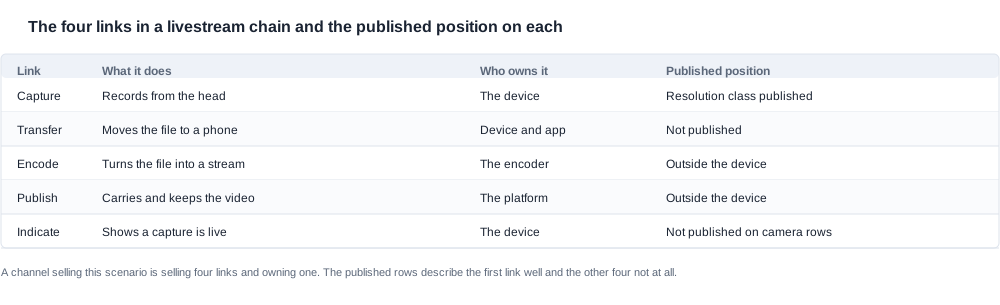
Smart glasses for livestreaming are one device at the end of a four-link chain, and the commercial mistake in this scenario is to sell the chain as though the device covered all of it. The glasses capture, the phone receives the file, the encoder turns it into a stream, and the platform carries and keeps it. A catalogue that publishes the capture step well and says nothing about the other three leaves the buyer owning every hand-off. That is the situation our range is in, and the way to buy into it is to treat the unpublished rows as the specification and to build a protocol around the ones that are published.
Smart glasses for livestreaming: one device in a four-link chain
Who this article is for and what it settles. The reader is a brand owner, a channel buyer or a category merchandiser selling into creator equipment, or an agency that equips presenters. The decision in front of them is what the listing may promise a presenter and what the channel has to supply around the device. Three commercial risks sit behind that decision: a session that fails because a hand-off was never measured, a return generated by a claim the device cannot support, and a total cost that was computed on the unit price alone and therefore omitted the encoder, the phone and the microphone that the product does not replace.
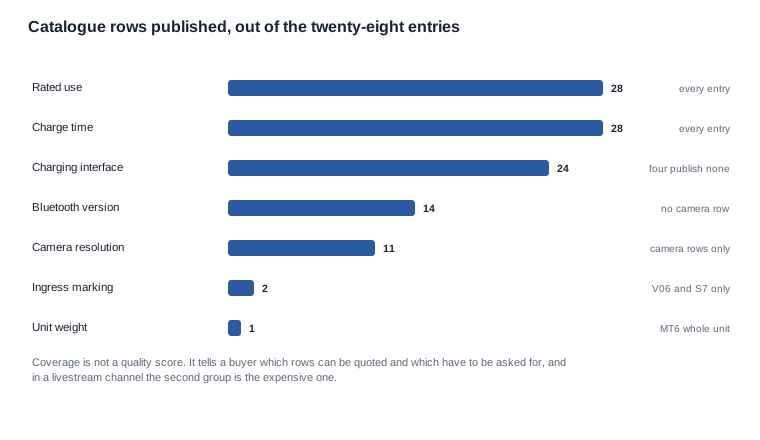
What the published position actually is. Twenty-eight entries are published. Eleven are camera rows, eight are audio rows and three are sport rows. The camera rows publish a resolution class — 8 megapixels on eight of them and 13 megapixels on three — a cell capacity from 220 mAh to 290 mAh, a charge time, a rated use figure, and a charging interface on seven of the eleven. The audio rows publish a Bluetooth version, a cell capacity, a charge time, a rated use figure and a charging interface. Nothing in the catalogue publishes a Wi-Fi function, a streaming capability, an integration with any broadcast platform, a storage capacity, a file format, an overwrite behaviour, a field of view, a video resolution, a frame rate, a sensor model or a low-light figure. That list is not a criticism of the range. It is the boundary of what a listing can be built on.
What the four links mean for a buyer's own scope
The chain is worth drawing out because it decides what the buyer is buying. Capture is inside the product and is the only link with published rows. Transfer sits half inside the product and half inside an application, and it is where every session failure happens. Encode and publish sit entirely outside the product, on hardware and software the channel already owns or already rents. A buyer who has scoped the whole chain will price the product as one line in a kit. A buyer who has scoped only the product will price a kit as a product, and the difference between those two numbers is the difference between a channel that works and a channel that returns.
There is a second consequence that shows up in the paperwork rather than in the session. Because three of the four links sit outside the device, the regulatory profile of a livestream configuration is not the regulatory profile of the glasses. The radio element sits inside the Radio Equipment Directive framework; the capture function and the platform's own content and retention rules sit outside the product entirely and are the presenter's or the operator's to satisfy. A buyer who treats one certificate file as covering the whole configuration is making a mistake that the platform will not correct for them.
What the published rows settle and what they leave open
The capture link is the one the catalogue describes. A camera row publishes its resolution class, and that is genuinely useful for a channel because it separates the eight 8-megapixel entries from the three 13-megapixel entries in a way a buyer can put in a tier structure. What the resolution class does not do is tell a buyer what the presenter sees in frame, because the field of view is not published, and it does not tell the buyer how the image behaves in a low-lit room, because low-light behaviour is not published. Those two gaps are the reason the channel's answer to "will it look good" has to be sample footage rather than a specification.
The transfer link is the expensive gap. Storage capacity, file format and overwrite behaviour are published for no entry in the range, and the camera rows publish no Bluetooth version either — the fourteen entries that carry a radio version are the AR entry, the children's audio entry, the eight audio rows, the three sport rows and the electrochromic entry, and none of the eleven camera rows is among them. A buyer who assumes a specific radio version on a camera row is assuming something the catalogue does not say. The operating rule that follows is the only defensible one: transfer and clear on a schedule rather than at the end of a session, and verify on the sample that the transfer actually completes inside the window you allocated for it.
The encode and publish links belong to other people entirely. No camera row can stream on its own, so the encoder, the platform, the retention policy and the content policy sit outside the product. That is not a gap in the range; it is the architecture of the category. The commercial consequence is the one a buyer most often gets wrong. A livestream configuration's total cost includes the phone, the encoder, the broadcast microphone, the connectivity and the platform account, and a channel that computes the landed cost of the glasses alone is comparing its own configuration against a competitor's configuration without the same inputs. Any supplier comparison has to fix the surrounding kit before the unit price means anything.
The indicator crosses every link. The AR entry publishes an indicator light with button control. No camera row publishes an indicator row, so the question of whether a capture is visible to the presenter and to anyone else in the room is not answered for any of the eleven camera entries. In a livestream this is a bigger question than it is in most scenarios, because the presenter is often in public, the platform's own rules usually require disclosure, and a presenter who cannot tell whether the device is live will not take the risk. The question is answerable on a sample in five minutes, and it has to be answered before the listing is written.
The pre-flight protocol is the deliverable a channel actually ships

A session that has been measured once does not fail live. The protocol below is what makes the difference between a configuration that works and a configuration that works once. Each step produces a number or a confirmation, and each number goes into the presenter rundown so that nobody has to improvise in front of an audience.
- Time one transfer on the phone and network that will actually be used. Not on the office network and not on the newest handset. Write the seconds into the rundown, because a presenter who knows the delay will present from a script rather than from a preview.
- Rehearse at full session length with the camera running. The published rated use figures run from 5 to 8 hours on the camera rows and from about 6 to 8 hours on the audio rows, and no figure states the condition it was measured in. A continuous capture session is close to the worst realistic load, and the rehearsal is the only measurement that finds out where the real figure sits for the configuration being sold.
- Separate the broadcast microphone from the glasses. An open-ear frame does not attempt to contain sound, so a microphone near the presenter picks up the presenter's voice and the frame's output together. The result reads as a technical fault within seconds of the stream starting. One extra line in the equipment list removes the category of complaint entirely.
- Test the app install in the destination region. The companion application's availability, its account flow and its store region are not published for any entry. A product that pairs perfectly in one market and fails to install in another produces returns rather than complaints, and the test is done once per market, not once per order.
- Confirm the recording indicator on the unit in the hand. Not on the specification. On the sample, with the camera running, with somebody else in the room.
- Write the transfer budget and the session length into the presenter rundown. The rundown is what makes the rehearsal repeatable by a presenter who did not attend it.
Why a channel should ship the protocol rather than the device alone. The protocol is the part that makes the product work in public, and it is also the part that survives a change of supplier: the numbers and the sequence transfer, while a device-specific instruction does not. For a channel buyer this is a cheap, defensible asset. The alternative is a product page with a resolution class and a promise, and a returns rate that measures how many presenters had to discover the hand-off timing live.

What to demand in writing before a livestream configuration is ordered
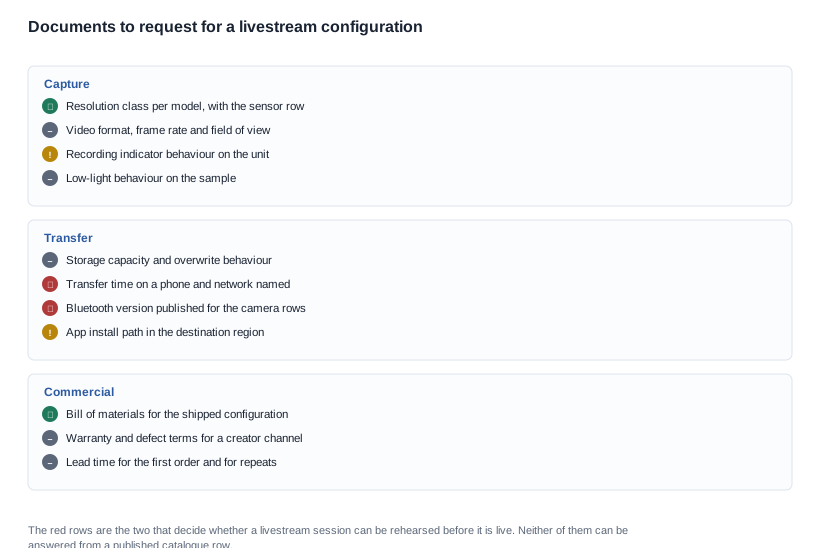
The questions a shortlist for this scenario has to be able to answer. Which model is on the shortlist, and what resolution class does it publish. What the storage capacity is and what happens when it fills. What the radio version is on that row, given that no camera row publishes one. What the transfer time is on the target phone and network. What the app does in the destination region, and whether it needs an account. What the recording indicator does. What the file format is. Each of these is a question to put to the supplier, and each one is a question worth putting before the deposit rather than after the first live session.
The four that most often have no answer, and what that means. A supplier with no storage figure has either not measured it or does not want it compared; either way the operating rule has to be written by the buyer. A supplier with no radio version on a camera row cannot tell you which phones it has been validated against, so the compatibility test moves into the buyer's programme at real cost. A supplier with no app region statement cannot tell you whether the product works in the market you are selling into. A supplier with no file format cannot tell the presenter's editing team what they will be handed. None of these is a reason not to buy. They are reasons to write the protocol, price the testing and avoid the claims.
The regulatory rows for a camera that records in public. A device that captures images and audio and communicates by radio sits inside the European Union's conformity framework for radio equipment — the Radio Equipment Directive (EU) 2014/53/EU — and the general product safety framework through the General Product Safety Regulation (EU) 2023/988, applicable since 13 December 2024. The red directive and GPSR pages set out the route. The catalogue text contains no reference to CE, FCC or RoHS, and it carries no per-model certification row, so the certificate file for the destination market has to be requested per model and checked by number. That request is part of the due diligence for a camera product and it is the same request the certification checklist describes. The data side of a recording device in a public place is a separate question, and it is covered at GDPR and smart cameras.
The commercial terms that move. Minimum order quantity tiers and whether two configurations can share one purchase order. The packaging and the insert, which in this category are photographed and reviewed as often as the product, so the artwork cost is not incidental. Whether a branded quick-start card is supplied or customer-supplied, and whether that card can carry the pre-flight protocol — which would make the protocol a shipping asset rather than a document the channel has to chase. The quantity a channel order runs at pilot tier. Splitting a first run into two deliveries against a staged payment. The terms are at pricing and MOQ, and the clause language is at contract terms.
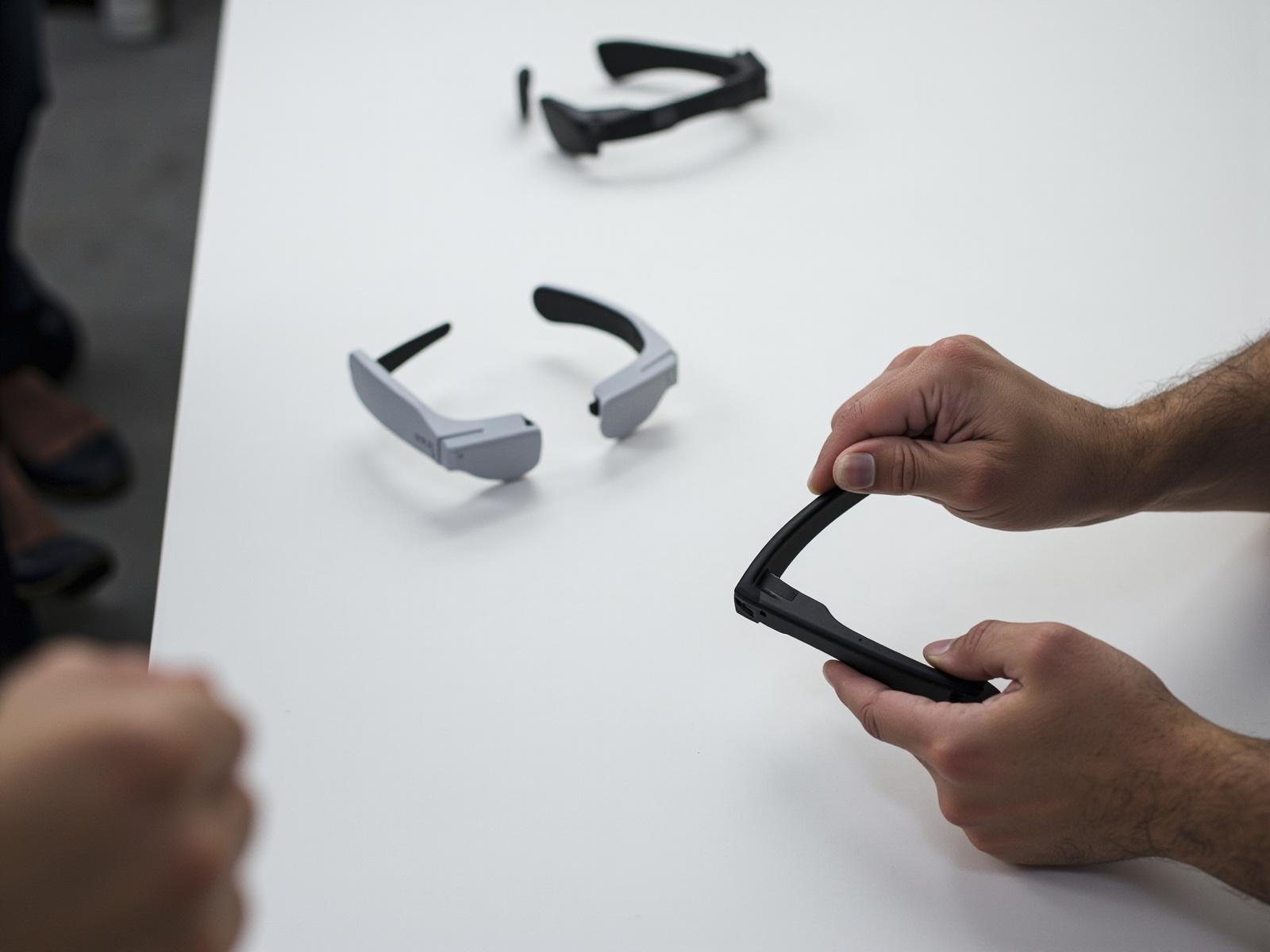
The claim set a livestream listing can carry
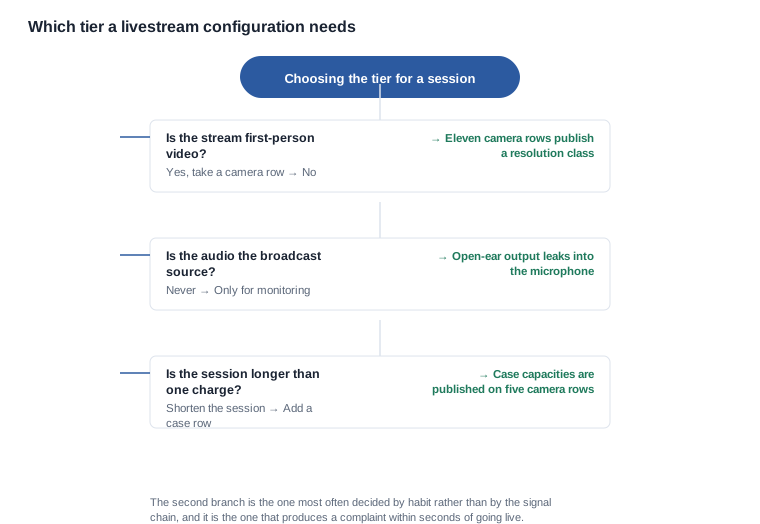
What can be written. The model, the resolution class, the cell capacity, the rated use figure as a band, the charge time of two hours or less, the charging interface where the row carries one, the case capacity where one is published, and the structural features the catalogue names. The claim that carries the most weight in this scenario is not a specification at all: it is the statement that this is a first-person recorder that feeds a phone, rather than a broadcast device.
What cannot be written. The word "streams" or "streaming" as a device capability is not supportable, because no entry publishes a streaming function or a platform integration. A field of view figure, a video resolution, a frame rate, a storage capacity or a battery duration with a stated condition are all outside the published rows. "Noise cancelling" is outside them too — the audio rows publish surround sound on several models and nothing about cancellation. Any claim about assistant accuracy or translation accuracy is outside them, because the catalogue names twenty entries as AI products without publishing a feature list, a language coverage or a latency for any of them.
The three questions that separate a good listing from a bad one. How the presenter knows a capture is live. What happens to the file between the device and the phone. What the session looks like when there is no connection. A listing that answers all three will sell a narrow product and keep its returns; a listing that answers none of them will sell the chain and pay for it.
The total cost a buyer should quote to a retailer. The device at its unit price, plus the phone, plus the encoder, plus a directional microphone, plus the connectivity, plus the time to run the compatibility and rehearsal programme once per market. A channel that publishes that number is more useful to a retailer than one that publishes a lower unit price and hides the rest, and it is the only comparison that holds when two suppliers are being assessed against each other.
Where a livestream channel fails after the first session
A listing that says the glasses stream. This is the most expensive error in the scenario and the easiest to write by accident, because the words are the ones a buyer expects to see. The correction is one sentence, and it should be in the listing rather than in the support answer.
A configuration that was never rehearsed at full length. The published runtime is a band with no condition attached, and a live session is the heaviest realistic load. A channel that rehearses once per market and once per configuration will find the real figure; one that does not will find it on a stream.
An app that does not install in the destination market. This generates returns rather than complaints, and the return reason will say "does not work" rather than "the app store region is different".
A battery that is flat when the session starts. The most common real report in this category is a unit that was not charged after the previous session. The protocol fixes it, and the protocol is cheap.
An indicator nobody checked. If the presenter cannot tell whether the device is live, they will not use it in public, and the listing's promise quietly becomes unusable.
A creator channel that treats the packaging as an afterthought. In this scenario the unboxing is content. The insert, the quick-start card and the regulatory content all sit inside the box, and the print minimum does not depend on the order size — which is exactly where the total cost of a small run is won or lost.
A support load that arrives before the documentation does. A device used by presenters generates questions from people who did not choose it, and the answers have to exist before the first live session rather than during it. The sample terms and the supplier verification pages are the starting material for that answer set.
Why a missing parameter is an operational problem
Concretely, we publish the rows we hold and we will not fill the missing ones with typical values, because in a live session a missing parameter becomes an operational problem rather than a specification gap. We publish the cell capacity, the charge time of two hours or less with about one hour on the D17 and the ZH12, the rated use figures, the charging interface on the twenty-four entries that carry one, the Bluetooth version on the fourteen entries that carry one, the camera resolution class on the eleven camera entries, the case capacities where they are published, and the structural features the catalogue names — the detachable inner frame on the V06 and the S7, remote photo capture on the D17 and the ZH12, the ultra-slim detachable temples on the G07, and the four colours on the V06.
What we do not publish, and will not estimate: the storage capacity, the file format, the overwrite behaviour, the field of view, the video specification, the frame rate, the sensor model, the low-light behaviour, the acoustic measurements, the runtime test condition, the standby draw, the cycle life rating and the operating temperature range. We will not claim that any entry streams, connects to a broadcast platform, or works offline, and we will not present the AI capability of the twenty AI-named entries as an accuracy claim, because the catalogue publishes no feature list and no accuracy figure for any of them.
What we will do: take the session format, the region, the platform and the volume, and tell you which configuration exists, which published rows cover it, which parts of the chain you have to supply, which claims the listing can carry, and what has to be settled in writing before a purchase order. The camera tier is at AI camera glasses, the audio tier is at Bluetooth audio glasses, the adjacent production workflow is at content creation, and the scenario entry point is smart glasses for livestreaming.
Session length, platform and region
Send the session length, the platform, the region, the tier you are considering and the volume, and we will return the published rows that cover it, the parts of the chain that sit outside the device, the protocol steps that have to be measured, and the claims the listing can carry without overreaching. The way a runtime figure should be read is at how battery runtime is measured.
Related reading
- The scenario entry point — smart glasses for livestreaming
- The product tiers — AI camera glasses and Bluetooth audio glasses
- The compliance route — red directive and GPSR
- The adjacent workflow — content creation
Tell us the session length, the region and the tier, and we will return the published rows that cover it and the hand-offs that sit outside the device.


