

An outdoor channel does not sell smart glasses for outdoor use; it sells them for a season, and it supports them for nine. That difference changes every decision in the programme, from the order window to the wording on the product page, and it is the reason the seasonal question has to be answered before the first purchase order rather than discovered in the first wet week of the shoulder season.
The answer has two branches, and both are defensible. A channel can sell a summer product with an honest season statement on the page, or it can sell an all-season product and carry the evidence that an all-season claim requires. What loses money is the third position, which is the all-season claim evidenced only by summer. This article works through what each branch costs, which published rows survive the shoulder season, and how the returns reserve should be set.
Smart glasses for outdoor: the season decides the commercial model
Two commercial models, and the evidence each one needs
The summer model is the cheaper one to run and the harder one to sell well. Its listing says plainly that the product is built for warm-weather activity, its inventory arrives against a narrow peak, and its support obligation runs for months after the season closes because the customers who bought in July are the ones who discover in October that the product does something they did not expect.
The all-season model costs more and depends on evidence this category mostly does not publish. It needs temperature behaviour across a range, ingress behaviour beyond the catalogue marking, and low-light performance — three items that are not published for the outdoor candidates and that the catalogue's own documentation leaves open. A buyer choosing this branch is choosing to close those three with the factory in writing before the listing goes live, not to state them in the copy and hope the season is mild.
The decision is a commercial one rather than a technical one, and it is made at the level of the channel rather than the model. It is also reversible in one direction only. A summer product can become an all-season product once the evidence arrives; an all-season product cannot become a summer product without losing the reviews that the broad claim produced.
The order that commits the most, and the order that commits the least
Not every order in the seasonal plan carries the same exposure, and the buyer should spend negotiation effort where the exposure is. The first order against the peak carries the highest exposure in three ways at once: it is the largest quantity, it is the one where the samples and the shipped configuration are least likely to match, and it is the one whose mistakes are most expensive to correct because the season is already running.
The order that commits the least is the pilot. A small quantity against a single model, with the claim set and the inspection criteria attached, buys the information that the peak order needs and costs a fraction of it. Because the catalogue publishes 28 configurations with different cells, interfaces, runtimes and case arrangements, the number of variables a pilot has to cover depends entirely on how many models the channel is actually going to list, and a channel that plans to list four outdoor configurations needs a pilot that covers four.
The negotiation sequence that follows from that is standard but worth stating, because it is where seasonal programmes usually go wrong. The claim set and the inspection criteria are settled before the quantity, because they determine whether the quantity is buyable at all. The delivery window is settled before the unit price, because a price negotiated against a slipped window is a price paid for stock that arrives in the wrong season. And the pilot quantity is never negotiated against — it is the line item that protects the line item that is.
There is a seasonal variant of this that is worth naming separately: the second order. It is usually placed at a better price and it is usually placed against a configuration that has quietly changed, because the factory's own range has moved on and the buyer has not re-requested the conformity evidence. A seasonal programme should treat the second order as a new claim-set review rather than as a continuation, because the season will not allow a slow answer the first time.
The shoulder season is where the reviews are written
A unit bought in July is evaluated in October, and October is colder and wetter than the July demonstration. That is when the questions arrive — does it work in the rain, does the cell hold up on a cold morning, do the temples sit properly under a cap — and it is when the answer a customer writes in a review is formed.
Two of those three cannot be answered from the published documentation at all. On the V06 and the S7 the ingress marking is a catalogue attribute, and read as a level it gives dust protection plus a limit set at water splashing from any direction — short of immersion, short of a sustained downpour — with no third-party report published behind it on either model. The rated-use figures come without a test condition on every model in the catalogue, and a cell at low temperature behaves unlike a datasheet figure.
The consequence is that a review written in the shoulder season is a review of a product the buyer never described accurately, because the listing described the peak season instead. That is why the season belongs in the first line of the product page rather than in the specification section, and why a summer channel that states its season plainly can lose a December sale and still come out with a better return rate than a channel that promised everything.
The buying calendar and what each window commits you to
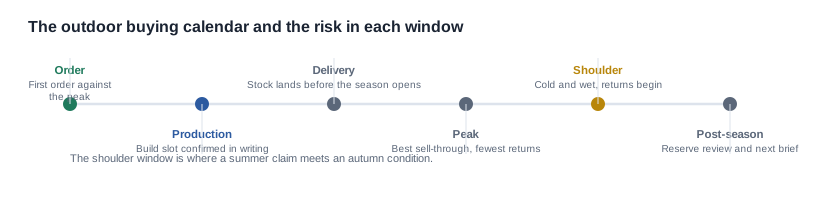
The calendar below is the working version for a northern-hemisphere outdoor channel. The windows are not fixed dates, because they are set by the factory's build slot and by the freight route, but the order of them is, and the risk attached to each is a function of the window that follows it.
- Order window. The first order is placed against the peak. Its real content is the claim set and the criteria, because the samples that were evaluated were evaluated against a configuration that may not be the one that ships.
- Production window. The build slot is confirmed in writing against a batch reference. A build slot that is confirmed verbally leaves the whole seasonal plan resting on a memory.
- Delivery window. Stock lands before the season opens, not during it. A delivery that lands in the first week of the peak has no time to resolve a batch problem before the selling season has started.
- Peak window. The highest sell-through and the fewest returns, because the conditions match the listing and the product is being used as intended.
- Shoulder window. Colder and wetter, and the returns begin. This is where the claim set either survives or does not.
- Post-season window. The reserve review, the defect data by batch, and the brief for the next order — which is the only point at which the seasonal plan can be corrected rather than merely survived.
The two windows that carry commercial risk are the shoulder window and the delivery window, and they are connected. A delivery that arrives late compresses the time available to observe the product in its intended conditions, which means the shoulder season becomes the first serious test of a product the channel has already sold into the peak.
Where the calendar is set by somebody else
Three of these six windows are outside the buyer's control, and a seasonal plan that ignores that is a plan that will be rescheduled. The production window belongs to the factory's build slot. The delivery window belongs to the freight route and to the factory's own readiness. The peak window belongs to the channel's marketing calendar and to the weather.
What the buyer can control is the order window and the shape of the claim set that goes into it, plus the post-season review that decides whether the next order changes. That is not a small amount of control, and it is where the seasonal budget should be spent: the documents and the criteria are the parts of the plan that survive a slipped build slot, and the marketing calendar is the part that does not.

What changes between summer and winter, in the rows and in the wording
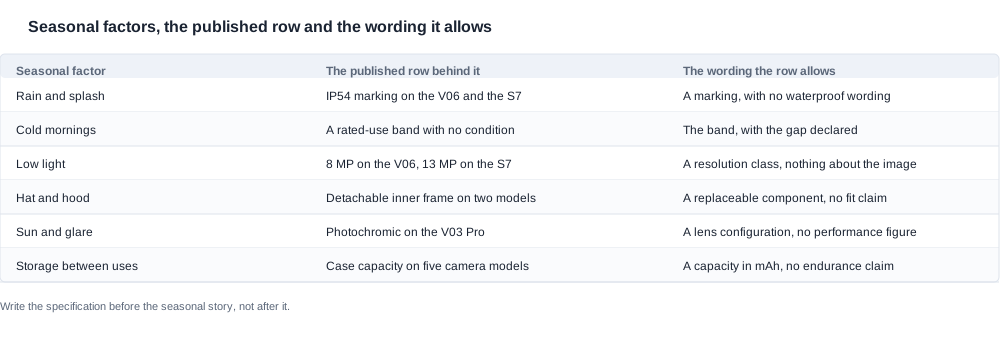
| Seasonal factor | The published row behind it | The wording the row allows |
|---|---|---|
| Rain and splash | IP54 marking on the V06 and the S7 | A catalogue marking, with no waterproof wording |
| Cold mornings | A rated-use band with no test condition | The band, with the missing condition declared |
| Low light | 8 MP on the V06 and 13 MP on the S7 | A resolution class, nothing about the image |
| Hat, hood and helmet | Detachable inner frame on the two models | A replaceable component, with no fit claim |
| Sun and glare | Photochromic configuration on the V03 Pro | A lens configuration, with no performance figure |
| Storage between uses | Case capacity published on five camera models | A capacity in mAh, with no endurance claim |
Every row in that table is a place where the published row is narrower than the seasonal story a channel might want to tell. The mistake is not in the listing copy but in the ordering: the seasonal story gets written first, the specification gets filled in afterwards, and wherever the specification is thin the copy overstates. Writing the table first and the copy second inverts that, and it is the cheapest seasonal control available.
The lens question in a sunny season
Two entries in the catalogue touch on light change. One is the V03 Pro, published with a photochromic lens configuration, flexible temples and a Type C charging port; the other is the catalogue's separate electrochromic entry, published with a Bluetooth 5.4 radio, a 100 mAh cell, a charge time of two hours or less, a rated run of about seven hours and magnetic charging.
Neither entry publishes a response time, a depth of change, a light-transmission range or a temperature range over which the change operates. That is not a small gap for a summer channel, because the seasonal complaint about a variable lens is precisely about how it behaves on the way from shade into full sun rather than at either end. The honest treatment is to publish the configuration and to run a ten-minute window test on a sample — shade into sun, sun into shade — before any wording about it goes on the page. The lens care routine that has to accompany that wording is at outdoor lens care.
The cold-morning arithmetic on a charging case
A winter channel has a specific operational need that a summer channel does not: the cell is cold at the moment it is needed, and a cold cell delivers less than a warm one on the same charge. The published rows that bear on this are the case capacities, and only some of the camera models carry one — the CY05 and the L1 Pro, and the CY03 — each at 1400 mAh, the L2 Utral at 900 and 1400 mAh, and the MT6 with its 1200 mAh foldable case.
The gap matters more than the numbers. The catalogue publishes no charging-case row at all for the three sport models, so a running channel that wants to make a winter claim about carrying a charged spare has nothing published to base it on. Where the case is published, the claim is a capacity in mAh and nothing more, because the catalogue does not publish what that capacity delivers in an outdoor duty cycle.
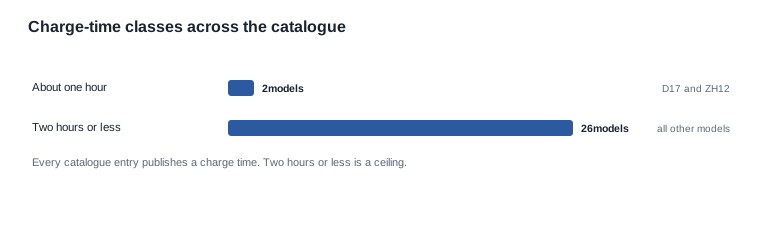
The other published figure with seasonal weight is the charge time, and the catalogue is unusually complete on it — all twenty-eight entries publish one. Twenty-six of them publish a charge time of two hours or less, and two, the D17 and the ZH12, publish about one hour. That pair is the relevant one for a cold-weather turnaround, because a unit that can be recharged inside a vehicle stop on a Type C port is a different operational proposition from one that needs a two-hour window. The two-hour figure is a ceiling the catalogue publishes, not a measured duration, and a seasonal plan should be built against the ceiling.

The listing rules that decide the return rate
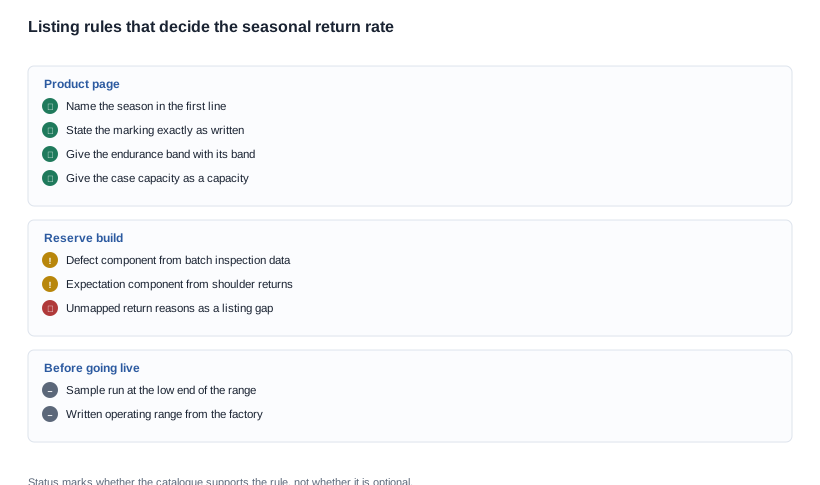
The seasonal return rate is mostly decided by the product page rather than by the product. Four rules do most of the work, and each one exists because a specific published row is narrower than the story the page would otherwise tell.
- Name the season in the first line. The season is the condition under which the published rows were written, and stating it filters the buyer who will not return the unit.
- State the ingress marking exactly as it is written. "Marked IP54 in the catalogue" is defensible; "waterproof" is a different claim that no published report supports.
- State the endurance figure with the band, and say the condition is not published. A customer who reads a band as a single number will hold the product to it.
- State the case capacity as a capacity. 1400 mAh is a fact; "two extra days of use" is a derivation the catalogue does not support.
Setting the reserve from the shoulder season rather than from the peak
A returns reserve set from peak-season data is set from the quietest data the channel will ever see. The units that come back in the shoulder season are not the units that came back in the peak: they are the units that were sold to buyers whose use did not match their expectation, and the return reason recorded on the form is the expectation gap rather than a defect.
That means the reserve has two components, and they need different evidence. The defect component is estimated from the batch and defect data, which the factory inspection criteria produce. The expectation component is estimated from the difference between the claim set and the seasonal conditions, and the only way to size it is to look at the return reasons from the previous shoulder season rather than at the review average.
A useful discipline here is to write the return reason in the channel's own words before the customer writes it. Every return reason that does not map to a defect should map to a line in the product page, and every line in the product page should map to a published row or to a stated procedure. A channel that finds a return reason that maps to neither has found a gap in the listing, and the cheapest repair is a sentence rather than a refund.
The seasonal risk that has no published row at all
There is one seasonal exposure with no published row anywhere in the catalogue, and it is the one that catches new channels: the operating temperature range is not published for any model. A winter channel is therefore running a season in which the product's specified operating envelope is undefined, and the consequence is a decision that has to be made with the factory rather than read off a page.
The decision is whether to run the winter season at all, and the criteria are unglamorous. A sample has to be run at the low end of the intended range before the listing goes live, the outcome has to be recorded with the conditions attached, and the listing has to state the season in which the product is supported. Where the factory cannot answer the range question in writing, the channel is running an unsupported season and the reserve should reflect that.
What we publish about seasons, and what we will not forecast
The working rule we apply: a seasonal decision should be made against the published rows and written into the claim set, because the seasonal variables in this category are mostly undocumented and the documentation gap is what creates the return. Season changes what a buyer asks for, so the outdoor rows are worth reading in that order. The cell capacities first, then the charge times — two hours or less across the catalogue, and about one hour on the D17 and the ZH12 — then the rated-use bands. After that come the charging interfaces, the radio versions on the rows where the catalogue states them, the ingress marking carried by two models, the four colour options on the V06, and the inner frames that detach together with the ergonomic frame on the V06 and the S7, plus the charging-case capacities where they are published.
What we do not publish and will not estimate: seasonal demand data of any kind, temperature performance or operating ranges, ingress behaviour beyond the marking, low-light performance, sensor part numbers, field of view, video specifications, lens materials, coating characteristics, and the unit weight of every model except the single 158 g whole-unit figure published for the MT6. We will not let a channel imply a waterproof capability, and we will not supply a seasonal forecast dressed as a market opinion.
What we will do is take the season, the climate, the channel, the price band and the target markets, and tell you which published rows apply to which candidates, which claims the documentation supports for that season, which items have to be requested in writing before the order, and where the honest limit of the seasonal story sits. The catalogue pages behind this are sport smart glasses and AI camera glasses; this application is filed under outdoor.
The season you intend to open in
Send the season you intend to open in, the climate, the channel, the price band and the target markets, and we will return the published rows that cover it, the claim set that holds for those conditions, and the criteria to write into the purchase order. The adjacent documents are the outdoor real-world pilot, which covers the evaluation itself, and the outdoor warranty and returns policy, which covers the reserve on the shoulder season.
Related reading
- The application page for this use case — outdoor
- Where the range is described — sport smart glasses
- The endurance figures and their conditions — battery life
- The lens position — IP ratings explained
Send the season and the climate, and we will return the claim set that holds for those conditions and the criteria to write into the order.


