Smart glasses for outdoor spend most of their life in a bag, and that is where the lens is usually lost rather than where it is used. A retailer buying an outdoor line optimises for the outing, because the outing is what the customer remembers and what the review describes; the six months in a rucksack or a vehicle boot between outings is the part nobody designs for, and it is the part that produces a lens that is hazed, marked or degraded by the time the customer takes it out of the box in the spring. Our catalogue publishes the lens material, the coating, the surface treatment and the operating temperature range for no model in the range, and it publishes no charge-cycle rating and no storage condition, so the outdoor buyer has to build the storage position out of documents rather than out of rows. That is the argument of this article: for an outdoor range the lens decision is mostly a storage decision, and the consumable is a low-frequency consumable that has to be kept dry inside the bag rather than issued at the counter.
Smart glasses for outdoor: the situation where storage causes the damage
The buyer, the season and the unit that spends most of the year in a bag
The reader is a brand owner building an outdoor line, a channel buyer sourcing a leisure range, or a product manager deciding whether a model belongs in an outdoor collection at all. The task is to select the model, decide the accessory bundle, decide what the listing claims about outdoor use, and decide what the customer is told to do when the device comes out of storage after months. The commercial risk being managed is a seasonal one, which makes it unusually hard to see: a return that arrives in a cluster three months after the peak season is a return the buyer will attribute to a defect in the product, when the actual cause is usually the environment the product spent that time in.
Seasonal buying makes three commercial decisions harder than usual. The first is the forecast, because the order is placed months before the demand and the replenishment window is short. The second is the accessory bundle, because the outdoor bundle — a pouch, a clip, a case, a lanyard — is where the consumable usually ends up, and where it usually ends up wet. The third is the claim set, because an outdoor listing is written in a register that rewards adjectives: "built for the elements", "all-weather", "sandproof". None of those has a published row behind it in our catalogue, and two of them are contradicted by it: the only models in the whole range that publish an ingress marking are the V06 and the S7, and the marking itself covers a dust protection level and protection against splashing water rather than immersion or a sustained downpour.
There is a fourth consideration that belongs to this channel rather than to any other. An outdoor device is typically used in bursts, and the customer may go a long time between outings. Our catalogue publishes a charge time for every model — up to two hours for all of them and roughly one hour on the D17 and the ZH12 — but the published figure carries no starting state and no termination criterion, so it cannot be turned into a "restored and ready" promise for a unit that has been sitting. We publish no cycle-life rating either. A buyer who wants to tell a customer that the device will be ready after a winter in a cupboard has to obtain that evidence, because our rows do not carry it.
Why outdoor contamination differs from a single day's use
Three properties separate outdoor contamination from the exposure that a day of use produces.
The first is that outdoor contaminants are combined. Grit alone is an abrasive that needs rubbing to do damage; grit plus salt, or grit plus a damp case lining, is a grinding compound that damages on contact. A beach outing produces salt, sand and moisture together, and the combination is what pits a coating rather than what scratches it. This is why an outdoor instruction has to deal with a sequence — rinse, then dry, then handle — rather than with a single wipe.
The second is that damage happens while the device is not being used. A lens that is pressed against a case lining for a season carries a mark for a season, and the mark is discovered in the first five minutes of the next outing. This is the failure that most damages an outdoor brand's review profile, because the customer has done nothing wrong and cannot understand it.
The third is that the relevant controls are seasonal and low-frequency. A cloth used six times a year does not need a per-unit allocation policy and a restock interval; it needs to be in the bag, and it needs to be dry when it goes back in. The bigger risk is the case, because the case is what holds the lens against something for months.
The four outdoor exposures that a wipe does not solve
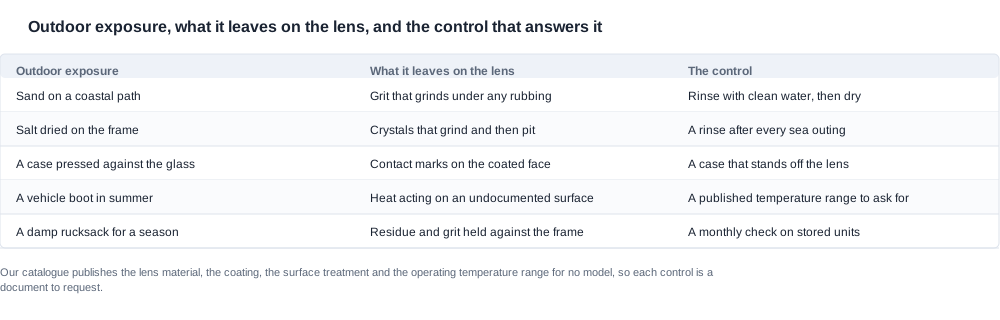
Sand, salt, heat and cold, and what each one does
Sand is the classic abrasive, and its behaviour depends on whether it is dry. Dry sand on a coated surface is itself relatively harmless until something rubs it, at which point it becomes a grinding compound. The control is therefore not "do not wipe" but "rinse first, dry second, wipe third" — a sequence that removes the particles before the wiping step puts them against the coating.
Salt is the one that is easy to underestimate, because a salt film looks like a dusty lens rather than like damage. Salt crystallises in the frame gap and around the edge of the lens, and it draws moisture from the air when it is humid, which keeps the area damp and keeps the grit in place. A rinse after a sea outing is the cheapest control in this channel and the one most often left out of the insert.
Heat is the exposure nobody can answer from our catalogue. A device left in a vehicle is in an environment whose temperature swings are not published for any model, and the operating temperature range is one of the rows we do not publish. The honest position for an outdoor buyer is that the device should not be left in a vehicle, and that if the brand wants to claim otherwise it needs the range from the supplier.
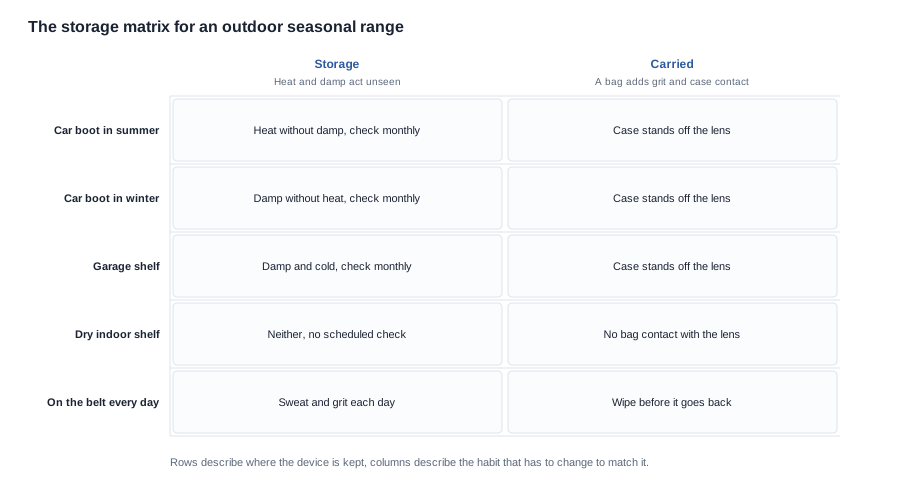
Cold and damp are the fourth, and they act on the stored unit rather than the used one. A unit kept in a damp rucksack in a garage is held against residue and grit for months. The control is a scheduled check on stored units, which is a different discipline from anything the customer does on an outing and therefore has to be either in the brand's own process or in the customer's calendar.
The thresholds an outdoor range should set
Six thresholds decide whether an outdoor range can be specified defensibly, and they are mostly about storage rather than about handling.
Threshold one: the surface statement, per model. How it is measured: a written statement of the lens substrate and the coating treatment for each model in the range, with the model designation on it. Pass line: the statement covers the model the customer will put in a bag for a season. What a soft answer looks like: a statement covering the family, which cannot tell a buyer whether the photochromic configuration behaves the same way as a fixed lens. The material background to the lens and the frame is published at materials and ergonomics, along with the fit questions.
Threshold two: the operating temperature range. How it is measured: a stated minimum and maximum operating temperature for the model, with any qualification about storage stated separately. Pass line: a range exists and is quoted with its conditions. What a soft answer looks like: a listing that implies the device is safe in a hot vehicle because it is sold for outdoor use, which is an inference rather than a published row.
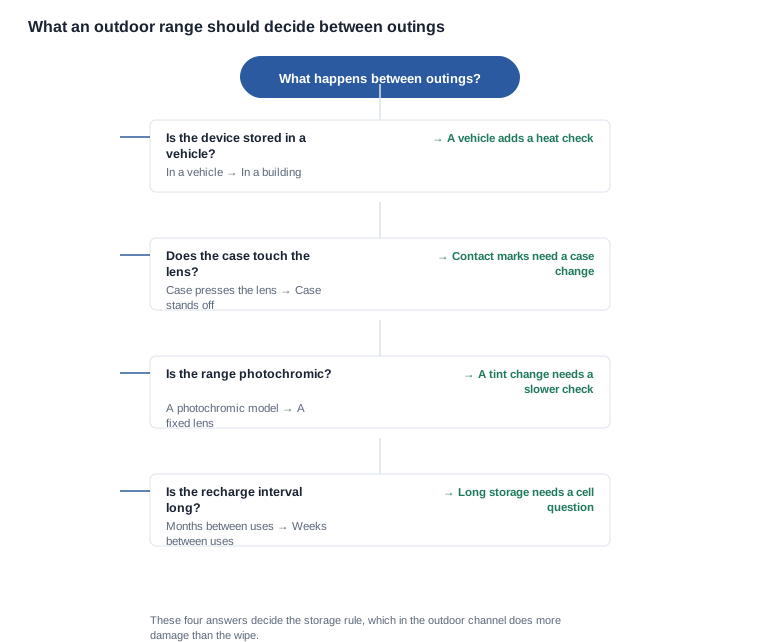
Threshold three: the storage instruction, including the case geometry. How it is measured: a statement of where the device may be kept, and whether the case permits the lens to rest against anything. Pass line: the case stands off the lens, and the instruction says so. What a soft answer looks like: a soft case illustrated in the listing as protection, where the illustration is evidence of the opposite.
Threshold four: the rinse-and-dry sequence, not the wipe. How it is measured: the stated method for a unit that has been in sand, salt or spray. Pass line: rinse with clean water, dry, and only then wipe, with the dry step stated as a step rather than an assumption. What a soft answer looks like: "wipe with a dry cloth", which is the instruction that puts grit onto the coating.
Threshold five: the ingress position, read digit by digit. How it is measured: the published marking for the model. Pass line: the listing says what the marking covers — a dust protection level and protection against splashing water — for the V06 and the S7, and says that no rating is published for the other models. What a soft answer looks like: "waterproof" or "all-weather", neither of which any published row supports. The digit reading is at IP ratings.
Threshold six: the first-use-after-storage check. How it is measured: what the customer is told to do when the device comes out of storage after months. Pass line: a stated sequence — charge, inspect the lens and the contacts, and wipe before the first use. What a soft answer looks like: an instruction that assumes the device was just used, because the insert was written for the outing rather than for the season.
Verifying an outdoor lens position across a storage cycle
A storage-cycle test that mirrors a season
The verification for this channel is about time, and the honest way to test it is to run a shortened cycle rather than to reason about a season.
- Put one unit into a realistic storage environment — a vehicle boot, a garage shelf or a damp rucksack — and mark the date and the lens state with a photograph. Completion test: a dated reference frame and a written description of the environment.
- Inspect the unit on a fixed interval, using the same light and the same angle each time. Completion test: a photograph series with dates, so the accumulation rate is visible rather than argued about.
- Run one realistic outing in the middle of the cycle, with the outing sequence the insert prescribes. Completion test: a before-and-after pair from the outing itself, which is the only place the customer will notice the difference.
- Bring the unit out and check it against the first-use-after-storage sequence. Completion test: a written observation of the lens, the contacts and the charge behaviour at first use.
- Test the case, separately from the device, by storing the device in the case in the same environment and comparing the two units. Completion test: a comparison that shows whether the mark came from the case or from the environment.
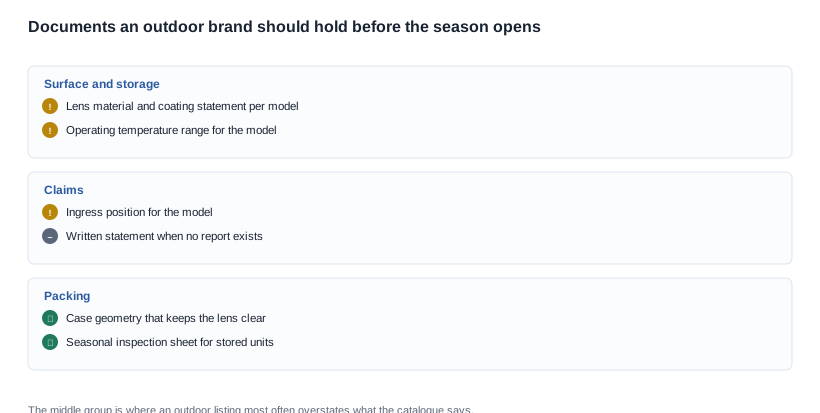
The supporting documents are the surface statement, the operating temperature range, the storage instruction and the case geometry statement, the rinse-and-dry method, the ingress position, the first-use-after-storage sequence, the model designation table, the certificate register and the seasonal inspection sheet. The certification register procedure is at certification checklist, the clause language is at contract terms, the commercial structure of a first order is at pricing, and the transport file a configuration with a case requires is at battery transport. The product families are at sport smart glasses, photochromic smart glasses and AI camera glasses.
The questions to ask a supplier before you order an outdoor range are about the season rather than about the outing:
- What is the lens substrate and the coating treatment for the exact model?
- What is the operating temperature range, and does it differ for storage?
- Is there a published cycle-life rating for the cell, and what are the test conditions?
- Does the case permit the lens to rest against any surface?
- What is the published transition specification for a photochromic configuration?
- Which ingress position can we state for this model, and is a report behind it?
- Can the same configuration and surface statement be repeated across seasons?
- Will you review the storage instruction and the first-use-after-storage sequence?
The third question is the one that decides whether a seasonal range can make a ready-to-use promise at all. Our published charge time carries no starting state and no termination criterion, so on its own it cannot support a claim about a unit that has been stored for months, and the supplier's answer to that question is what the listing copy has to be written around.

Where an outdoor lens position fails commercially
Six failure signatures in a seasonal range
A soft case pressed against the lens. Symptom: a mark that appears on a batch of units with no obvious cause, discovered by the customer on the first outing of the season. Root cause: the case interior rests on the coated face. Prevention: the case geometry statement, and a case change at the next revision if it is unfavourable.
A vehicle-boot listing. Symptom: a unit returned after a hot summer with a degraded lens and a customer who has done nothing wrong. Root cause: the operating temperature range is unpublished and the listing implies otherwise. Prevention: the range requested from the supplier, and a storage instruction that excludes vehicles until it exists.
A wipe instruction on a sandy lens. Symptom: a scratch that appeared after a coastal outing, attributed to the coating. Root cause: the instruction says to wipe, and wiping is what puts the particles against the surface. Prevention: the rinse-dry-wipe sequence, written in that order.
A salt film left after a sea outing. Symptom: a haze that returns every time the unit is used, and a customer who concludes the camera is failing. Root cause: no rinse step, and crystallised salt in the frame gap. Prevention: a rinse step in the insert, and a frame-gap check at the first use after storage.
A tint expectation that the photochromic configuration cannot carry. Symptom: a customer who expects the lens to darken in a specific condition and a return that says it did not. Root cause: the photochromic entry in our catalogue is published as its own line with a cell capacity of 100 mAh, a rated runtime of about seven hours, magnetic charging and a published Bluetooth version of V5.4, and the V03 Pro is published as the photochromic-lens configuration of that model — but no transition specification is published for either. Prevention: request the transition specification, and describe the behaviour as the supplier states it rather than as the listing copy imagines it.
A season with no restock of the consumable. Symptom: an outing in which the cloth was missing, because it was in the last unit's box and never replaced. Root cause: the consumable was allocated per unit rather than per season. Prevention: the consumable is a bundle item that is replaced with the device, and the bundle is checked before the season opens.
The clauses an outdoor brand should write
A worked scenario for a seasonal leisure line
Take a brand launching a leisure range in spring, with one sport model and one photochromic model, sold through outdoor retailers who will hold the stock for a season. The first decision is the model pair, and it is settled on the environment rather than the specification: the sport family publishes a case architecture and the photochromic entry publishes no case row, so the two models are packaged differently and the listing copy is written separately for each. The second decision is the accessory bundle, and it is settled on the storage environment rather than on the outing: a hard case that stands off the lens, a pouch that keeps the cloth dry, and a single wipe instruction printed inside the lid rather than on a separate card that will be lost.
The third decision is the storage instruction, and it is settled on what the brand can actually control, which is the box and the case — the customer's garage and vehicle are not controllable, so the instruction excludes them and the brand stops making claims about heat. The fourth decision is the seasonal inspection, and it is settled as a brand process rather than a customer task, because a customer will not run a monthly check on a bag. The fifth decision is the claim set, and it is settled on the digit reading: the ingress position is stated for the models that publish one and the absence is stated for the models that do not, and no outdoor adjective is left to imply what the catalogue does not say. The sixth decision is the consumable, and it is settled as a bundle item with the case, so that a customer replacing the case also replaces the cloth. The outcome is a range whose seasonal failures are diagnosed in the season rather than in the following spring.
Where the commercial room sits on a seasonal range
The lens material, the coating and the surface treatment are fixed for a model revision, and the certification cost and lead time behind them are a cost of market access rather than a price item; tooling belongs on its own line so that a one-off charge stays visible. What an outdoor buyer can move is the case specification and its geometry, the accessory bundle contents, the artwork of the storage instruction and the first-use-after-storage sequence, whether a cloth ships in the pouch rather than in the box, the consumable quantity per unit and the replacement interval against a seasonal forecast, the split of a first order into batches against a staged payment, and the share of units taken at the pilot tier. On a seasonal line the split of the first order against the forecast is the largest single lever, because a season that ends with stock has no second chance.
What we publish for outdoor ranges, and what we will not claim
Here, we publish the rows a buyer can order from and the absence of the other rows with the same prominence, because an outdoor customer meets the consequences of a missing row months after the sale. For this range that means the resolution class, the cell capacities from 40 mAh to 290 mAh, the charge times, the rated runtimes between five and eight hours, the charging interface per model, the published Bluetooth versions, the colour counts, the case capacities where they are published, and the structural features the catalogue states — the ultra-slim detachable temples on the G07, the slim detachable temples on the YK12, and the detachable temples published on the sport models.
What we do not publish, and will not estimate: the lens material, the coating, the surface treatment, the operating temperature range, the storage conditions, the cycle-life rating, the field of view, the video specification, the runtime test condition, the standby draw and the per-model unit weight. We publish one weight figure in the whole catalogue — 158 g for the MT6, a camera model, which is the whole unit including its 265 mAh cell and its camera and excluding the folding charging case — and we will not present it as a frame weight. We will not state that any product is tested to IP54, because the marking appears on the V06 and the S7 with no test report published behind it. We publish no all-weather claim, no waterproof claim, no transition specification for the photochromic entries, and no claim that a stored unit will hold its charge for a season.
What we will do: take the models, the season, the storage environments, the retailers and the volume, and tell you which published rows apply to each model, which storage questions have to be settled before the bundle is specified, what the insert should say, and which claims the available evidence supports. The product families are at sport smart glasses and photochromic smart glasses, the scenario entry point is smart glasses for outdoor, and the selection logic upstream of the lens position is at how to choose smart glasses for outdoor.
What to send us next. Send the models, the season, the storage environments, the retailers and the volume, and we will return the published rows for each model, the storage and bundle questions to settle before the artwork, and the claim boundary in writing.
Related reading
- The entry point for this scenario — smart glasses for outdoor
- Which product families exist — sport smart glasses and photochromic smart glasses
- The ingress question — IP ratings
- The first question — materials and ergonomics
Send us the models, the season and the storage environments, and we will return the storage questions to settle before the bundle is specified.