

Retail and education look like one category from a distance and behave like two from close up, and the reason is not that the products differ. The products overlap. The reason is that the party carrying the risk differs: in retail the customer owns the device after the transaction, and in education the organisation owns it for its whole service life. Every other difference between the two channels descends from that one fact.
This overview is written for a buyer who has to decide whether this category applies to them at all, and if it does, which group of models to look at first. It does not recommend a model, and it does not quote a price. It sets out the decision structure, the published rows that support it, and the questions that remain open.
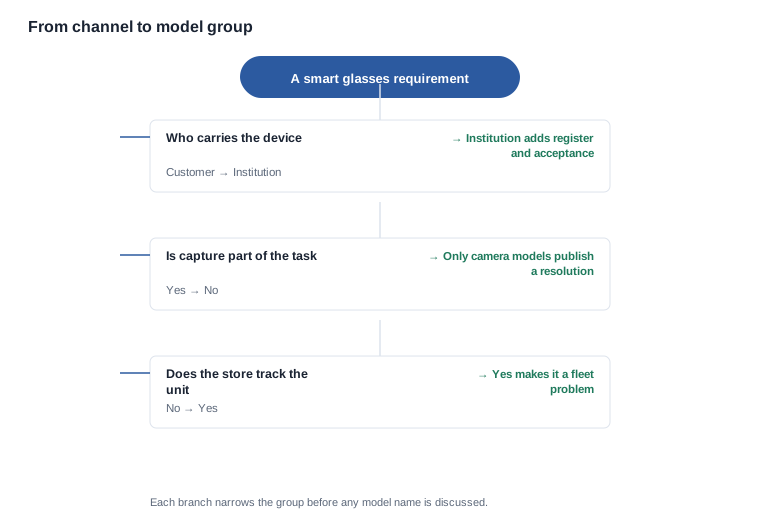
The conclusion is that the category divides into three model groups with published evidence, and that a buyer can establish which group applies from site facts before contacting any supplier. What a buyer cannot do from published material is select within a group, because the published rows within a group are largely identical by design, and the differences that matter are commercial rather than technical.
Smart glasses for retail and education: four differences that separate the channels
Who owns the device, and who owns the failure
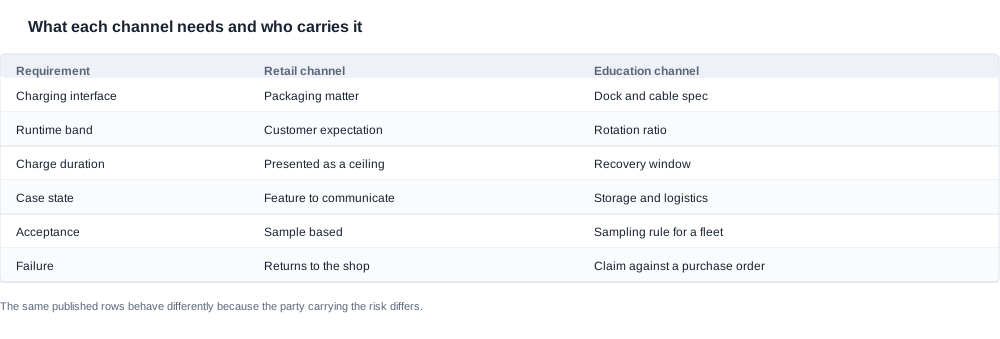
The first difference is ownership of the device, and it propagates into every decision downstream. A retail customer owns the unit after purchase, which means the charging routine, the damage risk and the replacement are private matters that the brand never sees. An institution owns the unit for its service life, which means an asset register, a charging routine, a damage process and a replacement provision all sit on the buyer's side of the table.
This is not a small difference in administrative effort. It is the difference between a product that has to work once and a product that has to work in a fleet, and between a returns process and a procurement process. The published rows are the same in both channels, but the number of rows that become specification lines is much higher in an institutional deployment.
Who owns the charging routine
The second difference is the charging routine, and it follows from the first. In retail, the customer charges the device at the bedside, in a habit that has to be established and that the customer controls. In education, the organisation charges it in a window between the last lesson and the first, in a room where a whole cohort of devices is connected at once.
The consequence for the published rows is that the charging interface becomes a packaging matter in retail and a procurement specification in education. In retail, a magnetic interface in the box obliges the brand to ship a cable or explain its absence. In education, the same interface determines the cable types the institution holds, the training material it needs and the dock it has to buy.
What the customer is asked to believe
The third difference is the promise. A retail customer is asked to believe that a product will do something for them personally, and the published rows support that promise at the level of a runtime band and a charge duration. An institution has to be able to describe, in writing, what the device does and what it does not do, in terms its own governance can accept.
That requirement reaches directly into the boundary between a published row and a claim. The published charge durations are ceilings rather than guaranteed intervals: two hours or less across twenty-six models, and approximately one hour on the D17 and the ZH12. An institution that has to report a guaranteed interval needs the test condition behind it. The published resolution class for the camera models is a resolution class, not a capture specification, and an institution that has to document what a camera records needs more than a resolution class. The published IP54 marking on two models is a catalogue marking without a third-party test report number behind it, and an institution that has to advertise it needs the report.
What happens when it fails
The fourth difference is failure handling, and it is where the commercial terms live. A retail customer with a faulty unit returns it to a shop. An institution raises a claim against a purchase order, against acceptance criteria, and inside a warranty and returns process that has to exist in advance.
This is why the acceptance criteria sheet matters more in education than in retail, and why the register matters more in education than in retail. A returns process for a single unit is a customer service function. A returns process for a fleet is a quality assurance function, and it needs the acceptance criteria to have been agreed before delivery rather than reconstructed after the first fault.
The four questions to ask in a retail context
Establishing whether the category applies at all
A retail buyer should be able to answer four questions from site facts, before any catalogue discussion, and the answers determine whether the category is relevant.
- Does the product need to do something the customer cannot already do with their phone?
- Does the store need to demonstrate the product to a customer, and does that demonstration need capture?
- Does the store carry the product as a stocked item with its own accessories, or as an order-on-request item?
- Does the store need to know anything about the unit after the customer takes it away?
The fourth question is the one that usually decides the category. If the answer is no, the store's requirements reduce to packaging, a price, a minimum order quantity and a delivery date, and the published model rows matter less than the commercial terms. If the answer is yes, because the store runs demonstrations, staff training or a rental or trial arrangement, then the requirements become a fleet problem and the institutional questions start to apply.
What the published rows settle in retail
The rows that matter in retail are a short list, and every model in the range publishes them: runtime, cell configuration, charge duration, charging interface, and the case state for the camera models.
The retail-specific work is deciding how those rows are communicated. The charge duration is a ceiling and should be presented as one, because a customer who expects a full charge in ninety minutes on a model published at two hours or less will treat the difference as a fault. The runtime is a band and should be presented as one. The case states should be communicated per model rather than as a range-wide statement, because a customer who is told a case is included will be right for some models and wrong for others, and the four published states make that communication genuinely model-specific.
The retail questions that remain open
These are the questions a retail buyer should carry into a supplier conversation, and none of them can be answered from a catalogue page:
- Which charging interface does each model in the proposed range use?
- Which models ship with a charging case, and what is its capacity?
- What does the carton deliver, and which accessories are quoted on their own?
- What does the configuration cost per unit, what is the order minimum, and how long does production take?
- What warranty and returns terms apply, and what does the returns process require from the store?
The last one is the retail question most often left unanswered, and it is the one that determines whether the store can handle a return at all.
The four questions to ask in an education context
Establishing whether the education category applies at all
An education buyer answers a different set of four questions, and they are equally answerable from site facts.
- Is there a task that the current equipment cannot do, and how often does it occur?
- Who holds the device during that task, and what does the institution's own policy permit?
- Does the deployment involve learners, and what does that change in the approval process?
- What is the charging window, and who owns the space it happens in?
The third question is the one that carries the most weight and is the one most often left until late. Where the children's category is concerned the internal product record carries no certification status at all, and the catalogue publishes no per-model certification row anywhere in the range. Where the deployment involves learners, that question has to be answered in writing before the purchase, not after the first delivery.
What the published rows settle in education
The rows that matter in education are the same published rows, read differently. The runtime band becomes a rotation ratio rather than a customer expectation. The charge duration becomes a recovery window rather than a convenience. The charging interface becomes a dock and cable specification. The case state becomes a storage and logistics decision, because a cohort of cases is a cohort of objects to store, to charge and to lose.
The camera models add a requirement that retail does not have, which is that any capture has to be documented institutionally. The published position there is narrow and has to be stated plainly: the eleven camera models publish a resolution class and nothing further. No sensor model is published for any of them, and neither is a field of view, a frame rate, a video format, a storage capacity or a capture indicator behaviour.
The education questions that remain open
The institutional question list is longer, and it is worth writing it as one document:
- Which models are eligible for the task, from the published rows?
- Which charging method applies to each, given that four camera models publish none?
- What is the case capacity for the KY06 and the MT5, and does a case apply to the rest?
- What capture specification and indicator behaviour apply to the camera models?
- What Bluetooth version do the camera models use, given that none is published?
- Certification scope, per model, with reference numbers that can be checked against the issuing body.
- What is the acceptance criteria and sampling rule for the delivered fleet?
- What is the unit price, the production lead time and the minimum order quantity?
The last question is the one that has to be asked earliest, because in an education deployment the production lead time is measured against a term calendar rather than a budget cycle.

The four mistakes in treating the two channels as one
Merging the pricing discussion
The most consequential mistake is treating the two channels as one commercial conversation. The unit price is confirmed per enquiry in both cases and is not published on this site, but the configuration that sits behind it is not the same, because the retail configuration is a unit plus a case and a cable, while the institutional configuration is a unit plus a dock plus a cable plus a charging routine plus a spare pool plus an acceptance and returns process.
A buyer who asks for a retail-style quotation for an institutional deployment will get a number that excludes the infrastructure, and will discover the infrastructure later, when the budget has already been committed.
Merging the acceptance criteria
The second mistake is using a sample-based acceptance process for a fleet. A single unit can be approved against a sample. A fleet cannot, and an institution that has not written a sampling rule will find that nobody owns the acceptance.
Merging the data expectations
The third mistake is assuming that a device which publishes no storage or retention specification is a device with no data dimension. The catalogue publishes nothing about capture storage for the camera models, which is an absence of published material and not a statement that there is nothing to govern. Where an institution issues camera models, the governance question exists regardless of what the catalogue says.
Merging the models
The fourth mistake is picking a model first and a channel second. The models in this range overlap between the channels, so a model chosen for a retail proposition can be right for it and simultaneously wrong for an institutional deployment, because the institutional deployment needs an acceptance criteria sheet, a register, a warranty process and a lead time that the retail proposition never required.
The three model groups and what each one publishes
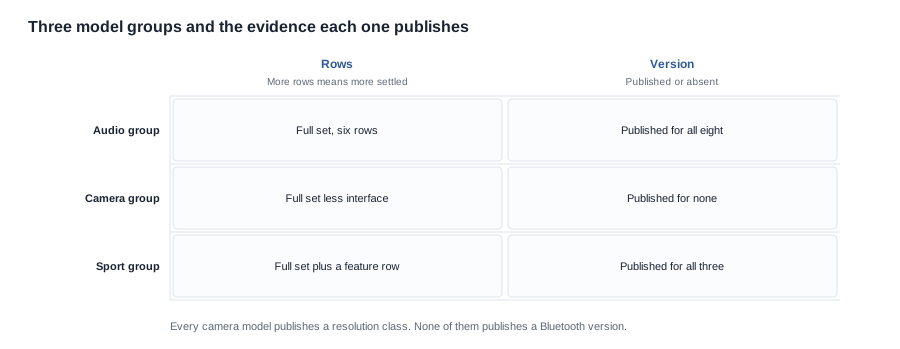
Three of the groups in the range are worth navigating, and the navigation is possible from the published record alone. The audio group publishes a Bluetooth version for every model in it, along with a runtime, a charge duration, a cell configuration and a charging method, and the versions are 5.3 for the K01 and the K02 and 5.4 for the other six. The camera group publishes a charging method for most of its models alongside a runtime, a charge duration and a cell configuration, plus a resolution class for all eleven of them, and it publishes no Bluetooth version at all. The sport group publishes the full set of rows plus a feature row on each model.
Three entries in the range carry no model designation, and they are published as an AR entry, an electrochromic entry and a bone-conduction entry with an amplification gain of 35 dB. Their internal product record shows no formal SKU for any of the three, and for the bone-conduction entry the customisation capability is not disclosed. The gain figure is a catalogue row and it is not a hearing-aid claim or any medical claim, and nothing in this article or on our product pages should be read as one.
Boundaries that run across all three groups
Certification, resolution class and the entries without a model designation
Three boundaries sit across all three model groups, and a buyer who has read only the group sections may still need them stated together because they apply regardless of which group the requirement lands in.
The first is certification. Our export certification page for the company is made up of images rather than extractable text, so it carries no citable standard by itself, and the range contains no per-model certification row of any kind. Certification coverage is tracked apart from the specification pages. The internal product record behind the catalogue records no published position for those standards on the legacy site or on the independent site either, and no model coverage and no certificate number is published for any of them. Two qualifications ride alongside it: the IP54 marking on the sport models is a catalogue entry rather than an accredited test report, and the children's category carries no certification status of any kind. Those are three different starting positions, and a buyer has to ask which one applies to the model in front of them.
The second is the resolution class. All eleven camera models publish one, eight of them at eight megapixel and three of them at thirteen megapixel, and the catalogue publishes nothing further about the imaging hardware for any of them. A buyer who needs a capture specification has to obtain it in writing, and the camera imaging note is the right place to start understanding what a capture specification would need to cover.
The third is the entries without a model designation. Three catalogue entries carry no model designation: the AR entry, the electrochromic entry and the bone-conduction entry. The first carries an indicator light and button control among its feature rows and the second carries no feature rows at all, and our internal product record shows no formal SKU for any of the three, with the customisation capability for the bone-conduction entry not disclosed. The bone-conduction entry publishes an amplification gain of 35 dB, which is a catalogue row and not a hearing-aid claim or any medical claim, and the same internal record flags that 35 dB carries the highest compliance risk of any figure in the range.
A buyer who plans to include any of these three entries in a programme is planning around the least documented part of the range, and the questions to ask are correspondingly specific.
How to decide whether this category applies at all
The overview is more useful if it helps a buyer decide that the category does not apply, since that is a legitimate and common outcome.
The category does not apply where the task the product would perform is already performed adequately by a phone and a pair of glasses, and where the organisation does not need to describe the device's behaviour in writing. It applies where the task is physical and hands-busy, where the deployment must be documented, or where the channel needs to demonstrate the product rather than describe it.
The honest test is the documentation one. If the organisation cannot say what the device does, does not do, and what evidence it will hold about it, then buying it introduces a problem rather than solving one, and that remains true whatever the published specification rows say.
Where the overview lands
What we publish, and what a buyer should take from it
We publish specification rows per model, and the useful property of such a row is that a buyer can hold it against a unit in the hand. Where a row is absent we say so rather than letting a buyer infer a value.
On smart glasses for retail and education as a category, our position is that the channel decides the requirement set before the model does, that the published rows settle the hardware questions in both channels, and that the residual questions are the same in both and should be asked in writing at the same time. We will not publish a certification claim the catalogue does not carry, and we will not publish a price, a minimum order quantity or a production lead time, because each is confirmed per enquiry and moves with the configuration, the quantity, the mix and the schedule the factory is working to.
The retail and education solution page carries the positioning, the retail use case walkthrough covers the shop-floor application in detail, while the lifecycle support discussion covers the part of an institutional deployment that begins once the units are in service.
Tell us the channel, the task, the site facts and the volume, and we will return the eligible model groups with their published rows attached, together with the written question list that applies to your channel.


