
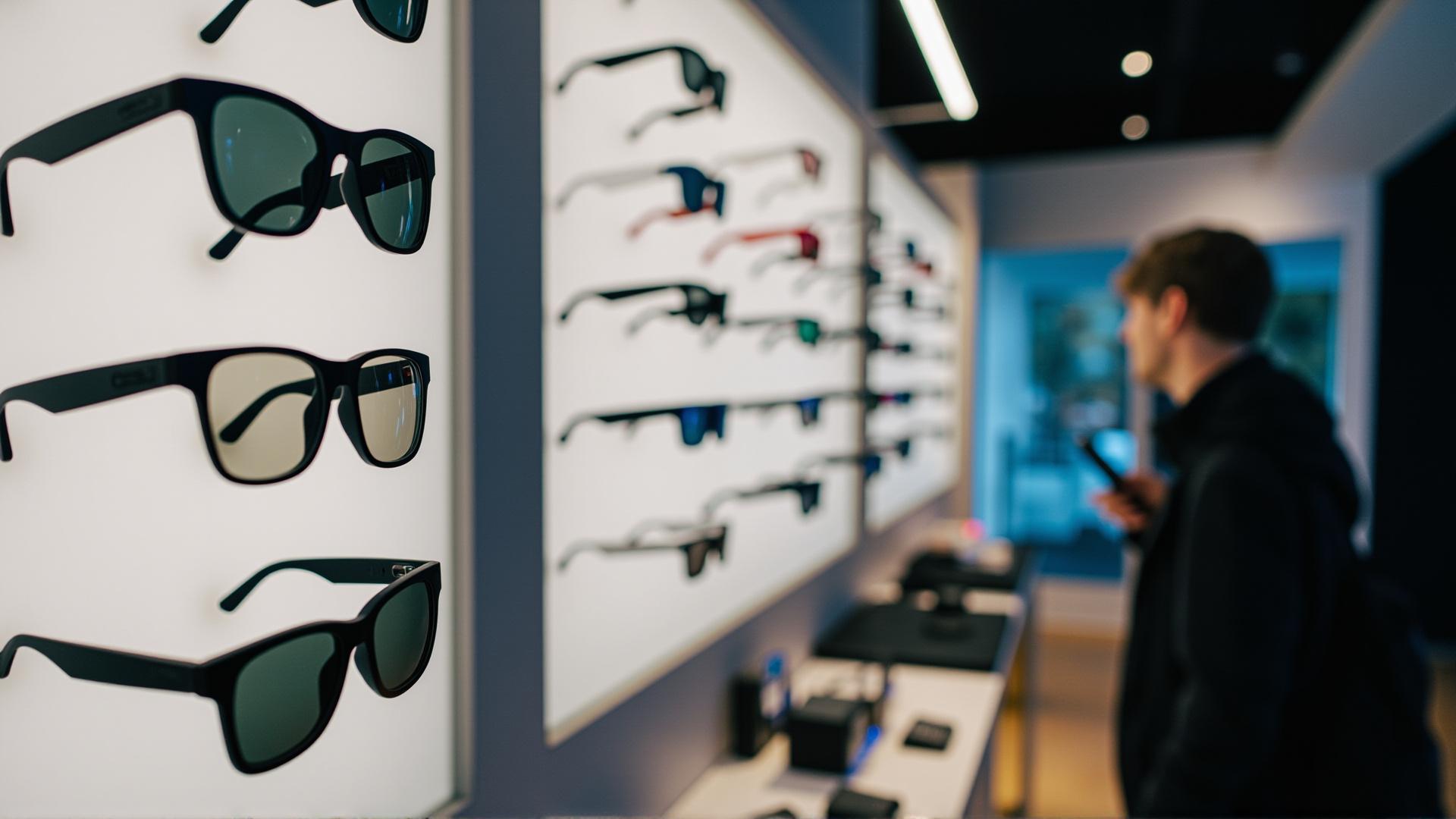
A retail use case is decided in the shop, not in the product catalogue. The person who decides is the staff member standing in front of a customer with a device in their hand, and the decision they have to make in a few seconds is whether this solves the thing the customer came in with. Everything in this walkthrough is built around that moment, because a specification that does not survive that moment fails regardless of how well the catalogue rows read.
The walkthrough follows one store on one ordinary trading day. It is a hypothetical exercise rather than a description of a customer programme we have delivered, and the models referenced are the models our catalogue publishes.

The conclusion the walkthrough produces is that a shop's requirements are narrower than an institutional deployment's and harder to satisfy in a different way. A shop rarely needs the fleet, the register or the acceptance criteria sheet that an institution needs. What it needs instead is a small number of answers about the device in the customer's hand, and those answers have to be available to the staff member at the moment of the sale, not to a procurement file somewhere else.
Smart glasses for retail and education: what retail actually needs
The four jobs a shop uses the device for
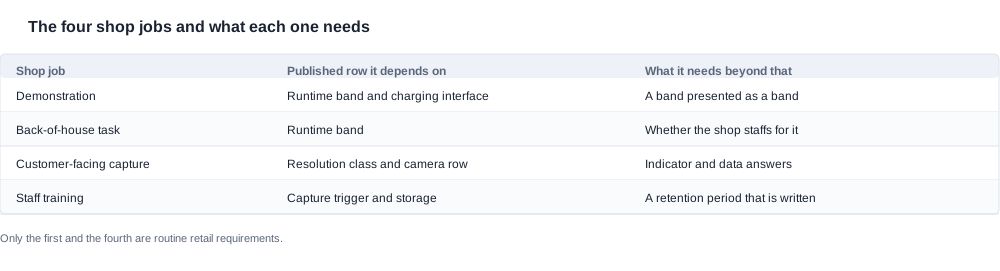
Across the retail use cases in this category, the device does one of four things, and knowing which one is the first requirement for a buyer.
The first is demonstration, where the staff member shows a feature that is hard to describe. The second is hands-free documentation of a task, such as unpacking a delivery, checking stock or setting up a display. The third is customer-facing capture, where the device records something for the customer, which is the least common of the four and the one with the most governance attached. The fourth is staff training, where the device records the demonstrator so that the next person can learn the routine.
Only the first and the fourth are routine retail requirements. The second is a back-of-house task that a shop may want but does not usually staff for. The third is where a shop runs into the data questions that the institutional side of this category deals with routinely, and it is worth noting that a shop has the same obligations as anyone else when it records people who have not agreed to it.
The demonstration moment, and what it needs
Demonstration is the job that decides whether the category applies to a shop at all, and it has a specific requirement that is easy to miss.
A demonstration is delivered by a person who is already busy. The device has to work in the hand, in a shop, in the time it takes a customer to decide. That produces three requirements which the catalogue rows bear on directly and the feature descriptions do not.
The first is the charging interface, because a staff member demonstrating for an hour needs the device to be charged and the interface determines what the shop holds on the counter. The published rows are decisive here. On the interface row, magnetic charging covers the bulk of the audio, camera and sport lines, while a Type-C socket appears on seven named entries: the D17 and the D11, the L2 Utral and the D12, and the V03 Pro and the ZH12, and the bone-conduction model. The CY05 and the L1 Pro, and the CY03 and the MT6 carry no interface row at all, and for a shop stocking one of those four, the answer has to arrive before the order rather than on delivery.
The second is the runtime, because a demonstration that runs out mid-conversation is a lost sale. The published runtimes are bands rather than guarantees: roughly eight hours for several of the audio models, roughly six for the G07 and the YK12, and five-to-eight-hour bands across much of the camera line. A shop that plans demonstrations around a full shift needs to know that the band is the band, and it is exactly the kind of figure that has to be presented as a band on a product page rather than as a fixed expectation.
The third is the case state, because what is in the box decides what a customer takes away. The camera line publishes three distinct states, and a shop that stocks several models cannot use one sentence on its product page.
The product page is part of the retail use case
A shop's product page is the demonstration before the demonstration, and it is where a published row becomes a customer-facing statement.
That makes the three published case states a live commercial issue rather than a documentation detail. A camera model published with a 1400 mAh case, one published with two case capacities in a single row, one published with a case and no capacity, and four published with no case row at all: these are four different sentences for a product page, and a shop that writes one sentence for the range will be wrong somewhere. The catalogue publishes no model as having no case, so the product page cannot promise one in either direction.
The same applies to the charge duration, which is a ceiling of two hours or less for twenty-six models and approximately one hour for the D17 and the ZH12. A product page that says a device charges in under two hours states something the catalogue does not state, and a customer who measures it at two hours and ten minutes has a complaint the shop cannot answer with the catalogue.
The ecommerce discussion covers how this category is presented online, and the charging case options note covers the case question specifically.
What the shop does not need
It is worth saying what a shop can skip, because over-specifying a retail deployment is a common and expensive error.
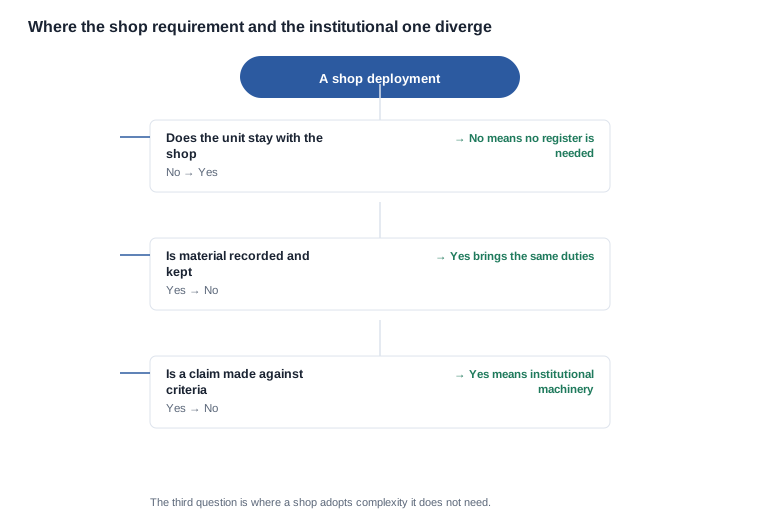
A shop does not need an asset register, because the device belongs to the customer after the sale. It does not need a fleet acceptance criteria sheet, because it inspects one or two units before they go on the shelf and the customer inspects the one they buy. It does not need a rotation ratio, because the charging happens at home rather than in a room with twenty units on one schedule. And it does not need a sampling rule.
What it does need is the set of answers that lets the staff member be accurate, and those answers are the published rows plus the residual items the catalogue does not carry.
Where the two use cases meet, and where they must not
The overlap that makes a shop a good test site
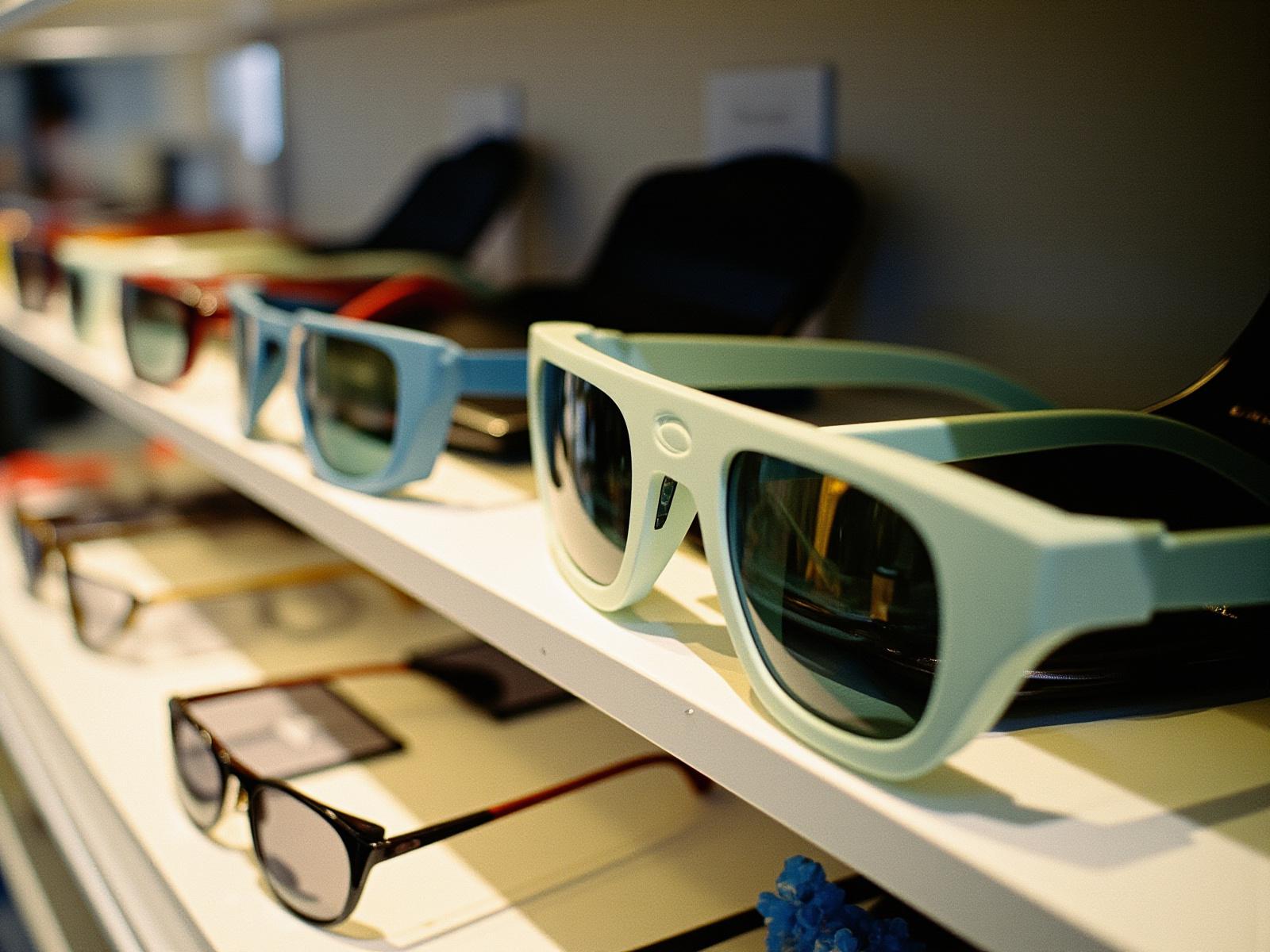
There is one reason a shop is a reasonable place to establish a deployment before an institution commits, and it is that a shop exercises most of the published rows in a short time.
A shop that stocks one model from each of three families (the audio, the camera and the sport lines) encounters the differences that matter. The audio models publish a Bluetooth version, with the K01 and the K02 at version 5.3 and the other six at version 5.4, and they publish no camera row. The camera models publish a resolution class and no Bluetooth version at all. The sport models publish a full row set plus a feature row each.
A shop also surfaces the accessory question quickly, because the customer asks about the case and the cable in the first conversation. And it surfaces the charging interface question, because the counter has one charger and the shelf has several models.
The three places where they must not be merged
The first is the data question. A shop that records a demonstration for training has the same obligations as an institution, and the temptation to treat a shop recording as informal is exactly how a governance problem starts. Our catalogue publishes no storage, retention, transmission or capture indicator behaviour for any camera model, so a shop's recording practice has to be written on the same basis as an institution's.
The second is the claim and return process. A shop's return is a customer service function with a customer who has a choice. An institution's return is a procurement claim against acceptance criteria. A shop that adopts institutional machinery it does not need is paying for complexity, and an institution that borrows a retail process is left without an evidence chain.
The third is the commercial structure. The unit price, the minimum order quantity, the production lead time and the packaging options are confirmed per enquiry because each depends on configuration, quantity, mix and the current schedule, and a retail order and an institutional order are different configurations of the same catalogue. The office audio discussion covers a similar comparison between a workplace deployment and a retail one, and the wholesale packaging discussion covers what the packaging decision costs.

The two catalogues a shop actually needs
Specification description and shelf description
A shop that stocks this category ends up maintaining two descriptions of the same product, and the reason the second one goes wrong is that it is written later and from a different source.
The first is the specification description, which comes from the catalogue rows: charging interface, cell configuration, runtime, charge duration, and case state. It is written once, at listing time, and it does not change unless the model does.
The second is the shelf description, which is what the customer reads and what the staff member says out loud. It is shorter, it has to be accurate, and it is the one that carries the risk of an overclaim. The failure mode is specific: a description that says a device charges in under two hours, or that includes a charging case for a model whose case state is not published, or that presents a runtime band as a fixed figure.
The discipline that prevents it is simple enough to be worth stating: every shelf description traces back to a published row, and any phrase that cannot be traced gets removed rather than softened. A product page that says less is accurate, and a product page that says more than the catalogue supports is a claim the shop cannot defend when a customer measures it.
The ecommerce discussion covers how this category is presented online, and the listing optimisation note covers the same requirement on the OEM side.
What a shop should ask before it orders
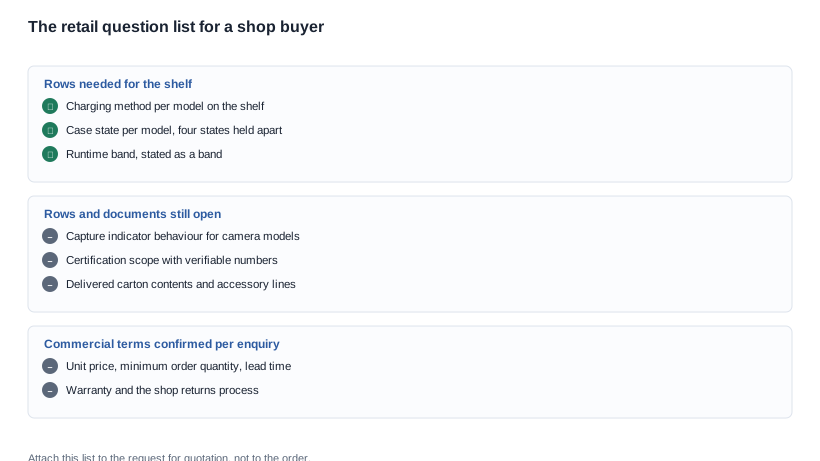
The retail question list
This is the list a shop buyer should attach to a request for quotation, and it is deliberately short.
- Which charging method applies to each model on the intended shelf?
- Which models ship with a charging case, and what capacity does it hold?
- What is the published runtime band for each model, stated as a band?
- What is the delivered carton contents, and which accessories are quoted separately?
- What is the unit price, what is the minimum order quantity, and what is the production lead time for the configuration?
- What warranty and returns terms apply to a customer return, and what does the returns process require from the shop?
- What certification scope applies to each model, with certificate numbers that can be verified?
- What is the capture indicator behaviour, if any model on the list has a camera?
The last question is the one a shop is most likely to skip and the one most likely to matter, because the answer determines whether the shop can demonstrate a camera model to a customer at all. Our catalogue records an indicator light and button control in its feature rows for the one entry that has no model designation, and it carries no indicator row for the camera models, and the internal product record records that nothing is published for the same three standards, and that no scope and no certificate number exists for us to quote. Those are answers to request in writing, not facts a shop may publish.
The children's models, and the question a shop has to ask
The range publishes three models for children's use, and a shop stocking them has a documentation question that a shop stocking adult models does not.
The A05 and the A06 publish identical rows, and our internal product record notes that the gap between them is still to be confirmed. Each publishes a 40 mAh cell, a charge duration of two hours or less, a runtime of roughly twenty hours, and magnetic charging. Their feature rows list a lens-based electronic element together with a fogging unit, along with correct posture and distance and incorrect posture and distance, and cover lens clarity and lens fogging. The A07 is different again: it publishes a 70 mAh cell, roughly twenty hours of runtime, the same charge ceiling, and magnetic charging with a Bluetooth version of 5.4, and it publishes no feature rows at all.
Those are the catalogue's rows, and stating them is the whole of what can be said: they describe what the catalogue lists, and they do not establish a medical, therapeutic or eyesight-related outcome, and nothing of that kind is claimed in this article or on our product pages. The internal product record holds no certification status for the children's category at all, so a shop stocking these three models has to obtain that status in writing before it lists them. The certification status note for the A05 covers that position, and the parenting discussion covers the questions a buyer asks from the other side of the transaction.
The staff member is the specification
There is one more requirement in retail that has no equivalent in an institutional deployment, and it is the one that decides whether the shop programme works.
The staff member is the specification. Whatever the catalogue says, the product page says and the box says, the customer will make their decision based on what the person in front of them does with the device. That means the accuracy of the answer has to be available at the counter, in a form a busy person can use in a few seconds, and it means the training on the device has to be short enough to be delivered to a shop team with a high turnover.
Three practical consequences follow. The published row a staff member needs most often is the one about the customer, which is what is in the box and how long it lasts, and both of those have to be on the shelf card rather than in a training pack. The second is that the demonstration device has to be charged and available at the counter, which brings the charging interface back to the accessory order. The third is that a product with an unknown behaviour is a demonstration risk, and a shop that cannot answer a customer's follow-up question loses the sale and the credibility together.
This is also why the residual question list matters more in retail than the size of the order suggests. A shop that has not obtained the capture indicator behaviour or the certification scope cannot answer a customer who asks, and a customer who asks in the shop is a customer who asks in the shop.
The criteria for judging a supplier on the retail use case
Three criteria make a retail supplier comparison decidable, and all three can be applied before an order.
The first is row completeness against the shelf. Can the supplier return the published rows for every model the shop intends to stock, including the case state and the interface, so the product page can be written accurately? A supplier that cannot do that is a supplier whose listing the shop will have to write.
The second is question closure. Can the supplier close the residual list in writing, and does it say plainly which answers come from the product records and which require the factory?
The third is packaging realism. Can the supplier state what is in the delivered carton for each model, given that the published case states are four different situations?
The trade-offs are simple enough to state. A wide model range gives the shop a merchandising choice and spreads the interface question across more than one cable type. A narrow range gives a simpler shelf, a single cable and a single product page, at the cost of the shop having fewer things to show. A shop with an active demonstration programme has a stronger reason to carry the camera models, and inherits the indicator and data questions with them.
The practical method is to total the cost of the shelf rather than the unit: the units, the accessory lines, the packaging configuration, and the display and stock handling. Which model to carry is a shortlist question, and the shortlist should be assembled from the published rows rather than from anyone's preference, and only then should price be discussed.
Where the retail walkthrough lands
What we publish, and what a shop can rely on
We publish specification rows per model: charging interface, cell configuration, runtime, charge duration, and case state, together with the IP54 marking on the two models that carry it, the Bluetooth version for the audio models, and the resolution class for the camera models. Those rows are what a shop's product page should be built from, and they are checkable against a unit.
On the retail use case for smart glasses, our position is that a shop's requirement is a short list of customer-facing answers rather than a fleet system, that the published rows settle most of those answers, and that the residual items have to be requested in writing at quotation stage so that the shelf can be written accurately on day one. No certification claim goes out that our catalogue does not carry, and no price, minimum order quantity or production lead time goes out with it, because every one of those figures is confirmed per enquiry and moves with how the order is configured, how many units it covers, the production mix and the schedule the factory is working to.
Across the wider category, the retail and education solution covers the point where the two channels diverge, and the office deployment discussion covers the parallel question for a workplace.
Send the models you would stock, the counter charging setup and the packaging you need, and we will return the published rows, the residual question list and the accessory lines to put into the quotation.


