
Quality assurance in this category is usually written as a list of tests, and a list of tests is the least useful document a buyer can produce. Tests describe what a supplier will do. What a buyer needs to know is whether the thing that arrives matches the thing that was ordered, whether the organisation can prove that it does, and what happens when it does not.
Those are three separate questions, and they fail in three separate ways. A unit can arrive that does not match the order, and the buyer discovers it at the customer counter. An organisation can receive a perfectly good unit and be unable to demonstrate where it came from, and it discovers that during an audit or an insurance question. A buyer can have both under control and still have no route for a defect, and it discovers that when the first claim is raised.
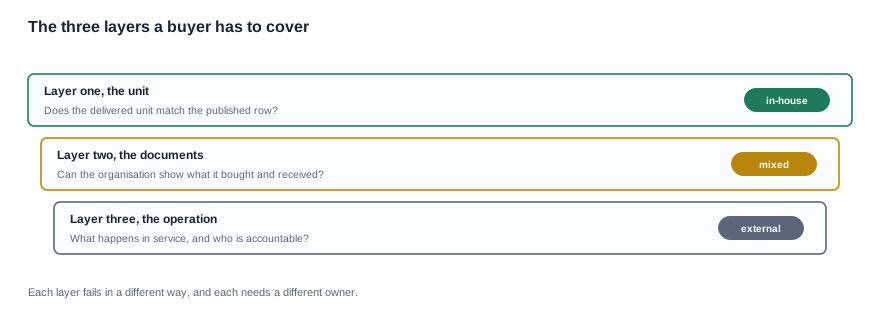
This article works through those three layers in order. The first is whether the delivered unit matches the published description. The second is whether the institution can document the purchase and the delivery. The third is the operational question that sits underneath both, which is what the device does in service and who is accountable for it once it leaves the supplier.
The position our published record supports is narrow and specific. We publish specification rows per model, and the rows are checkable against a unit. We publish no per-model certification row, our catalogue text contains no reference to CE, FCC or RoHS, and the catalogue's export certification page carries images rather than extractable text. Quality assurance in this category therefore rests on converting published rows into acceptance criteria, on documentary discipline, and on a written specification of what the supplier is and is not required to provide.
Smart glasses quality assurance, layer one: the unit matches the listing
What the published rows settle and how to check them
The published rows are unusually well suited to incoming inspection, because a row is a statement about a unit rather than about a product family. The catalogue publishes a cell configuration, a charge duration, a runtime and a charging interface for every model in the range, and it publishes a case state for every camera model.
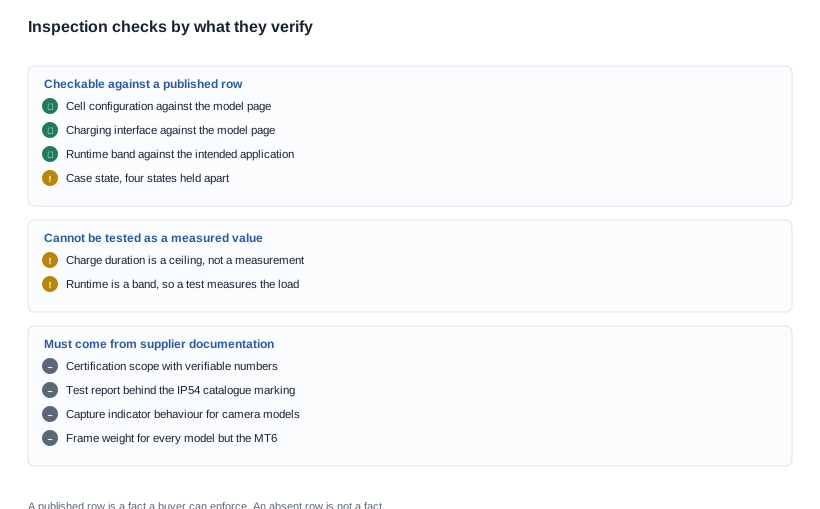
Each of those becomes a check rather than an aspiration. The cell configuration on the carton can be compared with the model page. The charging interface can be identified. The runtime band can be tested against the intended application rather than against a number. The case state can be confirmed by opening the box, and it has to be confirmed rather than assumed, because the four published states across the camera line are genuinely different: a published capacity, a case whose capacity is not published, no case row at all, and a published absence of any case.
Two published rows need particular care in a quality assurance document because they are frequently mis-transcribed. The charge duration is a ceiling for twenty-six of the models and roughly one hour on the D17 and the ZH12, and it is published without a start state or a termination criterion, so it cannot be tested as a measured value. The runtime is published as a band, so a test that measures a single duration and compares it with the band is testing the load rather than the unit.
Where the catalogue is silent, and what to ask instead
The list of published gaps is short enough to attach to a purchase order as a specification schedule, and every item on it is a question rather than a figure we have not published.
- The charging method for the CY03 and the MT6, and the CY05 and the L1 Pro, all four of which publish no charging method row.
- The charging case capacity for the KY06 and the MT5, both of which publish a case but no capacity.
- Which of the two published L2 Utral case capacities pairs with which of the two published variant names.
- The Bluetooth version for the eleven camera models, none of which publishes one, against the published versions for the audio models.
- The certification scope per model, with reference numbers that the issuing body can confirm.
- The test report behind the IP54 catalogue marking on the two models that carry it.
- The frame weight for every model except the MT6 glasses body, which is the only published weight in the range.
This is the practical meaning of a published row. A published row is a fact a buyer can check and therefore a fact a buyer can enforce. An absent row is not a fact at all, and the acceptance criteria have to be written around that absence rather than across it.
Building the acceptance criteria from the rows
The acceptance criteria sheet is the deliverable of the first layer, and it has a particular shape. Every line is one published row, one check, and one pass condition. A line that cannot be traced to a published row or to a written supplier commitment does not belong on the sheet, and a line that traces to a row but has no pass condition is incomplete.
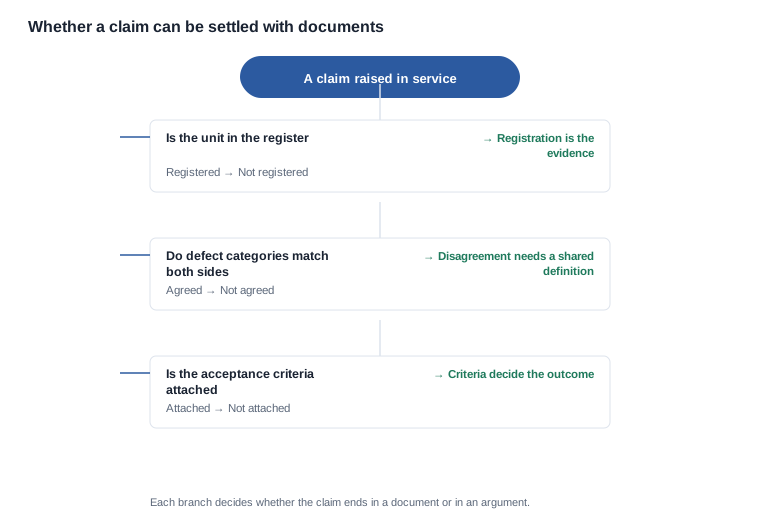
Three properties make the sheet usable. It is specific, because each line names a model and a measurable condition rather than a category. It is sampleable, because a buyer inspecting a fleet cannot inspect every unit, so the sheet has to state how many units are inspected and on what basis. And it is defensible, because each line points at something published or something committed in writing, which means a claim raised later can be settled with a document rather than an argument.
The sampling rule is the part buyers most often leave out, and it is the part that determines whether the sheet works at all. A rule that inspects a percentage of each delivery gives the organisation a defensible position; no rule at all means every dispute becomes a question of memory.

Layer two: the institution can document the purchase
The documentary chain, and where it usually breaks
A quality assurance failure that is not a product defect is still a quality assurance failure, and it happens when the organisation cannot show what it bought, what it received and what it did with it.
The chain has four documents, and they have to agree with each other.
- The purchase order, which specifies the model, the configuration, the agreed acceptance criteria, the warranty and returns terms, and the commercial figures.
- The delivery documentation, which identifies what arrived and against which order it was received.
- The acceptance record, which shows what was inspected, what was found, and which units were accepted.
- The register entry, which carries the unit forward into service.

The break almost always occurs between the first and the second document, and it occurs because the purchase order specified a model rather than a configuration. An order that says a model name leaves the supplier free to deliver whichever variant of that model the specification left open, and the buyer discovers that the delivered unit does not match what the product page described. The V03 Pro is a good illustration of why: the catalogue publishes three colours for it and a feature set that includes a photochromic lens row, so an order that specifies the model without specifying the colour and the lens configuration has left two things unsaid.
The second break occurs between the second and the third document, and it happens when the acceptance criteria sheet did not exist at the time of delivery. Inspecting against criteria written afterwards is not inspection; it is an argument about what the criteria should have been.
What documentation the supplier has to provide
The documentary layer depends on documents that only the supplier can produce, and they should be named in the order rather than requested afterwards.
- A packing list identifying the model and the serial numbers of the units delivered.
- The certification scope for each model in the order, with reference numbers that the issuing body can confirm.
- The test report behind any IP rating the buyer intends to advertise.
- The software baseline each model ships with, and the update mechanism, since our catalogue publishes neither.
- The capture indicator behaviour for any camera model in the order.
- The country of origin and the applicable product marking for each destination market.
Our internal product record states that nothing is published for those standards, with no model coverage and no certificate number for us to quote, and for the sport category it adds that the IP54 marking rests on a catalogue entry, with no accredited test report number behind it. For the children's category no certification information is published. Those are the starting positions a buyer works from, and they are the reason the certification scope has to be a delivery document rather than an assumption.
The export documentation discussion covers this at the platform level, and the listing optimisation note covers the parallel requirement on the retail side, where the listing has to match what was actually delivered.
Where the children's category needs separate handling
Three models in the range are published for children's use, and our internal product record states that the certification status for that category is not provided. The two models published as A05 and A06 carry identical rows, and the same record flags that what separates them is still to be confirmed, which is a question rather than a specification.
The A07 publishes a 70 mAh cell, roughly twenty hours of runtime, a charge duration of two hours or less, magnetic charging and a Bluetooth version of 5.4, with no feature rows published for it. The A05 and the A06 publish a 40 mAh cell, roughly twenty hours, the same charge ceiling and magnetic charging, together with feature rows covering a lens-based electronic element, a fogging unit, correct posture and distance, incorrect posture and distance, and lens clarity and lens fogging. Those rows describe what the catalogue lists and nothing beyond it: they establish no medical, therapeutic or eyesight-related outcome, and no such claim appears anywhere in this article or on our product pages.
For quality assurance, the consequence is that the acceptance criteria for this category are not the same as for the rest of the range, because the documentation position is different. The child product compliance route sets out what has to be documented, and the certification checklist is the instrument for closing the per-model scope.

Layer three: the operational question nobody writes down
What the device does in service, and who owns it
The first two layers cover the unit and the paperwork. The third covers the period after acceptance, and it is the layer that determines whether a quality assurance programme holds up over a deployment's life.
Three operational questions have to be answered, and none of them is answered by a catalogue page. What happens when a unit fails in service, and who pays. What happens when a unit is lost or damaged, and who replaces it. And what happens to the captured material if the deployment includes camera models, and who is accountable for it.
The failure question has a commercial answer and a technical one, and they need to be written together. The commercial answer is the warranty period and the returns policy. The technical answer is the defect classification the supplier uses, because the returns threshold in the agreement has to reference the same categories the supplier counts. A buyer that writes a visual-defect threshold and a supplier that treats light surface marks as cosmetic rather than as defects will find that every mark becomes a claim.
The capture question only arises for camera models, and our catalogue publishes no storage, retention or indicator behaviour for any of them, so the answer has to come from the supplier in writing before the deployment rather than after the first incident.
The claims process, decided before the first claim
A claims process designed after the first claim is a process designed in a hurry. The elements that have to exist before delivery are short, and each one exists because a specific failure needs it.
- A defect classification the buyer and the supplier both use.
- A returns threshold expressed in measurable terms, tied to the acceptance criteria.
- A replacement lead time the organisation can plan around, confirmed per enquiry.
- A defined route for evidence, which is the register and the acceptance record.
- An escalation path for a disputed claim, and a named contact on each side.
The third element is the one that institutions most often underestimate, because a device that is out of service for longer than the organisation can tolerate is not a warranty matter, it is an availability matter, and it belongs in the operating plan rather than in the quality file.
The register that closes the loop
The last document in the chain is the one most often assumed rather than built, and it is the one that makes the other three worth having.
A register for this category is not a spreadsheet of serial numbers. It is the mechanism that lets a buyer answer three questions about any unit at any point: what it was specified to be, what was found when it arrived, and what has happened to it since. The published rows populate the first of those directly, because the cell configuration, the charge duration, the runtime and the charging interface are catalogue facts for every model, and the case state is one for the camera models. The second and third come from the buyer's own process.
What the register must hold for the quality system to work is fairly narrow. The serial number and the model, so the unit can be tied to a delivery document. The acceptance result, so a defect claim can be tested against what was checked. The location and custodian, so a fault can be assigned. And for camera models, the capture and deletion status, so that a unit cannot return to service while material on it is still live.
There is a commercial reason to build this properly rather than partially, and it is the reason quality assurance conversations usually end in the register discussion. A warranty claim, an insurance question and an audit all ask the same question: where is this unit and what is its history. An organisation that cannot answer it has a quality assurance problem that no supplier can solve, because the missing evidence was never captured.
The register and the claims process together
The claims process is the part of layer three that most often gets written after the first claim rather than before it, and the reason is that it is easy to mistake it for a customer service procedure.
It is not. In a fleet deployment a claim is a quality event, and it needs the evidence chain to exist. That means the defect classification the buyer and the supplier both use, a returns threshold expressed in measurable terms and tied to the acceptance criteria, a replacement lead time the organisation can plan around, a defined route for evidence that is the register, and an escalation path with a named contact on each side.
The replacement lead time deserves particular attention, because it converts a warranty question into an availability question. A unit that is out of service for longer than the organisation can tolerate is not a claim to be settled, it is a deployment to be managed, and it belongs in the operating plan rather than in the quality file. That is why it is a figure that has to be confirmed per enquiry rather than published, and why it has to be obtained before the deployment rather than during the first incident.
The factory audit route is what establishes the supplier-side counterpart to this evidence chain, because the first article approval record and the corrective action record are what make a claim arguable rather than merely assertable.
Judging a quality assurance programme before it runs
Three criteria are worth applying to any quality assurance proposal, whether it is ours or a competitor's, and all three can be checked before an order is placed.
The first is traceability: can every published row in the order be traced to a check, and can every check be traced to a document that will exist at delivery? The second is completeness of the documentary chain: are the four documents named, and does the supplier commit to producing the ones only it can produce? The third is operational realism: is the claims process written against a defect classification and a replacement lead time rather than against an aspiration?
A proposal that satisfies all three is one that can be audited. A proposal that satisfies none of them is a brochure, and the difference between the two is visible in the first quarter of the deployment rather than at the point of sale.

The commercial terms that carry the quality system
Quality assurance does not float above the commercial terms; it is implemented through them, and a buyer who separates the two ends up with a quality system the agreement does not support.
The terms that carry it are these. The unit price has to be stated against a named configuration rather than against a model, because that is what the acceptance criteria are attached to. The minimum order quantity determines whether the configuration the buyer specified is even available, and a configuration below the minimum is a specification that cannot be ordered. The production lead time determines when the acceptance sheet is first used, and it is confirmed per enquiry rather than published because it turns on the configuration, the quantity, the mix and where the production schedule currently stands.
The warranty period and the returns policy are the terms that implement the third layer directly, and they should be drafted against the acceptance criteria rather than in general language. The delivery and incoterms position determines where the goods-in inspection happens and who is responsible for it at the point of arrival. And the payment terms determine who carries the risk between the moment of shipment and the moment of acceptance, which is the window in which a non-conforming batch is discovered and in which the buyer's leverage is weakest if the terms have already transferred.
The payment terms route covers how those terms are usually structured, and the contract terms page covers the clauses that carry a quality system into an agreement. The MOQ route and the lead time route cover the two figures that determine whether a specified configuration can actually be ordered on a schedule.
Where the quality position stands
What we publish and what we will commit to
We publish specification rows per model, and we publish them in the form the catalogue uses, including the cell-and-count notation for capacity, the ceiling form for charge duration and the band form for runtime. We do not publish a per-model certification row, a firmware baseline, a capture specification, or a frame weight for any model beyond the single MT6 glasses-body figure.
On smart glasses for retail and education quality assurance, our position is that quality assurance in this category is a documentary discipline built on published rows rather than a set of laboratory tests, that the acceptance criteria are the deliverable that matters, and that the supplier's own documents are as much a part of the quality system as the units are. We will return the published rows for the models in a buyer's order, a draft acceptance sheet derived from those rows, and a written list of the items that require the supplier's documentation.
The retail and education solution sets out the category context, the children's models page covers the three models published for that category, and the quality consistency route covers the supplier-side process that produces the first article approval record.
Send the model list, the destination markets and the volume, and we will return the published rows, a draft acceptance criteria sheet, and the list of documents the order has to require.


