

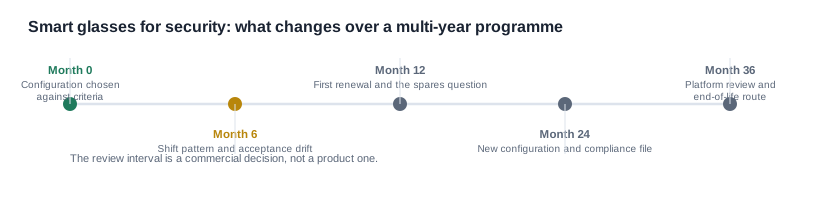
Smart glasses for security deployments fail on time, not on specification. The published specifications in this range are good enough to start a pilot; what decides a multi-year deployment is battery replacement, charging logistics on shift, and the fact that frame weight is published for exactly one model. This walks through a three-year deployment assumption and shows where each published figure holds and where it stops. The procurement question underneath all of it is whether the configuration chosen for year one is still the configuration the programme wants in year three, and the answer is usually no — which is why the re-evaluation trigger is the clause that matters most.
Smart glasses for security: what a multi-year programme actually depends on
Assume a security team of twenty, deployed across three shifts, with units in continuous use rather than intermittent use. That assumption is what breaks most published runtime figures, because published runtime across this range is stated as a rated figure with no test condition — approximately 7 hours on the L1 Pro and the MT6, and the L2 Utral and the CY03, and the CY05, 6 to 8 hours on the KY06 and the MT5, and 5 to 8 hours on the V03 Pro and the V06, and the S7 and the V03.
A rated figure of seven hours is not a shift. A shift is eight, ten or twelve. That gap is the whole deployment problem, and no amount of specification reading closes it.
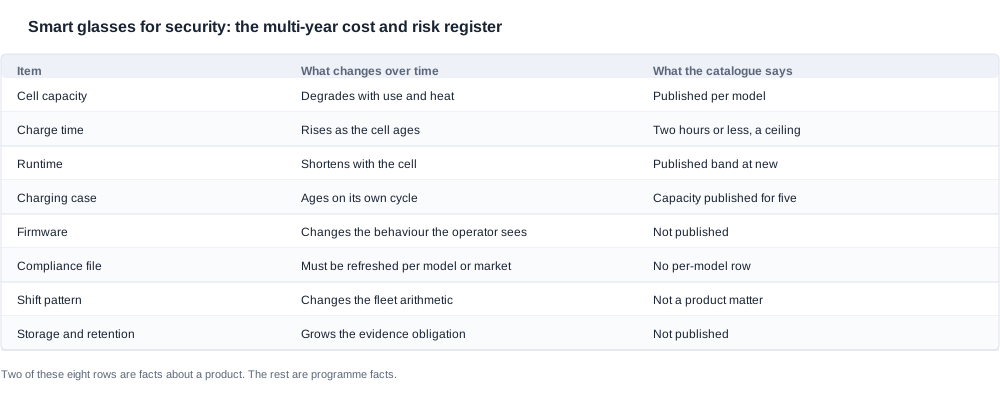
Two published facts make it worse over time rather than better. First, standby current is Not published for any model in this range, so overnight recharge cannot be modelled from documentation — and that is precisely the calculation a multi-year programme needs in order to decide how many bench positions to build and what production capacity to plan against. Second, unit weight is published for exactly one model — the MT6 at 158 g, for the glasses body including the cell and the camera and excluding the foldable case, whose own weight is not published — so the single most common long-service complaint in this application cannot be predicted from documentation at all.
A third fact shapes the renewal rather than the operation: the catalogue publishes no cycle life, no service life, no charge-start state and no charge-end criterion for any model. A programme that intends to run three years therefore has no published basis on which to forecast when a cell becomes a fleet liability, and any replacement interval it adopts will be its own assumption rather than a figure from the documentation. A supplier's quality control data may narrow that interval, but the catalogue does not carry it and a buyer should ask for it per model rather than infer it.
That request is worth making at the pilot stage rather than at the first renewal, because the two conversations have different leverage. At the pilot stage a supplier has an incentive to establish the working relationship, and cycle life data offered early costs it little. At the first renewal the buyer has a purchase order in hand and a supplier who knows the fleet is already committed, and the same request becomes a negotiation. The same logic applies to the three other figures the catalogue does not publish that bear on the operating plan — standby current, the charge-start state and the charge-end criterion — because each of them turns a bench arrangement from a rule of thumb into a calculation, and each of them is far cheaper to obtain while the volume is still small.

The two things that break on a security deployment
Replacement intervals, not battery hours. If units are swapped rather than recharged mid-shift, the question becomes charge throughput. A magnetic case model such as the CY03, the CY05 or the L1 Pro, all publishing a 1400 mAh case, turns charging into an overnight bench operation for twenty units. A Type-C model with no case requires twenty cables, twenty wall positions and twenty disciplined people. Both work; only one works when people are tired at 3 a.m.
The multi-year version of this calculation is where it usually goes wrong, because the bench is sized for the launch fleet and the launch fleet is rarely the programme fleet. A programme that grows from twenty to sixty units in its second year needs three times the bench positions and three times the cases, and if the cases were treated as a device accessory rather than as a fleet consumable, that is a capital request the buyer has not made. The published case capacities — 1400 mAh on the CY05 and the L1 Pro, and the CY03, 900 or 1400 mAh on the L2 Utral, 1200 mAh in a foldable case on the MT6 — are the numbers that let a bench plan be built for year two rather than for the pilot.
Two further models complicate that arithmetic, and both are visible in the published rows. The KY06 and the MT5 publish that a charging case exists without publishing its capacity, so the reserve for those two cannot be calculated from the catalogue at all. The S7 and the V06, and the V03 and the V03 Pro publish no case row, which is silence rather than a documented absence. A buyer who sizes the year-two bench from the case-published models alone and then adds the silent ones to the fleet has a bench plan with an unquantified gap in it. The remedy is the same as it is for the launch fleet: confirm the case position in writing per model before the fleet order, not after.
Firmware and configuration continuity. If a deployment issues firmware updates, the update path and the re-imaging process need to be settled before you own twenty units rather than two. Firmware customisation is a published customisation item, which means it is also a maintenance commitment: a configuration you fork is a configuration you support. Over three years the cost of that commitment is rarely counted, and it is the cost that turns a hardware purchase into a platform relationship.
The related control is the change-notice process. A deployment that has agreed in advance how the supplier tells it about a component change, a build change or a firmware change can plan for each one; a deployment that has not will find out from a support call, in the middle of a shift, on a unit that no longer behaves like the other nineteen. This is a clause rather than a feature, and it belongs in the first agreement rather than the renewal — because a supplier who has already shipped two years of volume has less incentive to offer it than one who has shipped a pilot.

The camera question that stays open
For a first-person recording use case, the camera specification is where documentation is thinnest. Sensor model, field of view, video resolution and frame rate, stabilisation and low-light behaviour are all Not published for every camera model in this range. An 8 MP or 13 MP figure tells you pixel count and nothing about whether the recorded material is usable as evidence.
That is a serious gap for security use specifically, and it is the gap that gets more expensive over a multi-year programme rather than less. The reason is that the gap closes only by testing, and testing a fleet requires a sample, a site, an hour and a reviewer. A programme that tests once at launch and never again is relying on a configuration that has been in service for three years and has been through weather, contacts, cases and operator handling — none of which is the configuration that was tested.
The practical consequence is that the low-light test belongs in the review cycle rather than in the launch. The published runtime bands hold as planning ceilings across the life of the deployment, because the cell is what the catalogue publishes. The capture behaviour does not, because nothing in the catalogue speaks to it, and because a unit that has been in a service fleet for three years is a different object from the one that came out of the box.
Before committing, obtain the camera specification in writing for the exact model code, and test with the actual lighting conditions of your site — corridors, loading bays, night exteriors. A camera that performs acceptably in daylight and poorly in a car park is a different product from the specification sheet's impression. The procedure is set out at the security test guide and the capture gaps are detailed at camera and imaging.

What breaks in the second year
A multi-year programme has three recurring failure patterns, and none of them is a hardware defect. They are all consequences of decisions taken at launch and never revisited.
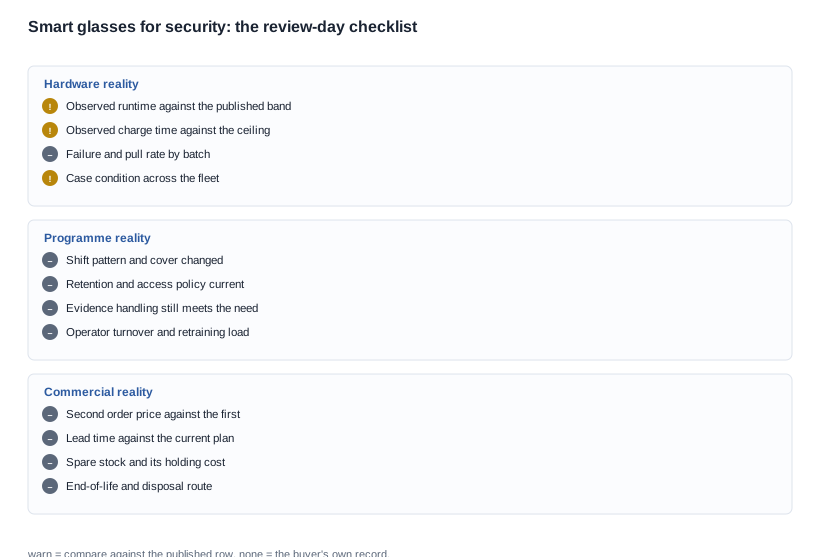
Physical wear, which is not in any specification. A security deployment puts more hours on a temple and a hinge than a retail product ever will, and the wear shows up as a rising pull rate rather than as a dramatic failure. Ingress protection for the two camera models that carry the marking is published as IP54 at catalogue level, with no third-party test report number — and IP54 means dust ingress limited and protection against splashing water, not immersion and not a guarantee in sustained rain. Treat it as a marking to be stated rather than a protection level to be relied upon, and read it at IP ratings and what they do not cover.
The procurement consequence is that a rising pull rate has to be separated into three causes before it becomes a spend: physical damage from handling, cell behaviour, and design change. Only the second of those is a product issue, and only the second is a warranty matter against a published row. A buyer who reports a rising pull rate as a single number to a supplier has handed them an opportunity to decline it, because the number does not say which of the three causes it is. A pull rate broken down by reason code does, and the reason code list is worth agreeing with the supplier at the first order so that the two sides are counting the same things.
The reason code list should be agreed as part of the first order rather than introduced at the first review, and it should be short. Four or five codes is enough for a security deployment: physical damage, contact fouling, transfer failure, cell behaviour and unit not returned. Each code maps to a different owner — the first and the fifth to operations, the second to the bench routine, the third to the retrieval process, the fourth to the warranty claim — and that mapping is what lets a purchase order, a warranty claim and a maintenance log be reconciled at the end of a year. It is also the document that turns the second-year spare pool from a percentage into a number.
Acceptance drift. The written criteria agreed at launch describe the deployment as it was at launch. By year two the shift pattern has changed, the client has changed, the recording purpose has changed, and the units are running against criteria that no longer describe the work. Nothing breaks at that moment; the programme simply stops meeting its own standard without anybody noticing. The review date is the control, and it is the cheapest item on the list.
The drift has a specific procurement form, and it is worth naming because it is easy to miss. A deployment that drifts usually drifts by accretion rather than by replacement: a second site is added, a second shift pattern is introduced, a second client comes on board with a slightly different recording requirement, and each of these is a reasonable operational decision taken by a reasonable person. The units are unchanged and the supplier is unchanged, but the configuration in the field is no longer the configuration that was assessed, ordered and documented. This is why the configuration — as a single named model with a single named case — has to be re-stated at every renewal rather than described by reference to the original order.
Evidence obligation growth. The programme that stored a shift's material for a week now stores a month, and the storage, the access controls, the retention review and the disposal route all scale with it. None of that appears on a product specification, because it is a consequence of the deployment rather than of the device — and it is the item most likely to be discovered by an auditor rather than by the buyer.
The commercial dimension of that growth belongs on the review agenda too, because the operating cost of retention is a line in the programme budget that starts at the pilot stage and grows every year it is not revisited. Storage, access control, the disposal route and the periodic review of the retention rule are all buyer-side costs with no supplier document attached, and all four scale with the retention period. A buyer who negotiates the retention period downward at year two saves on storage and on review effort, and a buyer who negotiates it upward to match a client requirement is committing to those costs for the life of the programme. The catalogue publishes no storage capacity for any camera model, so the buyer is choosing a retention period without knowing what the device can hold — which is one more reason for the retention rule to be written as a policy with a periodic review, rather than as a fixed number in a purchase order.

The re-evaluation decision
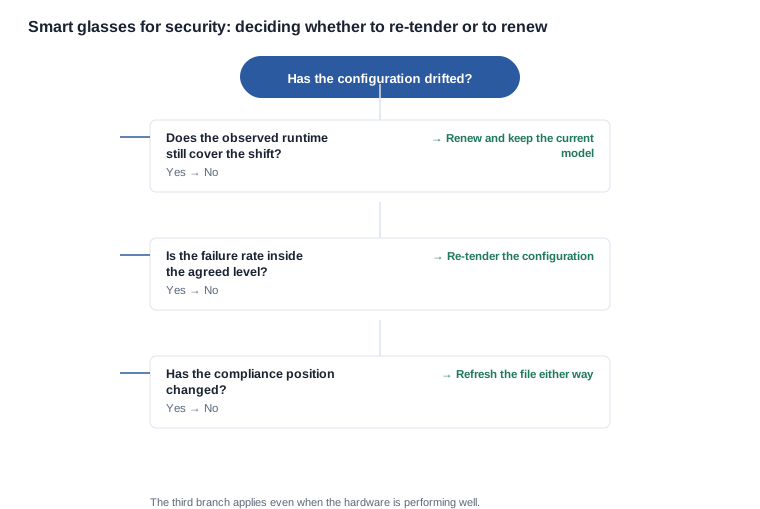
The question at every review date is whether to renew the configuration or to re-tender it, and the decision is easier than it looks because it can be reduced to three branches. The important part is that the third branch applies even when the hardware is performing well, which is why the review has to be scheduled rather than triggered by a complaint.
Does the observed runtime still cover the shift? If yes, the renewal is a renewal of the same configuration, and the spare ratio and bench plan are the two numbers to review. If no, the shift model has changed or the cells have aged, and the answer is a case decision rather than a cell decision — because the catalogue's cell capacities are fixed per model and only the case configuration changes the fleet arithmetic.
Is the failure rate inside the agreed level? If yes, keep the model and fix the operating practice, because a high pull rate on a correct configuration is a roster, contact or handling problem. If no, re-tender the configuration, and take the observed failure data with the re-tender rather than describing the problem in general terms. A pull rate with a reason code attached is a procurement document.
Has the compliance position changed? This branch runs regardless of the other two. A new market, a new site type, a changed recording purpose or an updated legal frame can all change the compliance position of a configuration that is performing perfectly, and the catalogue contains no per-model certification row — so each per-model document has to be refreshed for whatever is bought next, and the per-model route is at the certification checklist.
Two of those three branches are commercial rather than technical, and that is worth noting because it explains why a hardware decision gets made in a review meeting with no supplier present. A renewal is mostly a question about the price basis, the spare ratio and the bench plan, and it is decided on the buyer's own numbers. The re-tender branch is the one that needs a supplier, and it is the one worth preparing for in advance by keeping the acceptance criteria, the observed failure data and the pull-rate breakdown current. A buyer who has those three documents ready at the review date can re-tender in weeks; a buyer who has to reconstruct them has to re-tender in months.
Where our published position stops
The boundary we hold: we will tell you which published specifications exist for a configuration, and we will not present a rated runtime figure as a shift length or a catalogue IP marking as a tested protection level. For a long-term deployment those two substitutions are the ones that fail quietly and expensively — the first at handover, the second in the rain.
Weight for most models, camera specifications, standby current, cycle life and third-party ingress test reports are Not published for this range, and we will say so rather than fill them with typical values. Our experience is that a deployment which starts from acknowledged gaps goes far better than one that starts from assumed figures and discovers them in month three.
We do not publish minimum order quantities, unit prices or lead times as fixed numbers; all three are confirmed per enquiry. What we will do is identify which published configurations fit the wear cycle and shift pattern you describe, and which figures we cannot evidence for your conditions.
For the protection-rating detail specifically, IP ratings explained sets out what each level does and does not cover. If your deployment is sport or outdoor adjacent rather than fixed-site, the sport smart glasses range is where the removable inner frame and ergonomic design work is concentrated, and the two camera models carrying the IP54 marking are the V06 and the S7.
Related reading
- IP ratings and what they do not cover — reading a protection marking correctly
- Battery life and runtime conditions — why rated hours are a ceiling
- Sport smart glasses range — designs aimed at sustained wear
- The test script for the open questions — what only a sample can answer
Tell us the shift pattern, the environment and whether recording is required, and we will tell you which published configurations fit and which figures we cannot evidence for your conditions.


