
Testing smart glasses for security work is a script, and the script matters more than the checklist. The device is settled before the script begins; what is not settled is the six conditions under which it has to work, and those conditions belong to a site, a shift and an evidence rule rather than to a specification sheet. This page sets out the six steps, the conditions each one has to be run in, and the pass lines to agree with the supplier before the first unit is issued.
Two conclusions come before the steps. The first is that the camera range publishes the frame of reference but not the evidence behaviour: the MT5 and the MT6, the V06 and the CY05, and the V03 and the CY03, and the V03 Pro and the KY06 publish 8 MP, and the S7 and the L2 Utral, and the L1 Pro publish 13 MP, while the field of view, the video format, the frame rate, the storage capacity, the low-light performance, the time-stamping method and the audio capture behaviour are published for no model at all. The second is that a security deployment is a per-shift cost centre, so the test is not a quality exercise — it is the thing that decides whether the renewal conversation happens on evidence or on anecdote.
The third conclusion is a caution about published rows that look stronger than they are. Two models in the range publish an IP54 ingress marking, and the V06 and the S7 are the two; no third-party test report accompanies either marking, and the catalogue carries no per-model certification row and no CE, FCC or RoHS wording in its text. A script that treats a catalogue marking as a tested result will produce an evidence chain that a reviewer can dismantle.
A smart glasses for security deployment is decided by the script, not the checklist
Who signs off the script, and what they are defending
Three roles end up owning this decision, and they want different things from the same six steps. A security operations manager is signing off a device for officers and needs the test to reflect the patrol rather than the demonstration, because the demonstration is run by a person who knows what the device does and the patrol is not. A procurement manager is committing budget to a deployment and needs a script the supplier has already agreed to, because a script agreed afterwards is a negotiation rather than a test. A brand owner is deciding whether the security channel is viable at all, and for that decision the six steps are the whole of the due diligence.
What all three are defending is the same thing in different clothes: the evidence chain. A clip that cannot be retrieved, a timestamp that cannot be tied to a sequence of events, a device that is flat at the changeover — each of those lands in the renewal conversation, and none of them is a hardware fault that a warranty would cover.
That is why the ordering of the six steps is not arbitrary. The framing step comes first because if the scene of interest does not fall inside the frame, no downstream quality question matters; the low-light step comes second because a camera that performs acceptably in daylight and badly under a loading-bay light is a predictable failure that a daylight test will not catch; and the motion step comes third because the footage is only ever used while somebody is walking.
What the published range settles, and what it leaves to the script
The published rows for the camera range are complete on the electrical side, and they are the part of the test that can be planned rather than measured. Cell capacities are published per model at 220 mAh on the V03 and the V03 Pro, and the MT5, 260 mAh on the S7 and the KY06, and the V06, 265 mAh on the MT6, and 290 mAh on the L1 Pro and the CY03, and the L2 Utral and the CY05. Charge times are published for the whole range at or under two hours, and the rated runtimes sit between about seven hours on the MT6 and the CY03, and the CY05 and the L1 Pro, and the L2 Utral and five to eight hours on the V03 and the V03 Pro, and the S7 and the V06. The charging interface is published per model, with four camera models carrying a case capacity and four camera models publishing no charging interface row at all.
The sport models publish a remote capture control on the D17 and the ZH12, and that row is unusually valuable for a security deployment because it is the published difference between a control on the frame and a control the wearer triggers without touching the device. The shutter button answer and the recording control discussion set out what is published and what is not.
Everything that determines whether a recording is usable as evidence is unpublished, and that is the whole argument for running a script. The AI camera glasses range page lists the models and their published rows, and it is worth reading before the script is written, because the model you shortlist determines which of the published rows you are comparing and which of the unpublished rows the script has to produce.
Smart glasses for security: the steps that must close their rows
Steps one to three: framing, low light and motion
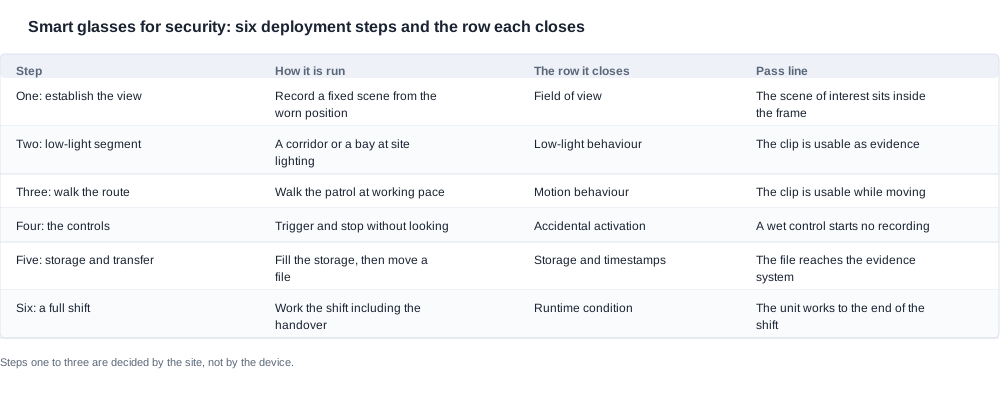
| Step | How it is run | The row it closes | Pass line |
|---|---|---|---|
| One: establish the view | Record a fixed scene from the worn position | Field of view | The scene of interest sits inside the frame |
| Two: low-light segment | A corridor or a bay at site lighting | Low-light behaviour | The clip is usable as evidence |
| Three: walk the route | Walk the patrol at working pace | Motion behaviour | The clip is usable while moving |
| Four: the controls | Trigger and stop without looking | Accidental activation | A wet control starts no recording |
| Five: storage and transfer | Fill the storage, then move a file | Storage and timestamps | The file reaches the evidence system |
| Six: a full shift | Work the shift including the handover | Runtime condition | The unit works to the end of the shift |
Step one has to be run from the worn position rather than from the front of the unit, because the difference between the two is exactly what the field-of-view row would have told you if it were published. The scene to record is the scene of interest as the officer will meet it — a doorway, a far end of a bay, the approach to a barrier — and the pass line is that it falls inside the frame from the worn position with the officer's own head movement included. A field of view measured while the unit is held at chest height is a number with no bearing on the deployment.
Step two is the step most often skipped, because daylight is the condition the tester has. The segment has to be the site's own corridor or bay, at the lighting level the site actually has, and the lighting has to be recorded rather than described — a phrase like "dim conditions" is worthless six months later, whereas a lux reading or the name of the fitting is reproducible. The sensor part and the pixel size behind the low-light behaviour are unpublished, so the result is a property of this model in this light rather than a figure that can be quoted as a specification.
Step three is where image quality is judged in practice, because a device that reads well standing still can be unusable while walking. Record the same route twice, once slowly and once at working pace, and keep both clips — the slow pass isolates the framing, the fast pass exposes the stabilisation behaviour that the published frame rate does not describe. If the step is going to be cut for time, cut it only in a deployment whose evidence rules do not depend on moving footage, and record that decision.
Steps four to six: controls, storage and the shift
Step four is about the unit that will actually be issued. Two models in the range publish a remote capture control, the D17 and the ZH12, and a remote control is a different interaction from a button on the frame: it removes the need to touch the device to start and stop a recording, which removes the need to look down, which is the difference between a usable interaction and one that produces unusable footage. The step is run with the conditions the officer works in — a wet hand, a sleeve, a gloved hand — because accidental activation is not published for any model and it is the failure that produces a patrol with no footage at all.
Step five is where the deployment is actually decided. A recorded file that cannot be retrieved, or whose timestamps cannot be tied to a sequence of events, is not evidence. The storage behaviour is unknown until it is deliberately tested: fill the storage, watch what happens, and write down whether the oldest material is overwritten, whether recording stops, and what the device does when it happens. Then move a file to the evidence system and time it. The time-stamping method is not published for any model in the range, and it is the row a security reviewer asks about first, because a timestamp that is merely plausible is worth less than a timestamp that is demonstrably aligned to a reference clock.
Step six is the one the buyer usually skips and the one a supervisor notices. A device that is flat at the handover was flat for the last twenty minutes of the previous shift, and the loss happens in the gap. The runtime condition is unpublished, so the published rating cannot be turned into a shift-length guarantee; what the step produces is a measured behaviour across one real shift including the changeover, plus a statement about where the charging point is and who owns it.
Thresholds a security deployment can be held to
The seven rows nobody publishes
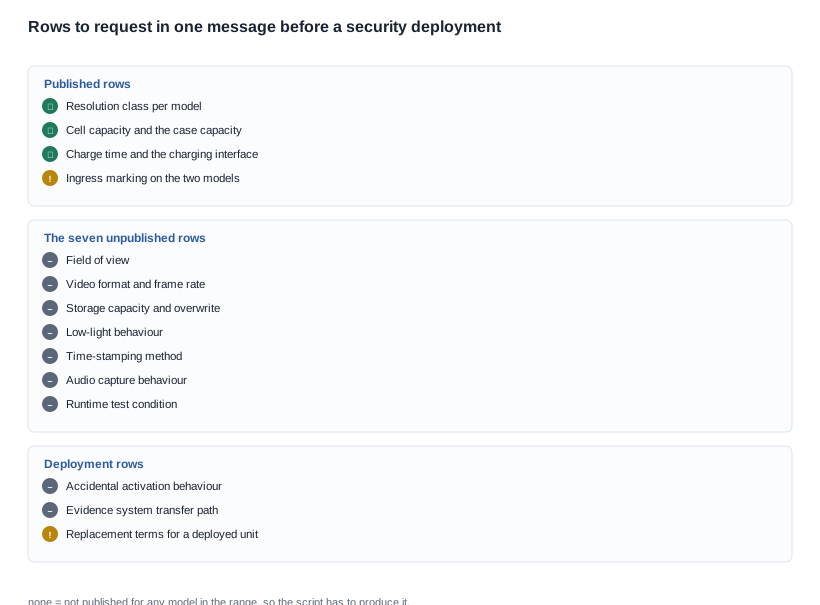
The seven unpublished rows are worth treating as a single request, because the answer to each one tells you something about the supplier beyond the row itself. The field of view, the video format and the frame rate, the storage capacity and its overwrite behaviour, the low-light behaviour, the time-stamping method, the audio capture behaviour and the runtime test condition — none of these is published for any model in this range, and the script exists to produce them.
A supplier who answers with a method gets a usable answer, even where the number is approximate. A supplier who answers with a figure and no method has given you something you can check against your own run and disagree with. A supplier who does not answer has given you something more useful than a number: they have told you which rows the script has to produce on its own, and the script can be planned around that rather than around a hope.
The audio capture row deserves particular attention because it carries a legal dimension rather than a technical one. What a body-worn device records, and whether it records in a space where a conversation is taking place, is a question the buyer's own policy has to answer before the device is deployed — and the device's behaviour is not published, so the policy has to be written against the measured behaviour rather than against the brochure.
Rows that cannot be compared between two suppliers
Four comparisons are unsafe in this category, and putting them in a table is the fastest way to make a bad decision look like a good one. Runtime without a condition is the first, because the runtimes are published for every model and read like a comparable axis when they are not. The ingress marking is the second, because two models in the whole range publish it — the V06 and the S7 — and a table with a marking in one cell and a blank in another is not a comparison.
The third is the per-model weight, where the range publishes one figure in total at 158 g for the MT6, a camera model with a foldable case, and every other cell would be an assumption; and the fourth is the certification scope, where a company-level capability and a per-model declaration are different objects entirely. The rule for all four is the same one that applies in every other category in this range: a row that is not published on both sides does not go in the comparison table, it goes on the script with a pass line attached to it.
Verifying the script before the first deployment
The agreement that has to precede the first run

Five things have to be true before the first unit is issued, and all five are cheaper to arrange before the script than after it. The six pass lines have to be agreed with the supplier in writing, because a pass line written after the result is a negotiation. The unpublished rows have to be requested in one message, and a non-answer logged as an open row rather than treated as a pass. At least three units from the same batch have to be available, because security devices are issued to individuals and a unit that works for one officer and not another is a unit-to-unit variation problem rather than a design problem.
The conditions have to be recorded with every result — the lighting, the route, the pace, the network, the platform and the time of day — because a low-light result with no lighting attached cannot be defended and cannot be repeated. And the boundary of what the listing may claim has to be decided before the copy exists, not after: the resolution tier, the cell, the charge time, the charging interface, the case capacity, the rated runtime, the remote capture row and the ingress marking on the V06 and the S7 are published rows, while the field of view, the video rows, the storage behaviour, the transfer path, the time-stamping method, the audio capture behaviour and the ingress evidence are not.
How the script is executed on the site
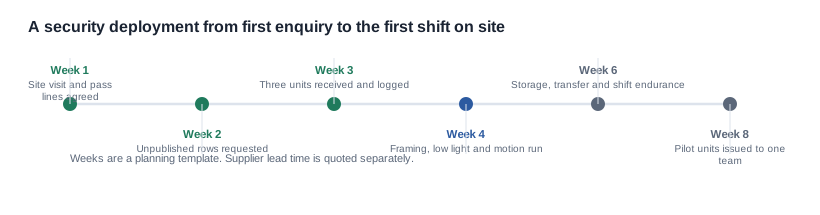
Running the whole script on at least three units on the actual site is what turns a demonstration into a deployment test, and the site is not negotiable. A device that passes a bench test and fails a corridor is not a defective product; it is a product that was never tested in the corridor, and the difference matters because the remedy is a different conversation entirely — a product change, a configuration change, or a deployment rule.
Three units is a small number and it is worth saying why it is the minimum rather than the target. The purpose is not statistical confidence about defect rates; it is to separate a design characteristic from a unit-to-unit variation. Three units on the same route will expose an intermittent behaviour that a single unit hides, and they will do it in the time a single shift allows. Beyond three, the marginal value falls and the schedule cost rises, which is why the script is designed so that the steps can be run in a specific order and the most expensive ones can be scheduled last.
The handover in step six deserves one more sentence, because it is where the loss actually occurs. A charging point that is not owned by anyone is a charging point that is not charged, and the evidence of that is a flat device at the start of a shift — which arrives as a complaint about the device rather than as a finding about the charging point.

Six ways a security test script goes wrong
The test was run in daylight indoors. Symptom: a deployment that produces unusable evidence on a night shift. Root cause: the test used the conditions the tester had. Prevention: step two, at the site.
The frame was checked standing still. Symptom: footage that is unusable while the officer is moving, which is the only time it matters. Root cause: the test did not include motion. Prevention: step three.
The storage behaviour was never tested. Symptom: a recording that stopped mid-patrol. Root cause: the overwrite behaviour was assumed. Prevention: step five, deliberately filling the storage.
The timestamps were not checked. Symptom: evidence that cannot be tied to a sequence of events. Root cause: the time-stamping method is not published and nobody asked. Prevention: step five, against the evidence system's requirements.
The controls were tested with dry hands. Symptom: a recording started by a sleeve or a wet hand, and a patrol with no usable footage. Root cause: the accidental-activation behaviour was never established. Prevention: step four, with the conditions the officer works in.
The shift was measured without the handover. Symptom: a device that is flat at the changeover. Root cause: the gap was treated as downtime. Prevention: step six, including the handover.
What a tested security deployment is worth commercially
The commercial terms the script moves
A security deployment is a per-shift cost centre, and the script is what keeps the cost per shift predictable, so the commercial conversation and the test programme are the same conversation seen from two ends. The unit price and the volume tiers are the obvious line, but they are not the line the script moves. The script moves the case and charging-point set with its own minimum order quantities, the spare dock, the cable and the replacement contact with their pricing, the evidence-system integration requirements, the packaging specification, the delivery split, the payment nodes against inspection, the warranty period with a stated response, the replacement terms for a deployed unit, and the terms of a pilot order.
Replacement terms are the one worth arguing hardest, because they decide whether a deployed device is a service line or a consumable. A unit that is deployed, issued to an individual and returned at the end of a shift is exposed to damage in a way a boxed unit never is, and the difference between a replacement on warranty and a replacement at cost is the difference between a service line that scales and one that does not. A warranty period with a stated response time matters for the same reason: a supervisor cannot plan a shift around a response that is unspecified.
Two things do not move. Certification cost and lead time are set out by the schedule and by whoever certifies the build and do not move, and no amount of negotiation shortens them; and tooling is often amortised across the first order while certification cost sits per product family, so ask which one you are being quoted, because the two are frequently bundled into a single line that hides which is which. Both belong in the agreement alongside the published rows for the configuration ordered, the six pass lines and the measured results, the unpublished rows the script produced, the runtime condition, the warranty period with a stated response and the replacement terms.
What to leave out of the agreement is as important as what goes in. Any evidence-quality claim not established on the site should not appear, and neither should a shift-length guarantee drawn from a rating — the rating is a bench figure and a shift is a site condition, and the difference between the two is exactly what the script exists to close.
A hypothetical security deployment, step by step
Take a facilities operator running two sites — a distribution centre and a smaller depot — who wants body-worn cameras for the night shift, issued to four supervisors, with a decision to expand to thirty units after one quarter.
The first decision is the evidence rule, because it drives the script. The operator's rule is that a clip has to carry a usable timestamp, which makes step five the one that cannot be deferred, and it also makes the time-stamping method the single most important unpublished row. The second decision is the model shortlist, and it is made against the published rows — the cell and the runtime band decide the shift coverage, the case capacity decides whether the charging point is one dock per unit or a shared point, and the ingress marking narrows the choice to the two models that publish one.
The third decision is the script itself, with the six pass lines written down and agreed before the sample ships. The fourth is the unit count and the site, which is decided against step two: two lighting conditions across two sites, and the night shift is the one that decides whether the low-light step passes or fails. The fifth is the control scheme, and the two models with a published remote capture control are preferred for the reason the step exposes — a control that does not require the wearer to touch the device removes a whole category of accidental activation.
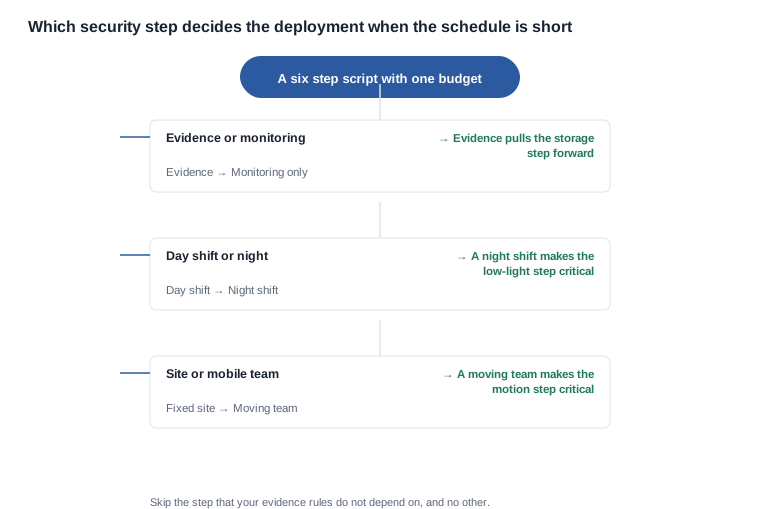
The sixth decision is the commercial one, and it is where the script pays for itself: the replacement terms, the warranty response, the charging-point set and its minimum order quantities, and a pilot order sized for four units across two sites rather than for the thirty the expansion might need. The outcome is a deployment whose evidence chain was established before the first shift rather than after the first complaint, and an expansion decision made on a pilot rather than on a hope. The steps below are illustrative rather than a report of a real engagement, and the order in which the decisions are taken is the part worth reusing rather than the figures in them.
What we publish for a security configuration
Here, a security deployment has to be tested in the environment it will be used in, because the rows that decide it — the framing, the low-light behaviour, the motion behaviour, the storage and the timestamps — are the ones nobody publishes. We will not publish a field of view, a video format, a frame rate, a storage capacity, a low-light performance, a time-stamping method or an ingress rating for a model where the manufacturer has not provided one, and we will not present a catalogue marking as a tested result.
What we do publish for this range is the resolution class, the cell capacities, the charge times at or under two hours, the rated runtimes, the charging interface per model, the remote capture row on the D17 and the ZH12, the removable inner frame on the V06 and the S7, and the case capacities where they are published. The range publishes one weight figure in total, at 158 g for the MT6, which is the whole-unit figure for the glasses including the cell and the camera and excluding the foldable case, and the case weight is not published. We will also not state that any model in the range is certified to CE, FCC or RoHS, because the catalogue carries no per-model certification row and no such wording in its text.
What we will do is give you the six steps, the conditions each one has to be run in, and the pass lines to agree first. The AI camera glasses range page lists the models and their rows, and the recording control discussion and the shutter button answer cover the control rows.
What to send so the test script can be matched to your site
Send the site, the shift pattern, the evidence rules and the models you are shortlisting, and we will tell you which rows are documented, which the script has to establish, and which step decides the deployment under your own schedule. If the script is already written, send the pass lines instead — that is the fastest way to find out whether one of them is untestable.
Related reading
- AI camera glasses range — the models and their published rows
- Recording control discussion — the control rows in context
- Shutter button answer — what the published rows settle
- Smart glasses for security — the scenario entry point


