

Smart glasses for security: the trade is decided outside the device
The honest answer to the pros-and-cons question in this category is that the pros are almost entirely on the device and the cons are almost entirely off it. The camera group and the audio group do what their published rows say they do, and neither of them solves the two problems that decide whether a security deployment works: how the record is handled, and how the site is powered. A buyer who evaluates the two configurations on the device specifications alone will end up with a device decision and an operations problem, and will meet the operations problem at the charging point in a corridor at three in the morning.
Three conclusions follow, and they are the substance of this article rather than a summary of it. The decisive cost in a security deployment is base-level, not unit-level. The magnetic models need an installed charging point at every vehicle and every base location; the Type C models need a cable, which is a consumable. The same price difference that decides the unit order decides nothing about which of those two lines the buyer ends up carrying. The two groups fail in opposite directions, and a mixed fleet doubles both failure paths. The camera group fails when the recording is unusable or does not survive the shift; the audio group fails when the shift outlasts the published run time. Running both means two charging strategies, two spare pools and two consumable streams. And the largest single gap is common to both groups: the storage and overwrite behaviour is not published for any model in the range, which is why the recording decision sits ahead of the product decision.
The reader and the decision in front of them. This is written for the procurement manager who has to choose between two configurations for a security team, brief an operations director on the choice, and defend it afterwards. The fear behind that decision is not that the device will be poor. It is that the deployment will fail in a way that gets attributed to the device — a shift that ended early, a record that turned out to be unusable, a record that turned out to have been overwritten — and that the person who chose will have no published row to point at.
What the camera group buys you, and what it takes back
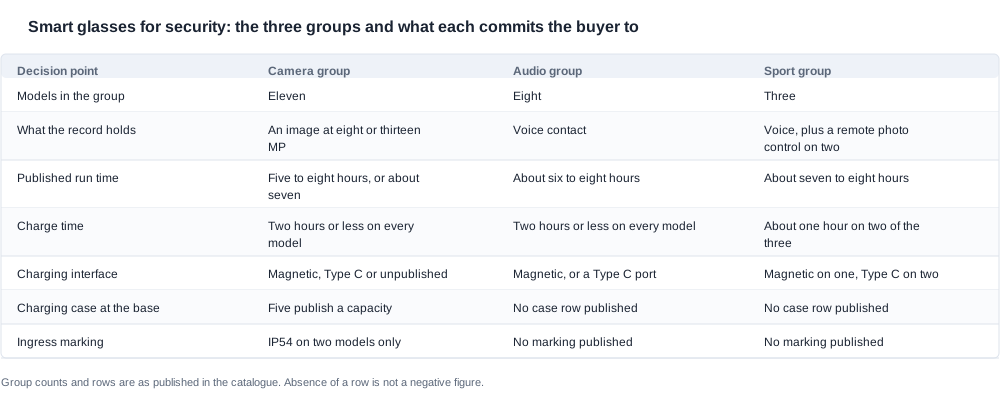
The camera group is the eleven models MT6 and CY03, CY05 and V03 Pro, S7 and L2 Utral, V06 and KY06, L1 Pro and MT5, and V03. Eight publish an 8 MP sensor and three publish 13 MP — the L2 Utral and the S7, and the L1 Pro. The pros are straightforward and they are the reason the group exists: the record carries an image, the image is tied to the moment by the device rather than by a witness statement, and the resolution class is a published row that a buyer can put in a specification and a supplier can be held to.
The pros, stated precisely enough to be useful
The published rows are better than most buyers expect. Every one of the eleven camera models publishes a run time, a cell capacity and a charge time, and seven of them publish a charging interface, so the base-level charging design can be planned before the order rather than discovered after it. Five of them publish a charging-case capacity — CY05 and L1 Pro, and CY03 — each at 1400 mAh, L2 Utral at 900 or 1400 mAh, and the MT6 as a 1200 mAh foldable case — which gives a buyer a real second option for extended deployments. Two of them, the V06 and the S7, publish an IP54 marking together with a removable inner frame and a 260 mAh cell, which is the only route in the catalogue to an outdoor spec that a buyer can state on a deployment sheet.
The cons, which are the same three items in every configuration
The storage row is absent. Capacity, overwrite behaviour and the notification before the limit are not published for any model in the range. This is the single largest gap between what a camera group promises and what it can prove, and it sits on the most valuable capability the group offers. The run time is published without its test condition. Five to eight hours on some models, about seven on others, and no statement of what the device was doing while it was measured. The night behaviour is unpublished. Low-light performance, stabilisation, field of view and video format are all absent, and the only models in the range with a published remote photo control are the D17 and the ZH12 in the sport group. A buyer planning a night patrol therefore cannot write a performance claim, only a supplier question.
The weight of the mistake
Choosing a camera model when the job needs voice contact is expensive in a specific way: the deployment acquires a recording policy, a storage policy, a retention schedule and a review process, none of which exist yet, and every one of them is a legal rather than a hardware cost. The device is the cheap part of that decision.
What the audio group buys you, and what it takes back
The audio group is the eight models K02 and G07, K01 and LC-105-1, D11 and LC-105-2, and YK12 and D12, and its pros are the mirror image of the camera group's. The device stays out of the way, the unit cost sits lower, the run time is not competing with a sensor, and the deployment carries no recording policy at all. For a security team whose real problem is hand-free contact — a reception desk, a patrol that needs a radio rather than a record, a loading bay — this is often the correct answer and it is worth saying plainly that a device with no camera is a legitimate choice rather than a compromise.
The pros, and they are substantial
Bluetooth is published per model, so a handset fleet narrows the shortlist before anything else applies: 5.3 on the K01 and the K02, 5.4 on the D11, the D12 and the rest of the group. The run times cluster between about six and about eight hours, which covers a standard shift in the majority of the group. The charging interface splits cleanly — magnetic on the K01, the K02, the LC-105 pair, the G07 and the YK12; Type C on the D11 and the D12. And the published structural features are real purchase arguments rather than decoration: ultra-slim detachable temples on the G07, and surround sound with a slim temple on the YK12. No model in the group publishes a touch row, so a temple control surface is a question for the supplier rather than a line you can order from.
The cons, and where they hide
The runtime tier inside the group is the trap. Four audio models carry two cells of 55 mAh: the LC-105 pair publish about eight hours, while the G07 and the YK12 publish about six. The two models in that tier carrying the slim and detachable temple feature rows are the two with the shorter figure, so a buyer selecting on the frame feature is selecting on the shorter-runtime models without necessarily realising it. The interface commits the base. The D11 and the D12 are Type C, which is a cable, which is a consumable — a genuinely better outcome than an installed dock, and a real difference in the recurring cost of the deployment. And the group has no case row at all. No audio model publishes a charging case, so the spare-power strategy has to be a spare pool at the base rather than power in the case, which changes the loan pool, the tracking and the loss exposure.
The case for a mixed fleet, and against it
A mixed fleet is genuinely defensible when the site has two different job types — a fixed post where voice is the requirement and a patrol where an image is. It is not defensible as a way of avoiding a decision. A mixed fleet doubles the charging strategy, the spare pool, the consumable stream, the training and the firmware handling, and it multiplies the number of published rows a buyer has to keep true at once. Decide the job split first, then decide whether the split justifies the operational load.

The four trade-offs that never appear on a specification sheet
This is the section that separates a procurement decision from a product comparison, and it is where the real cost of each configuration sits.
One: the charging point is an asset, and the asset sits outside the product budget
A magnetic model needs a dock at every charging location — a vehicle, a charge room, a night desk. That is a fixed asset to be placed, powered, protected, maintained and insured, and it is found after the first invoice because it was never in the product order. A Type C model needs a cable, which is a consumable replaced at the base, at a cost per unit per month that is small and continuous rather than large and one-off. The camera group publishes three different interface answers — magnetic, Type C, and unpublished on CY05 and MT6, and L1 Pro and CY03 — so the buyer cannot even assume a single strategy across the eleven models in a shortlist.
Two: the break-length recharge is a scheduling decision, not a specification
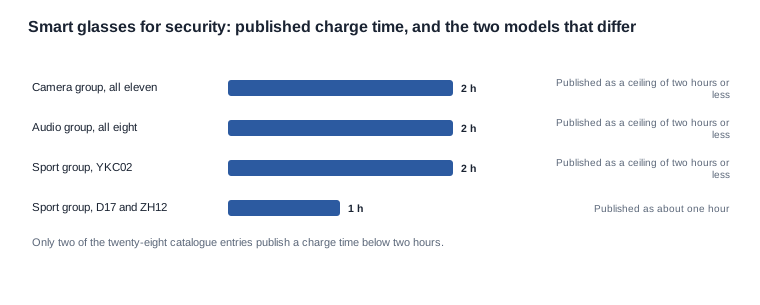
Only the D17 and the ZH12 publish a charge time of about one hour. Every other entry in the catalogue publishes a ceiling of two hours or less, and a ceiling is not the same claim as a figure under two hours. If the deployment's recharge opportunity is a coffee break, then only the two sport models are guaranteed to be back in service inside it, and the rest of the fleet has to be planned around a longer interval or a larger spare pool.
Three: the consumable stream is the cheapest evidence-quality improvement available
A lens scratch produces a record that cannot be used, and the lens material and coating are not published for any model, so the cleaning instruction has to be restrictive rather than permissive: a specified item, a stated prohibition list, one motion. A contact that has been left dirty overnight in a vehicle produces a device that will not charge, which arrives as a hardware fault report rather than as routine. Both consumables cost a fraction of the unit price and both are the difference between a usable record and an unusable one. This is the one line on the operating budget with the highest return in the category, and it is where the base-level cost argument stops being about capital.
Four: the loss exposure is invisible until it is expensive
A device that does not come back is a device that has to be bought again, and in the accounts that reads as a repeat sale rather than a loss. Without a count at the issue point, the loss rate is not a number anybody can manage, and the first visible sign is a budget that does not reconcile. The cost of a count is a line on a handover sheet. The cost of not having one is a figure nobody can put in front of a procurement review.
Five: the total cost of ownership is not the unit price, and nobody prices it
A buyer comparing two configurations on unit price is comparing two numbers that differ by a fraction of what follows them. The cost that decides a first year is the sum of the unit price, the consumable stream, the charging hardware, the spare pool, the replacement rate of a device that fails a shift, and the administrative cost of the recording and retention policy that only one of the two configurations triggers. The last item is the largest and the least visible, because it is a staff cost rather than a purchase. The practical consequence is that a configuration with a lower unit price and a recording policy attached can be more expensive over twelve months than a higher-priced configuration with none — which is a conclusion most shortlists are not built to reach, because the categories that make it true live in different budgets.
The comparison method that survives scrutiny is to build the operating cost for a single device over one year, on one page, with the consumable rate, the replacement rate, the charging hardware allocation and the case or spare-pool count stated as assumptions. The assumptions are then the things the supplier and the operations director have to agree, and the page becomes the document the buyer brings to the next order. This is the arithmetic behind the pricing discussion and behind lead time, and it is worth doing before the order rather than reconstructing it after the first invoice.
Six: the deployment's reputation cost is real and appears late
A camera deployment that produces unusable records damages the case for the next one. An audio deployment that ends shifts early produces a team that quietly stops carrying the device, and the next purchase request comes with a lower headcount than the one before. Neither shows up in the acceptance test, because acceptance tests are run in conditions the site does not have. The only defence is to make the operating assumptions explicit at the point of purchase — shift length, environment, recording purpose, consumable rate, recharge interval — and to have the supplier confirm the rows the site will be judged on. That is what the written question list is for.
The questions to put on the record before choosing either configuration
A pros-and-cons comparison that ends in a recommendation without a question list is a sales document. The list below is organised by where the answer comes from, because that is the distinction that matters when the decision is challenged later: some answers are already published and can be cited, some require the supplier to commit in writing, and two block the order entirely.
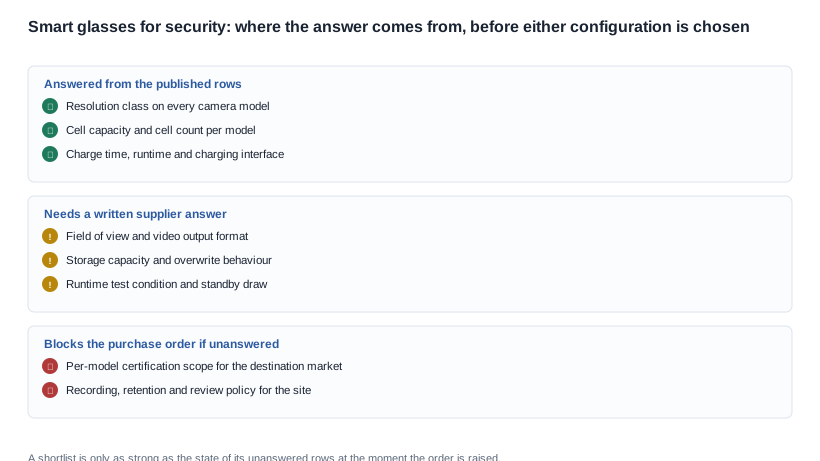
- Which job does each model in the shortlist serve, and which published row proves it? A shortlist that cannot answer this per model is a feature list.
- What is the shift length, and what is the published run time for the exact model? If the shift outruns the figure, the plan for the gap is the answer, not the figure.
- What is the charging interface for the exact configuration, and what does that imply for each site location? Include the four camera models whose interface is not published.
- Is the deployment outdoors, and for which part of the year? Only two models in the range publish an ingress marking.
- What are the storage capacity, the overwrite behaviour and the notification before the limit? Ask in writing, per model.
- What does the supplier confirm about the destination market? The catalogue holds a company-level export certification page, the content on it being images rather than text, and the catalogue text makes no mention of CE, FCC or RoHS. There is no per-model certification row anywhere, so the scope is a written answer and not an inference.
- What does the supplier confirm for the radio requirement? The Radio Equipment Directive (EU) 2014/53/EU and the related EMC standards are a supplier declaration question, and the catalogue publishes no per-model declaration.
- What is the recording, retention and review policy for the site, and who owns it? For the camera group this is the largest cost in the deployment and it is not on any purchase order.
- What consumable quantities does the base stock per device per week, and what is the restock interval?
- What is the incoming inspection criteria, and what is the return path for a device that fails it? The terms are at contract terms.

A note on what the specification should say. Keep the cell values in the form the catalogue publishes them — 55mAh*2, 90mAh*2, 70mAh*2 and 100mAh — and keep the charge time as "two hours or less" unless the model is the D17 or the ZH12, where "about one hour" is the published figure. A derived total is fine in a purchasing plan as long as it is marked as derived, because a bare total in a specification reads as an official figure and will not survive a supplier audit. The battery rows are at battery life and the product families are at AI camera glasses and Bluetooth audio glasses.
The boundary we draw around these pros and cons
We publish the rows a buyer can order from, and we will not fill the gaps with figures borrowed from elsewhere in the industry. That means the resolution class, the cell capacities and cell counts, the charge times, the rated run times, the charging interface, the charging-case capacity where it is published, the Bluetooth version on the audio models, the published structural features, and the IP54 marking on the V06 and the S7 stated as a catalogue attribute.
We do not publish, and will not estimate, the field of view, the video resolution and frame rate, the stabilisation, the low-light behaviour, the storage capacity and overwrite behaviour, the capture latency, the standby draw, the runtime test condition, the thermal behaviour, the operating temperature range, the cycle life rating, the frame and lens material, the coating, the hinge specification, the unit weight of any model other than the MT6 glasses body at 158 g, and the per-model certification scope. We will not write that a device in this range is tested to IP54, because no test report is published behind that marking, and we will not extend the marking beyond the two models that carry it. And we make no medical, hearing-aid or vision-care claim for any device in the range; the boundary is set out at the medical boundary.
What we will do is give a buyer the comparison in the form it needs to be decided on — the group, the model, the published row, the gap and the base-level consequence — and then say plainly where the catalogue cannot answer. Send the job, the shift length, the number of units, the environment and the target market, and we will return the group that fits, the models inside it, the published rows that support them, and the written supplier questions that close the rest before the deposit. The scenario entry point is smart glasses for security.
Related reading
- Where the scenario starts — smart glasses for security
- The families in the range — AI camera glasses and Bluetooth audio glasses
- The model-to-job matching — security product recommendations
- The published power rows — battery life
Send the job, the shift length and the environment, and we will return the group, the published rows and the questions to close before the order.


