
Smart glasses for security: matching the published rows to the job on the purchase order
A model recommendation for a security buyer is only as good as the published row underneath it, and most recommendations in this category fail that test before they fail any other. The catalogue behind this article carries twenty-eight product entries across three distinct groups — eleven camera models, eight audio models and three sport models — and each group settles different questions. The right unit price is the last thing a buyer should select for. The first thing is the job on the purchase order, the group that job can physically be served by, and the published rows that group will and will not give you.
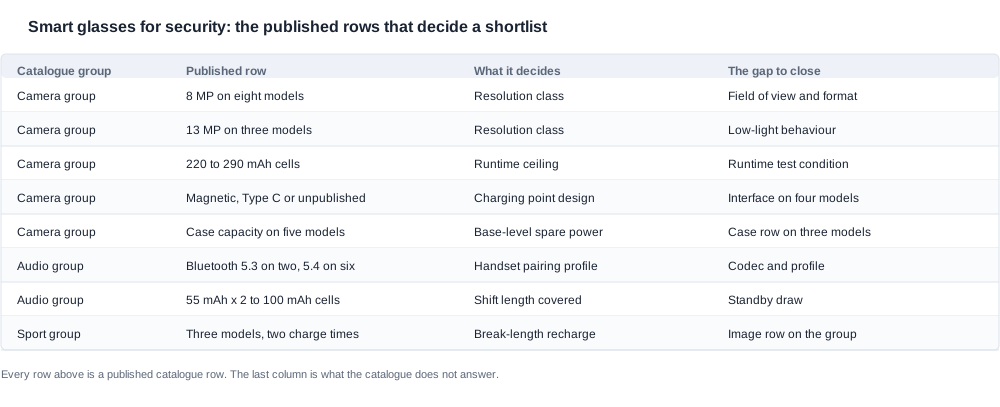
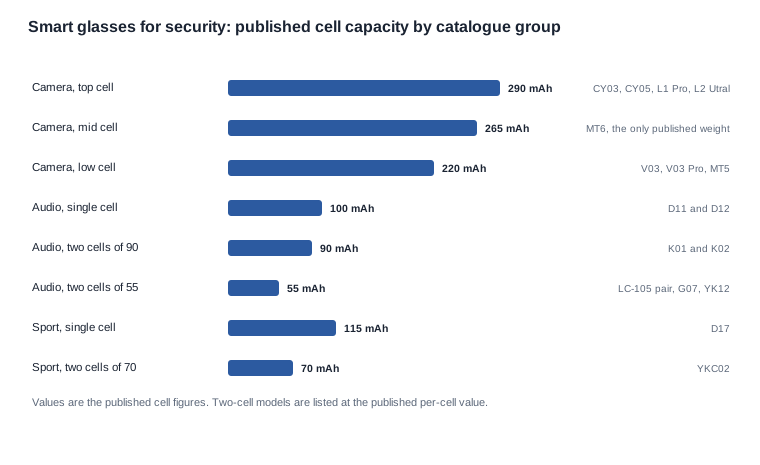
Three rules follow from that, and they are the whole method. First, the job chooses the group before the price does. A record that must produce an image cannot be served by a model with no published image row, whatever the unit price. Second, the group fixes the published rows, and the published rows fix the questions you must close in writing before the deposit. The camera group publishes cell capacities from 220 mAh to 290 mAh and a charge time of two hours or less; the audio group publishes a Bluetooth version per model but no runtime test condition. Third, where the catalogue publishes nothing, no recommendation is possible. A recommendation that ignores its own gaps is not a shortlist, it is sales copy, and it is exactly the document a procurement manager is asked to defend later.
The reader this article assumes. A brand owner, channel buyer or solution integrator who has to put a defensible shortlist in front of an operations director, and who will be held to that shortlist when a shift ends early or a recording turns out to be unusable. The reader is not choosing a device for themselves. They are choosing rows that will survive a supplier audit, a freight booking and a customer acceptance test. That changes what counts as a good answer: not "which model is best", but "which model can I defend, on which published row, and what am I contractually requiring from the supplier for the rows that are not published".
How the three groups actually divide. The camera group is the largest and the most varied, and it is not one product — it splits into an evidence job, an endurance job and a pocket job, each with its own row set. The audio group is smaller and splits into two jobs that share a Bluetooth decision and diverge on cell architecture. The sport group is three models that are often miscounted, because the YKC02 sits on the same catalogue pages as the audio models but is published as a sport model with surround sound and a long-battery feature row. Buyers who fold it into the audio column get the cell architecture and the Bluetooth version right and the group wrong, and the group is what drives the compliance and labelling consequences.
What a defensible shortlist has to carry. A shortlist that reaches an operations director should be four columns, not a spreadsheet of features: the job each model serves, the published row that supports it, the written supplier question that closes its remaining gap, and the commercial consequence if the answer comes back badly. The fourth column is the one most shortlists omit, and it is the column that tells a buyer whether a model is a candidate or a fantasy. A camera model with a published five-to-eight-hour run time and a magnetic interface becomes a different commercial proposition the moment the shift is nine hours, because the base has to absorb a second charging point or a spare pool. A buyer who notices that on the shortlist can still choose it; a buyer who discovers it after the first invoice has to absorb it as a variation. The related reading on the operational side of this decision is at the deployment template, and the failure patterns this shortlist is meant to catch are at troubleshooting before deployment.
The camera group read as three different jobs
The eleven camera models are L1 Pro and MT6, V03 and S7, CY03 and MT5, KY06 and V03 Pro, V06 and CY05, and L2 Utral. Eight of them publish an 8 MP sensor — V06 and KY06, V03 Pro and MT5, and CY05 and CY03, and MT6 and V03 — and three publish 13 MP — L2 Utral and S7, and L1 Pro. That split matters commercially, because a 13 MP model is a different purchase conversation from an 8 MP one and should never be shortlisted against the same unit price without a stated reason.
The evidence job, where the resolution class is the first question
For a deployment where the image is the deliverable — an incident record, a task verification, a customer dispute — the shortlist starts with the resolution class and then narrows on three further rows. The first is the charging interface, because the camera group publishes three different answers and the buyer has to plan the base around whichever one the shortlist lands on. The second is the charging case, where the catalogue publishes a four-way status that a buyer who has only read one product page will get wrong. The third is the runtime row, which every one of the eleven camera models publishes, unlike the audio group where the same number is harder to compare.
The endurance job, where the ingress marking is the differentiator
Only two models in the entire catalogue carry an IP54 marking: the V06 and the S7. Both are sport camera models, both publish a removable inner frame, both carry a 260 mAh cell and a rated run time of five to eight hours, and both use magnetic charging. For an outdoor security deployment this is a narrow and important column — the buyer who assumed that any camera model carried the marking would end up with a shortlist that cannot be deployed outdoors without a written answer from the supplier. The digit reading itself is at IP ratings, and the advanced considerations are at advanced IP considerations.
The pocket job, where one published weight does a lot of work
The MT6 is the only model in the catalogue with a published weight: 158 g. Read that precisely, because the number is quoted loosely across the trade. The catalogue publishes the whole-unit weight of the MT6 glasses body, including the 265 mAh battery and the camera, and excluding the foldable charging case; the case capacity is published separately at 1200 mAh and its own weight is not published. No bare frame weight is published for any model in the range, and the whole series has never published a frame-only figure.
| Catalogue group | Published rows a shortlist can rely on | The question a buyer must put to the supplier |
|---|---|---|
| Camera group | Resolution class, cell capacity, charge time, run time, interface, case capacity | Field of view, video format, low-light behaviour |
| Audio group | Bluetooth version, cell architecture, charge time, run time, interface | Codec, audio profile, standby draw |
| Sport group | Cell architecture, charge time, run time, interface, feature rows | Image row, ingress beyond the published marking |
The case status deserves its own note because it is the most common arithmetic error in this category. Of the eleven camera models, five publish a case capacity — CY03 and CY05, and L1 Pro — each at 1400 mAh, L2 Utral at 900 or 1400 mAh, and the MT6 as a 1200 mAh foldable case. Two more, KY06 and MT5, publish a charging case but no capacity for it. Three — S7 and V06, and V03 — have no charging-case row at all, which is an absence of information rather than a statement that no case exists. And one, the V03 Pro, has no charging-case row. Seven camera models therefore ship with a case, the V03 Pro is published as the one without one, and V06 and the V03, and S7 are simply not addressed by the catalogue.
The audio group read as two different jobs
The eight audio models are K02 and D11, G07 and D12, YK12 and LC-105-1, and LC-105-2 and K01, and they divide on cell architecture rather than on feature marketing. Four of them carry two cells of 55 mAh — the LC-105 pair, the G07 and the YK12. Two carry two cells of 90 mAh — the K01 and the K02. Two carry a single 100 mAh cell — the D11 and the D12. The catalogue publishes the cell value and the cell count as written, which is the form a buyer should keep in the specification and in any comparison table, because a derived total would read as an official figure and would not survive an audit.
The long-shift voice job, and the runtime tier it comes from
The K01 and the K02 publish two cells of 90 mAh, magnetic charging and a run time of about eight hours. The LC-105 pair publishes two cells of 55 mAh, magnetic charging and also about eight hours. The G07 and the YK12 sit in the same 55 mAh by two architecture and publish about six hours. That difference is structural rather than incidental: the two models in that tier carrying the ultra-slim and detachable temple feature rows are the two that publish the shorter run time. A buyer who reads "55 mAh x 2, eight hours" as a group rule will over-promise the runtime of exactly the two models most likely to be chosen for a low-profile frame, and the shortfall will surface on the longest shift of the week.
The short-shift voice job, and the interface it commits you to
The D11 and the D12 publish a single 100 mAh cell, Type C charging and a run time of about seven hours. They are the two audio models that commit a deployment to a cable rather than a dock, which is a genuine commercial trade: a cable is a consumable replaced at the base, while a magnetic charging point is an installed asset with its own capital line. The Bluetooth versions also split cleanly — 5.3 on the K01 and the K02, 5.4 on the D11, the D12 and the rest of the group — so a handset fleet that only supports one of the two profiles narrows the shortlist before any other criterion is applied. The families themselves are at Bluetooth audio glasses.
One thing is easy to over-generalise and needs care in the specification: no model in the catalogue publishes a touch row. The K02 page publishes the phone, music and voice-assistant icon set, and the K01 page carries no touch icon row either, so neither page gives a listing anything to put behind a touch claim. Writing "capacitive touch across the K01 and K02" puts a claim into a specification that the catalogue does not support, and it is a claim that will be checked at the sample stage.
The sport models, which do not sit in the audio column
The three sport models are the YKC02, the D17 and the ZH12. The YKC02 is the one that gets miscounted, because it appears on the same catalogue run as the audio models and publishes surround sound and a long-battery feature row. Its published product name is a sport glasses designation, and it belongs in the sport group. The correct enumeration for a reader-facing sentence is eight audio models, three sport models and eleven camera models, and the YKC02 belongs with the D17 and the ZH12.
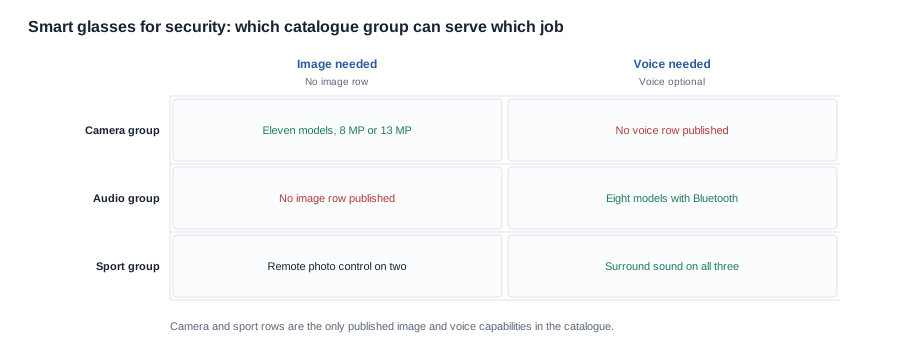
The D17 and the ZH12 publish a remote photo control and surround sound, use Type C charging, and — uniquely across the catalogue — publish a charge time of about one hour. The other twenty-six entries publish a ceiling of two hours or less. That distinction is worth handling carefully in every document a buyer writes, because a ceiling and a maximum are different assertions. "Two hours or less" allows a device that takes exactly two hours; "under two hours" does not, and a specification written the second way creates a compliance gap against a device that is entirely within the published row.
The YKC02 publishes two cells of 70 mAh, magnetic charging, a run time of about eight hours and Bluetooth 5.4. The D17 publishes a single 115 mAh cell and a run time of about seven hours; the ZH12 publishes a single 100 mAh cell and a run time of about eight hours. What the sport group does not publish is an image resolution row. The D17 and the ZH12 publish a remote photo control, which is a capability statement, but no sensor figure is published for the sport group and no sport model appears in the camera model's resolution tiers. A buyer who needs an image from this group must request the sensor figure in writing rather than infer it from the feature row.
What the recommendation table cannot tell a procurement manager
Every shortlist built from the published rows carries the same set of holes, and a buyer who knows their names can close them before the order rather than after the first shipment. These are the gaps, stated as the questions to ask rather than as accusations.
- Field of view and video format. Not published for any model in the range. Ask for the field of view in degrees and the output format, because a recording that cannot be played in the review tool is a record that does not exist.
- Low-light behaviour and stabilisation. Not published. The D17 and the ZH12 publish a remote photo control; no model publishes a night-performance figure. Ask what a frame looks like at the site lighting level, in writing.
- Storage capacity and overwrite behaviour. Not published for any model. This is the single most consequential gap in the category, because it decides whether a recording survives the shift that produced it.
- Capture latency. Not published. Ask whether a still capture is available immediately on the device, and what the transfer route is.
- Standby draw and the runtime test condition. The run times are published; the conditions behind them are not, and no standby figure exists for any model.
- Frame material, lens material and coating. Not published. This gap is not cosmetic — it is the specification behind the cleaning consumable a deployment will buy by the case.
- Unit weight. Published once, for the MT6 glasses body at 158 g. No other model publishes a weight, and no frame-only weight is published anywhere in the range.
- Certification. The catalogue includes a company-level export certification page whose content is images rather than text; nothing in the catalogue text refers to CE, FCC or RoHS. There is no per-model certification row anywhere. The certification question is therefore a supplier question, and the buyer's checklist is at the certification checklist.
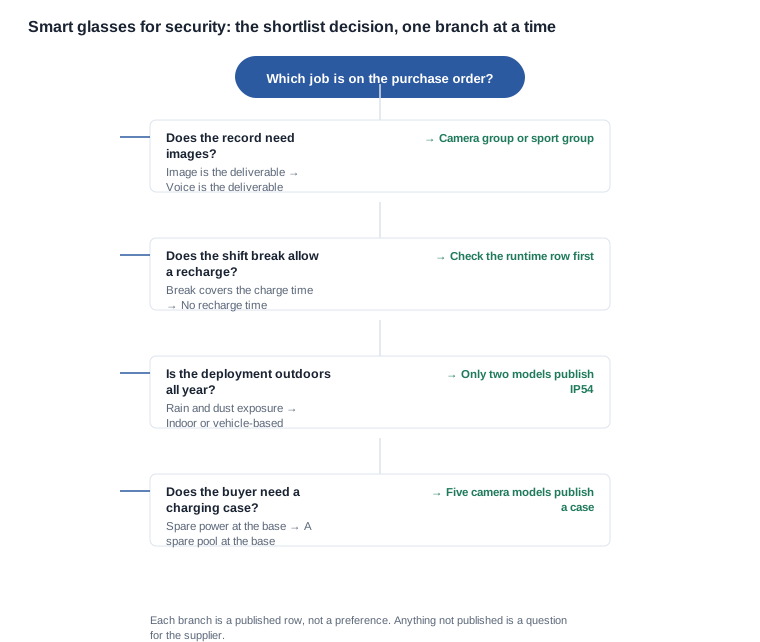
The order of operations matters more than the list itself. Buyers tend to shortlist first and verify afterwards, which is how an unverifiable row ends up inside a purchase order. The sequence that survives an audit is the reverse: define the job, use the job to eliminate whole groups, apply the published rows to the surviving models, then attach a written supplier question to every remaining gap. A shortlist that has survived that sequence contains no cell value the supplier did not publish, no interface the supplier did not publish, and no capability the buyer inferred from a product page rather than a specification line.
The published numbers, kept in the form the catalogue uses. In a comparison sheet, write 55mAh*2, 90mAh*2 and 100mAh as the catalogue writes them, and write the charge time as "two hours or less" unless the model is the D17 or the ZH12, in which case "about one hour" is the published figure. If a derived total is genuinely useful for the base's purchasing plan, mark it as a derived figure in the same cell. The charging rows are at battery life and the charging plan is at charging solutions.
The limit we place on any model recommendation
We publish the rows a buyer can order from and we will not fill the gaps with figures from elsewhere in the industry. For the camera group that means the resolution class, the cell capacities, the charge times, the rated run times, the charging interface, the charging-case capacity where it is published, and the IP54 marking on the V06 and the S7 stated as a catalogue attribute. For the audio group it means the Bluetooth version, the cell architecture, the charge times, the rated run times, the charging interface and the published structural features — the ultra-slim detachable temples on the G07, the slim detachable temples on the YK12 — with no touch row published for any model. For the sport group it means the YKC02, the D17 and the ZH12 with their cell architectures, their charge times and their feature rows.
What we do not publish and will not estimate: the field of view, the video resolution and frame rate, the stabilisation, the low-light behaviour, the storage capacity and the overwrite behaviour, the capture latency, the thermal behaviour, the operating temperature range, the standby draw, the runtime test condition, the frame and lens material, the coating, the hinge specification, the unit weight of any model other than the MT6 glasses body, and the per-model certification scope. We will not write that any product in this range is tested to IP54, because no test report is published behind that marking, and we will not extend the marking to the camera models outside the V06 and the S7 or to the audio and sport groups, where no rating is published at all.
We will do one more thing, which is to tell you when the catalogue cannot answer your question. That answer is not a refusal; it is the shortest path to a supplier commitment that will hold, because a written reply to a specific question is the only thing that becomes evidence later. The buying sequence is at how to choose smart glasses for security, the trade-offs are at security pros and cons, and the product families are at AI camera glasses and Bluetooth audio glasses.
What to send us next. Send the job in one sentence, the shift length, the deployment environment, the number of units and the target market, and we will return the group that can serve the job, the models inside it, the published row behind each one, and the written supplier questions that close the remaining gaps before a purchase order is raised. The scenario entry point is smart glasses for security.
Related reading
- Where this scenario begins — smart glasses for security
- The families covered — AI camera glasses and Bluetooth audio glasses
- The buying sequence — how to choose smart glasses for security
- The trade-off structure — security pros and cons
Send the job, the shift length and the environment, and we will return the group, the models and the published row behind each one.


