

The smart glasses catalogue does not contain a "sports" category in the way a range plan usually expects. It contains three groups of models that reach the sports and cycling shelf by different routes, and a buyer who treats them as one undifferentiated list will end up with a range that cannot be positioned. This overview sets out what the catalogue actually publishes, how the three groups differ in what they can honestly be marketed for, and how to turn that into a shortlist and then a programme.
The catalogue covers 28 models in total. Eight are audio models, three are sport models, eleven are camera models, three are child-oriented models, and three are listed without a model number. Only the first three groups carry a sports and cycling argument, so the shortlist question is narrower than the catalogue.
Two constraints shape everything below. First, the catalogue publishes product rows — cell, runtime, charge time, charging method, ingress rating, camera resolution, colour options, remote control, and a small number of others — and it does not publish commercial terms. Prices, MOQ, lead time, sample fees and warranty terms are not published for any model, because in an OEM programme they depend on a configuration and a volume that do not exist until the brief is frozen. Second, the catalogue does not publish per-model certification status. Any statement about a specific model holding a specific approval has to come from a document, scoped to that model string, and never from a catalogue page.
Smart glasses for sports: the three catalogue groups
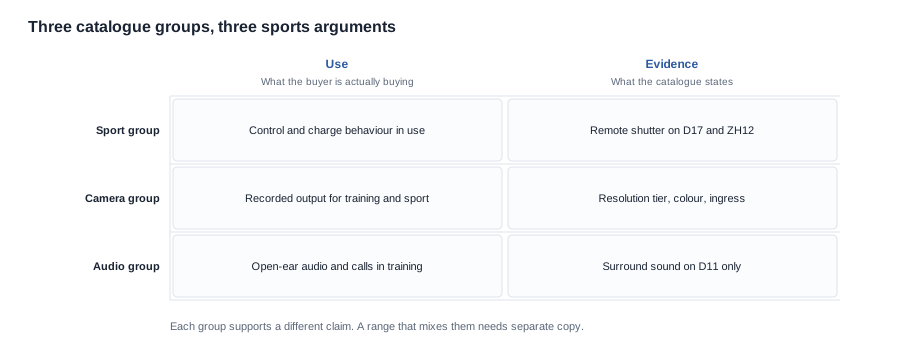
The sport group is YKC02, D17 and ZH12. These are the three models positioned closest to the use case, and they are the ones whose published rows support a sports claim directly. D17 and ZH12 carry the two most sport-specific published features in the whole catalogue: a remote control shutter, published on those two models and on no other, and a charge time of about one hour, which is also published on those two models only. Both features point the same way. A remote shutter lets a rider, a coach or a training partner start a capture without touching the frame, and a fast charge lets a device go from a charging case to a full session between two rides rather than overnight. The third sport model, YKC02, sits inside the catalogue-wide charge ceiling of 2 hours or less rather than carrying the faster published time.
The camera group is L2 Utral and CY05, L1 Pro and CY03, V06 and V03 Pro, MT5 and V03, S7 and MT6, and KY06. Their sports relevance is different in kind. These models are bought for recording — training sessions, outdoor activity, sport photography — and they are marketed on the strength of what they capture rather than on how they perform during movement. The published rows that carry that argument are the resolution tiers: 8 MP is published on eight models, and 13 MP is published on three, namely S7 and L1 Pro, and L2 Utral. Colour options matter here too, because a camera model is frequently the one a buyer wants across several channels. V03 Pro is the only camera model with a photochromic lens, and it publishes three colour options; V06 publishes four colour options, and is one of only two models in the catalogue with an IP54 ingress rating.
The audio group is G07 and LC-105-1, YK12 and K01, D11 and D12, and LC-105-2 and K02. These reach a sports or cycling range as an open-ear audio and calling product rather than as a recording or a performance device. The published rows that matter are modest but real: the D11 and the YK12 publish surround sound in the audio group while the YKC02 and the D17 publish it in the sport group, and the charging method split across the catalogue — magnetic on seventeen models, Type-C on seven, and not published on four — determines whether a charging dock can be shared with the rest of a range.
Connectivity is worth reading carefully, because it is where the catalogue's silence is easy to misread. A Bluetooth version is published for fourteen of the twenty-eight models. It is not published for the eleven camera models, nor for A05, A06, or the bone conduction entry. That is a boundary of the published data, not a statement about what the hardware does, and it is exactly the kind of gap we will close with a question rather than an assumption.
The practical difference between the sport group and the camera group is the difference between a device that participates in the activity and a device that observes it. A sport group model can be marketed on control and charge behaviour: how it is triggered without touching the frame, and how quickly it is ready again. A camera model can be marketed on what the recorded output looks like: resolution tier, lens behaviour, colour availability, and ingress for the situations where the device is left outdoors. The two are not interchangeable as claims, and a range plan that mixes them without separating the claim sets will produce listing copy that the published evidence cannot support.
A fourth consideration sits outside the three groups and is worth naming because buyers often assume it is included. The catalogue also contains three child-oriented models and three entries without a model number. Neither set carries a sports or cycling argument in the published rows, and we will not dress one up as a sports device in order to widen a range. If your programme needs a second price point, it is better served by a documented colour or configuration split within a group than by a model whose published rows do not address the use case.
The published rows that decide a sports range
The catalogue publishes a limited number of rows. Those rows are what you can compare between suppliers without asking a question, so it is worth being precise about which ones exist and what each one commits to.
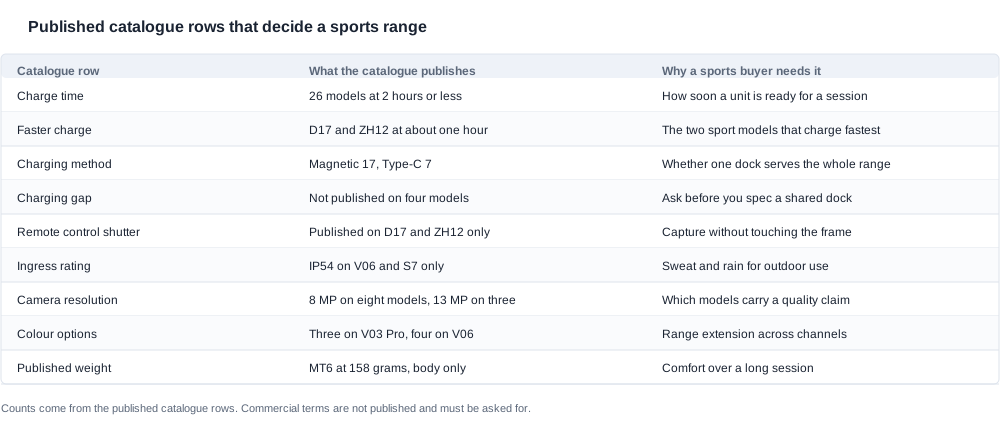
The rows that carry real weight for a sports or cycling range are these.
- Cell and runtime. Both are published per model in the catalogue. Treat the published runtime as the floor for the use case rather than as a headline, because a device that is recording continuously or playing audio continuously is under a different load than a device that is idle with a sensor running. The published figure is what the catalogue states; whether it covers your actual duty cycle is a question to ask, and the answer is what to ask the supplier about in writing.
- Charge time. Twenty-six of the twenty-eight models sit at the catalogue ceiling of 2 hours or less. Only D17 and ZH12 publish about one hour. There is no third value in the catalogue, so a supplier talking about fast charging for another model is describing something the catalogue does not publish.
- Charging method. Magnetic on seventeen models, Type-C on seven, and not published for four: MT6 and L1 Pro, and CY03 and CY05. That last group matters for a range plan, because a charging dock that works for seventeen models does not work for all of them, and the gap is easiest to discover late.
- Remote control shutter. Published on D17 and ZH12 only. This is the clearest published differentiator in the sport group, and it is worth confirming at the requirement stage rather than discovering at the listing stage, when the copy is already written.
- Ingress rating. IP54 is published on V06 and S7 only, and on no other model in the catalogue. For a range that will be marketed for outdoor and sweat exposure, the honest position is that IP54 is published for two models and not published for the rest.
- Camera resolution. 8 MP on eight models, 13 MP on S7 and L1 Pro, and L2 Utral. If a range mixes resolution tiers, the copy has to distinguish them, and a buyer who treats all eleven camera models as one tier will over-promise on eight of them.
- Colour options. V03 Pro publishes three, and V06 publishes four. These are the two camera models where colourway breadth is published at all.
- Weight. The only public weight in the catalogue is MT6 at 158 grams, which is the glasses body and excludes the folding charging case. For every other model, weight is not published, which makes it one of the most useful questions to ask a supplier, because a head-worn product is judged on grams in the hand.
- Bluetooth version. Published for fourteen models, not published for the eleven camera models plus A05, A06 and the bone conduction entry.
There are also rows that the catalogue does not have, and their absence is informative. There is no capacitive-touch row anywhere in the catalogue, so no model can be described as having capacitive touch. There is no translation row, so no model can be described as offering translation. There is no per-model certification row, so no model can be described as holding a particular approval on the strength of this catalogue. And there is no row for price, MOQ, lead time, sample fees or warranty terms, so those must be asked for as part of a quotation rather than read off a specification.
That last point is not a defect in the data. It is the reason a buyer should run a shortlist against published rows first and against commercial terms second: the published rows let you eliminate models without a single email, and the commercial terms are the part that genuinely needs a negotiation. We will separate the two in every document we produce for a sports or cycling programme, because a comparison that mixes a published product row with an unpublished commercial term produces a false ranking. If you want the shortlist logic in a form you can carry into a supplier meeting, the sport product portfolio article sets out the range structure, and sport smart glasses — which model to pick works through the model-by-model reasoning. For how the published battery and charge rows affect a session rather than a shelf, see battery during activity.
The programme shape
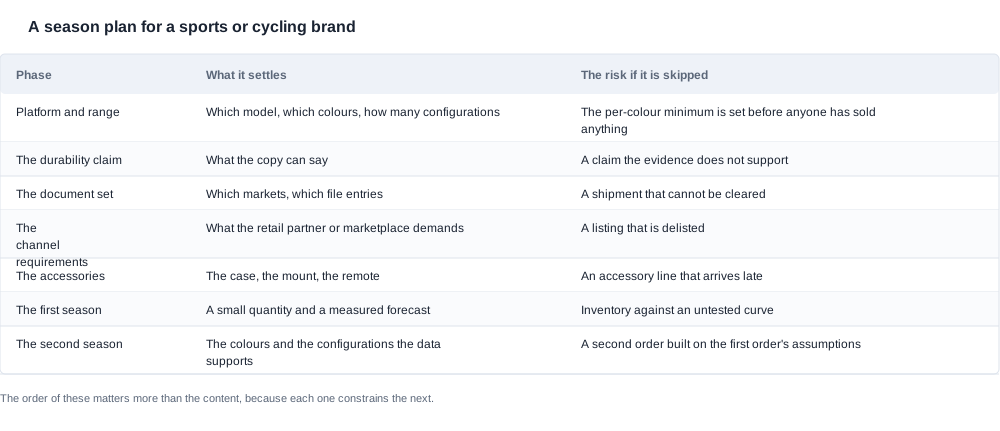
A catalogue tells you what a model is. It does not tell you how a programme with that model actually runs, and the two questions meet at the point where a range stops being a list and becomes a product line. Our development framework has six gates, in this order: requirements frozen, feasibility reviewed, engineering and tooling, samples built and verified, compliance file closed, and a pilot run before mass production. A gate is closed when it produces a document, not when a date arrives, and the document is what a buyer can hold a supplier to.
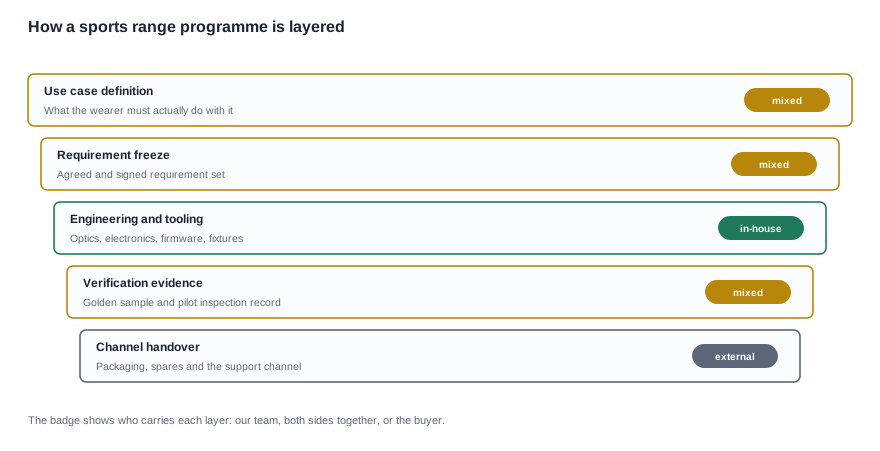
For a sports or cycling range, the six gates carry specific weight, and the deliverable at each one is different from what it would be for a general consumer programme.
- Requirements frozen. The requirement set is written, challenged and signed. In a sport programme, the requirements that need the most scrutiny are the ones describing physical use: how the unit is worn, whether it is mounted or worn on the face, what happens to it in a fall, and whether it is expected to work while the user is in motion. We will push on the requirement that says "weather-resistant", because the catalogue publishes an ingress rating for only two models and an open requirement there is a commitment nobody has priced.
- Feasibility reviewed. You receive a feasibility boundary: what we can do, what we cannot, and what would have to change. For a sports range, the most valuable part of this document is usually the section that says which of your requirements are standard on the current platform and which need new tooling, because that section is what determines whether the range is one product line or four.
- Engineering and tooling. The programme becomes physical here — optics, housing, electronics, firmware, fixtures. The output you should expect is a tooling agreement describing what is cut, what it produces, and what happens to it if the programme stops. We will classify every requested change as engineering or commercial before it is executed, so you know which of your changes reopen the verification record.
- Samples built and verified. Samples are built and checked against a golden sample — one unit, agreed and signed by both sides, that becomes the reference for every later build. In a sports programme this reference is worth more than a specification sheet, because a fit and control issue is obvious in the hand and invisible on paper.
- Compliance file closed. You receive a declaration scoped to the model string, with the scope of the claim written in words. Per-model certification status is not published in the catalogue, so this gate is the only place where certification evidence can come from, and we will tell you plainly what exists for the specific model you are shipping.
- Pilot run before mass production. A pilot order runs before the mass-production release, and you receive a pilot inspection record: what was inspected, what was found, and what changed. This is the gate that catches the tolerances that survive a single hand-built unit and fail in a real run, and we will report what we find without softening it.
So commercial terms deliberately sit outside the gate sequence. Price, MOQ, lead time, stage durations, sample fees and warranty are not published for any model in the catalogue, because each one is a function of a configuration and a volume that do not exist until the brief is frozen. They belong in a quotation with their conditions attached — incoterms, negotiable terms, and the assumptions behind each figure — and we will put them there rather than into a brochure. The trade-off is deliberate: a fast single-number quote is built on a guessed configuration and the rework lands after tooling has been cut.
How to shortlist a sports range and then start
Shortlisting works in three passes, and the order matters because each pass removes candidates for a different reason. Doing it in the wrong order is how a range ends up with eight models and no claim.
Pass one: eliminate on published rows. This pass needs no supplier contact, because the catalogue publishes enough to remove candidates outright.
- Does the model need remote capture without touching the frame? Only D17 and ZH12 publish a remote control shutter. If that is the spine of the product idea, the shortlist is two models, and that is a useful thing to know before writing a brief.
- Does the model need a documented ingress rating? IP54 is published on V06 and S7 only. If your claim set requires one, the shortlist is two models again.
- Does the model need a documented resolution tier? 8 MP is published on eight models and 13 MP on three. A claim that says "high resolution" needs to name a tier, and the tier needs to exist on the model.
- Does the model need colourway breadth? Three colour options are published on V03 Pro and four on V06. Everywhere else, colour breadth is not published and becomes a question rather than a fact.
- Does the range share one charging dock? Magnetic is published on seventeen models and Type-C on seven, with four models unpublished. A shared dock is a range-design assumption, so it belongs in pass one rather than in a packing list discovered later.
Pass two: shortlist on the claim, not on the model. Take what survives pass one and write one sentence per surviving model describing what it can be sold as. A sport group model will produce a sentence about control and readiness between sessions. A camera model will produce a sentence about recorded output, resolution, lens behaviour and ingress. An audio model will produce a sentence about open-ear listening and calls. If you cannot write that sentence from published rows alone, the model is a negotiation, not a shortlist candidate, and it should be treated as one — with an assumption attached and a cost attached to the assumption.
Pass three: put commercial terms on the table. Only now do you ask for price, MOQ, lead time, sample fees, warranty terms, spares and replacement-part arrangements, and only now does a supplier quotation become comparable. We will state the assumptions behind each figure so that two quotations can be compared honestly, and we will negotiate against the configuration and the volume rather than against a headline number. A quotation without its conditions attached is not comparable, and a range built on an incomparable number is where the trade-off gets hidden.
Opening the programme. With a shortlist in hand, the first thing to send is a requirement brief, not a model list. The brief needs the use case in one paragraph, the claim set in one list, the must-have rows in one table, and the open questions in one list. The first gate then produces a frozen requirement document, and from that point the programme runs on documents rather than on intentions. We will ask you to nominate the owner for each open requirement, because an unowned open requirement is the one that reappears after tooling.
Two things we will not do, and it is worth knowing before the first call. We will not quote a model as holding a particular approval on the basis of a catalogue page, because per-model certification status is not published and the only valid evidence is a document scoped to the model string. And we will not fill a gap in the published rows with a plausible-sounding assumption, because an assumption that reaches the product page becomes a claim you own.
The model-by-model detail lives in the sport smart glasses collection and in sport smart glasses — which model to pick. The range structure lives in the sport product portfolio, and the session-time consequences of the published charge rows are covered in battery during activity. Start from whichever of those matches the question you are actually trying to answer, and bring the answer back to the brief.


