
Three models sit in the sport group at CYNRIN: YKC02, D17 and ZH12. All three are published as AI sport glasses, all three publish the same runtime band, and all three publish the same Bluetooth version. What separates them is narrow and factual: the cell configuration, the charge time and the charging method. A buyer asking which model to pick is therefore not making a lifestyle choice between three different products. They are choosing which published row their channel can sell, and then going after the fields the catalogue does not print.
This article works through where the sport group sits in the range, the published rows that separate the three models, the questions that actually decide between them, and how the group fits into a camera programme. It is written for importers and OEM buyers who have already decided that sport-positioned AI glasses are the right product and now need to know which row to build the order around.
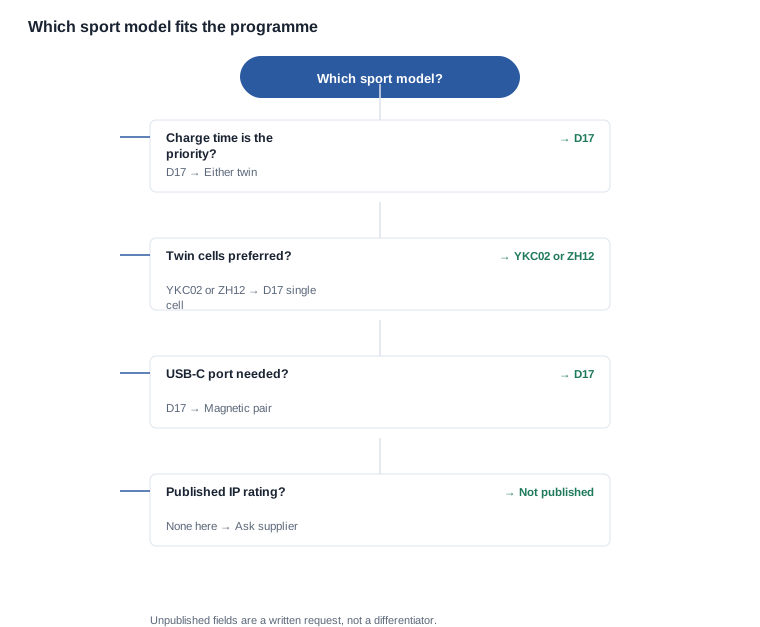
The short version, for a buyer in a hurry: if your BOM or your retail packaging depends on USB-C, take D17. If you want the twin-cell architecture, both YKC02 and ZH12 give it to you and nothing published separates them, so you need a commercial or packaging differentiator to run two SKUs. If you need an ingress-protection claim, none of these three models has one published, and that is a product change rather than a paperwork fix.
Where the sport group sits in the range
The sport group is small by design. Three rows in the catalogue are published as AI sport glasses: the YKC02, the D17 and the ZH12. Everything a buyer needs to compare them fits in one table, and everything else in this article is about the fields the catalogue does not print for them.
The wider range contains camera rows with larger cells — the V03 at 220 mAh, the V06 at 260 mAh and the S7 at 260 mAh, each published with a 5~8 hours runtime band, a 2 hours or less charge ceiling and a magnetic charging method. Those rows sit outside the sport group, and the comparison matters for one reason: two rows elsewhere in the range carry a published IP54 rating, V06 and S7. No model in the sport group carries an ingress rating at all. A buyer who inherits an IP54 claim from a neighbouring row has inherited a false claim, and that is worth stating before anything else because it is the single most common error made with this group.
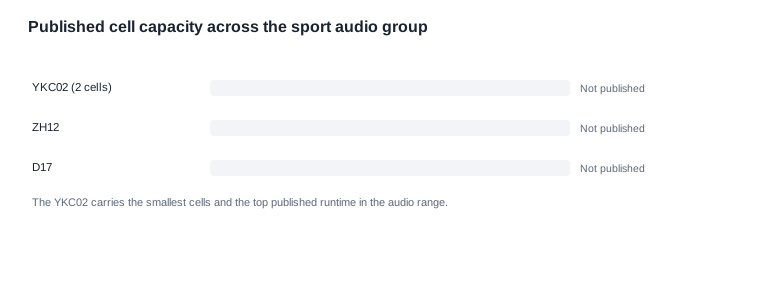
On the sport designation itself. What the sport designation changes in the published material is very little. It is a product positioning in the catalogue, and the catalogue does not attach an ingress rating, a weight, a lens specification, a colour list or a camera resolution to these three rows. It also does not publish capacitive touch controls for them, or a translation feature, or any acoustic figures — the surround-sound annotation appears on only one model elsewhere in the range and not on any of these. The honest reading is that the sport label tells a channel manager which shelf the product belongs on, while the engineering rows that would justify a price premium are simply not printed for this group.
On the camera side. The three sport rows are published as AI glasses with a camera, so they belong inside the AI camera glasses programme rather than beside it. That matters commercially: a camera programme usually has a shared software, a shared app behaviour and a shared content pipeline, and the sport rows are the sport-designated members of that programme. What the catalogue does not publish for them is camera resolution, field of view or any capture specification. The AI camera glasses range is where the camera positioning lives, and for the sport rows specifically, the camera figures are part of the written request list rather than part of the published row.
On weight. The only weight published anywhere in the range is 158 g, and it belongs to MT6, described as the glasses body without the folding 1200 mAh charging case. That number does not transfer to the sport group. Weight decides the shipping class, the comfort claim and the endurance experience, and for these three models it is unpublished, so it belongs in the request list, not in a comparison.
On what the sport group is not. It is not the ingress-protected choice. It is not the long-runtime choice, because the runtime band is identical across all three and across the camera rows. It is not the low-cost choice, because price and MOQ are not published anywhere in the range and cost cannot be inferred from a cell capacity. It is a design and channel decision supported by three published specification differences.
The published rows that separate the three sport models
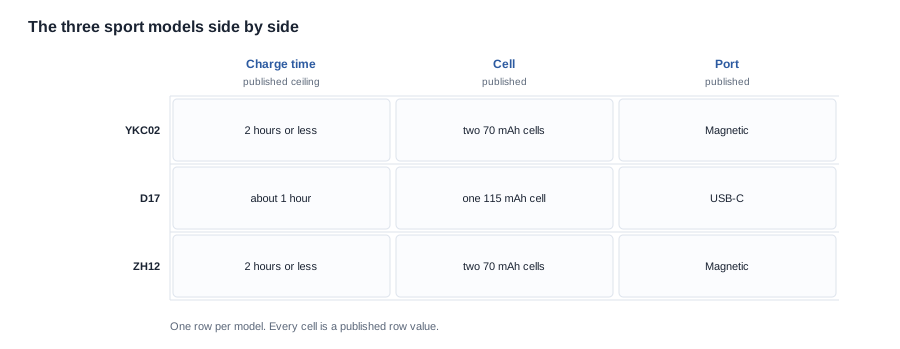
Here is the complete published data for the three models, exactly as the catalogue prints it.
| Model | Catalogue name | Cell | Runtime | Charge ceiling | Charging | Bluetooth |
|---|---|---|---|---|---|---|
| YKC02 | YKC02 AI sport glasses | 70 mAh × 2 | 6~8 hours | 2 hours or less | Magnetic | V5.4 |
| D17 | D17 AI sport glasses | 115 mAh | 6~8 hours | about 1 hour | USB-C | V5.4 |
| ZH12 | ZH12 AI sport glasses | 70 mAh × 2 | 6~8 hours | 2 hours or less | Magnetic | V5.4 |
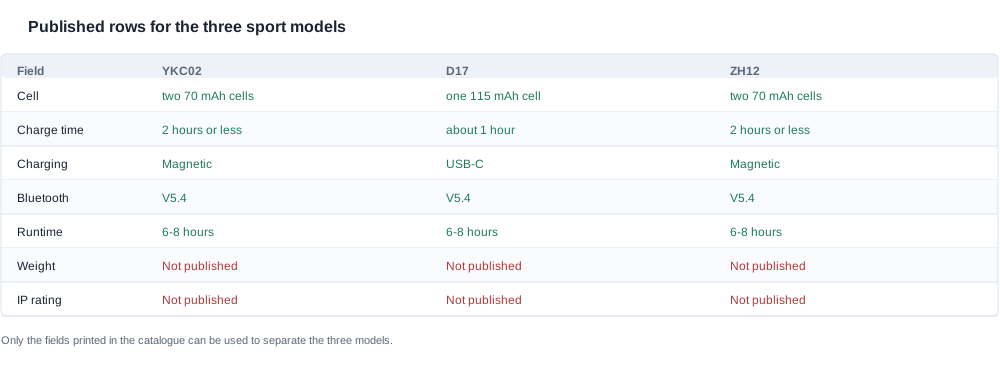
Three fields move. Everything else stays still.
Cell configuration is the first difference. YKC02 and ZH12 each publish two 70 mAh cells; D17 publishes a single 115 mAh cell. The two twins therefore behave as a pair in the published material, and D17 behaves as one larger cell. What the catalogue does not say is how the twin cells are wired, and that is a question worth asking before you order, because series and parallel wiring behave differently on charge time and different on depletion. The comparison a buyer can make today is the cell count and the capacity; everything finer is a written request.
Charge time is the second difference, and it is the one a buyer can feel. D17 publishes about 1 hour. The other two publish 2 hours or less. Two points matter here. The first is that 2 hours or less is a ceiling and not an average, so it is the threshold to write into an incoming inspection, and a unit that takes longer has not matched the published row. The second is that about 1 hour is a single published figure for a single model, so D17 is the only model in this group with a fast-charge proposition that can be quoted from the catalogue. D17's charge time is also the reason the D17 best for discussion leads with the recharge rather than with the camera.
Charging method is the third difference. D17 uses USB-C; YKC02 and ZH12 use a magnetic charging connection. This is the most concrete of the three for a buyer, because the charging cable and the charging dock are physical parts of the bill of materials. A channel that has already committed to USB-C across its accessories has effectively chosen D17. A channel that ships a magnetic charging dock has effectively chosen one of the twins. A mismatch discovered after the bulk order lands is a tooling conversation, not a small correction.
How the cell difference shows up on delivery. The published cell figures are the closest thing this group has to a hardware differentiator, so they are worth confirming physically rather than accepting from the packing list. A buyer can count the cells where the enclosure allows it, and where it does not, ask the supplier to confirm the configuration in writing with a teardown photograph attached to the batch file. The twin-cell question is the one worth pressing on, because a twin pack wired in series and a twin pack wired in parallel behave differently against the same published charge ceiling, and only one arrangement reaches that ceiling reliably. The inspection criterion that follows is simple and model-specific: the delivered unit must meet the charge time printed for its own row, whichever way the cells are wired inside.
What does not move is as important as what does. All three publish the same 6~8 hours runtime band, so no runtime argument separates them. All three publish Bluetooth V5.4, so no connectivity argument separates them either. All three are published without an ingress rating, so no water-resistance argument separates them — or applies to any of them. All three are published without a weight, a lens material, a colour range, a camera resolution or a field of view. And none of them has a published price, MOQ, lead time, sample order policy, warranty term, tooling cost, capacity figure, payment term, deposit, incoterm or shipment arrangement.
That last group of absences is the part that decides how long a model comparison takes. Any comparison that stops at the published table is complete in ten minutes. Any comparison that has to answer what a buyer actually sells — how much, how fast, with what terms, certified for which market, under what warranty — has to be built from the supplier's written answers, and that is where the time goes.

The questions that decide between them
The published rows narrow the choice to a short sequence. These are the questions to ask, in the order that actually decides the model, with the answer each one produces from the published material.
- Is your accessory BOM already USB-C? If yes, D17, because the charging method is a published difference and a magnetic charging dock would mean new tooling on your side as well as new packaging. If your channel already ships magnetic charging, the answer is one of the twins.
- Does the recharge ceiling matter to your channel? If the listing or the retail pitch leans on turnaround time between uses, D17, because about 1 hour is the only published fast-charge figure in this group. If it does not, the twins' 2 hours or less is adequate and the difference stops mattering.
- Do you want the twin-cell architecture for a stated reason? If yes, YKC02 and ZH12 both deliver two 70 mAh cells. Note what that means: the published rows for those two are identical, so running them as two SKUs requires a differentiator that comes from outside the catalogue — a colourway, a packaging format, a private label treatment, a channel split — and not a specification argument.
- Do you need an ingress-protection claim? If yes, none of these three can carry it. The catalogue publishes IP54 for two other rows in the range and publishes no ingress rating for the sport group. If your marketing requires the claim, you either obtain a rating for a specific sport model in writing, with the test evidence, or you change the product. That is a real trade-off and it should be made deliberately, not discovered by a customer in the rain.
- Does your listing lead with the camera? If yes, request the camera resolution and the field of view in writing before you order. They are not published for these rows, and a camera-led listing cannot be written honestly without them. How the sport rows relate to the wider AI camera glasses programme is the subject of the next section.
- Can the commercial side be agreed in writing? MOQ, lead time, sample order cost and timing, bulk order pricing, tooling cost and ownership, warranty period and terms, payment terms, deposit percentage, incoterms, shipment method, and the contract format for repeat business. None of this is published, so this is the question that either confirms or blocks the model choice.
The first three questions are specification questions and can be answered from the catalogue in an afternoon. The last three are documentation questions, and they take as long as the supplier takes to answer them properly.
That is also where the commercial judgement sits, and it is worth being explicit about it because the published rows create a temptation to stop early. A buyer who stops after the table has a model and no order. A buyer who continues past the table has to build the request list: what to ask, in what order, and how to evaluate the answers when they arrive. The request list for this group is short — weight, ingress rating, certification and compliance documents, the technical file, the declaration, and the commercial terms — and the discipline is to send it as one written document rather than as a sequence of informal messages, because a written answer is an answer the supplier can be held to and an informal one is not.
Build the request list before the model conversation. The order of operations matters more than it looks. A buyer who has already chosen D17 and then asks about weight, ingress rating, certification and the commercial terms gets a quotation and a set of caveats. A buyer who sends one request list covering the specification gaps and the commercial gaps gets answers that can be compared on the same page. The list for this group is short by design: three models, three published differences, and a fixed set of unpublished fields. Asking for it in a single document, with a response deadline, also lets the buyer compare two suppliers on identical axes, because a supplier who answers two of the six questions and another who answers all six are very different starting points for an audit.
The receiving checklist for this group is short. Four items cover the published rows: the cell count, the charging interface, the charge time against the row ceiling, and the runtime against the published band. Everything else on the incoming inspection is a packaging, cosmetic or documentation check, which is the normal shape of a first order and not a burden.
The sample order is the last cheap moment to change the model. A sample order for one unit of each candidate configuration — the twins together and D17 separately — costs far less than a bulk order for the wrong row, and it is the moment when weight, fit and camera output can still change the decision. The sample is also where the published rows get verified against a real unit rather than against a table, which makes it the cheapest verification available anywhere in this process. Ordering the sample before you order the bulk order is the single most effective risk reduction on offer here, and it is the reason the sample order terms belong on the request list in the first place.
Two evaluation rules follow from that. First, a written answer that says "this model has no published ingress rating" is worth more than a vague assurance, because it can be checked against the delivered unit; a refusal to answer at all is a fact about the factory rather than about the glasses, and the buyer should weigh it accordingly. Second, the trade-off between pressing for detail and getting an order placed is real. The pragmatic route is to ask everything in writing before you order, then convert the answers into purchase order criteria and negotiate a contractual inspection clause, so the detail protects the shipment instead of delaying it indefinitely.
The supplier's response to that request list is itself a due diligence signal. A factory that answers the cell-wiring question, the weight question and the certification question in a single reply, with the documentation attached, is telling the buyer something about how the relationship will run. A factory that answers only the commercial questions is telling the buyer something else.
Where CYNRIN places the sport models in a camera programme
Inside the AI camera glasses programme, the sport group has a specific and limited job. It is the set of rows that a channel can put in a sport context — running, cycling, hiking, general outdoor use — without the range's other rows being a better fit. The reason a camera programme needs those rows is not that they publish better specifications than the V03, V06 or S7; on capacity they publish less, and on runtime the bands are comparable. The reason is that the sport rows are positioned as sport products and everything else in the programme is positioned as a general camera product.
Two practical consequences follow for a buyer running that programme.
First, the programme should be sized on the rows that differ. Within the sport group, only the charge time and the charging method separate D17 from the twins, and the cell configuration separates D17 from both. If a channel runs all three, it is running one genuinely different hardware configuration and two identical published configurations. That is a legitimate choice, and the sport smart glasses bulk ordering guidance on splitting an order across models is worth reading before it is made — the inventory cost of a third SKU is real even when the specification difference is not. Where the two twins are run as separate SKUs, the differentiator has to come from the private label, the packaging or the channel, and it should be named in the purchase order so that the artwork, the manual and the listing all describe the same product.
Second, the sport designation does not substitute for a published specification. It is a position in the catalogue, not an engineering claim. Weight, ingress rating, camera resolution, lens material, colour options, capacity, MOQ, lead time, sample order terms, warranty, tooling cost and certification are all unpublished for the three rows, and every one of them is either a question for the supplier or a gap the buyer has to state plainly in its own listing. The honest way to market the sport group is to describe the published rows — the twin cell, the about 1 hour charge on D17, the 6~8 hours runtime band, Bluetooth V5.4 — and to keep every unpublished claim out of the copy.
Third, the sport rows inherit the programme's certification burden. A camera programme that ships to more than one market carries one conformity file per market, and adding sport rows to that programme does not create a separate file. The buyer who has already built a conformity file for a general camera row extends it to the sport rows; the buyer who has not built one yet inherits the whole obligation the moment the sport rows go out. The sequence that works is to fix the model first, because the model determines which technical file applies, and to request that file before the purchase order rather than after the bulk order has been produced and paid for. The cost of reversing that order is a shipment that cannot clear the destination market and a refund that may not be available.
On the paperwork side of the programme. A camera programme that exports needs a conformity file for each destination market, and the catalogue does not provide one per model: the export certification material is an image page with no per-model certification row, and the catalogue text does not mention FCC, CE, RoHS or RED for any row. So the compliance obligation is handled by asking, in writing, for the certification documents that apply to the market, for the technical file and for the declaration of conformity, and then by reviewing them against the actual product rather than accepting a summary. That review is part of due diligence on the factory, and it should be paired with an audit that looks at the process behind the sample rather than only at the sample itself. Certification claims without documents are not certification claims, and an importer who carries them into a listing carries the risk personally.
On the endurance side. The runtime band is identical across the three models, so endurance is not a selection criterion — but it is an inspection criterion. Because the band is a floor and a ceiling, the sport smart glasses battery during activity questions about real-world drain matter for the warranty conversation, and they should be written into the acceptance criteria alongside the charge-time ceiling. A model with the 2 hours or less ceiling needs that ceiling checked on delivery, because it is the number the supplier published.
So the position is this. The sport group offers a buyer a clean three-row decision with three published differentiators: D17 for USB-C and the fastest published charge, YKC02 and ZH12 for the twin-cell configuration and the magnetic charging connection. Everything beyond that — weight, ingress rating, certification, compliance, camera specifications, MOQ, lead time, sample order, bulk order pricing, private label, tooling, warranty, payment terms, deposit, incoterms, shipment terms and the contract itself — is a written request, a quality control criterion, or a negotiation.
We will not present a specification difference the catalogue does not publish, so a buyer choosing between the sport models should decide from the programme they are running and ask for the unpublished rows in writing.
A buyer who does that gets a defensible position: three published rows, one written request list, and a purchase order whose criteria come from the supplier's own answers rather than from an assumption carried over from a neighbouring model. That is a slower start than a catalogue comparison and a much stronger one at the moment the shipment is accepted.


