

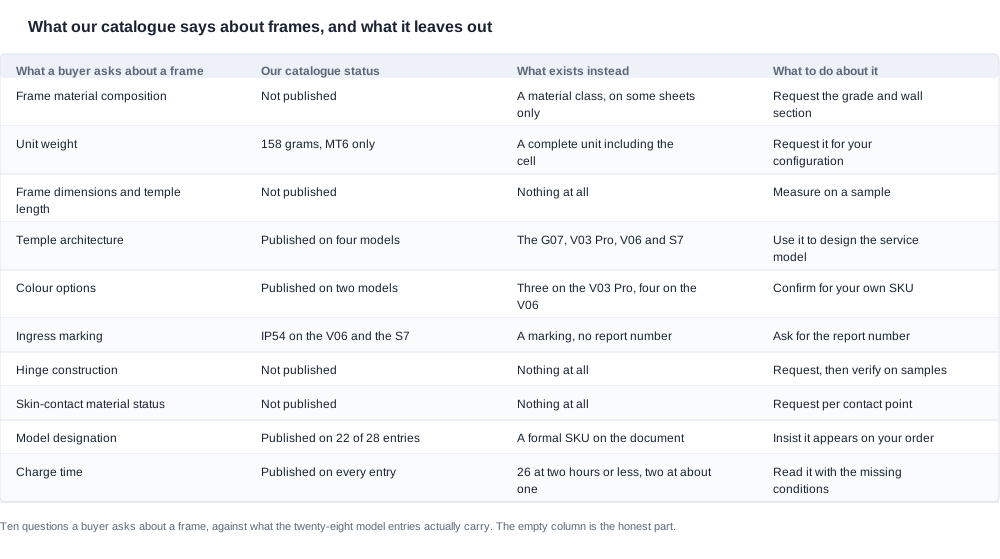
Frame materials are the least published and most consequential rows in our entire catalogue. Across twenty-eight model entries we publish exactly one weight figure, four temple-architecture statements, a handful of colour options and two ingress markings. We publish no frame material composition, no frame dimensions, no temple lengths and no hinge description. So when a buyer asks the usual set of smart glasses frame materials smart glasses faq questions, the honest answer is that the ergonomics of our range are almost entirely unevidenced — and that this is the single biggest gap between what a buyer needs and what a factory catalogue normally provides.
This article is written for a buyer who has just received our catalogue and is trying to work out what it does and does not tell them. It is also the place where we say plainly which of your questions we can answer, which we cannot, and what the honest answer to the rest is.
Smart glasses frame materials: why our catalogue rows come up empty
The reason is not that the frame is unimportant. It is the opposite. A smart glasses product is worn on the head for hours by someone who did not choose it for comfort — they chose it for the camera, the audio, or the features. That makes the frame the part of the product most likely to generate returns and the part least often measured, because measuring it properly is somebody else's job.
Three properties decide whether a frame succeeds in that situation.
Weight determines whether the product stays on the head. Our range publishes one figure: the MT6 camera platform at 158 g, complete, which is the glasses unit including the 265 mAh cell and the camera and excluding the foldable 1200 mAh charging case. For the other twenty-seven models, weight is not published. We are not going to substitute a typical figure from the industry, because a typical figure is not a specification.
Temple geometry and length determine whether the frame stays put. Temple length is not published for any model. A frame that is too long slides; a frame that is too short pinches at the ear. Neither is knowable from a datasheet.
Material composition determines durability and how the frame ages. Not published for any model. A frame that flexes under strap pressure and one that does not are not distinguishable without knowing the material.
Why we publish the gap instead of filling it
There is a commercial reason for this that has nothing to do with modesty. A catalogue that fills a row with a typical value creates a commitment nobody checked, and a buyer who relies on it will hold us to it when a customer returns a cracked temple. A catalogue that leaves the row empty creates a question that gets answered properly, and a question that gets answered properly is worth more to a procurement team than a number that turns out to be wrong.
The second reason is that the frame rows in this category are unusually hard to populate honestly in the first place. The frame is a system decision rather than a substance decision: it carries the electronics, the heat and the radio environment at the same time, so a material grade on a sheet describes only a fraction of what determines whether the product works.
The three questions buyers ask us most, and the answers we can give
"What is the frame material?" Not published, for any model, and it is the question we are asked most often. The honest answer has three parts. First, our catalogue does not carry a frame material composition because the company has not confirmed one to us. Second, a material name alone would not settle the question anyway, because the section thickness at the electronics bay and the hinge construction determine more about durability than the resin family does. Third, if you need the row for your own evaluation, we can request it for a specific configuration — some of these rows are obtainable with a request, and others are not in our source material at all.
"What is the weight?" One published figure, and it needs handling carefully because it is routinely misread in both directions. 158 g is the complete MT6 glasses unit — frame, 265 mAh cell and camera together. It excludes the foldable charging case, whose capacity is published separately at 1200 mAh and whose own weight is not published at all. It is not a frame-only weight and it is not a bare frame weight. For every other model in the range the answer is Not published, so it becomes a data request rather than a comparison.
"What are the frame dimensions?" Not published for any model, and this one has a hard consequence: without temple length and frame width, an optician fitting programme and any prescription route are blocked, because the lens size has to be decided before the frame can be set. This is the single most consequential empty row in the range for the optical channel, and it is not obtainable from us in general — it has to be measured on a sample.
Two questions we cannot answer at all
"Which model should I choose for my channel?" We can tell you which published configurations exist, which models carry an ingress marking, which carry a removable inner frame, and which carry a detachable temple. We cannot tell you which will perform better in your market, because that requires data we do not hold. Any factory that answers this question for you with a model recommendation is answering a different question from the one you asked.
"How does this product compare with a competitor?" Our published rows are sparse enough that a like-for-like comparison on frame properties is not possible from documentation. What is possible — and what we do — is tell you which properties we hold, which we can obtain for a named configuration, and which are not obtainable at all, so that you can compare those suppliers that do publish the same rows.
The published ergonomics-adjacent rows are worth listing, because they are more than nothing. Temple options: the G07 is listed with an ultra-slim, detachable temple, the YK12 with a slim temple, and the V06 and the S7 with a removable inner frame. Colour options: the V03 Pro lists three, and the V06 lists four including two ice-blue variants. Ingress markings: the V06 and the S7 carry IP54. Model designations: twenty-two of the twenty-eight entries carry a formal SKU, while the AR glasses entry, the AI electrochromic entry and the bone-conduction entry carry none, which matters for packaging, customs descriptions and certificate listing.
What a buyer should ask any frame supplier, ours included
The eight questions below are the ones we would send to any factory in this category, including our own. Asking us the same questions is the right way to use this catalogue.
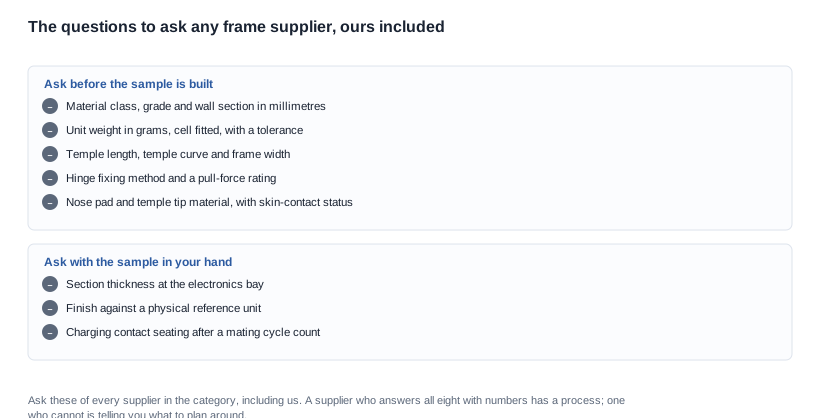
The reason to ask us specifically is that the answer is frequently "not published" — and knowing that before you commit is worth more than a plausible number would have been. It changes what you write into the purchase order, because an unanswerable row has to become a sample measurement or a contract term, and it changes which suppliers you shortlist, because a supplier who cannot answer these eight quickly is telling you something about their documentation process.
The three questions at the bottom of that list — the section thickness at the electronics bay, the finish against a physical reference, and the charging contact seating after a stated number of cycles — are the ones that can only be closed with a unit in your hand.
How to tell a real answer from a category answer
There is a simple test, and it works on our own documentation as well as on anybody else's. A real answer contains a number, a unit and a condition. "TR90 temples" is a category answer. "TR90, a named grade with a transition temperature of X degrees under a stated load" is a real answer. "IP54" is a category answer unless a report number is attached. "158 g complete unit including the cell" is a real answer, because it says what is included.
The discipline is to apply the test to every row of every sheet you receive, and to treat a category answer as an open row rather than a closed one.
How to read an absent row instead of guessing at it
An empty row is not one thing. Some empty rows are work that has simply not been done yet and which you can take over. Others are a statement about the supplier, and those are worth more to you than the number would have been.
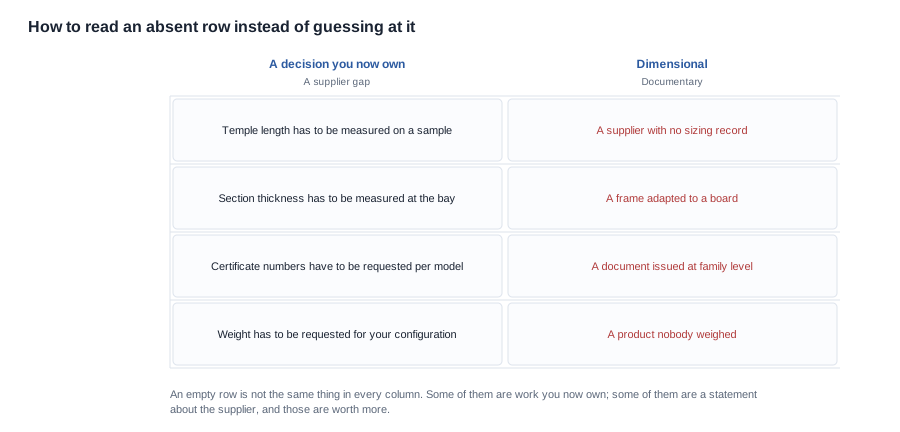
A dimensional row that is empty is usually a buyer-owned task. Temple length has to be measured on a sample, because no factory publishes accurate sizing for you — the person who would measure it is your customer. Section thickness at the electronics bay has to be measured on the unit, because it is a property of that build. Neither absence is a red flag; both are scheduled work.
A documentary row that is empty is a supplier signal. A certificate issued at family level, when you need one for your exact model, means the compliance work has not been done for your configuration. A product nobody has weighed means the mass is unknown to the factory as well as to you, and it will not appear in a sample report either.
The practical use of this reading is that it tells you which empty rows to schedule and which to escalate. In our range, the second kind is rare and the first kind is normal — which is itself a useful thing to know about a supplier before you place an order with them.

What a sample evaluation actually settles
Sizing is a measurement against a face, not a specification. No factory publishes it accurately for you, because the person who would measure it is your customer. A sample evaluation is therefore not a confirmation step for us; in this category it is the only measurement you will get.

A workable evaluation covers six things, and each has a stated method rather than a stated opinion. The weight, measured with the cell fitted, on a stated number of units, because a spread across units is a capability statement and an average is not. The temple length, the temple curve and the frame width, measured directly on the unit, because these decide the optical channel route. The section thickness at the electronics bay, because it is the one frame dimension that connects the material to the cell configuration. The finish, compared against a retained physical reference unit under a fixed light, because a screen is not a reference. The charging contact seating, after a stated number of mating cycles, because an interface in a temple is an opening in the frame. And every result recorded against the configuration it came from, because a measurement without a configuration is not a measurement.
For the protocol side of this, the measurement protocol in sample evaluation sets out the format we use, and the sport class where the most ergonomics-adjacent detail is published is covered on the bluetooth audio glasses range page.
How to brief a factory so that the sample is worth the freight
A sample evaluation is easy to arrange badly. The units arrive, they are handled by four people who each test something different, and what comes back is four impressions and a photograph. The fix is not more testing; it is a brief that names the configuration, the method and the deliverable.
Name the configuration, not the model. A factory will ship the model. What you need is a specific build: the cell, the temple type, the finish, the colour and the charging interface, because those are the variables that change the answers. If the sample arrives with a different temple than the one you asked for, three of the six measurements become void.
State the method, not the question. "What is the section thickness at the electronics bay" is a question and will come back as an opinion. "Measure the wall section at the bay with a calliper at the point where the cell bay meets the temple, and report the reading in millimetres on each of three units" is a method, and it comes back as a number.
Set the sample size in advance. Three units tells you whether the units agree with each other. One unit tells you almost nothing, because it cannot distinguish a measurement from an accident. Where the question is consistency across units, which is usually the question worth asking, three is the minimum and five is better.
Decide in advance what comes back. The deliverable should be a one-page record: the configuration, the readings, the instruments used, the date and the lot reference. That page is the artefact you will still have in two years, and it is what you compare the next delivery against.
Ask what should happen to the units afterwards. Retaining one approved unit is worth more than the freight that it cost, and a factory that can retain it and send it back with the paperwork saves you a second shipment later.
A worked scenario for a brand that started with our catalogue
What follows is a constructed case, written to show the order of the reasoning rather than to report a client engagement.
Assume a brand that found our catalogue first, is opening a line of camera glasses for an outdoor channel, and has discovered that it cannot compare the frame on any published row. The temptation is to ask a supplier to fill the gap with a number, and the risk is that the number becomes the specification by default.
Step one: the brand stops looking for a number it will not get. It asks the eight questions instead, and it asks them of every supplier including us. The answers arrive with a clear pattern: weight, material, dimensions and hinge construction are the four that nobody in this category publishes properly, and they are the four the brand now owns as sample work.
Step two: it converts the four into a sample plan. Each gets a measurement method written before the units arrive, and each is attached to the configuration it is measured on. The sample plan now has four items instead of a blank row on a spreadsheet, which is a much better artefact to send to a factory.
Step three: it asks us for the rows we hold and the rows we do not. We tell it that the unit weight exists for the MT6 only, that the temple architecture exists on four models, that the ingress marking on the V06 and the S7 is a marking without a report number, and that a formal model designation exists on twenty-two of the twenty-eight entries. That list is short, and it is enough to design a service model and a packaging structure around.
Step four: it separates the documentation it needs from the measurement it needs. The certificate numbers per model, the chemical-restriction position and the material declaration go into a written request with dates attached. The dimensions, the bay section and the finish reference go into the sample plan. The two lists travel separately and are closed separately, and the brand stops confusing a request with a measurement.
Step five: it writes the empty rows into the purchase order. Where a row will not be answered by the supplier, the order states the criterion and the method instead, so the standard is contractual even though the supplier did not supply the input.
The result is a programme that never had a frame specification and never needed one, because the specification was replaced by four measurements, four requests and four clauses.
What we can obtain, and what we cannot
Where we can be useful quickly: tell us the target wear time, the market and the configuration, and we will tell you which of these rows we can obtain for that specific build and which we cannot. Some of them are obtainable with a request; others are not in our source material at all, and we will say so rather than spend a week on it.
Where we will be direct is about the limit of our own catalogue. It is a real weakness in our documentation and we are not going to present it as anything else. If your product depends on sizing — and in this category it almost always does — the sample is not a confirmation step for us; it is the only measurement you will get.
The broader treatment of frame and fit sits under materials and ergonomics. For the outdoor and sport context where the exposure conditions are hardest, see sports and outdoor, and for the difference between a rating and a material claim, see ip rating myths.
Which rows to ask us for, and in what order
Tell us your target wear time, the market and the configuration, and we will tell you which ergonomics rows we can obtain for that model and which we hold no data for. If you send us the eight questions with your configuration filled in, we will answer each one directly — including the ones we cannot, and including where the honest answer is that the row will only close with a physical unit.
Related reading
- Where weight matters even more — sports and outdoor use case
- Why a rating is not a material claim — ip rating myths
- Testing fit against a real face — sample evaluation
Tell us your target wear time and we will tell you which ergonomics rows we can obtain for that model.


