
Frame specification is where this category's buyers make errors most consistently, and the reason is structural rather than careless. The frame is the part of a smart glasses product most likely to cause returns, and it is the part most rarely measured. Across our twenty-eight catalogue entries we publish one weight figure, no frame dimensions, no temple lengths, no material composition and no hinge description. Eleven of those entries carry a camera, which means for eleven products the frame is also the enclosure, the antenna environment and the structure carrying the cell.
Smart glasses frame materials smart glasses common mistakes is therefore a list of things to avoid doing with an almost entirely empty specification. Seven errors account for most of it, and each one has a question attached that prevents it — a question that costs one line in an email and saves a tooling cycle.
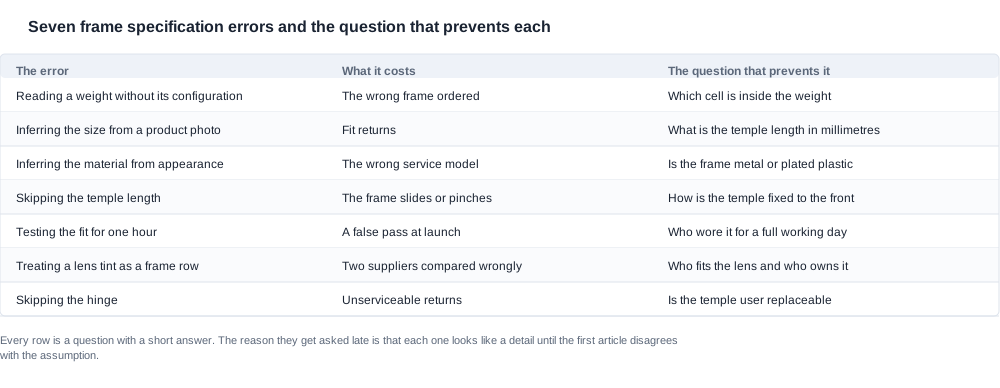
Smart glasses frame materials: seven errors and the question that prevents each
Error one: reading a weight figure without its configuration. A weight is meaningless until you know which battery configuration it describes and whether it includes the fitted cell. The one figure we publish for the whole catalogue is the MT6 at 158 g, and it is the glasses unit including its 265mAh cell and its camera, excluding the foldable charging case, whose capacity is 1200mAh and whose weight is not published. Quoting it as a frame weight would be wrong twice over: it is not a bare frame weight, and the bare frame weight is not published for any model. The question that prevents this error is simple and should be asked every time: which cell is inside the weight, and does it include the case?
Error two: inferring the size from a product photograph. Geometry does not appear in a product image, and two frames that read identically in profile can differ enough to change the whole sizing picture. The question that prevents it: what is the temple length in millimetres, and what head sizes was the frame designed around?
Error three: inferring the material from appearance. A frame that appears metallic may be plated plastic, and the difference decides whether it flexes, how it ages, whether it can be re-finished, and whether a replacement temple is even possible. The question that prevents it: is the frame metal, or a moulded frame with a plated surface?
Error four: skipping the temple length. This is the row that decides whether the frame stays where it should. Too long and it slides forward; too short and it presses at the ear. Both are return drivers and neither is knowable from a catalogue page. The question that prevents it: how is the temple fixed to the front — riveted, screwed or bonded?
Error five: testing the frame for one hour. This is the error with the highest commercial cost, because it produces a false pass. A frame can settle in nicely at hour one and become a complaint at hour five, and the information arrives long after the packaging is printed. The question that prevents it: who used the sample for a full working day, and did they adjust it after the first hour?
Error six: treating a lens tint as a frame specification. A tinted or photochromic lens is a different optical product from a different supply chain, fitted by a different party. Our range includes one electrochromic entry and a photochromic configuration on the V03 Pro, and neither publishes a tint range or a response time. The question that prevents it: who fits the lens, who owns the lens specification, and who carries the defect when the lens is the problem?
Error seven: skipping the hinge. A hinge is a service component and frequently a failure component, and its construction decides whether a temple can be replaced at all. Not published for any model in our range. The question that prevents it: is the temple user-replaceable, and if so, how?
The two errors that only appear above a certain volume
Six of the seven errors above are visible in a single sample. Two are not, and they are the two that cost the most, because they are invisible until the order is already placed.
The first is the assumption that one good sample represents the batch. A sample is a single unit from a single tool cavity, on a single day, under a single set of conditions. It tells you what that unit was. It does not tell you what the second cavity produces, what the fifth batch of pigment does to the colour, or whether the hinge torque holds across a year of production. Where the frame is a moulded component with an internal bay, cavity-to-cavity variation shows up in exactly the place that matters most — the section that has to carry the cell. The question that prevents this error is not a question you can ask the supplier; it is a question you answer with a sampling plan. Take units from different cavities, different batches and different dates, and record what you measure from each one.
The second is treating a first-article pass as a production qualification. The first article proves the process can make one good unit. A production run has to make many acceptable units, and the difference between those two statements is the cosmetic rejection rate, which is the largest uncontrolled cost in a frame programme. In this category the most common first-article rejection is cosmetic — a finish inconsistency, a tool mark visible under the line's own lighting, a colour that drifts across the frame — and the cost of a cosmetic rejection at the first article is not the rejected unit, it is the rebuild, the new first article and the schedule move that follows.
The way to manage both is to write the acceptance criteria before the first article rather than after it, and to make the criteria per-unit rather than per-batch. A finish tolerance expressed as "acceptable overall" cannot be applied to unit forty; a finish expressed against an agreed reference board can. This is where a buyer who wants to evaluate a supplier's quality control function gets its clearest answer, because a supplier with a real inspection standard will have a reference board and a supplier without one will not.

The one weight figure we publish, and what it actually describes
Because the weight is the most requested number in this category and the least available, it is worth being precise about the single figure that does exist, because a buyer who mis-describes it will be quoting it back to us.
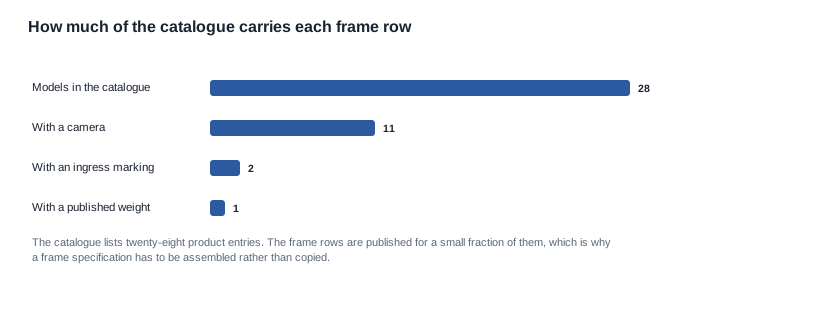
The catalogue lists twenty-eight product entries. Eleven of them carry a camera — eight at 8 MP and three at 13 MP — and for all eleven the frame is the enclosure. Two of the twenty-eight carry a published ingress marking, the V06 and the S7, and those two are the ones where the frame's seal geometry becomes a compliance question rather than only a mechanical one. One carries a published weight: the MT6.
That last figure needs its exact terms, and the terms are not a formality.
The MT6 glasses unit is published at 158 g. That figure covers the glasses unit as it ships, including the 265mAh cell and the camera module. It excludes the foldable charging case, whose capacity is published at 1200mAh and whose weight is not published. The weight of a bare frame — the shell without the electronics and without the cell — is not published for any model in the range, including the MT6.
The practical consequence is that there is no figure in our catalogue which answers the question "how heavy is the frame". A buyer who needs that number has to request it, and a supplier who quotes a figure from the optical industry as though it applied here is quoting a different product. This is not a criticism of the industry figure; it is a statement that the optical industry figure describes an optical frame, and an optical frame carries a lens and nothing else.
There is a second point about weight that is worth making before a buyer builds a business case on it. Weight is a consequence, not an input. It follows from the section geometry, from the cell configuration and from what the temple has to carry. A buyer who targets a weight without stating the section and the cell configuration is specifying a number and hoping a supplier can find a route to it, and the supplier will find one — but it will be their route, not yours, and it will come with a tooling conversation.
Why an empty row is a different situation from a wrong row
A supplier who publishes no weight and a supplier who publishes a wrong weight are in completely different positions, and the difference is the single most useful idea in frame procurement.
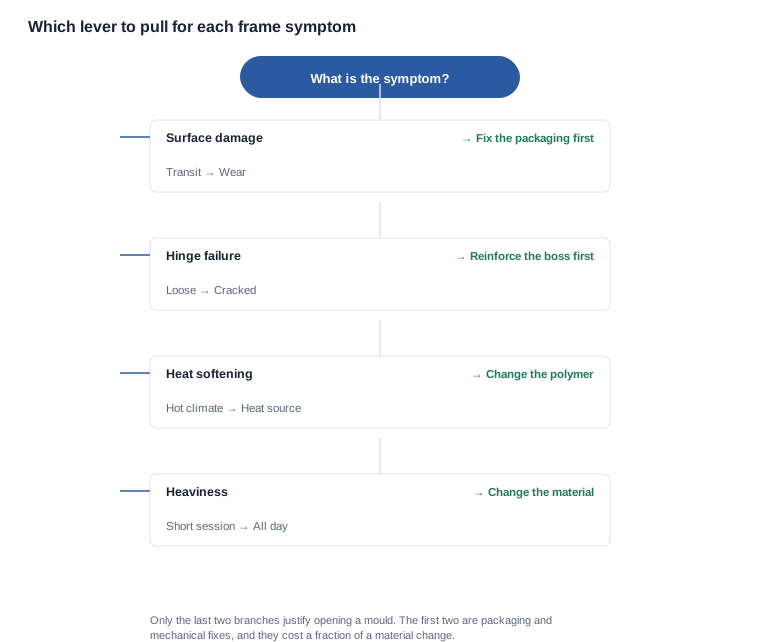
The supplier with an empty row has not measured, or has measured and not confirmed the figure, or has a document that names a different configuration. None of those is a lie. All of them are recoverable, and they are recoverable in the ordinary way: you ask, you get a number or you get a refusal, and a refusal is information.
The supplier with a wrong row is a different problem entirely. A wrong weight on a datasheet propagates. It propagates into your specification, into your own supplier evaluation, into the packaging copy if it reaches the product page, and into the returns analysis if the product turns out to behave differently. A wrong row is also much harder to detect, because a number that seems plausible invites trust.
This is why the practical advice in this category is to treat an empty row as an open question rather than as a bad product. The questions to ask when you meet one are: which configuration does this cover, what method produced it, on how many samples, and what date. Those four questions are the same for every row, and a supplier who answers them directly is a supplier whose other answers are probably sound too.
It also changes what you do with the answer. An empty row becomes a request. A wrong row becomes a stop condition — not a negotiation, not a caveat, a stop. In a procurement file, the two are handled by different procedures and they should be.
How to evaluate a supplier's documentation habits
The empty rows themselves are a diagnostic, and this is the part of frame procurement that is rarely used as an evaluation tool. A supplier's response to an unanswerable row tells you more about their operation than a brochure does.
Three behaviours are worth separating, because they mean different things.
A supplier who says "not published, but here is the internal figure and here is how it was measured" is demonstrating a working quality control system. They have a number, they know its provenance, and they are choosing not to publish it publicly. That is a normal and respectable position, and it is entirely different from not having the number.
A supplier who says "not published" and stops is neutral. It may mean the same thing as the first case and it may mean nobody has looked. The way to tell is to ask a second question: what would have to happen for that figure to exist. A supplier who answers that question has a process. A supplier who does not has a gap.
A supplier who supplies a typical value from the optical industry is the case to watch. This is the behaviour the red flags in this category are built around, because it is the only one of the three that actively makes your file worse. You will not find the wrong number by reading the datasheet, because the wrong number looks right; you find it when a customer returns a frame that behaves differently from the specification you built. The practical precaution is to ask how the figure was obtained before you accept it, every time, in every category. A figure with a method is usable. A figure without one is a liability that has been dressed up as an answer.
The criteria that come out of this are simple, and they transfer to any category where the published data is thin: how many rows can you close, how long did each answer take, and did any answer arrive without a method attached.
What to write when you do not have the number
Most frame specification templates have a column for the value and no provision for the state of the row. That provision is the whole trick, because it lets a buyer write something accurate without writing something invented.
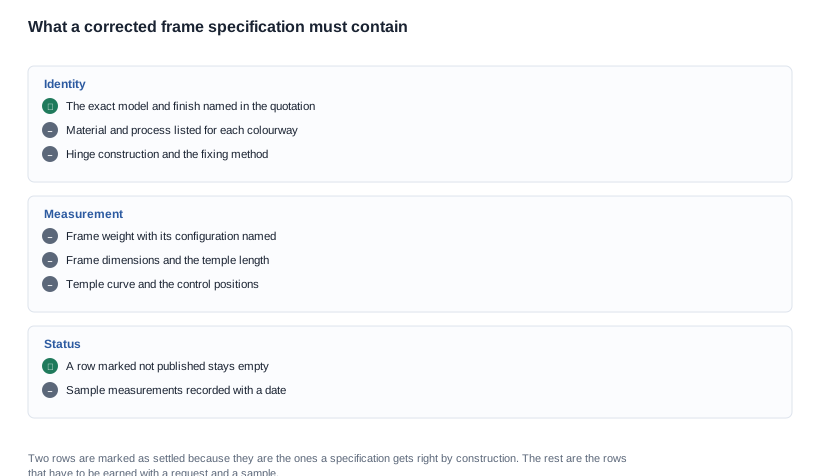
There are five states a row can be in, and only one of them is a number.
Measured — you have a figure, with the configuration, the method, the date and the sample count attached. This is the only state that carries a value.
Published — the supplier has published it, and you have the document or the page that says so. This is a legitimate state and it is worth recording where it came from, because a published figure can be superseded without notice.
Requested — the row has been asked for and the answer is pending. Record the date of the request and the name of the row. This is a live state and it closes.
Not published — the row does not exist publicly. It is not a gap in the supplier's knowledge necessarily; it may be a decision not to publish. Either way it stays empty.
Refused — the supplier has declined. Record the reason if you were given one. A refusal with a reason is a closed row; a refusal without one is a signal about the supplier's documentation habits that belongs in your evaluation.
The rule that follows from the five states is straightforward: never write a value into a row that is not in the measured or published state. Not a typical value, not a value from a comparable product, not a value from the optical industry, not an estimate with a note. A row that carries a wrong number and a caveat is worse than an empty row, because an empty row gets asked about and a wrong number gets believed.
The second rule is about the structure of the document. Every row needs a named owner and a named date. "The weight will be confirmed" is not a plan; "weight for the build with two 90mAh cells, confirmed in writing before the sample order, owner: product engineering" is.
The boundary of our own frame documentation
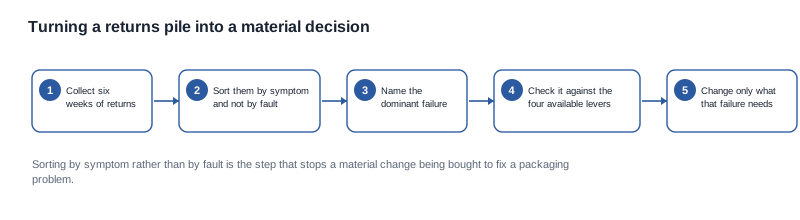
Stated plainly: we publish the figure we hold, in the terms we hold it, and we leave the other frame rows empty rather than filling them with typical industry values. The MT6 glasses unit at 158 g, including the cell and the camera and excluding the foldable case, is the whole of the weight data in this catalogue, and no bare frame weight is published for any model.
We will also say plainly that this is a genuine weakness in our documentation, and that we would rather state it than let a buyer discover it after committing to a specification. The frame material composition is not published for the range. The frame dimensions are not published for any model. The temple lengths and curves are not published. The hinge construction is not published. The export certification page on our catalogue front page carries images rather than text, with no certification statement in words and no per-model rows behind it, so it cannot be used to infer a certificate for any particular product.
What we publish about structure is limited but real. The G07 is listed with an ultra-slim and detachable temple. The YK12 is listed with a slim temple. Temple shape and frame colour are listed as customisable across most product classes. The V03 Pro lists three colours and the V06 lists four. The sport camera platforms V06 and S7 are listed with removable inner frames, and those two are the only products in the range carrying a published ingress marking. That is a short list, and none of it tells you how a frame behaves at hour five.
That last gap is the one we would most like a buyer to close, and the way to close it is the protocol rather than a document. The sample evaluation procedure is where the measurements in this article can actually be taken, and the wider topic is under materials and ergonomics. Where weight matters more than anywhere else in the range — and in sport and outdoor products it matters more than anywhere else — the context is under sports and outdoor hiking use case.
What we can do is tell you, for a specific model, which rows we can answer from what we hold and which have to be obtained or measured. Ask us for the frame rows on a specific model and we will say which we can obtain and which we cannot.
Three habits that this category rewards
Shortlist on the rows that are hard, not on the rows that are easy. Every supplier in this category can talk about the camera, the battery and the runtime, because those are the published rows. The frame rows are the hard ones, and they are the ones that decide the programme. Which model you pick should be a function of the answers you could not get, not of the answers you could.
Ask for the total cost of the gap, not the total cost of the frame. An unpublished weight is not a zero-cost row; it is a sample order, a measurement protocol, an acceptance criterion and a re-order check. Add those to the price of the alternative and the comparison changes. The trade-off between a supplier who publishes the frame data and one who does not is not usually visible in the unit price, and that is the reason buyers who compare on unit price alone end up paying for the gap twice.
Decide when to escalate, before you need to. The escalation ladder in frame specification is: request, then sample, then contract. Each step is more expensive than the last and each one closes more rows than the last. The mistake is not escalating early enough — a row that is still open when the artwork is final is a row that gets closed by a supplier's preference rather than by your criteria. A buyer who knows in advance that the decision point is the purchase order will keep the rows alive long enough to close them properly.
Related reading
- What the catalogue omits entirely — smart glasses frame materials
- Where weight matters even more — sports and outdoor hiking use case
- The full-day session protocol — sample evaluation
Ask us for the four frame rows on a specific model and we will say which we can obtain and which we cannot.


