

Frame material is one of the few upgrades that touches the product's electrical design, which is exactly why it should not be undertaken for a preference. Changing a material is a tooling and an engineering decision with a schedule attached to it, and the most common version of this mistake is spending tooling money to fix a problem that a carton would have fixed.
The right starting point is not a material sample. It is the returns pile.
Smart glasses frame materials smart glasses do you need it is therefore a diagnosis rather than a preference, and it is worth stating the diagnosis method before the branches: six weeks of returns, categorised by symptom rather than by fault, sorted so that the dominant failure is visible. The dominant failure is almost always one of the six below, and it is usually not the one the buyer assumed.
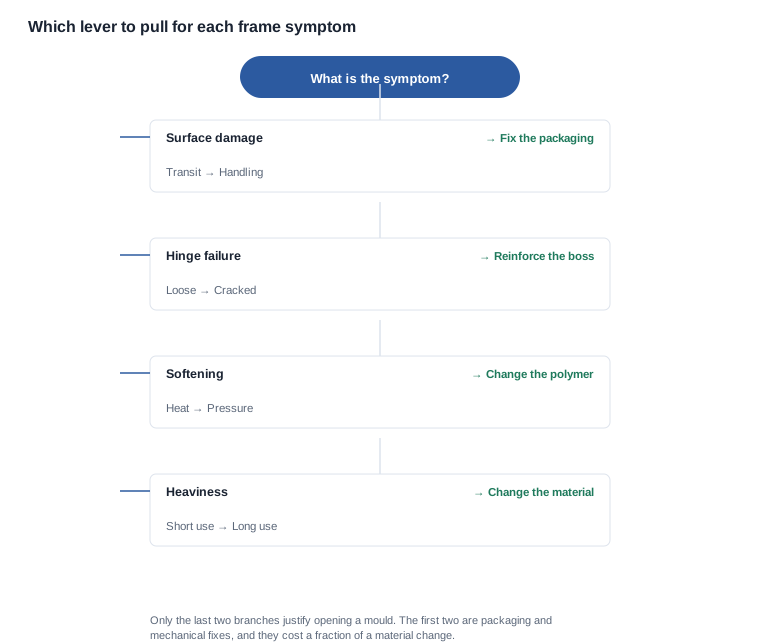
Smart glasses frame materials: branch one, a complaint about the surface
Scratches, finish loss, marks on arrival. The frame material is the wrong lever, because the customer is describing what they can see and structural strength is invisible to them.
What fixes it is packaging and finish discipline. Most cosmetic complaints in this category are transit damage — a frame that arrives scratched was scratched in the carton, not in the customer's pocket. Corner blocks and a rigid inner tray cost a fraction of a material upgrade and fix more of it.
Spend the money on the packaging and leave the frame alone.
There is a second sub-branch here that is worth separating, because the two are often confused. A frame that arrives with a scuff is a transit problem. A frame whose finish degrades after several months of use is a material or a process problem, and the diagnostic is whether the degradation is where the frame touches things — the hinge, the temple tip, the bridge — or spread across the front where nothing touches it. The first pattern is a coating or a hardness problem and can sometimes be addressed with a finish change alone. The second is a material problem and needs a new polymer.
Our catalogue gives you nothing on finish durability, because no drop, impact, vibration or abrasion figure is published for any model in the range. That means this branch is decided on a sample and on your own returns data, not on a specification.
How to tell a coating problem from a material problem
Both branches look identical in a returns database — a customer sends back a frame and says the finish has gone. Separating them takes five minutes on a sample and saves the whole cost of a mould if you get it right.
Run the sample through a controlled comparison. Take three units of the same build and put them through three different histories: one in a box, one carried daily in a pocket, and one left on a car dashboard through a day. After a week, compare the three against a new unit from the same batch.
If the pocket unit and the dashboard unit have degraded and the boxed unit has not, the finish is failing in use rather than in transit. That is a wear and environment problem, and the question becomes whether it is the coating or the substrate. Rub the degraded area firmly with a cloth and then with a harder edge. A coating that lifts or transfers is a coating problem, and it may be addressable with a finish change or an inspection standard change. A surface that has dulled or abraded without transferring is a substrate problem, and it is a material problem.
If the boxed unit has degraded too, the finish was already weak when the frame left the factory. That is a process problem rather than a material one, and the fix is in the finishing and inspection rather than in the polymer. It is also the most common of the three outcomes, and it is the one most often misdiagnosed as a material failure.
If all three are indistinguishable, then finish degradation is not what your customers are complaining about, whatever the descriptions in the returns notes say, and the real cause is somewhere else in the branch.
This is a small test with a large effect, because the three outcomes point at three completely different interventions: a finish change, a process change, or something else entirely. A buyer who skipped it and bought a new polymer will have paid for a mould and still have the same complaint.

Branch two: the failure is structural
Broken hinges, cracked temples, frames loosening at the hinge. Here the material is genuinely relevant, and the first intervention is not a material change.
A steel threaded insert in a reinforced hinge boss is the cheapest strength improvement available in this product class. It survives torque that a screw in unreinforced plastic does not, it requires no change to the frame silhouette, no new tooling profile and no acoustic retuning, and it costs a small fraction of a material change.
Exhaust this before opening a mould. Most buyers do not, which is why they spend tooling money and acquire a different set of problems.
The diagnostic that tells the two apart is whether the failure is at the joint or in the member. A crack that starts at the hinge boss and propagates into the temple is a joint problem: the geometry of the joint and the reinforcement around it. A crack that starts mid-temple is a member problem: the section and the material. The first is fixable with a hardware change, the second is the one where a material change is the correct answer.
The second diagnostic is whether the failure is temperature-dependent. A temple that cracks in a warm environment and holds in a cool one is telling you something specific about the material, and it is the difference between branch two and branch four.

Branches three to six, and the constraint behind each
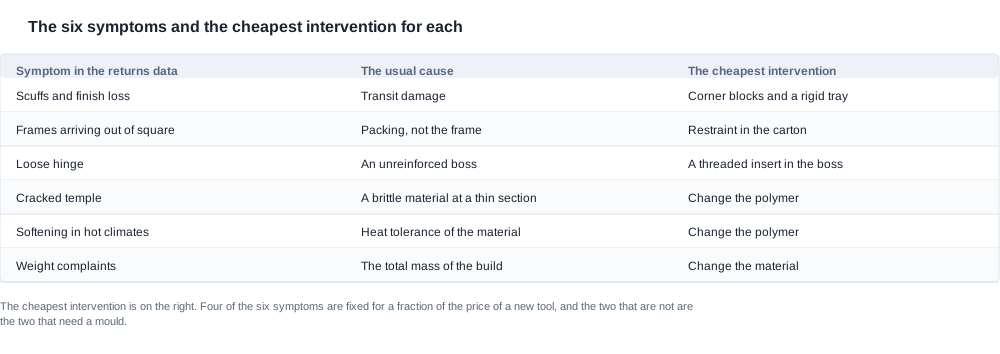
Branch three: frames arriving out of square. Frames arriving twisted is a packing failure, not a material failure. Flat-packed frames without corner blocks or a rigid tray will twist in transit, and the buyer blames the frame because it was fine when it left. Adding restraint to the carton fixes it. Changing the material does not.
Branch four: heat softening. Products sold into hot climates, or into environments near a heat source. This is the case where a material change is clearly correct: a nylon-based thermoplastic elastomer has a far higher heat tolerance than acetate, and the V06 and the S7 platforms in our range are built on that principle, with removable inner frames.
Note that nylon-based thermoplastics are also more forgiving of design errors — a temple that would crack in acetate simply bends and runs out of square. So a material change to solve heat can introduce a geometry problem, and the two need watching together. That is a real trade-off and not a footnote.
Branch five: weight complaints. A legitimate reason to consider a material change, and the one where our published data is least helpful. We publish a weight figure for exactly one model in the whole range, and that figure needs its exact terms: the MT6 glasses unit at 158 g including its 265mAh cell and its camera, excluding the foldable charging case, whose capacity is 1200mAh and whose weight is not published. The weight of a bare frame is not published for any model.
So measure it yourself. Weigh five units of the current model, and weigh the samples of the alternative. Frame mass is the parameter that most affects whether a customer keeps using a product, and it is entirely absent from our published data.
If the difference is small, do not change materials for it. If it is large and the alternative is mechanically sound for the cell configuration, this is the case where a change is justified.
Branch six: no clear pattern. If you cannot name the dominant failure, do not change anything. Upgrading on the assumption that a stronger material will produce fewer returns is how a programme spends tooling money and gets the same return rate.
Get six weeks of returns, categorised by symptom rather than by fault, and look at what dominates. The answer is usually one of the five branches above, and often it is packaging.
The cost arithmetic that usually does not get done
Before the tooling conversation, do the arithmetic that decides whether it should happen at all. It takes ten minutes and it settles most cases.
Three numbers are needed: the number of units shipped in the period, the number of returns attributable to the dominant failure, and the fully landed cost of one unit including the packaging change or the hardware change that would fix it.
The absorption case. If the cost of absorbing the failure across the shipped volume is lower than the cost of the cheapest intervention, stop. This is not a bad outcome. A 0.8% return rate concentrated on one cosmetic symptom is frequently cheaper to absorb than to engineer out, and engineering it out is a three-month project.
The marginal case. If the failure rate is rising rather than flat, absorption gets harder every period, because the cost compounds while the intervention does not. A rising rate is the strongest argument for acting, and it is the one that is easiest to see and hardest to admit.
The structural case. If the failure is a safety or a compliance issue rather than a satisfaction issue, none of the above applies and the decision is made. A cracked temple in a sport product at scale is not a returns problem, it is a product problem, and the cost of the mould is not the relevant comparison.
The red flags to watch for while doing this arithmetic are three. A failure rate that is quoted as "a few" rather than counted. A dominant failure that changes from month to month, which means the programme has a distribution problem rather than a material problem. And a proposed intervention that addresses a symptom rather than the branch it belongs to — which is the version of this mistake that costs the most, because it produces a new mould, a new qualification and the same returns.

The two cheapest interventions that come before a mould
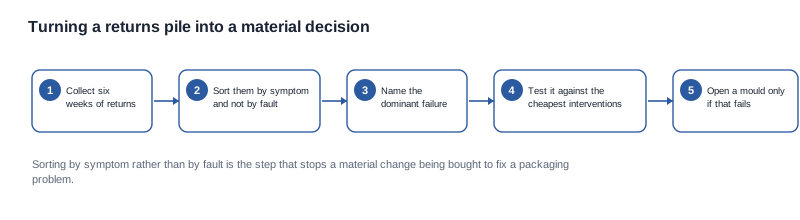
The order below is not a preference. It is a cost order, and the cost differences between the steps are large enough that skipping a step is usually a mistake on price as well as on risk.
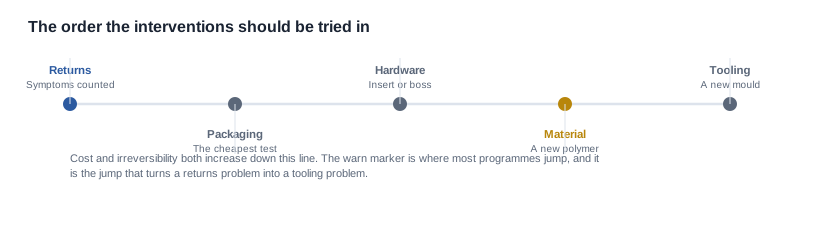
Step one: the packaging. Corner blocks, a rigid inner tray, restraint on the temples. This is the cheapest intervention in the whole list and it addresses the single largest category of frame complaints in this category. If your returns are dominated by cosmetic damage, this is where the money goes.
Step two: the hardware. A threaded insert in a reinforced boss, a stronger spring, a different fastener. This addresses the structural branch at a fraction of the cost of a material change and without touching the tooling.
Step three: the finish. A different coating, a different inspection standard, or simply a more realistic acceptance criterion at the first article. This is the branch where the cost is often already in the programme and simply not being managed — a cosmetic rejection at the first article is a rebuild and a schedule move.
Step four: the material. A new polymer, a new tool, a new qualification. This is the only step that changes the product's compliance position and its service construction, and it is the only step where the programme's own documentation has to be reopened.
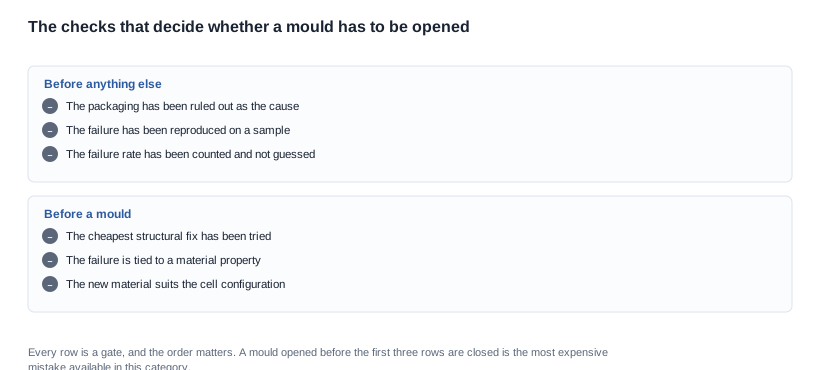
The checklist above is the gate for step four, and every row of it is a question that is answered before the tooling budget is committed rather than after. The first three rows are the ones that stop a packaging problem being solved with a mould. The second three are the ones that make sure the mould that is opened is the right mould.
There is one more cost consideration that belongs here, and it is the one most buyers forget: a material change is a re-qualification, not a re-order. The material declaration, the traceability route and — where the product is sealed — the configuration that the ingress marking covers all have to be revisited, and the IP54 marking published in our catalogue appears on the V06 and the S7 only. A programme with a sealed build that changes the polymer has to re-check that marking, because the seal and the frame are the same thing.
What a material change costs beyond the tooling
A buyer who has only budgeted the tool is budgeting the smallest part of the change. Four further costs sit behind it, and they are the reason a material decision taken at the returns stage so often exceeds its budget.
The first article and the qualification. A new polymer means new moulding parameters, new cycle times and a new set of process conditions. The first article is a trial rather than a confirmation, and the cost of a trial that fails is a second trial. This is where the schedule risk lives, and it is why the tooling decision should be made with a schedule that has room for a second attempt.
The documentation. The material declaration has to be reissued for the new grade, the traceability route has to be re-established, and the batch records have to start again. None of this is expensive in money and all of it is expensive in weeks, and the weeks are on the buyer's timeline rather than the factory's.
The parts and the service position. A new polymer changes what a replacement temple is made of, which changes the spare-parts position for the whole installed base of the previous build. A programme that has already shipped has an installed base that needs parts from the old material, and those parts need tooling too — sometimes a second tool, at a fraction of the volume.
The compatibility position. Any lens mount, any accessory system and any case interface that was designed around the old section has to be re-checked against the new one. A thicker section does not simply cost more; it changes the products around it.
The total cost of a material change is therefore a project, not a purchase. A buyer who evaluates it as a purchase gets a lower number than the real one and discovers the difference in the second quarter, when the programme is already committed. What to ask a supplier is not "how much is the tool" but "what else does this change touch", and the answer to that question is the number that should be in the business case.
The case for not spending anything at all
The fifth branch of the decision tree — no clear pattern — deserves its own ending, because "do not change the material" is a real answer with real commercial value, and it is the answer most often skipped.
The case for spending nothing is strongest when the return rate is not actually out of line. If your returns sit within the range you would expect for the category and the complaints are spread across several causes rather than concentrated in one, then a material change is being proposed to solve a distribution problem, and a distribution problem does not have a material answer. It has a process answer.
The case is also strong when the failure rate is small enough to be worth absorbing. A 1.5% return rate concentrated on one cosmetic symptom may cost less to absorb than to fix, and the arithmetic is worth doing before the tooling conversation rather than after it.
And the case is strongest of all when the programme is about to change anyway. If a new model is planned inside a year, the frame is going to be re-engineered regardless, and the returns data is a specification input for that redesign rather than a reason to open a tool on the current one.
There is a fourth case, and it is the one that is hardest to argue for because nobody wants to be the person who said nothing. If the supplier's own documentation is thin on the frame rows, a material change will not fix that either. Our catalogue publishes the material composition for no model, the glasses-unit mass for one model, and the temple dimensions for none. A programme that has been buying from suppliers with the same gap will get the same gap from a new polymer, and the honest conclusion is that the next thing to buy is measurement capacity rather than a new material.
Stated plainly: an upgrade should be justified by a counted failure rate, and the cheapest structural fix should be exhausted before anyone opens a new mould. We will say so even when the answer means telling you not to spend the money. The frame material composition is not published for our range, the glasses-unit mass is published for one model only, and no temple dimensions are published for any model, so this decision cannot be made from our catalogue — it has to be made from your returns, from a weighed sample, and from a written specification of what you are asking the supplier to change.
The wider context is under frame materials problems and fixes, the comparison rows are under frame material specifications to compare, and the case for a deliberate change rather than a reactive one is under frame materials upgrade considerations.
Tell us the failure you are trying to fix and we will start from your returns rather than from our catalogue.
Related reading
- frame materials problems and fixes
- frame material specifications to compare
- frame materials upgrade considerations
Tell us the failure you are trying to fix and we will start from your returns.


