

Smart glasses frame materials: no standard stands alone
Buyers looking for the standard that governs a smart glasses frame run into the same wall every time: there is not one that stands alone. A frame in this category is not a regulated product category in the way eyewear, textiles or medical devices are. It is a structural part of a radio product, and the requirements arrive through the finished product rather than through the frame.
That is not a technicality to be brushed aside, and it is worth being precise about why. A standard exists when an industry agrees on what a component has to do, how you measure it, and what counts as a failure. In this category the agreement was reached at the product level — on radio behaviour, on safety, on substances, on transport — because that is where the failure modes that matter were understood. Nobody wrote a frame standard, because the frame failures that reach a buyer are hinge cracks, plating reactions, out-of-square arrivals and seasonal movement, and none of those can be settled by a document that governs only the frame.
The consequence for a procurement team is not that there is less work. It is that the work cannot be delegated to a certificate. Because the frame is assessed as part of the product, a material change is a product change; a frame declaration has to be tied to a specific model designation and a specific configuration; and the material file has to be maintained by the buyer rather than inherited from a supplier's document package. A frame specification that nobody maintains is the most likely single cause of a compliance problem in this category, because the product around it changes while the frame row stays frozen.
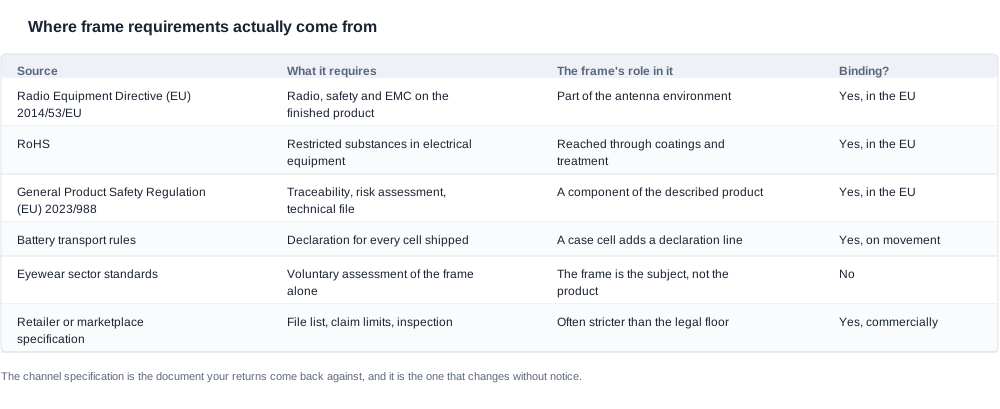

The product-level rules that reach the frame
Radio Equipment Directive (EU) 2014/53/EU. A Bluetooth device placed on the European market has to satisfy the radio requirements and the safety, health and EMC requirements of the directive, and the assessment is made on the finished product. The frame matters here for a reason that is not obvious from the name: the frame is part of the antenna environment. A resin front, a metal temple and a different hinge arrangement do not behave the same way radiatively, and a structural change late in the programme can move radio behaviour even when every component on the bill of materials is unchanged. If you are changing frame material after the radio design is fixed, that change needs to be assessed rather than assumed harmless. Note also the distinction between the directive and the standards used to demonstrate it: EN 301 489 is an EMC harmonised standard, not a directive number, and the two should not be quoted interchangeably in a file.
RoHS. The restriction of certain hazardous substances applies to electrical and electronic equipment. It reaches the frame indirectly, because a change of resin or of surface treatment changes what your substance declaration has to say. This is the rule most often overlooked when a buyer changes a colour or a finish to hit a retail deadline.
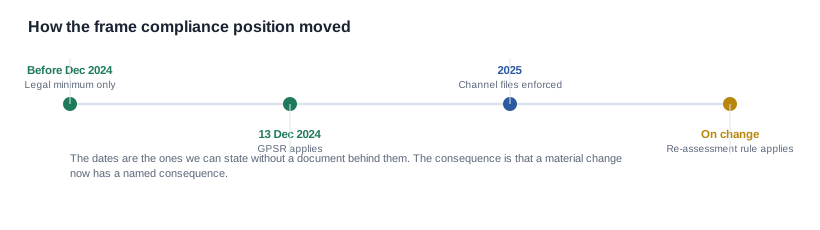
General Product Safety Regulation (EU) 2023/988. It has applied since 13 December 2024 and covers consumer products regardless of where they were made, including the traceability, the risk assessment, the technical documentation and the EU-established responsible person. The frame is a component of the product the file describes, and a material change is a change to the product.
EMC and immunity. These sit inside the same radio framework, and the same antenna-environment argument applies: a frame that changes the ground plane can change emissions and immunity behaviour, which is a test outcome rather than a design opinion.
Battery and transport rules. Where a case contains a cell, that cell is declared alongside the product's own cell. A charging case therefore adds a line to the transport paperwork, which is why the shipping decision and the case decision have to be taken together rather than in sequence. In our range, the CY03, the CY05 and the L1 Pro carry a 1400 mAh case, the L2 Utral carries a 900 mAh or a 1400 mAh case, and the MT6 carries a foldable 1200 mAh case, so the case decision is a real decision in four model families rather than an edge case.
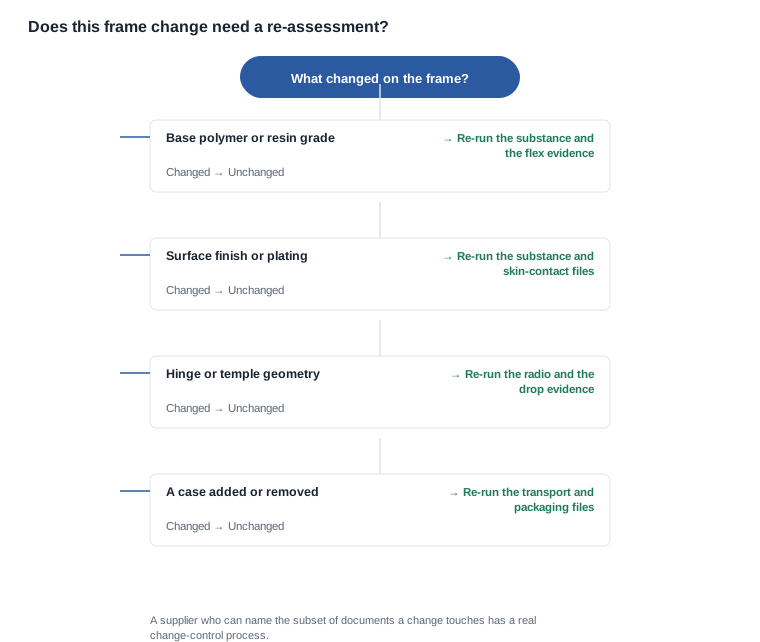
The rule that a frame change triggers a review
The most useful consequence of the product-level approach is a decision procedure rather than a document. When the frame changes, the question is not "does this need paperwork"; it is "which subset of the file does this reopen". The four answers below cover the changes that occur in practice.
A base polymer or resin grade change reopens the substance declaration and the flex and drop evidence. A surface finish or plating change reopens the substance declaration and the skin-contact declaration. A hinge or temple geometry change reopens the radio assessment and the drop evidence, because the antenna keepout and the structure both moved. A case added or removed reopens the battery transport declaration and the packaging file.
A supplier who can name that subset has a real change-control process. A supplier who says nothing changes is either wrong or has never run a change, and the difference shows up the first time a buyer asks for a reissue.
The rows a frame declaration should carry
Because the frame is governed through the product, the material declaration you ask for has to be tied to the product. Six rows are worth insisting on, and each of them has to arrive with a method attached rather than a conclusion.
- The frame material and grade, and the temple material and grade, stated separately. These are frequently two different polymers, and a single declaration covering "the frame" has usually been produced by testing one of them.
- The lens material, and any impact rating that exists for it. The lens and the frame travel together and age differently, and this is the row most often reused as a substitute for a frame impact rating.
- The hinge construction. Steel insert into a reinforced boss, or a screw into unreinforced plastic, and the cycle count if one has been run. This row decides the joint's service life and it is rarely present in a declaration.
- The coating specification, including the plating or coating process, the thickness and the adhesion method, and a nickel-release statement from the plating house rather than from the frame supplier.
- The dimensional tolerance on the rows that carry a load — the temple section at the electronics bay, the hinge boss, the lens seat.
- The sourcing of each row. Whether the value was verified on production tooling, verified on a sample, or taken from a resin supplier's datasheet. This is a small column and it is the one that determines whether the rest of the document means anything.
Then ask the question that actually protects the programme: if the frame material changes, what has to be re-assessed? The answer will name a subset of the radio, safety, substance and transport documents. A supplier who can name that subset has a real change-control process; a supplier who says nothing changes is either wrong or has never run a change.
Sector standards, and the question an optical buyer will ask
Sector standards for eyewear exist, and an optical buyer will sometimes ask whether a frame was assessed against one. This is a reasonable question with a slightly awkward answer. Those standards are voluntary, they were written for frames that carry no electronics, and an assessment against one tells you something about the frame and very little about the product. It is worth knowing whether the assessment exists and what it covers, and it is worth not treating it as a substitute for the product-level assessment.
The specific mismatch is understandable once you look at what an optical frame standard addresses: hinge geometry, lens mounting, dimensional consistency and material declarations for the frame components. A smart glasses frame fails in ways an optical frame does not — a battery bay that cannot accept the cell, a charging interface as a deliberate opening, a camera module changing the usable field of view, a temple that carries a board and therefore has a different flex characteristic from a plain optical temple. An assessment against an optical standard can tell you the hinge is correctly made. It cannot tell you the electronics bay is correctly made.
The disciplined position for a buyer is therefore to ask for both, separately, and to state what each one is being used for. If a channel or a retailer asks for an optical standard assessment, that is a channel requirement and it should be met. It should not be recorded as the frame's compliance position.


The channel specification, which is stricter than the law
In practice, the binding requirement is usually neither the regulation nor the sector standard. It is the specification of the retailer, the marketplace or the distributor you are shipping to. Those documents are frequently stricter than the legal minimum, they change without notice, and they are the ones your returns and your listing removals come back against.
Three practical consequences follow for a frame programme, and each of them is a procurement action rather than a technical one.
Obtain the channel file list before the frame specification is frozen. A channel requirement that arrives after the tooling has been cut is a change, and changes at that point cost a new tool or a concession. The channel document is a design input.
Treat the channel document as versioned. Record which version you designed against and which version was in force when the product shipped. When the channel updates its list, the difference between the two versions tells you exactly which units are affected, and without that record a channel change becomes a fleet-wide recall rather than a targeted correction.
Check the frame against the channel list separately from the legal list. Some channel documents require material declarations, nickel-release statements, specific labelling positions or packaging components that the legal minimum does not. These are cheap to comply with at the specification stage and expensive to retrofit.
This is also where the buyer's own due diligence question belongs: a supplier who has never been audited by a channel that inspects incoming product will not have a frame file ready for it. Ask whether the supplier has passed a retailer's incoming inspection on a product with the same frame construction, and ask for the date and the retailer.
What a material change actually costs in a programme
A buyer who has never run a material change tends to price it as a factory event. It is a documentation event with a factory event attached, and the two are scheduled by different organisations.
The factory side of a finish change on an already-qualified line is a setup, and the useful question is whether the colour has been run on that line before. A colour on a line that has never run it is a line qualification, which is a different project with a different queue.
The documentation side is the substance declaration and the skin-contact declaration, plus a re-inspection of the production tooling against the new coating. None of that competes for factory capacity, and all of it has a lead time that belongs to a test laboratory rather than to a supplier. A programme that changes a finish two weeks before a launch date has a documentation schedule that did not appear on the factory schedule, and that is the schedule which decides whether the launch date holds.
The radio side is the one that surprises people. If the frame geometry, the temple profile, the hinge arrangement or the material changes, the antenna environment changes with it, and the radio assessment may need to be repeated. The Bluetooth version published on our audio models — V5.3 on the K01 and the K02, and V5.4 on the LC-105-1 and the LC-105-2, the D12 and the YK12, and the G07 and the D11 — describes the radio generation, and it does not describe the behaviour of that radio in a frame that has just been rebuilt. The sport models publish V5.4 on the YKC02, the D17 and the ZH12, and a rebuilt frame puts their radio under the same question.

A six-step walk-through for the frame file
- Establish the destination markets and write down which product-level rules apply in each. The same frame ships into very different files in the European Union, the United Kingdom and the United States, and the frame-related differences are mostly in substances and labelling rather than in the radio assessment.
- Assemble the material and substance declaration for the current configuration, with the test method attached to each row and a mapping from each component to the document that covers it.
- Confirm the radio and safety assessment covers the frame as built, including the case if there is one and including any antenna keepout that the frame geometry defines.
- Define the change-control rule in writing, naming which material changes trigger which re-assessment and who has to approve the change before it is implemented.
- Check the channel requirement separately from the legal one, because the channel document is often the stricter of the two and it changes more often.
- Record the frame configuration in the technical file so that a later unit can be traced back to the material it was built with, and keep a retained unit from each accepted lot as the physical reference.
Six steps, and none of them requires a laboratory. Every one of them requires somebody to own the frame file, which in most organisations is the missing element rather than the missing document.
Three questions that reveal whether a supplier has ever run a change
Most frame compliance failures in practice are change-control failures rather than testing failures, and three questions separate the two situations faster than any document request.
- "Show me the last material change you made on this product and the documents you reissued for it." The answer is a set of files with dates on them. A supplier who has to think about it has never done it, and a supplier who has done it can produce the evidence in minutes.
- "Which of your documents mention the frame material, and who updated them last?" This tests whether the material is a controlled variable in the supplier's own system or merely an input they were given once. Suppliers who bought a mould from a sub-contractor frequently cannot answer this at all.
- "If I change the finish to match a competitor's listing next month, what has to be reissued and how long does it take?" The answer should name the substance declaration, the skin-contact declaration and a re-inspection, and it should distinguish that from the factory time. If the answer contains the word "nothing", the supplier has not thought about it.
The reason these three questions are worth asking before you order rather than after is that they are free, they are answered in a single email, and the answers do not change during the programme. A supplier that cannot answer them will not answer them better once a purchase order exists.
Managing materials harder because nothing manages them for you
Here, the absence of a frame-specific standard is a reason to manage materials more tightly, not less. When there is no standard doing the work for you, the material declaration and the change-control rule are the only things standing between a re-spin and a recall, and they are worth more attention than a compliance line that says the frame is fine. We will not claim conformity to a standard we have not assessed against, and we will not describe a structural capability such as a flexible temple as a materials certification.
Our own documentation is a useful illustration of the same principle. We publish that the catalogue's export-certification page carries ten patent certificates — eight appearance-design patents and two utility-model patents — and names no CE, FCC or RoHS marking, and we publish specific structural and configuration facts — flexible temples on the V03 Pro, ultra-thin and detachable temples as configuration options on the G07, a foldable charging case on the MT6, three listed colours on the V03 Pro and four on the V06. We do not publish the frame material, the temple material or the lens material for any model, and we do not publish test report numbers, because the company has not confirmed them. Where a buyer needs a material declaration, they should ask us for the current file rather than infer one from a listing.
If you tell us the market, the channel and the material changes you are considering, we will tell you which of the six steps above are already covered by our documentation and which need a document we still have to obtain. A practical way to start is to send the two or three frame rows you are least sure about, along with the destination markets, and to ask us whether the documentation for that configuration can be released. That request is usually answerable, and it converts an open question into a scheduled action on one side of the table.
One caution about the frame rows we do publish. The V06 and the S7 carry an IP54 marking in our catalogue, and we publish no test report number behind it, so it should be treated as a catalogue annotation rather than as a tested specification. The same applies to the structural features: a flexible temple on the V03 Pro, ultra-thin and detachable temples on the G07 and a foldable charging case on the MT6 are real and published, and none of them is a materials certification. A frame file that quietly upgrades an annotation into a tested result is a frame file that will fail its first audit.
The certification checklist covers the substance-declaration rows, the battery transport page covers the side of the file that a charging case creates, and the way a material change moves through a programme is set out under engineering customisation.
Related reading
- The structural and configuration facts our catalogue does publish — materials and ergonomics
- The substance and substance-declaration rows — certification checklist
- The transport side of a product that contains cells — battery transport
- The way a material change moves through the programme — engineering customisation
Send the markets you intend to ship into and the two or three material rows you are unsure about, and we will say what we can confirm today and what has to come from the testing programme.


