

A spec sheet for smart glasses frame materials usually lists one material name and stops. That single word tells you very little: not the temple thickness, not the hinge type, not the nose pad material, not the surface coating, not whether the temple can be replaced, and not the weight. This article takes the document apart row by row — what a frame specification sheet needs to contain before two of them can be compared at all, what our catalogue currently populates, and how to read the difference between an empty row and a covered one without guessing.
The important idea is that a specification sheet is not a document about a product. It is a document about the limits of what the supplier is willing to be held to. A row that is populated is a commitment. A row that is empty is a decision that the buyer has to make instead, and that transfer of responsibility is invisible unless you read the sheet as a list of commitments rather than as a list of features.
Smart glasses frame materials: what a specification sheet is actually about
Three kinds of document get confused with each other in this category, and confusing them is the reason a comparison goes wrong.
A specification sheet states what a product is. It is descriptive, it is written by the supplier, and it is only as binding as the contract says it is. Its failure mode is omission, because the cheapest thing to do with a hard row is leave it empty.
A sample report states what was measured, on which units, by whom, against what method. It is empirical, it is produced after the goods exist, and it is the only document in the set that can settle a dispute about a physical product.
A purchase order states what will be accepted. It is contractual, it is written by the buyer, and it is the only one of the three that has teeth. A criterion that appears only in a specification sheet is a description; the same criterion written into the order becomes an acceptance standard, and a lot that fails it is a lot you can refuse.
Most buyers read the first document and expect the second, and then treat the third as paperwork. That sequence of expectations is where frame sourcing goes wrong, because a specification sheet with an empty row is not a fault in the product — it is a silent transfer of the decision to you.
The catalogue's own frame rows, counted honestly
Because we publish our own catalogue, it is worth showing the same counting applied to it rather than describing it in adjectives.
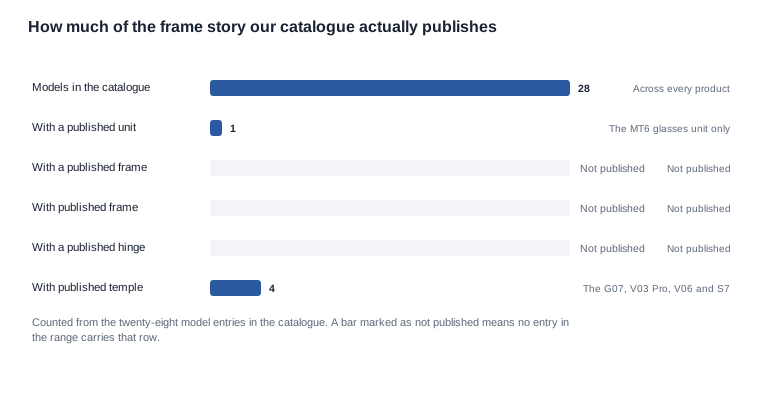
Across the twenty-eight model entries in our range, the frame story is thin and uneven. One entry carries a complete-unit weight: the MT6 at 158 g, which is the glasses unit including the 265 mAh cell and the camera and excluding the foldable 1200 mAh charging case. Four entries publish temple architecture — the G07 with an ultra-slim, detachable temple, the V03 Pro with flexible temples, and the V06 and the S7 with a removable inner frame and an ergonomic frame design statement across the sport class. Two entries carry an IP54 marking, the same V06 and the S7. Colour options are published on two entries, with three on the V03 Pro and four on the V06. Everything else about the frame — material, dimensions, temple length, temple curve, hinge construction, section thickness, finish standard, plating and adhesion — is empty for every model in the range.
That is not a criticism of the catalogue. It is a measurement of where a frame specification sheet in this category has to be completed by the buyer, and it is exactly the kind of number a buyer should ask any supplier for: not "are your frames good" but "which of your rows are commitments and which are descriptions".

The ten rows a frame sheet needs before two sheets can be compared
Two specification sheets can only be compared when they populate the same rows. Here is the reference set, with our catalogue's status against each one, because a buyer who asks for this table in a quotation gets a much sharper answer than one who asks for "more detail on the frame".
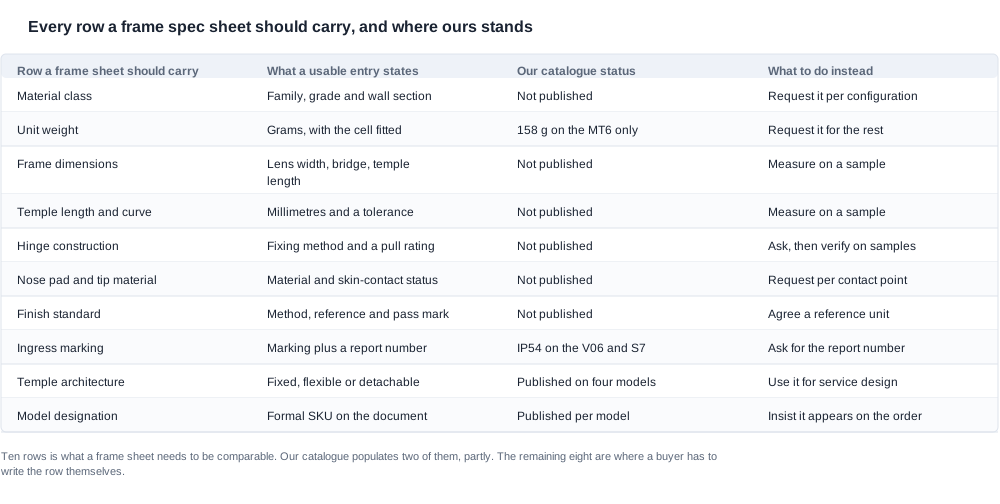
Material class. A usable entry names the family, the grade and the wall section, because a family name alone describes a hundred products at once. Ours is empty for every model.
Unit weight. In grams, with the cell fitted, since the cell and the electronics are part of the unit the customer carries. Ours carries 158 g on the MT6 only.
Frame dimensions. Lens width, bridge and temple length, because they decide whether an optician can set the product and whether a prescription programme is possible at all. Ours is empty for every model.
Temple length and curve. Millimetres with a tolerance. A frame that is too long slides; a frame that is too short pinches at the ear, and neither is knowable from a datasheet. Ours is empty for every model.
Hinge construction. The fixing method and a pull-force rating. Ours is empty for every model.
Nose pad and temple tip material. These are the skin-contact surfaces, and their material and chemical-restriction status are separate questions from the frame body. Ours is empty for every model.
Finish standard. The inspection method, the physical reference and the pass mark. Ours is empty for every model.
Ingress marking. A marking plus a report number. Ours carries the IP54 marking on the V06 and the S7 without an attached third-party report number, which is why we publish it as a marking rather than as a tested result.
Temple architecture. Fixed, flexible or detachable, and whether the temple can be replaced at distributor level. Ours is published on four entries, and it is the row that matters most for service design and for what a buyer replaces rather than replaces entirely.
Model designation. The formal SKU on the document, so that the paperwork, the packaging and the customs description can all name the same thing. Ours is published per model for twenty-two of the twenty-eight entries, while the AR glasses entry, the AI electrochromic entry and the bone-conduction entry carry no model designation at all.
The four rows that decide whether the product can be fitted and serviced
If a buyer can only push for four of these, push for these.
Frame dimensions and temple length decide whether the product can enter an optician's channel at all, and whether a prescription programme is a realistic roadmap rather than an aspiration. A brand that intends to sell through optical channels cannot defer this row, because the channel will not accept the product without it and no supplier will invent it.
Hinge construction and pull-force rating decide the warranty exposure. A frame that snaps at the hinge and a frame whose temple flexes are different products with different warranty terms, and the difference is invisible until somebody drops the unit. The cheapest structural improvement in this product class — a steel threaded insert into a reinforced boss — requires no tooling profile change and no silhouette change, and it is almost never requested.
Temple architecture and replaceability decide whether a broken temple is a returns problem or a service problem. On a detachable or removable design, the distributor swaps a part; on a bonded design, the distributor swaps a product. Those are different cost structures and they should not be discovered after the first season of returns.
Unit weight decides whether the product stays in use, and it is the row most often answered with an adjective. Weight published as a range across models usually means one configuration was measured and generalised, so the follow-up that resolves it is the sample size and the spread.
The chemical-restriction rows that do not appear on any frame sheet
One family of rows is missing from frame specification sheets more often than any other, and it is the family with regulatory consequences rather than engineering ones.
The obligations for consumer products placed on the EU market reach coatings, adhesives and plating, not only the base polymer. That means the material name on a frame sheet tells you almost nothing about whether the finished product is compliant, because the compliance question is asked about the assembly rather than about the resin. A frame sheet with a material class and nothing else cannot answer it, and the supplier's material certificate cannot answer it either, because a material certificate covers a material and the product's declaration covers the product.
What to request, per configuration, is therefore a specific set of documents rather than a single sheet. The material declarations for the components that are actually in the frame — the resin or alloy, the plating, the adhesives, the nose pads and the temple tips, since these are the skin-contact surfaces. The product-level declaration for the configuration you are buying, dated after the last component change, because a declaration that predates a component change is not evidence of anything. And, where the frame carries a metal core or a plated surface in contact with skin, the identity of the party who declares the nickel release, which is usually the plating house rather than the frame supplier and is therefore a question about your own supply chain below the supplier.
The practical reason to ask for these rows explicitly is timing. Chemical-restriction questions are cheap to ask before the artwork and the tooling are settled and expensive afterwards, because the answer can require changing a plating process or a supplier, and both of those carry a schedule. A frame specification sheet that lists them as standard rows is telling you the supplier has a chemical compliance process. One that omits them is telling you the question has not been asked.
Why a specification sheet and a purchase order answer different questions
The most common sourcing error in this category is treating a row on a specification sheet as if it were a commitment. It is not, and the gap between the two documents is where every dispute in frame sourcing actually lives.
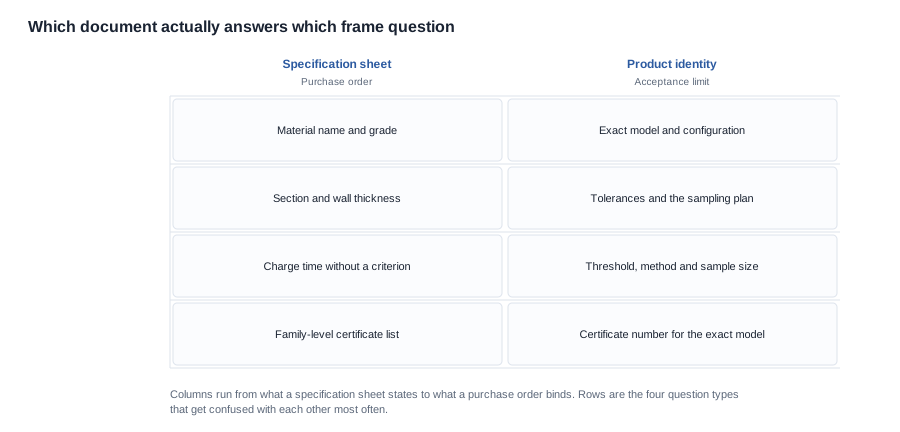
Read the matrix by row. A specification sheet states material identity — the name, the grade, the section. A purchase order states exact model and configuration. A specification sheet states the section and the wall thickness as a description; a purchase order states tolerances and the sampling plan. A specification sheet states a charge time, and a charge time without a starting state and a termination criterion is not a usable commitment — every entry in our range publishes one, with twenty-six of twenty-eight at two hours or less and the D17 and the ZH12 at roughly one hour, but none states the conditions, so the order has to state the threshold, the method and the sample size. And a specification sheet states a family-level certificate list while the order states the certificate number for the exact model, because a family-level document is not coverage for a branded configuration.
None of this means the specification sheet is useless. It means it is a starting position for a conversation, and the conversation has to reach the purchase order. The certification checklist for imported consumer electronics covers the document side of that transfer in more detail, and the regulatory layer that most spec sheets skip is set out in how regulations affect frame materials.

Three routes to the same missing number
When a row comes back empty, a buyer has three options, and choosing the wrong one is what turns a documentation gap into a commercial dispute.
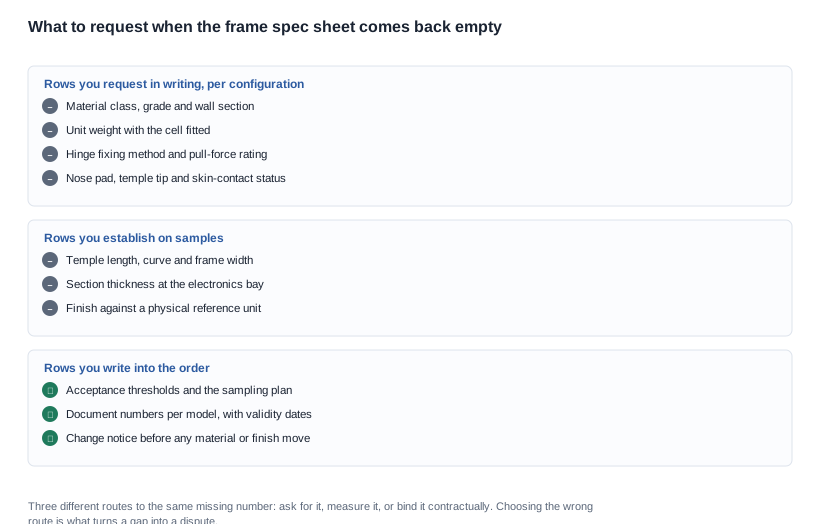
Route one: ask for it in writing, per configuration. This is the right route for anything that can be stated as a fact about a specific unit — the material class and grade, the unit weight with the cell fitted, the hinge fixing method and pull-force rating, the nose pad and temple tip materials. The request should be per configuration, not per model, because a model in this range can carry different cells, different temple types and different finishes, and a model-level answer will average across them.
Route two: establish it on samples. This is the right route for anything that depends on a human body or on a specific build — temple length and curve, frame width, the section thickness at the electronics bay, and the finish judged against a physical reference unit. These are not requests a factory can answer in writing because they are not properties of a specification; they are measurements of a particular unit in a particular configuration. The buyer's obligation is to write the measurement method down first, because a method designed afterwards is a description of whatever was found.
Route three: write it into the order. This is the right route for every row that has to survive a dispute — acceptance thresholds and the sampling plan, document numbers per model with validity dates, and a change-notice obligation before any material or finish move. These rows are not "missing information" in the sense of a gap in somebody's knowledge; they are terms the buyer is entitled to set.
How to tell which route a row needs
The test is short. If the answer changes when the cell, the temple type or the finish changes, it is a per-configuration request. If the answer depends on a person's head, it is a sample measurement. If the answer has to hold up a year later when a lot is disputed, it belongs in the order. Most rows need two of the three, and the mistake is stopping at the first.
The commercial reason this matters is timing. A request made before the deposit is answered as information. The same request made after the first shipment is answered as a concession, and the supplier knows the difference. Total cost, in other words, is dominated by when you ask rather than by what you ask.
What to do in the first two days of a sourcing programme
The ten-row table is only useful if it is applied to every supplier in the same way, at the same time, before any of them has had an opportunity to shape the answer.
Day one: send the table, not a request for details. A request for "more information about the frame" produces a brochure. A request that names the ten rows produces a comparison, because a supplier either has the answer or does not, and both outcomes are useful.
Day one: fix the configuration before you fix the questions. Every row has to be answered per configuration, so the cell, the temple type, the finish, the colour and the charging interface have to be settled first. Asking for per-configuration values against a moving configuration produces answers that cannot be tabulated.
Day two: tabulate the blanks as data, not as gaps. Build one sheet with the ten rows down and the suppliers across, and mark every empty cell. The pattern of blanks tells you more than the values do: a supplier that populates structure rows and leaves cosmetic rows empty has a different risk profile from one that does the reverse, and neither is wrong, but they need different contracts.
Day two: decide the sample plan from the blanks. Every row that is still empty after the responses come back is a row the sample programme has to close, and the sample plan should name the method for each one. A sample plan written before the sheets arrive is a measurement plan; one written after is a shopping list.
Before you order anything: move the answers into the purchase order. A row answered on a specification sheet is still a description. The shortlist should be made on the answers, and the order should be written on the criteria.

What a complete spec sheet would let you decide, and what it still would not
A sheet populated across all ten rows would let a buyer do three things decisively.
Shortlist on structure. Comparing a detachable temple against a bonded one, a reinforced boss against an unreinforced one and a characterised section against an unspecified one becomes an engineering comparison rather than a preference comparison. That changes which supplier you are dealing with, because it changes what you are buying.
Write the order without asking again. The rows become clauses with thresholds already attached, and the first article becomes a verification rather than a negotiation.
Price the programme honestly. Setup, tooling amortisation, per-configuration minimums and the number of documents you have to re-issue after a change all become visible before the deposit rather than after it. Two quotations can differ by a few per cent on unit price and by a factor on total programme cost, and the factor is always in the rows a specification sheet left empty.
What a complete sheet still would not do is settle sizing. Sizing is a measurement against a face, not a specification, and no factory publishes it accurately for you because the person who would measure it is your customer. The sample is not a confirmation step; in this category it is the only measurement you will get. For the longer treatment of pressure points and sizing, see frame materials and long-wear comfort, and for the sport class where the most ergonomics-adjacent detail is published, see sport smart glasses.
The rows our own catalogue leaves empty, and why we do not fill them
Stated plainly: we will not publish a material composition we cannot evidence, and we will not tell you a weight for a model where the manufacturer has not published one. The catalogue gives us 158 g for the MT6 and nothing comparable for the rest of the range; filling the rest with typical values would produce a table that appears complete and is not.
On regulatory matters, be careful what you infer from a material name. Chemical-restriction obligations for consumer products placed on the EU market reach coatings, adhesives and plating, and a base polymer statement does not address them. We can point you at the documentation structure to request, but we will not convert a family-level certificate position into a per-model coverage claim.
Our view is that a frame is the part of a smart glasses product a buyer keeps longest and complains about first. Weight, geometry and joint durability are not finishing details, and a supplier who treats them as finishing details is telling you something about their inspection process.
Where to start with a ten-row table
If you would rather work from the ten-row table above, send it to a supplier with your configuration filled in — that is usually the fastest way to get a real answer, because it removes the ambiguity that a general request for "frame details" always contains.
Related reading
- How regulations affect frame materials — the compliance layer most spec sheets skip
- Materials and ergonomics overview — the full frame and fit picture
- Certification checklist for imported consumer electronics — what to request in writing
Tell us the frame design you are targeting and the use case, and we will tell you which published configurations exist for it and which frame figures we cannot yet evidence.


