

Smart glasses frame materials: where compliance work sits
Frame material is where compliance work is most often underestimated. A buyer treating a smart glasses frame as a plastic part assumes the only question is whether the base polymer contains restricted substances, and that a single test report answers it. In practice the base polymer is the easy part. Coatings, plating, adhesives, nose pads and the solder and plating inside the temple each carry their own obligations, and the frame is also where several of the EU's general product safety requirements land, because a frame is a structural part of a radio product that sits against the head.
This is a procurement problem rather than a technical one, and the reason it keeps arriving late is that it is usually owned by a technical team rather than by the compliance and supply chain teams. The order of work matters more than the depth of work: the frame stack has to be listed before a report can be matched to it, the model designation has to be settled before a report can be checked against it, and the destination markets have to be written down before an obligation can be selected at all.
Our own position on this range is stated plainly at the end of this article. In short: our catalogue's export-certification page carries ten patent certificates — eight appearance-design patents and two utility-model patents — and names no CE, FCC or RoHS marking, and we publish no certificate number, no issuing body, no validity date and no component-level report for any model. Those are the exact items a buyer's own conformity file will need, and a company-level statement is not a substitute for any of them.
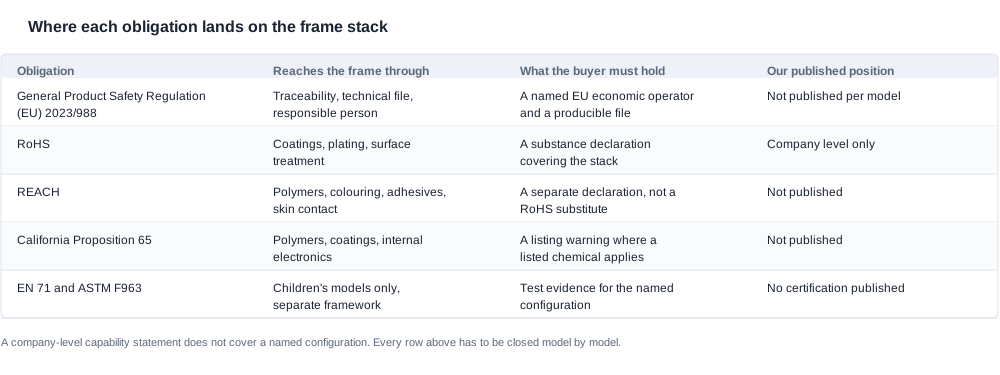

What the General Product Safety Regulation asks of a frame
The EU General Product Safety Regulation, (EU) 2023/988, has applied since 13 December 2024 and reaches all non-food consumer products placed on the EU market, including through online sales. For a frame, the practical obligations are less about chemistry and more about traceability and information, which is exactly why a frame specification is often the wrong document to start from.
- Traceability. The product must be traceable to its producer, to its importer and to the economic operator responsible for it in the EU. For a buyer this means the model designation has to exist, has to be printed, and has to be consistent across the product, the packaging, the listing and the technical file.
- Technical documentation. A body of product information must exist and be producible on request, covering what the product is, how it is intended to be used, and what foreseeable risks it presents.
- Information to the consumer. Instructions, warnings and identification must accompany the product and must appear on the online listing. This is where most marketplace rejections happen, because the listing is checked separately from the paperwork.
- An EU-established responsible person. A named entity in the EU whose details appear on the product, on the accompanying documents and on the online product page. This is the single item most frequently missed on online listings after 13 December 2024, and it is the one marketplaces check first.
For a wearable, "foreseeable risks" includes the ones a buyer rarely thinks about when the focus is on materials: small parts a child could access, sharp edges at a hinge, a battery carried against the head, and a charging interface that is an opening in an enclosure. None of these are frame-material questions in the narrow sense, and all of them are frame questions in the regulatory sense, because the frame is where the small part, the edge, the interface and the skin contact all live.
There is a second layer that bites hard in this category and is easy to miss. A material change is a product change. The frame is a component of the product the file describes; altering the resin, the coating, the plating or the adhesive alters the product and therefore the documented description of it. A programme that changes frame material after the file is written has to reopen that file, and the cost of reopening it is a queue at a test laboratory rather than a factory slot.

What the buyer's own technical file has to contain
The technical documentation is the artefact that survives the programme, and the part of it that concerns the frame is usually the shortest and the least owned. Six groups of content belong in it, and each one can be closed by a request rather than by a test.
- Product description. What the product is, which models it covers, and the configurations within those models. A configuration is a different product for this purpose: a different colour, a different temple option or a different case changes the frame stack and therefore the description.
- The manufacturer and economic operator chain. Who produced it, who imported it, and which EU-established entity is responsible. Names, addresses and the model designations each of them covers.
- The frame stack and its substance position. Base polymer and grade, coating, plating, adhesive, nose pads, and the mapping from each component to the document that covers it.
- Risk assessment for foreseeable misuse. Small parts, edges at the hinge, the charging interface as an opening, and the cell carried against the head. These are frame risks, and they belong in the frame's own assessment rather than in a general product argument.
- Instructions, warnings and identification. The wording that must appear on the listing, and the wording that must appear in the carton. Divergence between the two is a common cause of a listing rejection.
- The traceability record. How a unit on the market can be tied back to its production lot and therefore to the material it was built with. Without this, a complaint three months after launch is an argument rather than an investigation.
The order matters. Item two and item six are administrative and cheap. Item three determines the test programme, so it should be settled before the programme is costed. Item four is the one that most often gets deferred, and it is the one a marketplace assessor or a recall will look for first.
The substance layers: RoHS, REACH and Proposition 65
Substances and chemicals are governed separately from general product safety, and three frameworks come up in almost every frame enquiry.
RoHS restricts a defined list of hazardous substances in electrical and electronic equipment. For a smart glasses product, the electronics and the internal assembly matter as much as the visible frame, and the frame enters the scope through coatings and surface treatments rather than through the polymer itself. A buyer who has a RoHS report for the electronics has, in practice, a report for the electronics.
REACH governs chemical substances and, through its restriction provisions, reaches materials in contact with skin: frame polymers, colouring, coatings and adhesives. This is the requirement most often missed, because a buyer who asks for a RoHS report is not asking for a REACH one, and the two are not interchangeable. A statement that a product is "RoHS compliant" does not answer a REACH question about a skin-contact coating.
California Proposition 65 applies to sales into California and addresses listed chemicals including certain phthalates and lead, which again reaches frame polymers, coatings and the internal electronics. It is a warning regime rather than a certification regime, and it produces a labelling obligation rather than a document.
Note the pattern across all three: they reach the frame through treatments and secondary materials rather than through the base material. A supplier who provides one report and treats the frame as covered is making an assumption you should not accept, and the assumption is expensive when a listing is rejected or when a distribution partner runs its own incoming test on a random unit.
The practical correction is to demand a component map rather than a report. Ask for the frame stack as a list — base polymer and grade for the front and the temple, coating, plating, adhesive, nose pads, and the internal solder and plating — and then ask which document covers which component. A supplier with a real file can answer this in a table. A supplier without one will restate the general statement.
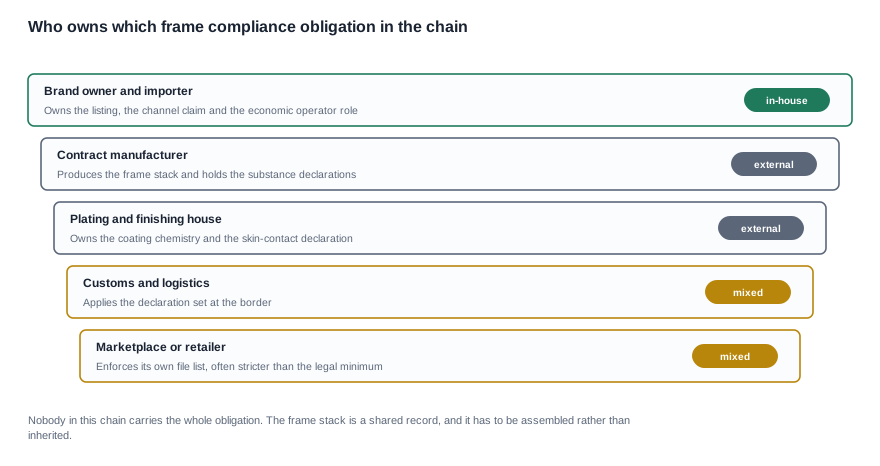
Who in the chain owns which obligation
The frame compliance picture is assembled, never inherited. The brand owner and importer carry the listing, the channel claim and the economic operator role. The contract manufacturer holds the substance declarations for the frame stack it builds. The plating and finishing house owns the coating chemistry and the skin-contact declaration, and it is frequently a different company from the frame supplier. Customs and logistics apply the declaration set at the border, where a mismatched model designation is discovered. The marketplace or the retailer enforces its own file list, which is frequently stricter than the legal minimum and changes without notice.
That last layer deserves emphasis for procurement purposes. The channel specification is a live input to the design, not paperwork. It is often the document your returns come back against, it moves faster than the law, and a programme designed only to the legal minimum will still fail the channel. The disciplined approach is to obtain the channel's current file list before the frame specification is frozen, because a file list that arrives late is a file list that changes the frame.
Four traps in the substance file
Even when a buyer asks the right questions, four traps account for most of the problems we see come back from a frame compliance audit.
The family-level report. A document that names a platform rather than a configuration is treated as coverage for everything under it. It is not. A report that covers the frame without a case does not cover the frame with a case, and a report that covers the front does not cover the temple.
The right report for the wrong component. A RoHS report that covers the electronics is often the only report in the file, and it says nothing about the coating on the outside of the temple. The fix is the component map, not a second general statement.
The changed plating house. The frame supplier declares the alloy, and the plating house declares nickel release. When the plating house changes, the alloy does not change and the declaration does not travel with it. A buyer who accepted the frame supplier's declaration has accepted a document that never covered the plating.
The finish that was never in the file. Changing a colour or a finish to meet a retail deadline is a frequent occurrence, and it changes what the substance declaration has to say. A programme that treats a finish change as a cosmetic decision will produce a product whose file no longer matches the product on the shelf.
None of these traps needs a laboratory to avoid. Each needs a written change-control rule, and a rule written before the first change is made is worth considerably more than one written after it.

A children's or school channel changes the project, not the degree
If your channel includes children's eyewear, the obligations differ in kind rather than in degree. Children's products placed on EU and US markets typically attract additional requirements — EN 71 in the EU, and CPSC or ASTM F963 requirements in the US — that sit alongside the general product safety framework rather than inside it. The test methods, the sample conditioning and the small-part criteria are different, and a report produced for a general consumer product does not carry over.
Our catalogue includes three children's entries: the A05 and the A06 children's smart protective eyewear at 40 mAh, and the A07 children's smart audio eyewear at 70 mAh. The published documentation for these models states that certification status is not provided at all. That is an honest gap rather than a failure, but it means the compliance work for that category has not been done, and no specification sheet can substitute for it. Treat it as a project with a schedule, not as a checkbox.
Two commercial consequences follow. The first is that a children's channel has a longer and less predictable path to a launch date, and the date has to be built from the testing programme rather than from the production schedule. The second is that the same applies to any school or education channel, where procurement requirements routinely exceed consumer-market requirements without the product being any different at all.
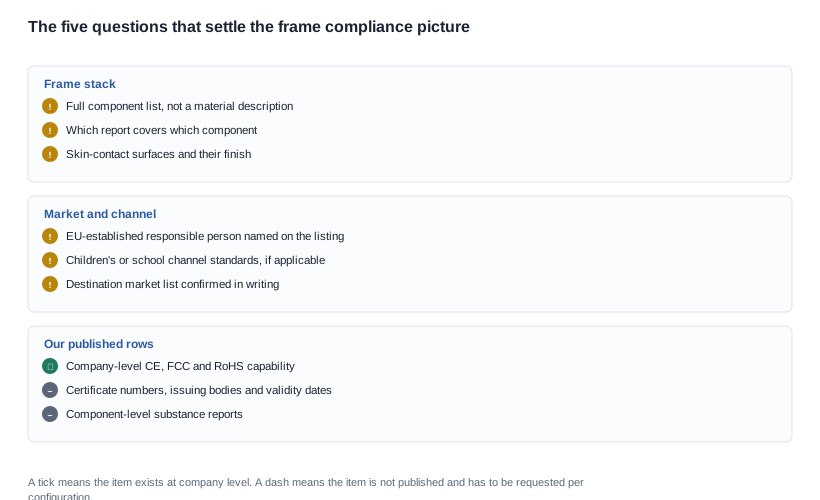

The questions that settle the frame compliance picture
Five questions, in this order, will close the frame compliance file for a consumer channel.
- What is in the frame stack — base polymer, coating, plating, adhesive, nose pads? Get it as a list, not a description. "Acetate frame" is not a stack, and a report that covers the base polymer has not covered the adhesive.
- Which reports cover which components? A RoHS report covering the electronics does not cover the coating, and a REACH statement does not substitute for one. Ask for the component-to-document mapping in writing.
- Who is the EU-established responsible person, and does the name appear on your product listing? This is the item most frequently missed on online listings after 13 December 2024, and it is the one marketplaces check first. It is also a question for your own legal entity, not for the factory.
- Is the model designation on the report identical to the designation on the product? A model code that differs by one character between the document and the label defeats the report. Compare the strings character by character, and check the designation on the units on receipt rather than on the sample box.
- For children's or school channels, which additional standards are covered? If the answer is that none are, plan for that before you promise a delivery date, and treat the additional testing programme as a project with its own schedule and its own risk.
Two further questions are worth sending in the same email, because they cost nothing and they change the way the supplier answers the first five. Ask which of these rows were verified on production tooling rather than on a supplier's datasheet, and ask which changes to the frame trigger which re-assessment. A supplier who can name the subset of documents a material change touches has a change-control process; a supplier who says nothing changes is either wrong or has never run a change.
What our compliance position is, and what it is not
The working rule we apply: we will tell you what documentation exists for a configuration and what does not, and we will not present a general compliance statement as though it were a frame-specific report. For this range, the only certification our catalogue shows is an export-certification page of ten patent certificates, eight of them appearance-design patents and two utility-model patents, and certificate numbers, issuing bodies, validity dates and component-level reports are not published for any of it. We also publish no frame material, temple material or lens material for any model, which means we cannot present a material declaration for the frame stack either, and we will not infer one from a listing.
We do not publish minimum order quantities, unit prices or lead times as fixed numbers on this site; all three are confirmed per enquiry. We will also be direct that this is a company-level capability statement and that your own compliance file requires the model-level documents behind it. Any supplier that gives you a certificate number without an issuing body and a validity date has given you something you cannot check later.
What we will do is tell you early which requirements are structural and which depend on your channel, because a children's channel is a different compliance project from a consumer channel even when the product is identical, and because a frame specification frozen before the destination markets are written down is a specification that will have to be reopened.
The clauses that keep the compliance risk where it belongs
Most frame compliance problems are contractual problems wearing a technical disguise. Six clauses, drafted before the first order rather than after the first problem, move most of them.
- A documentation obligation tied to the exact model designation. The supplier provides the documents for the model designation as ordered, and any change to the designation invalidates them. Written as a condition rather than an expectation, because a condition can be enforced and an expectation can only be mentioned.
- A component-to-document mapping as a deliverable. Not a general statement, a table. It is the only way to prove that the coating was covered by something.
- A change-control notice obligation. Any change to the material, the coating, the plating, the adhesive or the production site is notified before it is implemented, with the affected documents named.
- A re-issue obligation. When a change is made, the documentation package is reissued, and the programme waits for the reissue rather than proceeding on the old file.
- A retention obligation on the supplier's side. The supplier keeps the substance and test records for a stated period, so that a buyer asked to evidence a product two years after delivery can obtain it. This is a due diligence item that is routinely missed and routinely needed.
- An indemnity or remediation clause for a failed audit. If the file does not support the product, the cost of correcting it sits with the party that controlled the frame specification. Without this clause the cost falls on whoever notices first, which in practice is the buyer's own compliance team during a listing review.
The negotiable parts of this are the format of the mapping, the retention period and the review interval. The non-negotiable parts are the identification of the model, the notice obligation and the remediation route, because those are what make the rest of the file verifiable.
The certification checklist sets out the documents to request and the order to request them in. For the frame specification rows themselves, frame materials and the spec sheet covers what is published and what is not.
Related reading
- Frame materials spec sheet explained — the published rows and their gaps
- Materials and ergonomics overview — comfort and fit alongside compliance
- Kids eye protection technology — where children's requirements diverge
Tell us the destination markets and whether your channel includes children or schools, and we will tell you which documented requirements apply to your specific configuration.


