

Microphone compatibility is an odd phrase, and it is worth untangling because it is used for at least three different questions, each of which has a different owner and a different answer in this category. Two of them are technical and one of them is a question about legal boundaries, and the most common commercial error in this area is answering the wrong one and treating the answer as complete.
The published position sets the frame. Our catalogue describes the audio range as open-ear acoustic structure, directional audio and intelligent noise reduction, with Bluetooth V5.3 on the K01 and the K02 and V5.4 on the D12 and the LC-105-2, the D11 and the YK12, and the G07 and the LC-105-1; cell configurations from 40 mAh in the children's models to 290 mAh in the camera models; charging in two hours or less across the range except the D17 and the ZH12, which are quoted at about one hour; rated runtimes from roughly five to eight hours in the camera models, roughly six to eight hours on the audio models, and roughly twenty hours in the A05, the A06 and the A07. The sport models publish the same rows on Bluetooth V5.4, with 70 mAh × 2 on the YKC02, 115 mAh on the D17 and 100 mAh on the ZH12. On microphone specifications specifically, the published position is that there is no third-party measurement: no pickup distance, no frequency response, no signal-to-noise figure, no cancellation depth, and no microphone count for any model.
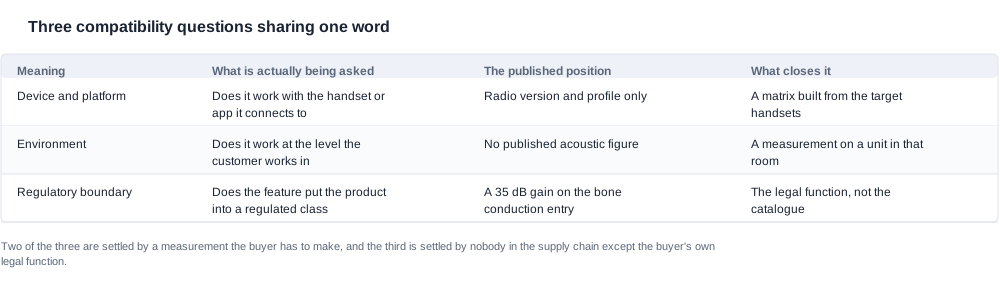
Smart glasses microphone quality: three compatibility questions, one shared word
Meaning one: does it work with the device it connects to
This is the real technical compatibility question, and it has more dimensions than most buyers expect, because the microphone path is only the last link in a chain.
The first dimension is the connection itself. A microphone has to be picked up by the host device, and the published Bluetooth versions in this range are 5.3 and 5.4. The version matters for the radio link rather than for the audio, but it determines what the radio is capable of doing in the first place.
The second dimension is the profile, and this is the one that bites. Many products on this form factor negotiate a hands-free profile rather than a stereo profile, because the mono microphone path and the stereo playback path are combined in one profile. A buyer who assumes a product supports both, and who then discovers it only supports one, gets a very different audio experience from the same hardware. This is worth asking about explicitly, because it appears on no specification sheet in this category.
The third dimension is the codec. The published data says nothing about which codecs are supported, and codec support is what determines whether the microphone path stays intelligible in a lossy environment. A missing codec is a compatibility problem that presents as poor quality rather than as a failure to connect, which is why it survives into the field.
The fourth dimension is the application. If the microphone is used with a companion application, that application's own audio handling and the platform's routing behaviour both enter the picture. This is a boundary between a product question and a software question, and it is one that a device supplier cannot answer for a third party's application.
Meaning two: does it work in the environment
This is where the published thinness of the data becomes a practical problem rather than an academic one.
A microphone in an open-ear device is a microphone with no seal, in an environment where sound reaches it by paths that a sealed headset never had to handle: through the temple, through the frame, and reflected from the side of the head. The person's own voice arrives at the microphone at a level that is a function of how the frame sits on that particular head, and a different geometry changes the ratio.
Compatibility is therefore environment-dependent in a way that device-to-device compatibility is not. Two devices that both "work" behave differently in a moving vehicle, on a windy street, or in a space with a steady noise floor. There is no published figure in this range that tells you where the limit is, and we will not supply one. What we can do is tell you which questions to put to the engineering team, and help you design a test that produces a number for your own units.
Meaning three: the legal boundary, which is the one that is easy to get wrong
In the United States, over-the-counter hearing aids are regulated under the classification at 21 CFR 800.30, and the definition covers air conduction devices. A bone conduction product with an amplification gain in the hearing range sits in a different regulatory category, and the boundary is not something a buyer can resolve by reading a catalogue.
Our catalogue entry for the bone conduction product in this range publishes an amplification gain of 35 dB, a 200 mAh cell, roughly seven hours of rated runtime, charging in two hours or less, and Type-C charging. That 35 dB figure is the most aggressive published parameter in the entire catalogue, and the certification status for that entry is not published to us. It is also a microphone-related question in disguise, because a product that amplifies sound is making a claim about what the person hears.
The general lesson for a buyer is to establish, before building a marketing proposition around an audio feature, whether that feature puts the product into a regulated category in the destination market. It is a legal question, it has a long lead time, and no catalogue can answer it.
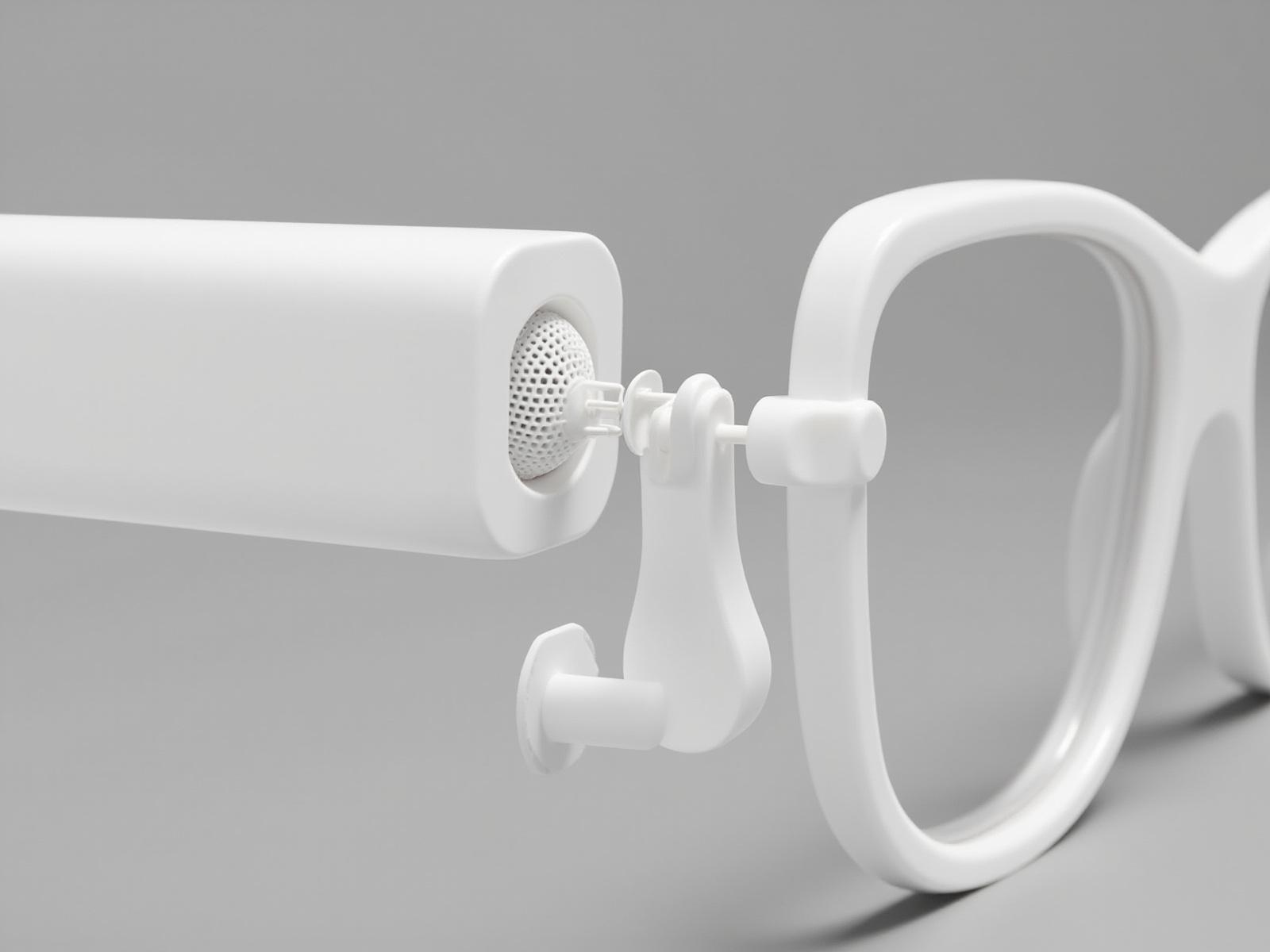
The device, profile and codec surfaces a microphone has to survive
The four questions that resolve the connection question
- Which Bluetooth profiles and codecs does the device support, and which one does it negotiate by default? This determines the microphone path in practice rather than on paper.
- Does the microphone behave the same when the product is used with the companion application and when it is used as a plain headset? These are frequently different code paths with different results.
- What is the microphone behaviour in the environment the product is sold into, measured on a fixed protocol? Ask for a test you can replicate, and expect to run it yourself on units.
- Does any feature of the audio chain put the product into a regulated category in the destination market? For anything with amplification, this is the first question rather than the last.
The order matters. The first two are answerable in an email and take minutes; the third needs a unit and a script; the fourth needs a legal function and a long lead time. A buyer who works them in a different order spends the time in the wrong place.
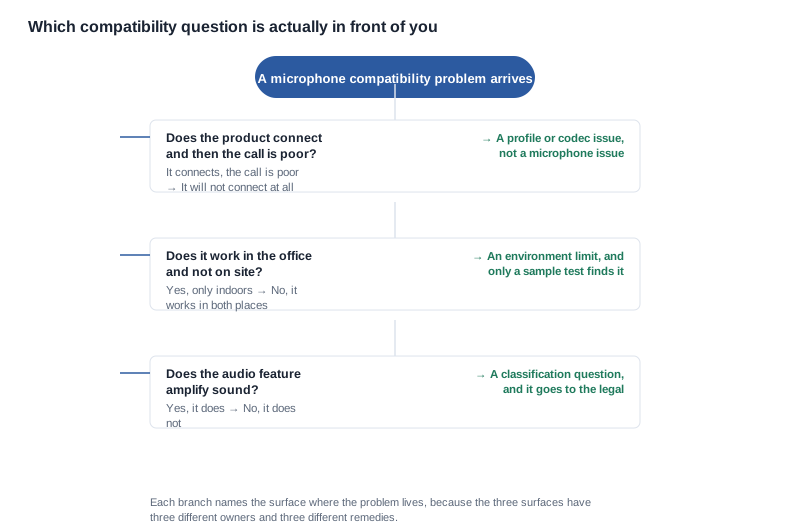
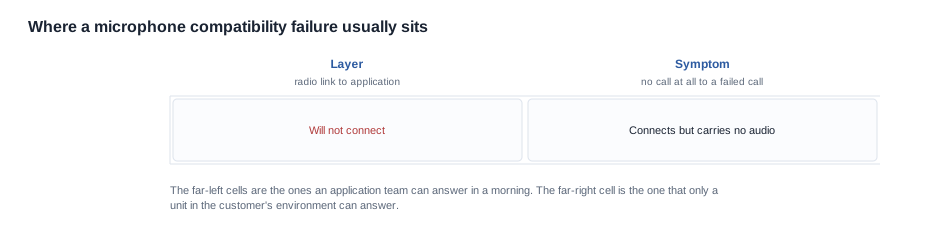
The chart above is the triage for a compatibility complaint that arrives without detail, and it is worth keeping on the desk of whoever takes support calls. The three branches do not overlap, and each one sends the problem to a different owner: the engineering team, the test bench, or the legal function.

Why a product that connects can still be incompatible
The category of failure that is most often misfiled is the one where the connection succeeds and the call is still poor. Three things produce it, and they have different remedies.
A profile that was negotiated rather than the one the product supports is the first. The symptom is a call that connects, plays audio, and carries the near-end voice at a lower level or a different character than expected. The remedy is a configuration change, and it has to be made on the product side.
A codec that was never supported is the second. The symptom is a call that is intelligible in a quiet room and degrades quickly on a lossy network. The remedy is either a codec change or an acceptance that this product is for a different network condition.
An application path that treats the microphone differently from the headset path is the third. The symptom is that the product sounds right in a plain call and wrong in the application, or the reverse, and the support tickets describe it as inconsistent. The remedy is a software fix, and the owner of it is not the device supplier.
The reason this matters commercially is that all three present to the customer as the same complaint. If the buyer's compatibility work stops at "it connects", all three arrive in the field and all three get answered with a replacement unit, which fixes none of them.
Environmental compatibility, and the limits of a sealed comparison
Why a sealed comparison misleads in this form factor
A comparison against a sealed headset is the easiest comparison available and one of the least useful, because the two products are solving different problems in different acoustic environments. The sealed headset wins on pickup and loses on the thing the glasses form factor exists for, which is leaving the ear open.
Three structural differences produce the gap, and each of them has a consequence for a buyer comparing two products.
The distance from the mouth to the microphone is larger on a frame and it changes during a call, because a person turns their head constantly while speaking. A result measured at a fixed distance in a static position is therefore a result about a posture rather than about a product.
The acoustic path is open. Sound arrives through the frame, along the temple and reflected from the head, and the frame material and the temple geometry both change the response. This is why two units of the same model can differ, and why a unit from one batch can differ from a unit from another.
The person's own voice is a competing sound source at a much higher level than it would be at a sealed earbud, and a processing chain tuned to suppress it can also suppress a distant voice, because the two resemble each other to the algorithm in some conditions.
What environmental compatibility can and cannot be settled with
Two things can be settled with a sample and a script. The first is whether a unit is intelligible at a stated background level, in a stated room, on a stated network. The second is whether the result is consistent between two units drawn from the same batch.
Three things cannot. The first is where the environmental limit lies, because that is a design property of the chamber and the processing, not a test outcome; a test finds the boundary, it does not explain it. The second is whether a different supplier's product would be better in the same environment, because the comparison needs both products in the same room with the same script, and a supplier's own demonstration is not that. The third is anything about how the result will be in a country with a different network, because the network is part of the environment.
That is the honest limit of the data in this category, and it is why a compatibility claim without a protocol behind it is worth very little.
Making one room stand in for another
The environmental result is only portable between products if the room is portable between products, and that takes more discipline than it sounds.
Three things have to be reproduced rather than described. The background level, which means a reproduced source at a measured level rather than a description of a street. The spectrum of that source, because a steady hum and a broadcast of the same level produce different results and a speaker that cannot reproduce the spectrum is not a fair test. And the distance and head angle, which is a fixture rather than a measurement, because a person holding a product at a stated distance will not hold it at that distance for the whole call.
The two environments that are hardest to reproduce are the two that matter most in a field-service channel: a moving vehicle and a windy site. For both, the honest approach is a result measured on site and a protocol that records the site conditions rather than a laboratory surrogate, and a comparison that is treated as indicative rather than as a specification. A protocol that promises more than it can reproduce is worse than no protocol, because it produces a number that will be compared against a number from a different room.
The regulatory boundary an audio feature can push a product across
When an audio feature changes the product's legal category
The audio feature is the one most likely to change a product's regulatory position without anyone noticing, because it is added as a feature rather than as a design decision. Two characteristics of the feature matter.
The first is whether it amplifies sound. The bone conduction entry in our range publishes an amplification gain of 35 dB, and a product that amplifies sound is making a claim about what a person hears. In the United States the over-the-counter hearing aid classification at 21 CFR 800.30 covers air conduction devices, and a bone conduction device with a gain in the hearing range sits near a boundary that the catalogue cannot resolve for you. The product category reference is set out at bone conduction audio technology and the boundary itself at medical boundary compliance.
The second is whether it captures data. A microphone that is only a microphone is an audio component. A microphone behind a voice function is an input to a data path, and the data path has documentation obligations of its own under the radio and cyber requirements that apply to connected equipment. We cannot publish a privacy architecture for a product whose firmware and application ownership the company has not confirmed, and we will not invent one.
The sequence that keeps the boundary question off the critical path
The boundary question is expensive when it arrives late, because its lead time is not the buyer's to compress. Three steps keep it off the critical path.
Ask the classification question in the first message, before the sample and before the artwork. The question is specific: does this feature, in this configuration, in this destination market, put the product into a regulated category, and who is the legal function that answers it? The answer is not a technical judgement and it does not belong to the supplier.
Ask it about the configuration rather than about the product. A feature that is not in the shipped configuration does not change the category, and a product with two variants may have one regulated variant and one that is not. The question has to be asked per configuration, because the product-level answer hides this.
Record the answer as a condition on the purchase order. The clause is short: the product shall not be supplied in a configuration that places it in a regulated category in the destination market, and the buyer shall be notified before any change to the audio chain. A clause like that costs nothing and it converts a regulatory risk into a commercial term that the supplier is managing.
A microphone compatibility matrix you can build from a sample
Building the matrix, and why it doubles as a support script
The matrix is the deliverable most often promised and least often built, and it is worth building because it answers two problems with one document. The first is the shortlist question — which candidate is compatible with the handsets that dominate your market. The second is the support question — when a customer reports a call that fails on one handset, the matrix is the first document anyone opens.
Six columns cover it in practice, and each column names a handset model that dominates the volume in a particular market rather than a handset that is easy to obtain.
| Column | What is recorded | How it is established |
|---|---|---|
| The handset model | The exact model, not the family | From the support ticket volume |
| The connection result | Connects, and stays connected | A live call on the unit |
| The profile negotiated | Which profile the product used | Asked of the supplier, confirmed by behaviour |
| The intelligibility result | The far end repeating a fixed phrase | One script, one judge, one distance |
| The failure mode if it fails | Silent, distorted, or dropping | Recorded during the same call |
| The remedy | Configuration, application, or environment | Set by whoever owns the layer |
The matrix should be built on the two or three handsets that dominate the volume in each market, and rebuilt when the platform lineup changes, because a handset that negotiates a different profile is a different host device even when the model name is similar. The rebuild is cheap if the script was written down the first time.
The six-questions request that produces it
Six questions, asked together, produce most of the matrix without a single unit.
- Which Bluetooth profiles does the product support, and which one does it negotiate by default?
- Which codecs does the product support, and what happens when none of them is available?
- Does the microphone path differ when a companion application is used?
- What is the documented behaviour when the connection drops and is re-established?
- What is the stated behaviour of the mute control, and is it a hardware or a software state?
- What is the recommended re-connection procedure, in the form a support script can use?
Questions four, five and six are the ones that turn a matrix into a support asset, because they are the questions the customer is actually asking when the call fails. The rows a buyer's compatibility file should contain are described further at microphone specifications to request.
The compatibility claims we can and cannot make
What we will and will not state
We publish the audio technologies exactly as the catalogue states them, and we will not attach a microphone figure, a profile list or a codec list to any model in this range, because none is published to us and a wrong microphone claim in a product listing is a claim a customer will test. We will not tell you that a product is compatible with a platform or an application in a way we cannot evidence, and we will not resolve a regulatory boundary question on your behalf — that one belongs with your legal function, and for the bone conduction entry in particular the position is clear enough that it should be the first conversation rather than the last.
We will tell you which models exist, what the catalogue publishes for each of them, and where the catalogue is silent. We will tell you which of the three compatibility questions each of your questions actually sits in, because a buyer who knows that a symptom is environmental rather than a connection fault will not spend the week on the wrong fix. And where a question needs a unit and a script, we will say so rather than answering it in a way that sounds complete.
If you send us the environment, the host devices and the destination markets, we will say which of these questions are decisive and which of them are already answered by the published rows, and the underlying technology position is set out on noise control and microphone pickup.
Related reading
- Noise control and microphone pickup
- Microphone specifications to request
- Bone conduction audio technology
- Medical boundary compliance
Send the environment, the host devices and the destination markets and we will say which of these questions are decisive.


