

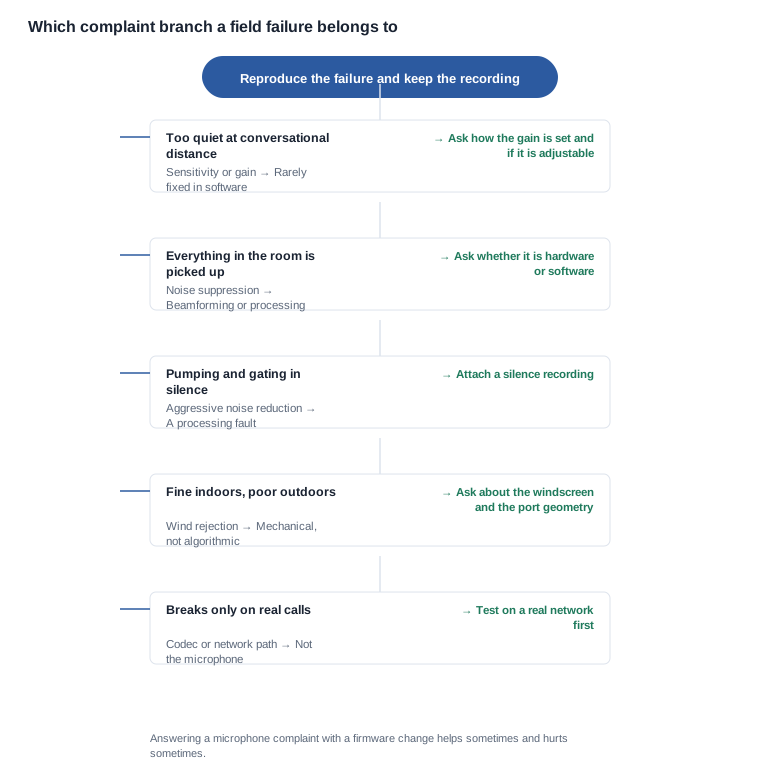
A microphone complaint is a symptom, and a buyer who treats it as a diagnosis will spend the upgrade budget on the wrong remedy. The complaint in a field return almost never arrives as a technical description. It arrives as "the other person cannot hear me", and that single sentence is consistent with five quite different causes, four of which have nothing to do with the capture hardware. That is why smart glasses microphone quality smart glasses upgrade considerations is structured as a decision tree keyed on the complaint rather than as a list of improvements: the decision a sourcing team has to make is not which product is better, but which branch the complaint belongs to, because the branches have different owners, different costs and different lead times.
The commercial stake in getting this right is straightforward. An upgrade applied to the wrong branch costs the tooling or the NRE, and it does not fix the complaint. The customer still cannot hear. What the brand has acquired is a different problem, a later delivery date and a unit price that no longer matches the original quotation.
Smart glasses microphone quality: a complaint is a branch, not a diagnosis
The buyer behind this question is a product manager or a sourcing manager holding a returns file. The returns are not numerous enough to be a crisis and are too numerous to be noise. The customer reports that the voice is unusable in some conditions and fine in others. The supplier's response is that the sample performed well. Both statements are usually true, and the disagreement is about which condition the product was supposed to handle.
The mistake that costs money is to start from the remedy rather than from the symptom. "Let's move to a platform with better noise handling" is a remedy, and it is a legitimate one for exactly one branch of the five. Applied to the other four, it produces a unit that is more expensive, later, and no better at the thing the customer complained about — because the complaint was never about the capture hardware.
There is a second reason to work this way. Each branch has a different owner, and the owner determines the negotiation. A processing fault belongs to the firmware side of the supplier, and it can often be fixed on a firmware release schedule with no new tooling. A geometry fault belongs to the mechanical side, and it cannot be fixed without a tooling change and a re-validation cycle. A codec or network fault belongs to neither the factory nor the product, and no upgrade to the glasses will resolve it. A buyer who has not located the branch will negotiate with the wrong party about the wrong deliverable.
The five questions that locate a branch before any money is committed
- Is it too quiet at conversational distance, or is everything in the room captured too? A quiet result and a loud result point in opposite directions, and the same word — poor quality — describes both.
- Does it pump, gate or cut out during silence? Thirty seconds of silence on a table answers this in a way no description does.
- Is it fine indoors and poor outdoors? If the difference tracks with movement through air, the cause is mechanical.
- Does it fail only on real calls, and not on a local recording? If so, the capture path is probably not the problem.
- Is the complaint consistent across units, or concentrated in a subset? A concentration in one production lot points at a component or process change rather than at the design.
The fifth question is worth doing first in a returns analysis, because it is free. It is a query against the returns data by batch, and it costs nothing but a spreadsheet. The answer separates a design fault, which is present in every unit, from a process fault, which is present in some, and those two have completely different commercial remedies.
Why most microphone complaints are processing faults wearing a hardware costume
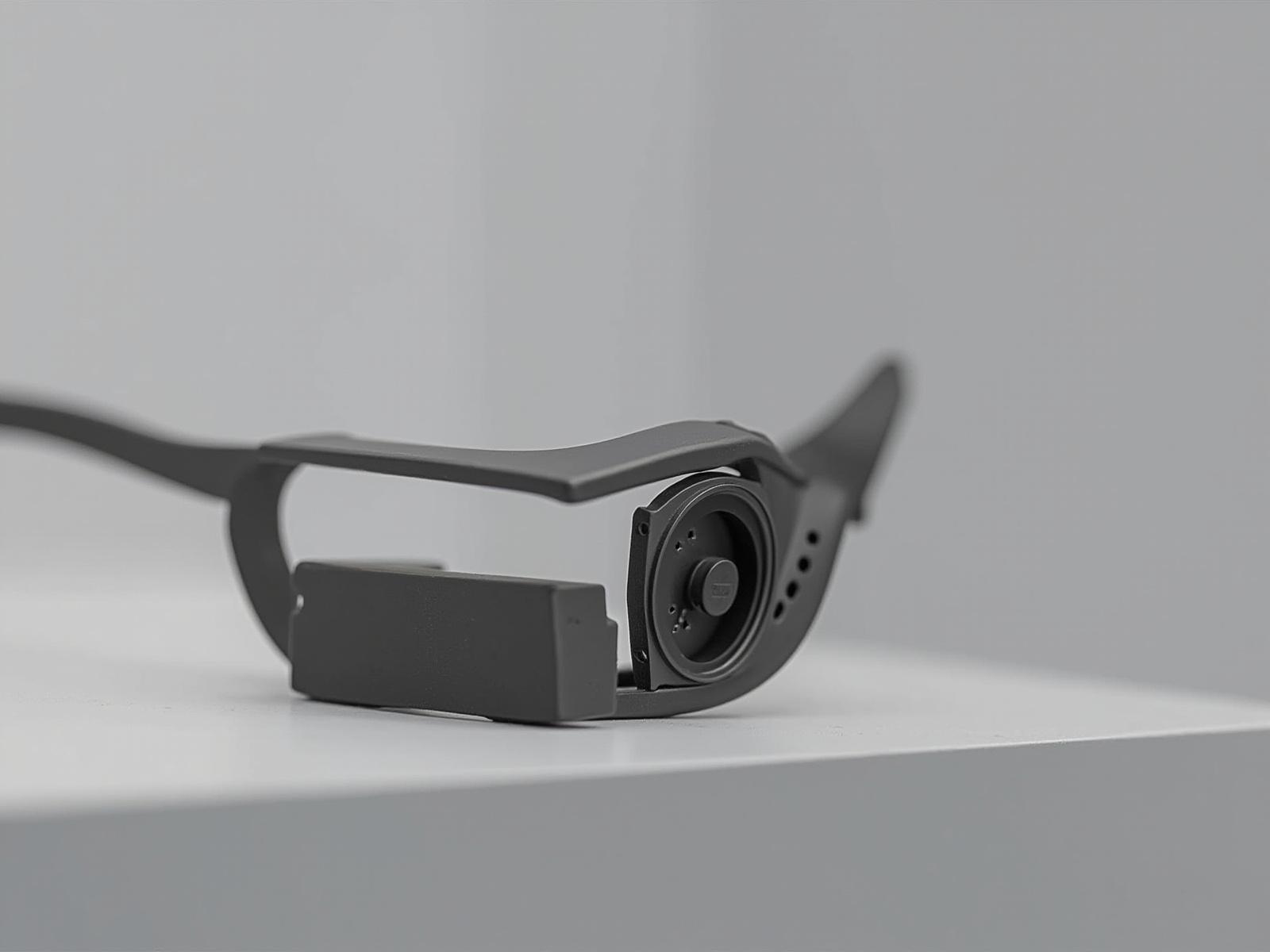
Three of the five branches are processing faults, and they are commonly misread as hardware faults because the symptom arrives in the language of hardware. "The microphone is poor" is usually a statement about the gain structure, the gating threshold or the wind handling rather than about the capsule.
The reason is that processing faults are the ones a supplier can fix quickly and a buyer therefore assumes are hardware. A gain default, a gating threshold, a noise-handling parameter: each of these is a firmware change, and firmware changes are cheap and fast. The complaint is described in hardware language because that is how a customer experiences it, and the remedy gets described in the same language.
The practical consequence for a sourcing team is that the first upgrade conversation should never be a hardware conversation. It should be a baseline conversation, because until the current platform has been measured on a fixed protocol, nobody knows whether the complaint is in the capture path, in the processing, or in the network, and an upgrade to a different platform will reproduce the same complaint at a higher price.
What the published rows can and cannot contribute to this decision
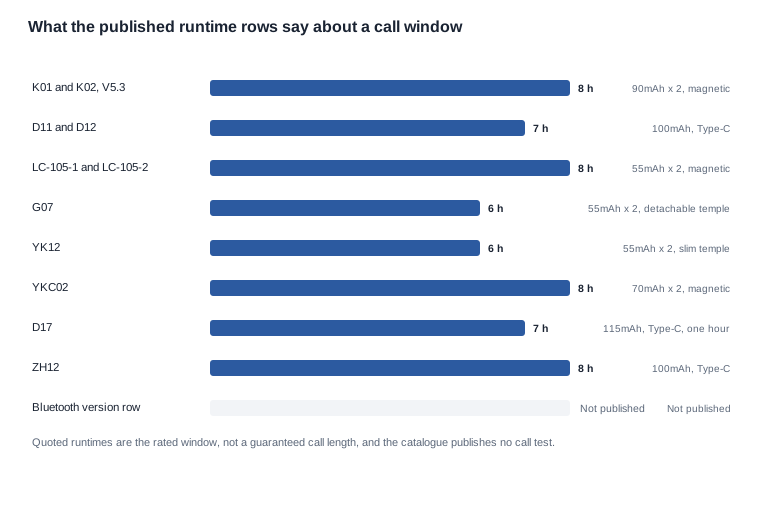
The electrical rows are genuinely useful here, because a call window is a power question before it is an acoustic one. In this range, the K01 and the K02 publish two 90 mAh cells, roughly eight hours of rated use, magnetic charging and Bluetooth 5.3; the D11 and the D12 publish a single 100 mAh cell, roughly seven hours, Type-C charging and Bluetooth 5.4; the LC-105-1 and the LC-105-2 publish two 55 mAh cells, roughly eight hours and magnetic charging; the G07 and the YK12 publish two 55 mAh cells and a shorter rated window of roughly six hours, the G07 noted for a slim and detachable temple and the YK12 for a surround sound slim temple; the YKC02 publishes two 70 mAh cells and roughly eight hours; the D17 publishes 115 mAh, roughly seven hours and about an hour to charge on Type-C; and the ZH12 publishes 100 mAh, roughly eight hours and about an hour to charge on Type-C.
Two of those rows carry a warning a buyer should hold onto. A rated runtime is a quoted window, not a guaranteed call length, and the catalogue publishes no call test for any of these models. And a charge time is quoted without a stated start state and without a stated end criterion, so it cannot be turned into an allowance for a shift change. These are not defects in the data. They are the correct limits of what the data can be used for, and knowing them prevents a buyer from building a duty roster on a figure that was never intended to support one.
The five branches and the intervention each one calls for
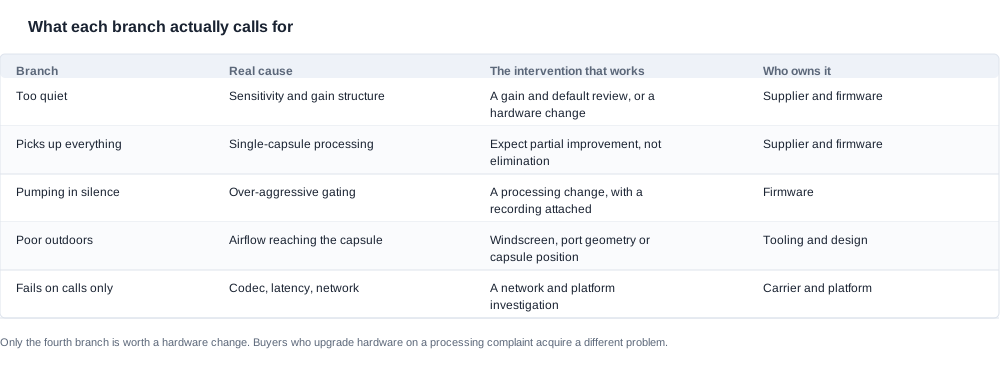
The table below is the working decision aid. The branch is defined by the complaint, the real cause is what is actually happening, the intervention is what fixes it, and the owner is who has to act.
Branch one: too quiet at conversational distance
This is a sensitivity or gain problem. It is rarely fixed in software alone, because a gain increase brings the noise floor up with the signal, and if the original complaint was quietness rather than a poor signal-to-noise ratio, the remedy simply moves the problem.
Ask how the gain is set and whether it is adjustable. If the product has a user-facing volume control, test the extremes, because many microphone complaints are complaints about the default rather than about the hardware. A platform whose gain is fixed at the factory and not documented in the published rows is a platform whose acoustic ceiling the buyer cannot see, and that is a selection criterion rather than a defect.
Branch two: everything in the room is captured too
This is the noise suppression question. Beamforming — using two capsules in a defined geometry to favour one direction — addresses it at the hardware level. Single-capsule processing addresses it partially, and partially is the operative word. Expect improvement, not elimination.
A supplier who says the product has intelligent noise reduction without naming a mechanism has not told you whether the improvement is in the geometry or in post-processing, and those two have different costs, different limitations and different upgrade paths. A geometry improvement requires a hardware change and re-validation. A processing improvement requires a firmware change and a test cycle. The trade-off between them is one of schedule and tooling rather than of performance.
Branch three: pumping and gating during silence
This is the signature of aggressive noise reduction, and it is a processing fault rather than a hardware one. It is also the complaint that disappears in testing and returns in the field, because it is most audible in quiet conditions — a quiet office, a vehicle at night — and nobody tests there.
This is the clearest case for a firmware change, and it should be raised with a recording attached rather than described. A thirty-second silence recording is the cheapest and most diagnostic piece of evidence a buyer can collect, and a supplier who cannot act on it will not act on a description of it either.
Branch four: fine indoors, poor outdoors
This is wind rejection, and it is mechanical rather than algorithmic. A capsule on a temple sits in the airflow, and wind noise is low-frequency, which is exactly the range a basic filter handles worst. Software can reduce it; it cannot remove it, because by the time the air movement reaches the capsule the acoustic information is already contaminated.
If the product is used outdoors, treat this as a hardware constraint. A windscreen, a change to the port geometry, or repositioning the capsule relative to the airflow are the interventions that work, and all three require tooling. Ask about all three, because a supplier who can only answer the third one has only done the cheap part of the work.
Branch five: breaks only on real calls
Test this on a real network before changing anything. A loopback test and a local recording skip codec behaviour, packet loss and any processing that only engages on a network path, and those are common causes of a call that sounds acceptable in testing and is unusable in practice.
If the problem reproduces on a real network and not locally, the diagnosis points at end-to-end latency or at an interaction with the platform, not at the microphone. This is the branch where an upgrade is most likely to be entirely wasted, and it is also the branch where a buyer is most likely to want one, because the customer complaint arrives in the strongest possible terms.

Building the baseline that makes an upgrade measurable
No microphone specification is published for this range — no pickup distance, no frequency response, no capsule type, no noise-handling description, no sampling rate — so there is nothing to compare an improvement against except a measurement the buyer makes. Before any upgrade conversation, record a baseline on the current platform using a fixed protocol:
- Thirty seconds of silence, with the unit placed on a table and the recording left untouched.
- A fixed passage at one metre and at three, using the same script every time.
- A two-minute call on a real network, not a loopback.
- A street recording, with the unit in the position it will actually be used.
Keep the audio. The recordings are the baseline, and they are what any subsequent change is judged against.

The sequence that turns a complaint into a decision runs as follows. Record the fixed baseline on the current platform. Capture a two-minute call on a real network and a street recording. Place the complaint in one of the five branches, with the recording attached. Confirm the branch on a second unit from the same batch. Apply the intervention the branch calls for. Re-run the same baseline, and record the outcome against the baseline rather than against the expectation.
That last step is the one that decides whether an upgrade was worth paying for. A result recorded against the baseline is a measurement. A result recorded against the expectation is an opinion, and it is the one that makes an upgrade programme look successful while the returns continue.
Why the second unit is not optional
The variation between two units from the same batch is frequently larger than the variation between two suppliers. A single unit cannot distinguish a design characteristic from a unit-to-unit spread, which means that a complaint confirmed on one unit may not be a design characteristic at all. Two units of the same batch turn the complaint into a question that can be answered, and the answer determines whether the branch is real or whether the buyer is looking at a spread.
The same rule applies to the intervention. If a change improves one unit and not the other, the change did not address the cause, and the buyer's conclusion about the platform will be wrong.
What an upgrade actually costs, and which branch is worth paying for
The honest position is that most microphone complaints are correctly addressed by changing the processing rather than the hardware, and that changing hardware is only worth the cost in the wind branch. Buyers who upgrade hardware on a processing complaint spend money and acquire a different problem.
The cost differences are large enough to change the decision. A processing change is a firmware release cycle: no tooling, no NRE, no re-validation of the acoustic design, and a schedule that runs in parallel with the rest of the product. A mechanical change — a windscreen, a port geometry change, a capsule repositioning — is a tooling change: new tooling cost, a new validation run, and a lead time that cannot be compressed by adding people. A platform change is larger again, because it resets the certification file, the acoustic qualification, the packaging and the artwork, and because it usually resets the price tier as well.
The questions to ask before committing to any of them
- Which branch is this, and what evidence establishes it? If the answer rests on a description rather than a recording, the branch is a guess.
- Is the intervention a firmware change, a tooling change or a platform change? The answer determines the cost class and therefore whether it needs a new approval cycle.
- Who owns the branch? Firmware, tooling, the carrier, the platform. Asking the wrong owner wastes a cycle.
- What is the acceptance condition for the fix? A fix with no written condition is an opinion, and the returns file will not improve.
- Does the fix change any published row? If the change alters the charge time, the runtime, the interface or the configuration, the catalogue rows and the listing copy have to change with it, and that is a compliance task rather than a marketing one.
The fifth question is routinely missed and it is the one that creates a downstream problem. A firmware change that alters the default gain or the noise handling can change the battery drain, and a battery drain change alters a published figure that a product page and a specification file are already carrying.
The checklist to run before an upgrade is approved
Five criteria, in the order they should be applied, and each one has a document behind it.
- The branch is established by a recording, not by a description. The evidence is attached to the complaint and identifies the unit and the batch.
- The intervention is classified as firmware, tooling or platform, with the cost and the lead time stated for that class.
- The owner is named, and the owner has accepted the branch in writing rather than acknowledged it.
- The acceptance condition exists before the change ships, written the way the incoming inspection will apply it.
- The published rows have been re-checked against the change, and any altered figure has an owner and a date.
Two trade-offs sit underneath all five. The first is speed against evidence: every step skipped to save a week is a step that converts a cheap diagnosis into an expensive one later. The second is scope against usefulness: the fifth criterion often creates work, because a change that improves the complaint also alters a published specification, and the specification has to be updated whether or not the buyer thinks about it. Neither trade-off argues for skipping the checklist. They argue for doing it once, early, where it is cheap.
A signs-that checklist for the buyer who has not yet decided whether to escalate at all: complaints that cluster in one batch, complaints that appear only on real calls, complaints that are absent on local recordings, complaints that changed character after a firmware release, and complaints that arrive from a single channel while the same product is quiet in the others. Any two of those together are enough to stop a platform discussion and start a branch analysis instead.
A worked example of a branch that was misassigned
This is a worked case rather than a client project. It offers a view of the order. A brand buyer receives returns from a fleet channel complaining that calls are unusable. The supplier's proposal is a platform with a different noise-handling approach and a higher price tier.
The branch check comes first. The complaint is concentrated in units from one production lot rather than spread across the range, which points at a component or process change rather than a design. The complaint is absent on local recordings and present on calls, which points towards the network path rather than the capture path. And the affected units are from a lot where a capsule supplier had changed.
The conclusion is not that the platform is at fault. The conclusion is that the lot is suspect, that the remedy is a lot-level investigation and possibly a re-inspection rather than an upgrade, and that the proposed platform change would have cost a price tier and a lead time without touching the actual cause. The baseline recordings made before the platform was proposed are what allow the buyer to say that with confidence.
Sending a complaint in a form that can be diagnosed
A complaint that reaches a supplier as a sentence will be answered with a sentence. A complaint that reaches a supplier as a recording plus a protocol plus a batch reference will be answered with a branch and an intervention. The difference is not politeness; it is the difference between a negotiation and a cycle.
The minimum package for a diagnosable complaint contains five items. The recording that demonstrates the fault, in the condition where it occurs. The protocol: the script, the distance, the background level and the network. The unit identifiers and the batch reference, so the fault can be tied to a production lot. The same test repeated on a second unit from that batch, which distinguishes a design characteristic from a spread. And the question being asked, phrased as a branch rather than as a demand.
That last item is the one that changes the reply. A complaint that asks for a better microphone will be answered with a better microphone. A complaint that asks whether the mechanism is in the geometry or in the processing, with the recording attached, will be answered with a mechanism.
We will not publish a microphone specification we do not hold, and we will not quote an improvement figure we have not measured. Where samples are sent to us, we will run the fixed protocol with you and tell you which branch the complaint sits in — including the branches where the honest answer is that the microphone is not the cause. The related material sits at noise control and microphone pickup, at microphone quality testing before ordering and at open-ear audio specifications.
Related reading
- noise control and microphone pickup
- microphone quality testing before ordering
- open-ear audio specifications
Send recordings of the failure and we will tell you which branch the complaint sits in.


