

A minimum order quantity in smart glasses is not one number. It is at least four numbers, quoted in at least four different places, and the buyer who sends a request for quotation before working out which of them applies to their own plan will receive a quotation that answers a question they did not ask. The twelve items in this checklist are therefore sequenced before the RFQ goes out, not after the quotations arrive, because every one of them changes what the supplier is being asked to price.
The published configuration options are what turn the checklist from a list of abstractions into a set of specific things to settle. Three colours are published on the V03 Pro and four on the V06, which means a two-colour launch on the V06 is two configurations rather than one product. The L2 Utral is published with either a 900 mAh or a 1400 mAh charging case; the CY03 and the L1 Pro, and the CY05 are published with a 1400 mAh case; the MT6 carries a 1200 mAh folding case. None of those options is a cosmetic choice. Each one is a separate material set, and each separate material set is the place where a separate floor tends to live.
Smart glasses MOQ: what to settle before the RFQ goes out
The buyer, the moment, and the exposure being managed
The reader is a brand-side procurement manager, a channel buyer or an e-commerce seller who is about to open a supply relationship in this category for the first time, or who is opening a second one while the first is still running. The immediate task is narrower than it sounds: there is a range plan, there is a target market, there is a launch window, and there is a budget, and the buyer needs to convert those four things into a specification a factory can quote against.
The exposure that sits behind the task is rarely the unit price. It is the combination of a deposit that leaves the treasury before anything exists, a floor that is quoted per configuration rather than per order, and a documentation route that is assumed rather than scoped. Those three together determine how much cash is committed, how much of it is at risk, and whether the goods can be sold when they arrive. A buyer who has settled the specification carefully and the floor casually has bought the wrong risk.
There is also an internal position to defend. A programme whose minimum was agreed in a meeting and never written down cannot be explained to a finance colleague who asks why the deposit is the size it is, and it cannot be defended when a second supplier offers a lower number for a different thing. The checklist is the document that ends that conversation before it starts.
Why the preparation decides the outcome, not the negotiation
The popular version of a buyer checklist is a list of things to confirm after the quotations arrive: unit price, lead time, warranty, packaging, payment terms. Those are all worth confirming, and confirming them late is a reasonable habit when you are buying something ordinary.
Smart glasses are not ordinary in one specific respect: the specification has more degrees of freedom than the buyer usually realises. Our published range holds twenty-eight models, eleven of which carry a camera, and the camera models split into two published resolution tiers, with eight at 8 MP and three at 13 MP. Charging methods are not uniform either. Seventeen models are published with magnetic charging, seven with Type C, and four — the MT6 and the L1 Pro, and the CY05 and the CY03 — are published with a charging case capacity but with no charging method row at all. Every one of those published rows is a decision a buyer makes, and every decision a buyer makes is a chance for the floors to multiply.
The practical consequence is that a buyer who has specified the model but not the configuration has not specified a product. "The V06" is a family of four published colour options. "The L2 Utral" is two published case options. "The MT6" is a 265 mAh cell paired with a 1200 mAh folding charging case, and the weight published for it — 158 g — is the weight of the glasses body including its cell and camera and excluding the case, whose own weight is not published. A request for quotation that says "the V06, 800 units" is a request the supplier has to interpret, and every interpretation becomes a different quotation.

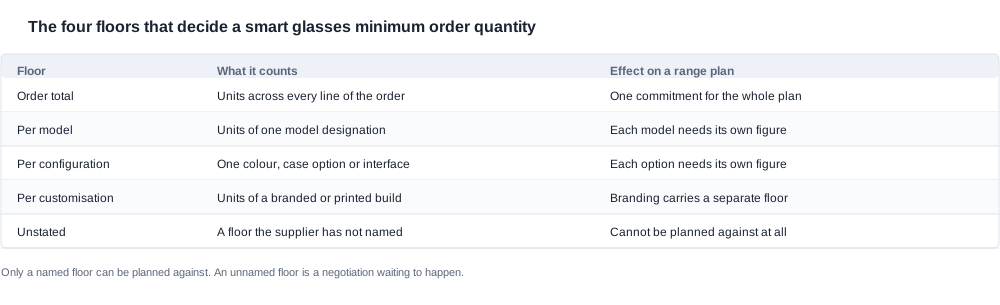
The four floors a smart glasses minimum order quantity can sit on
Order total and per model
The first floor is the order total: a number across every line of the order. The second is the per-model floor: a number for each model designation. These two look interchangeable and are not, and the difference is worth more than a point on the unit price. A supplier quoting per model is telling you that an order of two models at four hundred units each is two orders, not one, and that each model has to clear its own threshold before the factory will schedule it.
For a buyer with a single-model plan, the two floors produce the same answer and the distinction can be left alone. For a buyer with a two-model plan, the distinction is the whole cash commitment, and it is the single most common cause of a launch that has to be halved after the quotation arrives. The way to settle it is not to ask which one is better. It is to ask for the figure on both bases, in writing, and then to see which one the plan as drawn actually needs.
Per configuration and per customisation
The third floor is the per-configuration floor, and it is the one that most often surprises a buyer who believed they had ordered a model. A configuration is a colour, a case option, an interface or a lens combination, and each one creates a separate material set. Four published colours on the V06 is four material sets. Two published case options on the L2 Utral is two. The two case options on the L2 Utral and the 1400 mAh case on the CY03 and the L1 Pro, and the CY05 are not interchangeable with each other, because the case is part of the configuration rather than an accessory that can be added later.
The fourth floor is the per-customisation floor: a separate number for a branded, printed, or firmware-customised build. The logic is straightforward and the arithmetic usually is not. A logo, a printed retail box, a custom colour outside the published option list and a firmware build are each a different setup activity, and each of them can carry its own threshold. A buyer who assumes a custom build inherits the standard floor is assuming the supplier is absorbing a setup cost that it priced separately.
There is a fifth case that is not a floor but behaves like one: a floor the supplier has not named. A quotation that gives a figure without stating what the figure is a floor on leaves the buyer unable to plan against it, because a plan cannot be tested against a term that has no definition. This is the reason the first item in the checklist is about naming the basis rather than about obtaining the number.
The published rows also explain why the floors are not uniform across the range, which is a point buyers often assume the other way around. A camera model carries a cell, a camera module, a charging interface and, in several cases, a charging case, and each of those is a separate material stream. A model published with magnetic charging and a model published with Type C do not share an interface, so a plan that spans both creates two sets even when it spans only two models. A model published with no charging method row at all — the L1 Pro and the CY05, and the CY03 and the MT6 are the four such rows in our catalogue — cannot be assumed to share a charging set with anything, and the safe planning assumption is that it has its own.
A second published row matters for the floors and is easy to miss. The L2 Utral is published in two case options, at 900 mAh and 1400 mAh, and the MT6 is published with a 1200 mAh folding case. These are not case sizes of one product; they are different configurations of it, and the two L2 Utral options cannot be treated as two colours of the same line. A buyer who plans one L2 Utral launch and then discovers two case options in the quotation has discovered two floors in the place where they planned one.
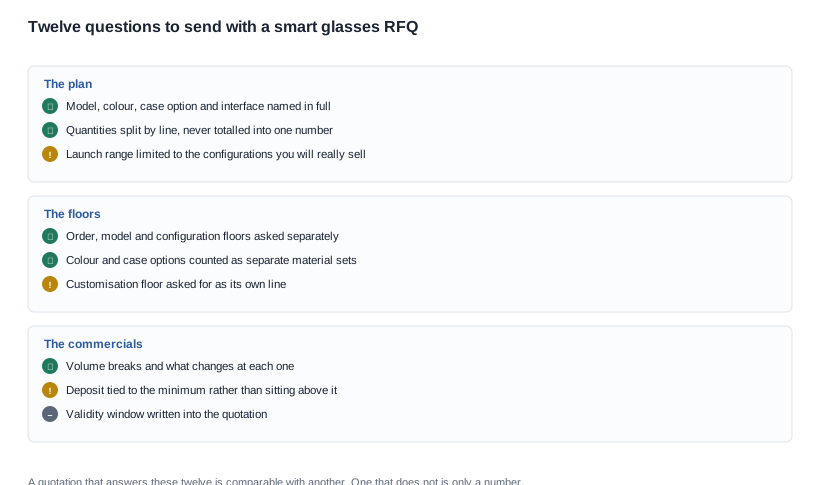
The twelve questions that turn a range plan into a quotable order
The four questions about the plan itself
- Which model, in which configuration, on which line? One line per model, per colour, per case option and per interface. A range plan is a list of lines, and a supplier can only price a list.
- How many configurations does the plan actually contain? Multiply the published option counts out. A plan that reads as one product in a launch deck is frequently four lines once the colour and case options are written against it.
- Which of the published options are you launching with, and which are held back? The held-back options matter as much as the launched ones, because they are the ones that create a second material set later and change the floor at renewal.
- What customisation is in scope at the first order? Logo, printed packaging, a colour outside the published list, a firmware build. Name each one, because each one may carry its own threshold and each one takes calendar time that no order can compress.
The four questions about the floors
- What is the order total floor, and what is it a floor on? Units, value, or production runs. All three exist in this category, and the answer changes what happens when the range changes.
- What is the per-model floor, and does a mixed order count against it? If the answer is per model, a mixed order with every model below its own threshold is below every threshold.
- What is the per-configuration floor, and is the colour or case option inside the model figure or on top of it? This is the question that decides whether a two-colour launch is one commitment or two.
- What is the customisation floor, and does it sit on top of the configuration floor? Ask for it as its own line rather than as an adjustment to a number you were given earlier.
The four questions about the commercials
- What are the volume breaks, and what changes at each one? A quotation that shows the thresholds is a usable quotation. One that shows a single price at a single quantity is a price for one quantity, and it tells the buyer nothing about the cost of the next thousand units.
- How is the deposit sized against the committed quantity, and what is the balance trigger? The deposit is usually the largest single cash movement in the transaction and it is made before anything exists.
- How long does the quoted floor hold, and what happens when it expires? A figure without a validity window is not a commitment; it is an indication.
- What are the terms on a second order of the same configuration? A repeat position agreed at the first order is the cheapest commercial term available, and a buyer who has not asked will renegotiate the whole structure at renewal.
How to check the answer once the quotations arrive
The arithmetic no supplier will do for you
Once three quotations are on the desk, the check that matters is not the lowest number. It is whether the three numbers are the same number. Take each quotation and multiply out the plan: the published option count for each model on the order, times the quantity per option, times the number of floors the supplier is applying. Two quotations that look twenty per cent apart can be identical once the same configuration plan is applied to both.
The method is straightforward. Take the supplier's own floor, multiply it by the number of configurations your plan contains, and compare the result against the total cash your budget was built on. If the result is larger than the budget, the problem is not the floor — it is the plan. The fix is a narrower launch, and it is almost always available: the V06 offers four published colours and the V03 Pro three, so a plan can be reduced in configuration count without reducing its reach.
The answers that are not answers
There are four answers in this category that look like answers and carry no information. "Our MOQ is flexible" carries no information unless it is attached to a configuration and a quantity. "We can do a mixed order" carries no information unless the arithmetic is written out. "The setup fee is waived above a certain quantity" carries no information unless the quantity is named. "We do not have a minimum" carries no information unless the supplier can then explain what happens to a single unit, and a supplier who can will say so.
The way to separate a real answer from an empty one is to ask for it in a form that can be checked: a number, a basis, a configuration, a date. A supplier that can answer in that form is telling you something you can put in an agreement. A supplier that cannot is telling you that the term is going to be decided later, and later is when you have less leverage.
What the smart glasses MOQ questions cost when they are left open
The cost that lands before the first shipment
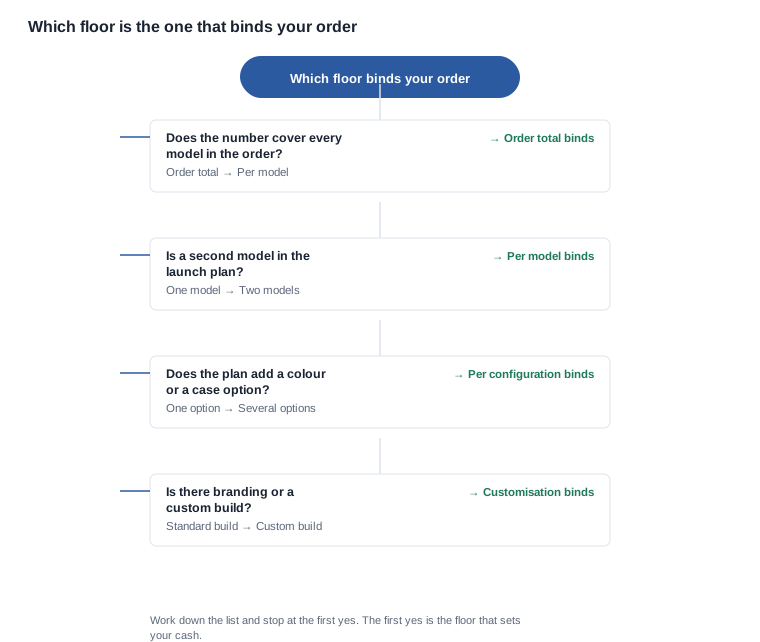
Leaving the floors open does not cost nothing; it moves the cost forward, into the one place a buyer has the least control. A plan that assumed one floor and is quoted three has a cash commitment that has to be found somewhere, and the two places it comes from are the unit price or the launch scope. Cutting the unit price is a negotiation that a supplier can refuse. Cutting the scope is a decision the buyer can make without asking anyone, which is why the sequence in the chart below is the one that protects the programme.
The second cost lands on the schedule. A minimum is not only a commercial term; it is also the quantity at which material can be reserved and a production slot is worth opening. A plan that leaves the floor undefined is a plan whose delivery date is also undefined, and a launch date communicated to a channel partner and then missed is a cost that does not appear on any purchase order.
The cost that lands at renewal
The deferred cost is larger. A minimum that was never written down is renegotiated at renewal, and the person negotiating it may not be the person who placed the first order. That is the point at which the buyer inherits a term they did not choose, priced in a market they have not watched, and with no document to point at. The defence is unglamorous: one page, dated, with the basis and the number on it, filed where the next buyer can find it.

What we can and cannot tell you about our own minimum
The figure we do not publish
We do not publish a minimum order quantity for our own operation, and the reason is not that it is commercially sensitive. It is that our internal statements on the subject have not been reconciled with each other, and a figure we cannot defend is worth less to a buyer than the structure of the question. We would rather say that plainly than hand over a number that changes the moment a colour is named.
We do publish the things the number is applied to, because those are what make the question answerable: the model range, the published colour options on the V03 Pro and the V06, the two published case options on the L2 Utral, the 1400 mAh cases on the CY03 and the CY05, and the L1 Pro, the 1200 mAh folding case on the MT6, the charging method on the twenty-four models that carry one, and the published charge time for all twenty-eight models. The charge time is published for every model in the range, with twenty-six at two hours or less and the D17 and the ZH12 at about one hour, and what it is not published with is a starting state of charge or a termination criterion, so it cannot be used to compare the interruption length of one shift against another.
The structure we will work through with you
What we can do is take a range plan and show you, configuration by configuration, which floors it creates, which of our customisation lines it touches, and what the same plan would look like if you narrowed it. That is a service rather than a publication, and it is the reason we publish the configuration rows so precisely.
The wider framework is under smart glasses MOQ, the commercial structure behind it is in procurement pricing, and the interaction between customisation and the floors is set out in customization options moq impact.
The action to take now. Send the range plan as a line per configuration, with the quantities attached, and ask for all four floors against that plan. We will come back with the configuration-by-configuration breakdown of what the plan creates and what narrowing it would remove.
Related reading
- The three floors — smart glasses moq
- The customisation interaction — customization options moq impact
- The cost breakdown — procurement pricing
Send the range plan as one line per configuration and we will show which floors it creates.


