
There is no industry benchmark for minimum order quantities in smart glasses, and the reason is not that the figures are secret. It is that a minimum is a property of a configuration rather than a property of a product, and a benchmark that averaged across configurations would average across things that are not comparable. The number that circulates in this category is usually a single figure from one supplier, one model, one market and one moment, repeated until it acquires the appearance of a standard. It is not one, and treating it as one is the most expensive shortcut in this part of a sourcing process.
The conclusion: build your own benchmark, and build it by holding three things constant — the configuration, the market and the accessory position — while collecting at least three answers to the same question in the same form. A benchmark you built is worth more than one you inherited, because you know what was held constant and you know when it expired.
Smart glasses MOQ: why the three variables break a promised benchmark
The conclusion, stated plainly
A benchmark in this category has to answer one question: for a given configuration, in a given market, with a given accessory position, what is the smallest order a factory will run and on what terms. The reason no published benchmark exists is that the configuration in that sentence contains more variables than most buyers hold constant. Our own catalogue makes the point: twenty-eight entries across seven product families, eleven of them camera models split between two published resolution classes, twenty-four entries with a published charging interface and four without, five camera models with a published charging case capacity and two more with a case whose capacity is not published. A minimum across that range is an average of different products.
Who goes looking for a benchmark, and what they are really after
The buyer who asks for an industry benchmark is usually a procurement manager who has been told a number by one supplier and wants to know whether it is reasonable. The question is a good one and the instinct behind it is sound; the problem is that the number being tested was generated under conditions the buyer cannot see, so there is no way to compare it with anything.
What the buyer actually needs is not a reference figure but a set of held-constant conditions. The useful question is not "what is the usual minimum" but "what is the usual minimum for a one-colourway camera model with a published case option, sold into one market, with the setup charges shown separately". That question can be asked of three suppliers and answered in writing, and the three answers together are a benchmark in the only sense the term is useful here.
There is a second reason buyers look for one, which is more tactical: a reference figure is leverage. It is easier to say "the usual is around X" than to explain why your configuration should be quoted at a particular number. That tactic works when the reference is real and fails badly when it is not, because a supplier who recognises a borrowed number will either discount the whole conversation or treat the buyer as inexperienced. The defensible version of the tactic is to describe the structure of the answer you received from somebody else, in enough detail that the supplier can tell it is a real configuration rather than an assertion.
It is worth adding that a benchmark has an expiry date even when nobody announces it. The material position behind a minimum changes, the factory's load changes, and the configuration set changes as a range develops. A benchmark collected for one programme is valid for that programme and for the next one only if the configurations are unchanged. Treating an old benchmark as current is the most common way a sourcing plan ends up negotiating against a market that no longer exists.
What a benchmark would have to control for
Three things, and the third is the one most often missed. The first is the configuration, down to the colourway and the accessory position: the V03 Pro is published in three colours and the V06 in four, and the L2 Utral is published with either a 900 mAh or a 1400 mAh charging case, so a minimum quoted for one of those positions does not transfer to another. The second is the market, because the documentation scope for a destination is a fixed cost that sits above the production arithmetic. The third is the point in time, because a minimum moves with material position and with the factory's current load, and a figure collected eighteen months ago is a description of a past configuration of a business.
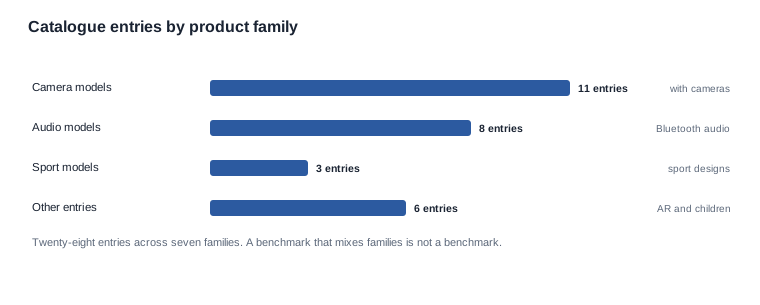
That third chart is the reason a family-level average is meaningless. Eleven of the twenty-eight entries are camera models, eight are audio models, three are sport models, and six are spread across the AR, children's, electrochromic and bone conduction builds. The audio models alone split on the radio version, with the K01 and the K02 published at Bluetooth V5.3 and the D11, the D12, the LC-105 pair, the G07 and the YK12 at V5.4, and they split again on runtime, with the G07 and the YK12 published at about six hours against about eight hours for the LC-105 pair on the same 55 mAh by two cell arrangement. A benchmark that does not say which family it came from is not a benchmark at all.

The five answers you will get, and what each one really is
Reading an answer for what it is
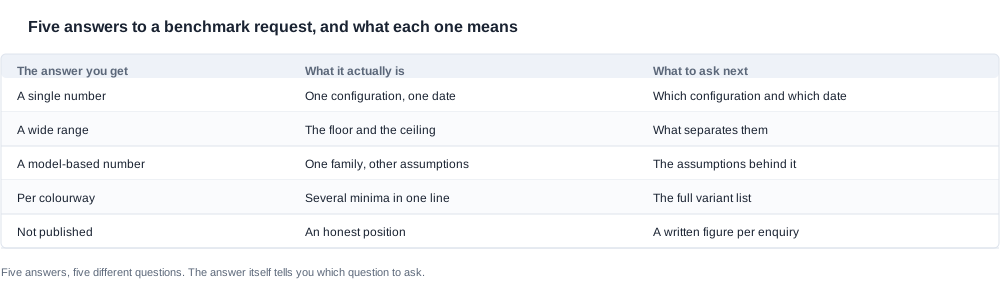
When a buyer asks three suppliers for their minimum and compares the answers, the answers arrive in recognisable shapes. The table below sets out the five, what each one actually represents, and the question that converts it into something comparable. The conversion question matters more than the answer, because the answer is only useful once it has been pinned to a level.
The five answers
- A single number. This is the most common shape and the least informative, because it carries no indication of the level it belongs to. The question to ask is which configuration, which market and which date it refers to.
- A wide range. Often honest, and often two different things joined together — a floor for one configuration and a ceiling for another, or a range that spans a material position the buyer has not chosen. The question is what separates the ends.
- A model-based number. A figure for a family rather than a build, with assumptions about colourway, accessory and market folded in. The question is what those assumptions are.
- A per-variant number. A genuine floor, stated at the level where it actually bites. The question is how many variants the plan contains, because the answer multiplies.
- Not published. An honest position rather than an evasion. The question is then whether the supplier will provide a written figure for a specific configuration, per enquiry, which is the arrangement we work to ourselves.
Only the fourth of these is usable without further work, and even it requires the variant count. The rest have to be normalised before they can enter a comparison, and normalisation is the work that turns three answers into a benchmark.
Building a benchmark you can defend
The three normalisations that matter
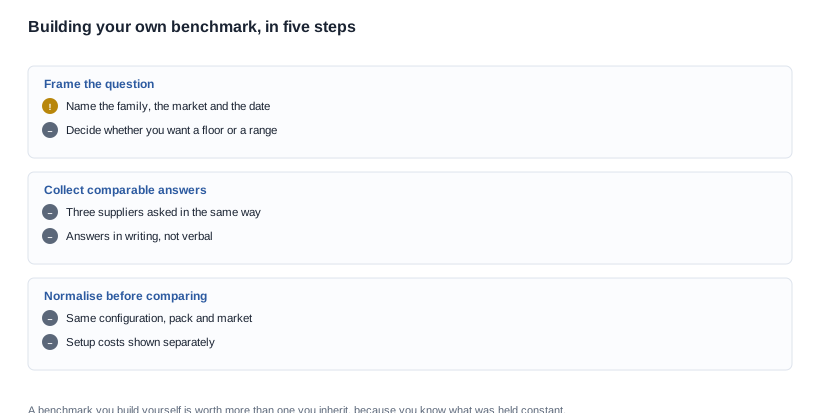
Hold the configuration constant. Decide the model, the colourway count, the case position and the pack before any supplier is asked. Then ask every supplier for the same configuration. This is unglamorous and it is the single thing that most often goes wrong, because buyers tend to send the question they would send to their own team and then compare the answers against each other rather than against a fixed subject.
Hold the market constant. The destination determines the documentation scope, and the scope is a large fixed cost that sits above the production arithmetic. Two quotations into two markets are not a comparison, however similar the numbers look.
Hold the commercial form constant. Ask for the same things from every supplier: the minimum with its level stated, the unit price with setup charges itemised separately, the price tier boundaries, the validity period and the binding schedule milestone. A benchmark assembled from partial answers is not a benchmark; it is a collection of figures that appear to agree.

The five-step sequence, and why the order matters
The sequence in the chart is not a preference. Fixing the configuration first stops the answers describing different products. Fixing the market second stops the fixed documentation cost from masquerading as a pricing difference. Asking every supplier in the same form third is what makes the answers comparable at all. Separating the setup charges fourth is what exposes whether a difference is a pricing decision or a volume artefact. Recording the date fifth is what stops the benchmark expiring silently, which is the failure mode that makes a benchmark worse than no benchmark, because a stale benchmark is used with confidence.
A sixth step is worth adding if the benchmark is going to be used more than once: record the conditions, not only the numbers, so that the next collection can tell whether the conditions still hold.
How many answers you actually need
Three is the working minimum, and the reason is not statistical. It is that with one answer there is nothing to normalise against, and with two you cannot tell whether a difference is a supplier's position or a difference in what the two suppliers thought they were quoting. Three answers drawn from the same configuration and the same market will show you the shape of the range and usually the reason for the spread, which is the finding that changes what you do next.
What to ask is a matter of sequence as much as content. The first question should be about the level, because the answer determines whether the rest of the exchange is worth having. The second should establish the configuration in writing. The third should separate the setup charges from the unit price. Everything after that is refinement.
One practical point about collection is worth making, because it is where benchmarks usually fail. Collect the answers within a short window rather than over a quarter. The purpose of the exercise is a comparison, and a comparison assembled across months mixes figures that were valid at different moments against different material positions. If the collection has to be spread out, record the date of each answer separately and treat any spread between them as a finding about the market's volatility rather than about the suppliers.

What a benchmark cannot tell you
Three limits worth accepting
A benchmark does not tell you whether a supplier will hold the number. It tells you what was offered on a date, not what will be honoured on another date. That is why the validity period is part of the benchmark and not an optional extra, and why a benchmark used six months later has to be re-collected rather than quoted.
A benchmark does not tell you anything about the relationship. A supplier who quoted a figure to help you build a plan and a supplier who quoted a figure to win a competition have produced the same number, and the number is identical in both cases. This matters because the practical value of a benchmark is not the figure but the question it lets you ask next.
A benchmark does not transfer across families. A figure collected on an audio configuration tells you nothing about a camera configuration, because the material set, the accessory position and the documentation scope are different. A camera model may carry a charging case where an audio model does not, and the case is its own order with its own quantity logic.
The one number that has no benchmark at all
There is one figure in this category that has no reference point, and it is the one buyers most want. It is the minimum order quantity for a configuration that has never been built, with a new colourway and a new market. There is no history for it, and every number available to you describes a different build. The only honest approach is to treat it as a build rather than a purchase: to ask for the material position, the setup charges and the schedule as separate items, to ask what would change if the quantity were different, and to build the order plan around a range rather than a single commitment until the first production run has produced a real history.

Using a benchmark in a negotiation
What you may cite, and what you may not
You may cite the structure of an answer you received from another supplier, provided you describe it accurately: the family, the configuration, the market and the date. That is a factual statement about what somebody else offered, and it is the form in which benchmark information travels usefully.
You may not cite a number you cannot source. The problem with an unsourced figure is not only ethical. It is that a supplier who asks to see the source will either produce a better answer or refuse the conversation, and both outcomes are worse than arriving with an honest description of your own requirement. A buyer with no benchmark but a clear configuration, a clear market and a clear forecast is in a stronger position than a buyer with a borrowed number and a vague requirement.
What to ask, in the negotiation itself, follows from the benchmark structure: ask which part of the answer is a floor, which part is a range, and what would move it. The three questions to ask are the same three that built the benchmark, and asking them of a single supplier is how a buyer converts a benchmark into a better offer for their own configuration.
The two questions that decide whether shopping is worthwhile
A benchmark has an obvious use and a less obvious one, and the second is the one that saves time. The obvious use is to check whether a quotation is reasonable. The second is to decide whether to shop across at all.
Two things make the range of minimums across three suppliers either wide or narrow, and they can be assessed before the orders are placed. The first is whether the answers came from suppliers running the same kind of production model. A factory that runs scheduled lots regardless of size and a factory that opens a dedicated slot above a threshold will produce different ranges for the same configuration, and comparing them without knowing which is which produces a spread that looks like a market opportunity and is actually a structural difference. The question to ask is whether the minimum is a floor on the lot size or on the order size.
The second is whether the documentation scope is the same across the answers. If one supplier has priced a market the others have not, the spread is a scope difference rather than a pricing difference, and no amount of further collection will narrow it. Both questions are answerable from the same three answers, and both are worth asking before a buyer spends a second round of effort.
Turning a benchmark into a decision
The value of a benchmark is not in the comparison it enables against other suppliers. It is in the comparison it enables against your own plan. Once three answers are normalised, you can see whether the range of minimums in the market is wide enough to be worth shopping across, or narrow enough that the choice of supplier should be made on the schedule, the documentation scope or the communication rather than on the number. That is the decision the benchmark actually supports, and it is the reason a benchmark built carefully is worth more than a benchmark built quickly.
Where our own figure stands
Our position
We do not publish a minimum order quantity, and the reason is the same one that makes a market benchmark impossible: our own internal statements on the subject have not been reconciled with each other, so a published figure would be a number we cannot defend and that would change the moment a colourway was specified. The MOQ section describes the structure behind the figure instead, and the pricing reference covers how the tiers sit around it.
We will take a specific configuration and quote the minimum for it, state the level it applies to, itemise the setup charges separately from the unit price, give the price tiers and the validity period, and name the binding milestone on the schedule. That is a better answer than a benchmark because it is checkable: it is a figure for a configuration you can name, on a date you can hold us to.
The benchmark inputs, in order
Send the model family, the colourway count, the case position for each line, the destination market, the first order quantity, the forecast behind it, and the date the goods have to land. We will come back with the minimum for that combination, the level it applies to, the tier boundaries around it, the setup charges itemised, and the schedule structure we would propose. If you are collecting a benchmark of your own, we will give you our answer in the same form we would give anybody else, which is the only way a benchmark stays comparable.
Related reading
- Lead time — the schedule half of a comparable answer
- Bluetooth audio glasses — the family where the radio version splits the range
- How a minimum actually works — the chain a benchmark has to hold constant