

A minimum order quantity in this category is not one number with a few conditions attached. It is the output of a chain, and the chain has four levels: the model, the variant set built on top of it, the accessory and packaging lines that sit beside it, and the market whose documentation scope has to be paid for. A supplier quoting a single figure has compressed that chain into a sentence, and the compression is where the misunderstandings come from. The first question is therefore not "what is your minimum" but "which level of the chain is your minimum quoted against".

The conclusion to act on: treat any figure you are given as belonging to one specific combination, and write that combination down before you compare it with anything. Once the combination is written down, the number stops being a matter of opinion and becomes a matter of arithmetic you can check.
Smart glasses MOQ: what the number is actually a minimum of
The conclusion, and the multiplication behind it
A minimum order quantity is the smallest quantity at which one specific build is worth running. The build is a combination, and the combination is the product of four things: a model, a variant set, an accessory and pack position, and a destination market with its own documentation scope. Change any one of them and you are looking at a different minimum, even where the model designation is unchanged. That is why the number is produced last rather than first, and it is why a comparison between two quotations that do not share the combination is a comparison of two different products rather than two different prices.
The buyer who asks the wrong first question
The buyer this article is written for is usually a procurement manager or a channel buyer who has been given a figure and a deadline, and whose instinct is to negotiate the figure. That instinct loses more than it wins, because the number is not a position the supplier chose freely — it is the point at which a specific set of fixed costs stops dominating the unit price. Push on the number and the supplier can only either refuse or reduce it in a way that moves the cost somewhere else, most often into the setup charges, the price tier or the schedule.
The productive first question is the one about the combination: is this minimum quoted for the model alone, for the model with a named colourway and case option, for a specific market, or for a customised build with your own artwork and firmware? Each answer implies a different comparison, and each of them can be asked in a single sentence. Once the buyer knows which of the four the number belongs to, the follow-up questions become obvious, and so does which part of the chain is worth changing.
There is a second thing this buyer is usually managing that the first question conceals: the possibility that the minimum the supplier quoted is simply not the right number for this programme, and that the right answer is to reduce the chain rather than the quantity. A narrow combination is cheaper to run than a wide one, and a wide combination is only worth it when the range itself has been planned. That is a design decision rather than a negotiation, and it is where the value is.
Why the number is produced last
The chain exists because the fixed costs sit at different levels of it. At the model level there is the base build and the material that goes with it. At the variant level there is a separate material set, a separate packaging print and often a separate colour-matching operation. At the accessory level there is a second line with its own quantity logic, and the charging case is the clearest example in our own catalogue: the L2 Utral is published with either a 900 mAh or a 1400 mAh case, the CY05 and the L1 Pro, and the CY03 are published with a 1400 mAh case, the MT6 with a 1200 mAh folding case, the KY06 and the MT5 with a case whose capacity is not published, and the V03 Pro with no case at all. At the market level there is the documentation scope, which is a fixed cost per configuration and per destination.
The consequence is that the minimum is not one number but a stack of numbers that the supplier collapses for convenience. Collapsing is reasonable — a buyer does not want four quotes, they want one order — but the collapse has to be undone before any comparison is meaningful, and the way to undo it is to ask for the chain rather than the total.

The multiplier chain, from model to written minimum
Level one: the model
The model fixes the base build, the cell and the basic material set. Our catalogue holds twenty-eight entries, and they are not one population: eleven camera models, eight audio models, three sport models, and six further entries covering the AR glasses, the three children's models, the electrochromic build and the bone conduction build. The camera models alone split on two published rows — eight of the eleven are published at 8 MP and three at 13 MP — and they split again on the charging interface, which is magnetic on seventeen entries across the catalogue, Type C on seven, and unpublished on four.
None of that is a minimum, but all of it is a reason two "the same model" orders can carry different numbers. The question to ask at this level is simple: is the figure quoted for the base build, and what exactly is included in it?
Level two: the variant set
The variant set is where the multiplication usually happens, and it is the level most often left unexamined. The V03 Pro is published in three colours and the V06 in four, so a range plan across both of them creates a variant count that nobody has agreed. Each variant can carry its own material set and its own packaging, and each one can restart the minimum.
The evidence to ask for is the minimum per variant, or alternatively a clear statement that the minimum applies to the order as a whole regardless of variant. Those are very different answers, and the difference between them is the difference between a plan and a problem. A buyer who discovers the per-variant position after the deposit has paid will find that the second colourway is a second order.
Level three: the accessory and the pack line
The accessory is the level that produces the most surprises, because it behaves like a second order rather than like an extra line on the same order. The questions here are about the case and about the packaging: is the charging case inside the minimum or beside it, does the case carry its own minimum, is the pack a retail box or a bulk carton, and does a different pack change the material set.
These questions have to be asked before the quotation rather than after it, because the answer changes the shape of the order. An accessory with its own minimum turns one commitment into two, and two commitments have two deposit points, two inspection stages and two schedules.
Level four: the market
The market level is the documentation scope, and it is the level with the longest tail of cost because it is largely fixed per configuration and per destination rather than per unit. The Radio Equipment Directive (EU) 2014/53/EU is the framework that applies to the radio side of these products, and there is a separate documentation scope for other destination markets. Two orders of the same model into two markets are two different products from a documentation point of view, and the minimum for each may differ.
Our catalogue carries a company-level page on export certification and does not publish a certification row for individual models, so a per-model certification position is something a buyer has to request in writing rather than read off a specification sheet. The documentation requirements guide covers how a document stack is built for a configuration, and the AI camera glasses range is where the variant positions are described.
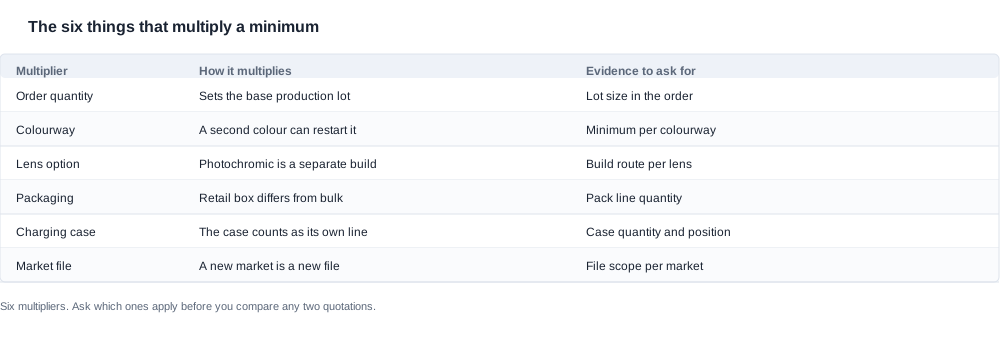
Reading a quotation to find out what the number belongs to
The six fields a comparable quotation carries
A quotation that can be compared with another quotation carries six fields, and a quotation that cannot be compared is usually missing two or three of them. The fields are: the model designation with the variant set attached; the accessory and pack position; the destination market and its documentation scope; the quantity the minimum applies to; the unit price with the setup charges itemised separately; and the validity period of the offer.
Each of the six is a question you asked and got a written answer to. Each is also a place where a plausible-looking omission hides, because a quotation missing the variant set still reads perfectly well as a quotation.
The decision that follows from each field
- Model and variant set. If the variant set is not stated, you cannot know whether a second colourway is free or another minimum. Ask for it in writing before anything else.
- Accessory and pack position. This tells you how many separate commitments you are making. It is the field most likely to change the total.
- Market and documentation scope. This tells you whether the price includes work that is fixed per market. If two suppliers quote different markets, their numbers are not comparable.
- The quantity the minimum applies to. Not the quantity you are ordering — the quantity the minimum is defined at. These are frequently different numbers and they are frequently confused.
- Unit price with setup itemised. Without the separation you cannot tell whether the minimum is protecting the setup or protecting the material.
- Validity period. A minimum without a validity period has not been agreed, it has merely been said.
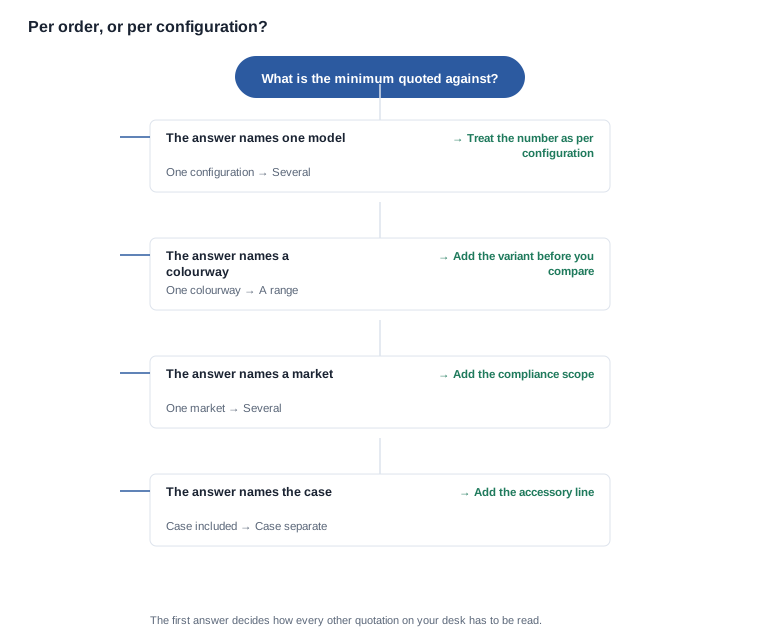
The decision tree above is the practical version of the six fields. It does not ask about the number at all until it has established what the number is a minimum of, which is the only order in which the question can be answered usefully.

What happens when the chain is short
The minimum quoted for the model, with no variant set. This is the most common short reading and the least dangerous one, provided the variant set is standard for that model. It becomes dangerous the moment the buyer adds a colourway, and the danger is that the addition happens after the number was agreed rather than before.
The minimum quoted per variant, presented as a single number. This is the reading that costs the most. The number looks smaller than it is, which is attractive, and the second variant then arrives with a second minimum. Nothing in the quotation says this, so the buyer discovers it when the second purchase order is raised.
The minimum quoted for a market the buyer is not selling into. Sometimes the figure reflects a documentation scope the buyer did not ask for. It is not a wrong number, but it is a number for somebody else's programme, and it will not move when the buyer's scope changes because it was never about the buyer's scope.
Correcting a number quoted in the wrong sense is not a matter of arguing. It is a matter of re-asking at the right level and letting the answer replace the old figure. The MOQ and margin guide covers why the correction changes the commercial outcome and not just the paperwork, and the sample policy guide covers the point at which a sample order becomes a commitment.
A shortlist built on the chain rather than on the number
When three or more suppliers are being assessed, the order in which the assessment happens decides which set of numbers reaches the buying review. The wrong order is to collect the figures first and to reconcile the configurations afterwards. The right order is to fix the configuration first — the model, the variant set, the accessory position and the market — and only then to ask every supplier for a number against it.
The reason is not tidiness. A quotation for a different configuration is not a worse quotation, it is a quotation for something else, and it will defeat a price comparison by an amount that looks like a supplier's pricing decision when it is actually a scope difference. Building the shortlist on a fixed configuration removes that failure mode by construction, and it also removes the most common reason a buying review runs long: the discovery, halfway through the price comparison, that the three numbers describe three different things.
The criteria for the shortlist then become simple and testable: comparable configuration first, then the four cost lines that have to be visible — unit price, setup charges separated, minimum with its level stated, and the schedule with a binding milestone — and only after those, the price. Which model a buyer should select is decided on the configuration and the range plan, not on the figure that happens to be attached to it.
The three questions that establish the level in one exchange
Ask what the minimum is quoted against, ask whether more than one level applies at once, and ask what happens to the figure when a second colourway or a different case option is added. A supplier who answers all three plainly has a chain they understand. A supplier who answers only the first has a number and not yet a mechanism.
Which parts of the chain you can change
What the buyer actually controls
The buyer controls three of the four levels, and it is worth being explicit about which ones. The variant set is entirely the buyer's decision: how many colourways, which ones, and whether a second one is launched in the first order or added later. The accessory and pack position is a decision with a commercial consequence rather than a technical one, and it is the level where the biggest savings usually sit. The market is a decision too, though usually a business one rather than a sourcing one.
The model level is the one the buyer controls least directly, but it still has a lever: choosing between two published configurations can change the chain substantially. A build published with a case and a build published without one are different chains, and the catalogue is explicit about which is which.
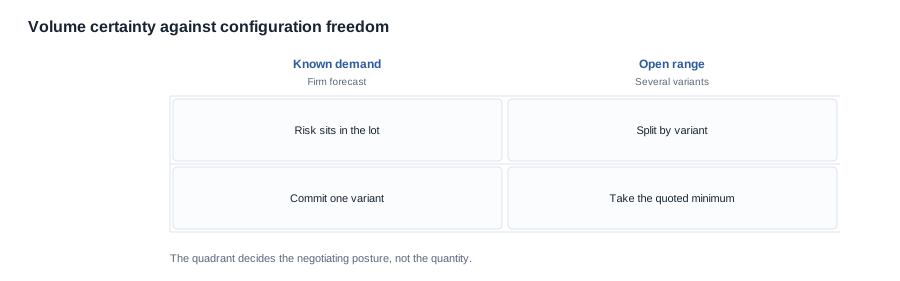
The matrix is the summary of the whole argument. Where the volume is certain and the configuration is open, the buyer should take the quoted minimum and spend the certainty on depth. Where the volume is uncertain and the configuration is narrow, the buyer should reduce the chain rather than argue with the number.
What no amount of negotiation will change
The setup cost is arithmetic. A mould, a first-article approval and a packaging print run are recovered over a run, and asking a supplier to waive them is asking them to carry a cost they cannot recover, which is a bad trade for the buyer as well because the recovery reappears in the next quotation. The documentation scope for a given market is close to fixed for the same reason. And the minimum that exists because of the material set is a function of the material set.
What is negotiable is the shape: fewer variants, a narrower accessory position, a staged release, a different market for the first order, or a different point at which the quantity commits. Each of those changes the chain rather than the number, and each of them is a better use of a negotiation than a request for a lower figure.
The two traps in negotiating the shape instead of the number
The first trap is narrowing the variant set to satisfy a minimum and then discovering that the range has become too thin to launch with. A minimum is a production constraint, and a range that exists only to satisfy a production constraint is a range that exists only to be bought. The criteria for narrowing are commercial — what the channel will actually sell — and not production. Narrow to the point where the range can be sold, and then ask whether the resulting order still clears the minimum. If it does not, the answer is a different configuration rather than a thinner one.
The second trap is moving the accessory position to bring the order under a threshold. Selling the charging case separately rather than in the box changes the order in ways that are easy to miss: the customer receives an extra item, the channel has a second line to manage, and the return path doubles. The total cost of that change often exceeds the saving, and it is rarely visible in the unit price. Before you make the move, ask what to ask about the second line — its packaging, its own minimum, and how it is returned if it is faulty — because the accessory position is a decision about the channel as much as about the order.
Both traps share a root cause, which is treating the minimum as the constraint and everything else as free. The minimum is one term among several in a commercial decision, and the total cost of the order is what should be optimised.
How we quote a minimum, and what we will state
What we will state for a given configuration
We do not publish a minimum order quantity, and the reason is specific rather than evasive: three readings of our own minimum order policy have not been reconciled with each other, and we will not print a quantity we cannot defend. What we will do is take a configuration and quote the minimum for it, say which level of the chain it applies to, say whether more than one level applies at once, and itemise the setup charges from the unit price so the arithmetic behind the number is visible.
That is a more useful answer than a published figure, and it is the answer the MOQ section describes. A published number would tell a buyer nothing about whether it applies to their variant set, their accessory position or their market, and a buyer who applies the wrong figure is worse off than a buyer who was told to ask.
Everything a minimum order calculation turns on
Send the model, the colourway count, the accessory position for each line, the destination market, the quantity and the forecast behind it, and the date the goods have to land. We will come back with the minimum for that combination, the level it applies to, the price tiers around it, the setup charges itemised, and the payment schedule we would propose. If your configuration needs something the published range does not cover, we will say so and tell you what the alternatives are.
Related reading
- Can I mix models to meet the minimum — the question that follows from the chain
- How a minimum affects your margin — the commercial side of the same number
- Hidden costs behind the minimum — the schedule side


