

Smart glasses MOQ is not a number a supplier quotes; it is a structure a factory applies to one configuration at a time. A buyer who asks "what is your minimum" receives a catalogue figure that will not survive the first purchase order. A buyer who asks "what sets the floor for this exact build, and what moves it" receives a number they can plan against and a lever they can pull. What follows is that conversation in six stages: what to specify, what to demand back, how to verify it, where it breaks, what is negotiable, and what has to be in writing before any money moves.

Smart glasses MOQ: the six stages a one-line enquiry goes through
What the minimum order quantity actually is
The minimum order quantity in this category is the quantity at which a component becomes worth ordering, a production slot becomes worth opening and the compliance work becomes worth repeating. Those three drivers produce three different numbers, and a supplier who quotes one of them without naming it has given you a number for a different question than the one you asked. The order quantity that makes commercial sense is the one that clears the binding constraint, not the one that arrives as a round figure on a price list.
Three things follow from that, and they shape the whole sequence. First, the minimum belongs to a configuration rather than to a product family, so it cannot be discussed until the configuration is written down. Second, the minimum is a quantity with a cause attached, and only a cause can be revisited later. Third, the number is a term rather than a fact, which means it belongs in a document, not in a conversation that one side remembers differently from the other.
Who is reading this, and the task in front of them
The reader is a brand-side purchasing manager, a channel buyer or an importer who has one of three situations: a set of quotations to compare, a new programme to open, or a market to enter with a date that cannot move. The question underneath all three is the same. Which of the suppliers in front of you can build what you have actually written down, and what happens to the launch schedule on the day they cannot.
The fear that sits underneath that question is rarely a bad price. It is a consignment that is not the sample the buyer signed, a document trail that halts the boxes at a frontier, or an opening delivery that becomes a returns issue nobody budgeted. A minimum order quantity that was never tied to a configuration is the mechanism through which all three of those arrive, because the goods that land are not the goods that were quoted.
Two questions arrive before the specification does. The first is what is being ordered in enough detail to be quoted at all, because a build described in general terms produces a price that cannot be compared with anything else. The second is what the programme has to survive, which is the part that decides whether this is a specification exercise or a lesson in finding out later which supplier was right. The stages below answer both.
Stage one: name the build, not the product family
Stage one is the request that makes every later answer possible. Instead of asking for the minimum on a model, you send the configuration: the model designation as it will be printed, the colour option, the charging interface, whether a charging case is included and at what capacity, the packaging, and the destination country. A factory cannot quote a floor for a family of builds, and the difference between "the V03 Pro" and "the V03 Pro in black, with the Type-C interface and a printed retail box for the European Union" is the difference between a catalogue number and a purchasable thing.
Two details in stage one are routinely skipped and both of them cause trouble later. The destination country changes the labelling, the documentation set and sometimes the component list, so a floor quoted without a market is a floor for an unknown build. The charging case option changes the material set completely; across our published range, case capacities of 900, 1200 and 1400 mAh all exist, and the models that carry a case are not the models that do not.
Stage one is also where the supplier learns what kind of buyer you are. A request with a configuration string, a quantity and a date reads as a buyer who will place an order. A request that says "we are evaluating suppliers" reads as a buyer who will not, and it gets a catalogue answer.
Stage two: find the cause behind the floor
Stage two is the question that turns a number into a negotiation: which purchased part sets this floor. The honest answer names a component and a lot quantity, and sometimes names an allocation rule on top of that. A supplier who answers "our standard minimum" has told you that the floor is a policy rather than a constraint, which is a different and more useful thing to know, because a policy can be discussed and a constraint usually cannot.
The catalogue side of this question matters too. Our own published material fixes the electrical rows for every build — cell capacity, charge time, rated use, charging method and case capacity where one is published — and those rows do not change with quantity. What changes with quantity is the component cost and the amortisation of one-off work. A buyer who has specified those rows has removed the technical part of the ambiguity before the commercial conversation starts, which is exactly the point at which the minimum should be discussed.
Stage three and stage four: the price table and the setup line
Stage three asks for the tiered unit price table rather than a single unit price. The question is where the price steps, not what it is at one quantity. A quotation that gives one unit price across a range of volumes has not told you how the floor interacts with the price, and it is the pair that matters: an order that sits between two steps is being priced on a step that does not exist.
Stage four separates the one-off cost from the production floor. Tooling, custom artwork, mould work and compliance testing are recoverable costs with a different character. A tooling fee amortised across the first three orders is a cost of doing business; the same fee recovered in full on a small first order distorts the unit economics of the whole programme. The order minimum and the setup charge are also different levers with different owners, and mixing them in one line is what makes a floor look immovable.
| Stage | The question being asked | The artefact that closes it |
|---|---|---|
| 1 | Which exact build are we discussing? | A written configuration string |
| 2 | What sets the floor for that build? | A named component and its lot quantity |
| 3 | Where does the unit price step? | A tiered unit price table |
| 4 | What is the one-off cost? | A setup line separate from the floor |
| 5 | What would move the floor? | A revised floor for a simpler build |
| 6 | What has actually been agreed? | A signed configuration string and floor |
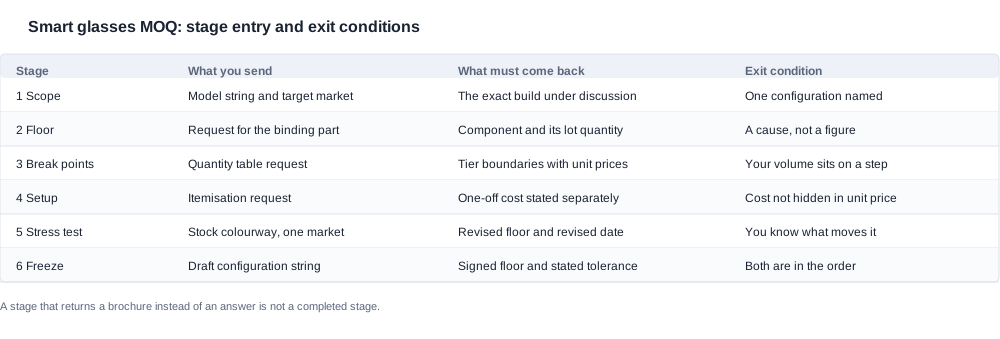
Each row above has a completion condition, and the condition is what a quotation has to satisfy before the stage is closed. A stage that returns a brochure instead of an answer has not been completed, and moving on to the next one with the gap open is how a negotiation ends with a figure nobody can defend.
Stage five: the stress test
Stage five is the stage most programmes skip, and it is the cheapest one to run because nothing has been ordered. You take the configuration you have been discussing and simplify it in writing: one stock colourway instead of the private-label colour, standard packaging instead of printed artwork, one destination market instead of three, and no case where a case is optional. You send that simplification back and ask for the floor again.
If the floor moves, you have just learned which two or three terms are worth trading later, and you have learned them before any deposit is committed. If it does not move, then the floor is driven by something the buyer cannot influence, and the negotiation from that point should be about price and schedule rather than quantity. Either answer is useful, which is why this stage is worth the round trip.
Stage six: freeze both sides in writing
Stage six is where the sequence ends and the agreement begins. Two things go into the purchase order: the configuration string exactly as it was tested, and the floor with the condition attached to it. A floor quoted without its condition is a floor that can be re-interpreted, and the re-interpretation always happens at a moment when the buyer has less leverage than the supplier.
The reason this stage sits last rather than first is that stages one to five produce the content. A configuration frozen before it has been tested is a guess; a floor frozen before its cause is known is a slogan. Freeze last, and freeze both together.

The verification work that sits behind each stage
Ask for the cause before the number
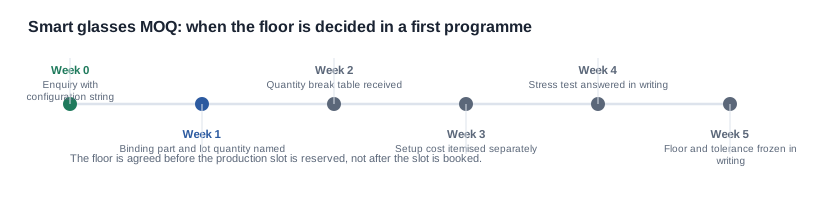
Verification in this category is document work, not relationship work. Every step below works with a quotation, a sample and a file, and each step has a completion condition you can point at.
- The floor appears in the quotation, attached to a configuration. A minimum quoted without a build reference is a catalogue minimum and will not survive contact with your order. The completion condition is a line in the quotation that names both the build and the quantity.
- The cause is traceable. If the supplier names a purchased part, you can ask that part's own lead time separately and check whether the floor and the schedule agree with each other. A floor set by a component usually arrives with that component's lead time attached, and a supplier who cannot name the part cannot show you the schedule either.
- Your quantity sits on a published step. Put the quantity you intend to order against the tier table and confirm it lands on a published boundary rather than between two of them.
- The one-off cost is visible. Ask for it as a separate line with a stated recovery period. If it cannot be itemised, treat it as part of the unit price and price the programme on that basis.
- The simplification test has been answered in writing. A revised floor for a simpler build is the only evidence that the floor is negotiable at all.
Run those checks against the documents you intend to sign, not against a marketing deck. The questions to ask are short; the order matters, because a cause asked for after the price has already been agreed has no leverage behind it.
What each stage fails when it fails
The stage sequence has a predictable failure mode at each point, and recognising them is faster than fixing them afterwards. Stage one fails when the request is answered with a catalogue extract, and the giveaway is that no colour, interface or market appears in the reply. Stage two fails when the cause is a policy rather than a constraint, which is not a failure but a reclassification: the number will not move, so the negotiation has to be about price. Stage three fails when a single unit price is given across a wide quantity range. Stage four fails when the setup cost has been folded into the unit price, because then it can never be amortised. Stage five fails silently, when the supplier does not answer the simplification and the round is simply closed. Stage six fails when the purchase order carries the model name but not the configuration, which is the single most expensive omission in this sequence.
Four ways a floor is set, and the lever each one opens
Once the cause is known it falls into one of four families, and each family has a different lever. A floor set by a purchased component is a batch constraint, and the lever is the batch itself: consolidation with another order, a different lot size from the same supplier, or a schedule that lets the existing stock absorb the first run. A floor set by a print or packaging run is a run-length constraint, and the lever is artwork approval timing and the number of distinct print runs, not the unit count. A floor set by compliance work is a scope constraint, and the lever is the number of variants for which a technical file has to be produced. A floor that is really a one-off setup charge is an accounting problem, and the lever is simply moving it to a line where it can be amortised.
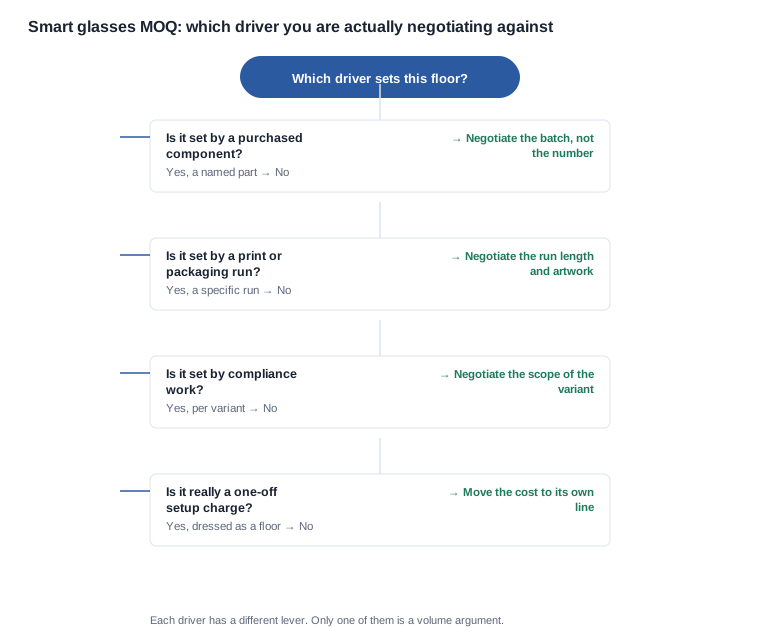
The practical test is simple. If the lever you would pull changes the unit price, you are dealing with a commercial term. If the lever changes the schedule, you are dealing with a production term. If the lever is the supplier's goodwill, you are dealing with a number they could have moved at any time, which usually means the first order was priced on the assumption that you would not ask.
The total cost of a programme is not the unit price
The unit price is one component of the total cost of the programme. The other components are the returns reserve, the cost of the documentation route, and the cost of the cash cycle while the goods are being made. The last of those is the one that connects this article to the payment side of the decision, and it is worth stating plainly: a minimum order quantity and a payment schedule are the same lever seen from two ends. The larger the minimum, the earlier the deposit falls due, and the two terms have to be negotiated together or the buyer ends up financing the whole production cycle before a single unit has been inspected. The structure of that relationship is set out under payment terms, and the commercial costs that sit behind the floor are separated out under hidden costs.

What breaks between stage two and stage six
The floor is really a setup charge. The supplier quotes a quantity floor to cover non-recurring work, and the buyer treats it as a demand signal and orders to it. The symptom is an order sized by a number that was never about demand. The control is to separate the minimum from the setup fee in the quotation itself, so that one is a production constraint and the other is a recoverable cost with a different owner.
A configuration is added late to a small order. A colourway or a packaging change after the first purchase order creates a second material set and a second approval cycle, and on a small order that second set is usually what breaks the schedule. The control is to freeze the configuration list before the first purchase order and to treat any addition after that point as a new programme with its own dates and its own floor.
The price tier never arrives. The buyer assumes the quoted unit price holds at the ordered quantity, and the price breaks at a volume the supplier never mentioned. The symptom is a marginal cost that appears at the second order and is attributed to the market rather than to the quotation. The control is to request the tier table in the quotation and to check the ordered quantity against it before the order is placed.
The consolidation that does not consolidate. The quoted price assumes a shipment grouped with other orders, and the volume does not support grouping. The symptom is a unit price at the second order that is higher than the one that was agreed. The control is to ask whether the quoted price assumes a consolidated shipment and what the rule is when it ships alone.
Not one item here is exotic, and none of them is grounds for changing supplier. They are reasons to put a line in the order, and each of them can be converted into a document before the deposit moves rather than a lesson after the goods have shipped.
A stage-by-stage sequence on one camera platform
Consider a constructed situation rather than a client project. A brand is opening a camera programme in one market with one printed box. The published camera range gives eleven models, eight of them at 8 MP and three at 13 MP, with published cell capacities that range from 220 mAh to 290 mAh and charging methods that include magnetic, Type-C and four models where the charging method row is not published at all.
The buyer picks one 13 MP platform with a 1400 mAh case, one colourway, and one print run. Stage one names all three of those things. Stage two returns a lot quantity for the cell and the case, because both are bought in batches and both are the components that decide the floor. Stage three returns a tier table with three steps. Stage four returns one printed box as a separate setup line. Stage five removes the private colourway and the printed box, and the floor falls by the amount attributable to the case lot, while the print run disappears from the quotation entirely because there is no artwork left to buy. Stage six writes the build, the floor and the print run into the purchase order as three separate commitments.
The value of the sequence is visible in stage five. The buyer did not negotiate a smaller number; the buyer found out which commitments were worth trading, and they found it out with nothing ordered and nothing paid. That is the difference between a negotiation plan and a bargaining position. The full framework sits under MOQ and order quantity, and the way the pricing structure interacts with the floor is set out under pricing structure.
What we will put in writing, and what we will not
Here, the published catalogue is the part of the specification we can stand behind, and everything else is a question for the supplier's own file. We publish the electrical rows for every model, the configuration options, the colour options and the case alternatives where they exist. We do not publish a minimum order quantity figure, because our own internal statements on that subject are not reconciled and a convenient number is worse than an honest gap.
That means two things for a buyer working through these six stages. We will tell you, for a specific configuration, which parts of the minimum order quantity question are settled by published data and which parts have to come back as a quotation. And we will not fill an open row with a typical figure drawn from another supplier's general data, because a claim built on an estimated number fails in the field rather than in the quotation, and the correction is always more expensive than the question was.
Send us the models, the quantities and the target market, and we will tell you which configurations exist, which of them are open on the published data, and what the answer is for each one.
Related reading
-
MOQ hidden costs — what the minimum costs beyond the price
-
Pricing structure — how tiers and setup charges interact
-
Payment terms — how the cash cycle compounds the minimum
Send the configuration, the quantity and the market, and we will say which parts of the minimum are settled and which are yours.


