

A minimum order quantity is not a number a supplier invented in order to sell more. It is the point at which a component becomes worth ordering and a production slot becomes worth opening, and everything that happens after that point is the buyer's problem, not the supplier's. That framing matters more than the figure itself, because the four costs below are not surprises caused by a hostile supplier — they are the mechanism showing through the quotation.
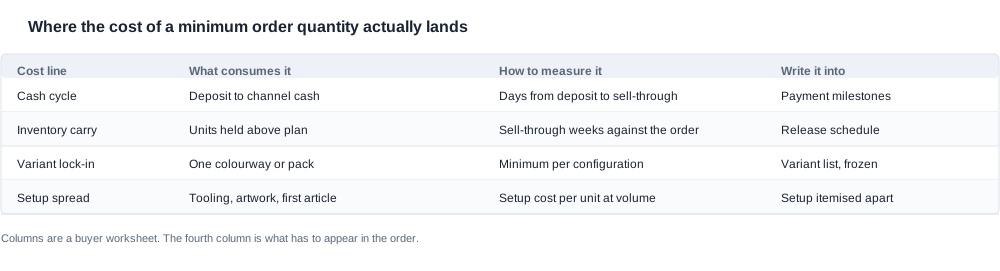
The short version: price the cash cycle in days, price the inventory against a sell-through horizon, price the variant you are committing to, and price the setup charge per unit at the volume you are actually ordering. Do that at three quantities and the arithmetic sometimes inverts — the lower minimum is the more expensive order. If you only have one number on the page, you do not yet have a costed order.
Smart glasses MOQ: the four costs that arrive after the order
The conclusion, stated so it can be quoted
A minimum order quantity is a commitment before it is a constraint, and the costs that follow it land in four places: the cash cycle between deposit and sell-through, the inventory you hold above plan, the variants you are locked into, and the setup charges that are spread across too few units. None of the four is on the quotation, and all four are computable from the quotation plus your own forecast. A buyer who cannot name those four in a single conversation is negotiating the smallest part of the deal.
Who is carrying these costs, and what they are actually managing
The reader here is a buyer working for the brand, a channel buyer or an importer who already holds two or three quotations and has to choose, or who is opening a new programme and has to decide what goes into the order before anything is quoted. The thing such a person is managing is rarely the unit price. It is a balance sheet with a hole in it: money has left, goods have not arrived, and nobody can say when the channel will absorb what was shipped.
That framing changes which questions are worth asking. "Can you drop the minimum" is a negotiation about a number and it can only end one of two ways. "Is the minimum per order or per configuration, what does the setup charge look like itemised, and how many weeks of sell-through does the first batch represent" is a conversation about three cost lines, and each of them can be changed, confirmed or planned around. The first question asks the supplier to give something away. The second asks the supplier to show their work, and most of the time the second one produces a better outcome for the buyer as well, because a buyer who can model the four costs knows which of them is worth trading.
The fear underneath all of this is specific and it is not usually expressed: a first order that sits in a warehouse past its season and has to be written down. That is the outcome the four costs add up to, and it is why the arithmetic below is worth an hour of preparation before the order is placed rather than an afternoon of reconciliation afterwards.
Why a minimum creates cost rather than removing it
In this category the fixed costs are real and they are large relative to the unit: a custom mould, a packaging print run, a first-article approval, a technical file entry and a batch of long-lead materials. A minimum is the point at which those fixed costs stop dominating the unit price. The factory sets it so that opening a production slot is worth doing at all, which is a rational response to the arithmetic rather than a negotiating tactic.
The consequence for the buyer is that the minimum transfers a share of the uncertainty across the transaction. The factory is protected against a slot it cannot fill; the buyer is protected against a unit price that has been set for a much larger run. What neither side is protected against is the four costs that only exist once the order has been placed, because they belong to the buyer's balance sheet and to the buyer's channel, and no quotation line addresses them.
This is also the reason two quotations for the same model can differ by a wide margin and both be honest, and it is worth naming before the numbers are discussed. A minimum order quantity is a statement about a specific order structure rather than about a product. Our own catalogue is wide enough to make "the same model" an unreliable description — the V03 Pro is published in three colours, the V06 in four, and the L2 Utral is published with either a 900 mAh or a 1400 mAh charging case, while the V03 Pro is published with no case at all. A quotation for a magnetic-charging build and a quotation for a Type C build are not the same product at two prices, and neither is a quotation for one colourway and a quotation for four.
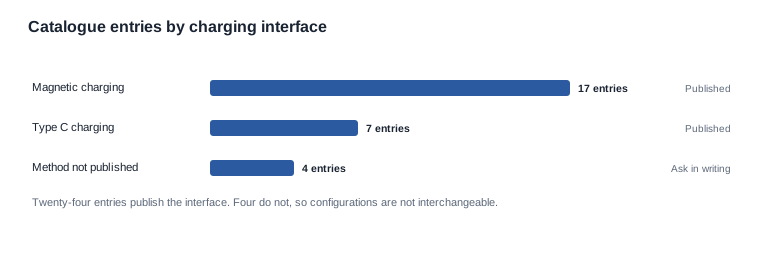
Across the twenty-eight catalogue entries, twenty-four publish the charging interface and four do not. That split is not a detail of the hardware; it is the reason a buyer cannot assume one minimum covers a related build, and it is the first thing to check when two quotations claim to describe the same product.

The four cost families, and how each one is measured
Each cost below is written as three things: what it is, how a buyer measures it, and what it looks like when it has been ignored. The measurements are deliberately simple, because a cost that needs a financial analyst to evaluate will not get evaluated.
Cash cycle: the days between the deposit and the sell-through
Money leaves when the order is placed and returns when the channel has sold through what was shipped. On a first order in a new category that gap is often four to six months, and it is a working-capital cost that appears on nobody's invoice because no invoice is raised for it. The measure is days, not currency: take the deposit date, add the production and transit time, add the sell-through horizon from your own plan, and count. A buyer with a ninety-day cycle and a buyer with a two-hundred-day cycle are running the same product at completely different costs, and neither of them will see this in a unit price comparison.
The mitigation is not a lower minimum. It is a payment schedule that returns the cash in stages rather than at the end, and the specific structure to ask for is a deposit, a payment against approved artwork and approved samples, and a balance against pre-shipment inspection. That sequence returns part of the cash before the shipment, which converts an open-ended commitment into three shorter ones. The payment terms section covers the structures that are workable in this category.
Inventory carry and the obsolescence horizon
A minimum sets your position in the channel, and the position is larger than the plan whenever the plan was made for a smaller lot. The excess does not discount. It sits, and in a category where consumer electronics turn over quickly it eventually becomes obsolete stock with a written-off value, and the write-off lands in a period that has nothing to do with the period in which the mistake was made.
The measure here is weeks of cover against a sell-through estimate, and the estimate does not have to be precise to be useful. Two or three weeks of cover above plan is a working buffer. Three months of cover above plan is a different commercial decision that needs a different reason. Before you order, check the minimum against the seasonal sell-through estimate, and check specifically whether the minimum applies per configuration rather than per order, because a second colourway or a different case option can double the position you have just agreed to hold.
Variant commitment: the minimum that repeats
Minimums are frequently quoted against a specific colourway, a specific case option or a specific packaging. Accepting the number without asking what it is quoted against ties the first order to a variant that may be the wrong one six months later, and changing it later means new packaging artwork, a new technical file position, a new inspection sample and a new minimum. The measure is simple to state and easy to miss: count the variants in the plan and multiply the minimum by the number that actually restart it.
Ask whether the minimum applies per configuration and get the answer in writing, in the quotation rather than in an email. If the answer is that it applies per order, the number may be lower than the one quoted elsewhere and the comparison in your spreadsheet will improve. If it applies per configuration, the plan needs to be re-costed against the number of variants, not against the single figure you were given.
Setup spread, and the inversion that surprises buyers
Custom moulds, first-article approval, packaging artwork and firmware integration are fixed costs. Amortised across a small order they are a large share of the unit price; amortised across a production run they nearly vanish. This is why a lower minimum can be the more expensive order, and it is the single most useful calculation a buyer can make in this category.
The method is to get setup charges itemised separately from the unit price, then compute the total cost per unit for a small order and a large order to the same destination, and compare. Not the unit price — the total cost per unit including the spread setup, the freight on the same terms and the same accessories. Done properly, the answer frequently inverts the ranking that the minimum implies, and it is the calculation that turns "their minimum is too high" into "their minimum is fine, and our order shape is the thing to change".
Pricing the four costs before you accept the number
Three quantities and one comparison
The comparison that settles most of these conversations is a three-point one. Ask the supplier for the total cost to you, to the same destination, at a small quantity, at the quantity you intend to order, and at a quantity roughly double that, with the setup charges itemised in each. Three totals give you the shape of the curve, and the curve tells you which side of the break you are on and what a change of quantity would actually buy.
Do this before the negotiation rather than after it, because the numbers it produces are the ones that will be on the table. A buyer who arrives with three costed totals and a sell-through estimate is negotiating a structure; a buyer who arrives with a target quantity is negotiating a number, and a number is a much weaker position. The MOQ step by step guide sets out how the number itself is assembled, and the pricing comparison template is the format most teams use to hold the three totals side by side.
The second half of the comparison is your own forecast, and it is the half that is usually missing. Take the quantity you intend to order and divide it by the units your channel is planned to sell in one selling season. If the answer is above one season of cover, the cash and inventory costs above are not a rounding error and the minimum has become the dominant term in the decision.
The five questions that produce the numbers
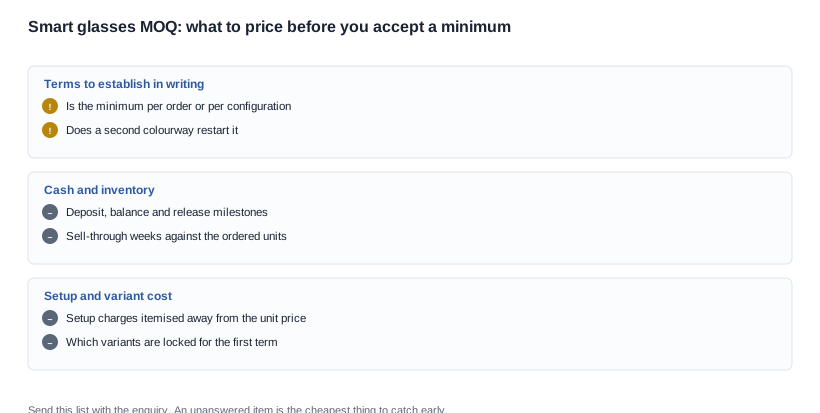
- Is the minimum quoted per order, per model, per configuration or per customisation, and does more than one of those apply at the same time?
- What are the setup charges, itemised separately from the unit price, and at which quantity do they stop being charged?
- Does the charging case count against the same minimum, or does it form a separate line with its own quantity?
- What is the payment schedule, and on which dated milestones is each payment made?
- How many weeks of sell-through does the first batch represent against our own forecast?
Each of those has to be answered in writing. An answer given verbally is an answer that will be re-asked when the order is repeated, and the re-asking is what turns a settled minimum into an open argument.


Where the hidden costs turn into an actual loss
The four costs are not catastrophic on their own. They become a loss when one of them is discovered late, and the three patterns below account for most of it.
The variant discovered at the artwork stage. The minimum was accepted against a colourway that nobody in the channel has actually asked for, and changing it after the packaging artwork has been approved means reprinting, not rearranging. The prevention is unglamorous: freeze the variant list before the deposit and attach it to the order as an annex. A variant list that changes after approval is a reprint, and reprints are quoted at the price of a first run.
The cash committed against a sell-through forecast nobody checked. The order was sized from a forecast that the channel then missed, and the inventory cost arrived before the demand did. The prevention is to compare the quantity against the plan before the deposit, and to have the release schedule written down rather than assumed.
The setup charge spread across a lot that was never going to be large. The order was made at the minimum because the minimum was available, and the setup charges then became the largest line in the total cost per unit. The prevention is the three-point comparison above, which is the only reliable way to notice that a small order is not a cheaper order.
None of these is a reason to change supplier. They are reasons to put a line in the order and a name against a document, and they are the reason the four costs above are worth pricing before the order rather than after the shipment.

Which of the four costs the order can actually absorb
Which of the four costs is negotiable, and which is arithmetic
The cash cycle is the most negotiable of the four and the least discussed, because it is not a number on the quotation and therefore not something anybody thinks to trade. Payment milestones, the split between deposit and balance, and the point at which the balance falls due are all structural choices with a range of workable answers, and moving a milestone by a few weeks changes the cash position more than a small price concession does.
The inventory cost is a planning cost rather than a negotiable one, but it is negotiable indirectly: a staged release schedule, a split delivery against two production runs, or a first order narrower than the plan. Each of those reduces the position you hold at any one moment without reducing the programme.
The variant commitment is negotiable only in the direction of fewer variants, and fewer variants is often the better answer anyway. The setup spread is arithmetic. Asking a supplier to waive a mould cost is asking them to carry a cost they cannot recover, and it is a poor trade for the buyer as well, because a supplier who has been asked to absorb a cost will look for it in the next order.
The order you actually sign
The clauses worth having are short. The minimum is stated per configuration and with the variant list attached. The setup charges are itemised and their treatment at a repeat quantity is stated. The payment schedule names each milestone and the date trigger for each. The delivery schedule names the milestone that is binding rather than indicative, and the change-control clause says what reopens the schedule if quantities move. The accessory lines are separated, with the case quantity and its position stated. And the validity period of the quotation is written down, because a minimum that moves without notice is not a term, it is an expectation.
That last one is the most frequently missing and the cheapest to fix. A quotation with no expiry date has agreed nothing about how long the number holds, which means the second order starts with the first order's argument still open.
What we will and will not tell you about a minimum
Our position, stated plainly
We do not publish a minimum order quantity, and the reason is specific rather than evasive: three readings of our own minimum order policy have not been reconciled with each other, so we will not print a quantity we cannot defend. What we will do is take a specific configuration and a specific quantity and give you the minimum in writing, tell you whether it is quoted per order or per configuration, give the price breakpoints, and itemise the setup charges separately from the unit price. The MOQ section covers the structure behind the figure.
We will also tell you where the four costs above are not ours to fix. The cash cycle is a function of your payment schedule and your channel's sell-through. The inventory position is a function of your plan. The variant commitment is a decision. Only the setup spread is the supplier's, and it is the one term most suppliers will talk about in detail if the buyer asks for it separated rather than as part of a unit price.
The inputs behind a minimum order quantity
Send the model family, the destination market, the colourway count, whether the charging case is in the box, the first order quantity and the forecast by quarter, and the date the goods have to land. We will come back with the minimum that applies to that configuration, the tier boundaries around it, the setup charges itemised, and the payment schedule we would propose. If your quantity is below the minimum for that configuration, we will say so directly rather than quote a number that will move when you specify a colour.
Related reading
- MOQ step by step — how the number is built
- Payment terms — reducing the cash cycle
- Pricing comparison template — the setup-fee column
- How a minimum reaches the delivery date — the schedule side of the same commitment


